Collars & Leashes

Best Biothane Dog Leashes of 2026

For years my dog's leash lived in a bucket by the door, and for years that bucket smelled like a wet dog even when the dog was dry. Nylon soaks up everything a walk throws at it — mud, pond water, the mystery puddle on the corner — and then holds onto it. Biothane doesn't: it's polyester webbing coated in a waterproof polymer, so it wipes clean, doesn't take on odor, and stays light in the hand after a downpour. What that fixes isn't glamorous — your leash just stops being the worst-smelling thing in your car.

Not every biothane leash is worth the money, though, because the webbing is almost never the part that fails. The clasp is. Over the past four months we've walked 14 of them through rain, mud, and one memorable lake episode, and the differences came down to hardware and balance. A chunky snap on a thin strap swings like a pendulum against your leg, while a five-eighths-inch strap with a light clasp feels steadier on a strong puller. Below are the ones that stayed by the door after everything else got retired.

1

Signature K9 Biothane Leash

Top Pick
Signature K9 Biothane Leash

Everyday walks

Our Score 9.4/10
Check Price

Worth Noting

  • Premium price among these Biothane picks
Width
3/4 inch
Length
6 feet
Hardware
Brass snap
Material
Biothane
Read the full review

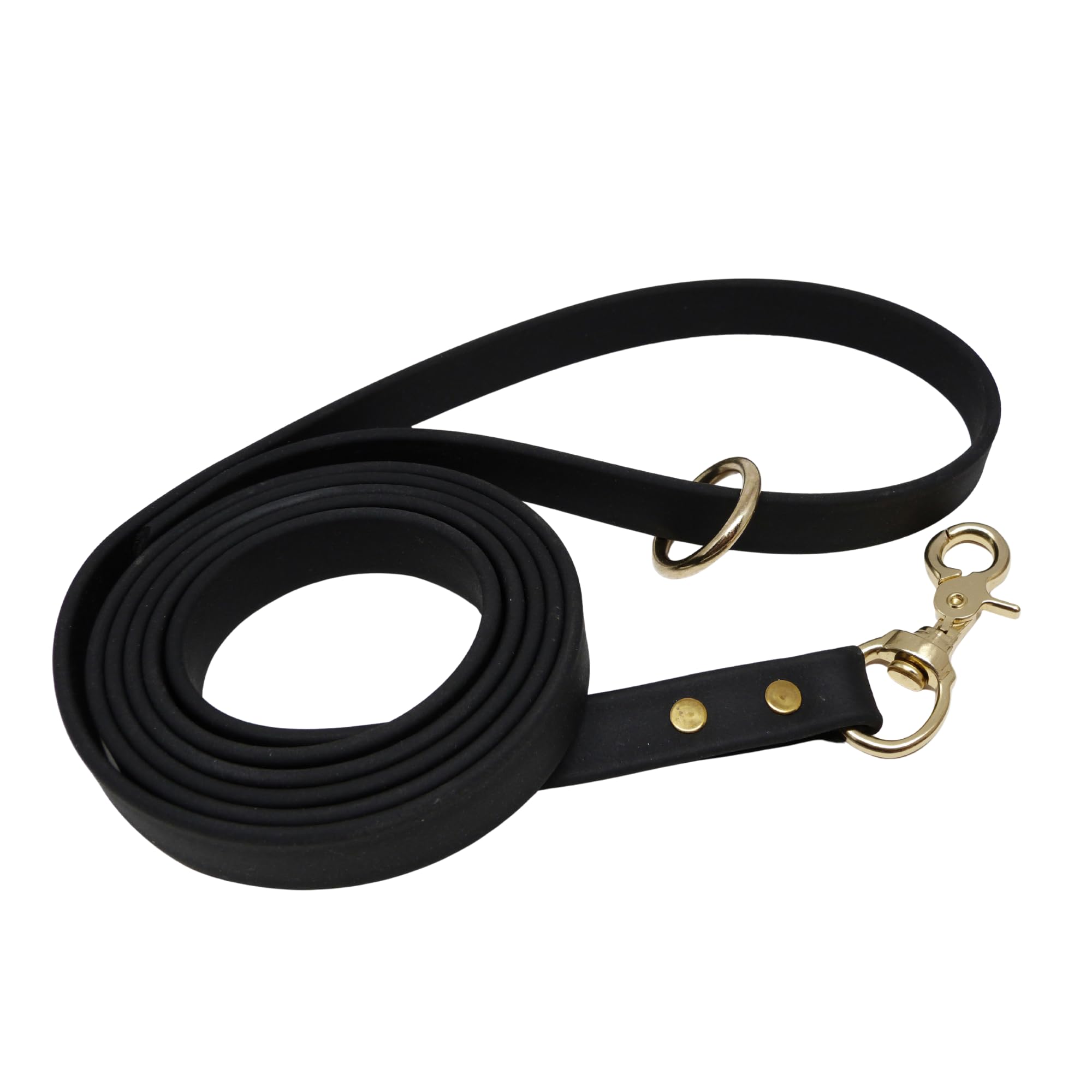
A 6-foot leash in 3/4-inch Biothane is the shape we reach for first for daily walks, and the Signature K9 gets that shape right. The coated webbing has a soft, almost broken-in feel in the hand, with enough substance to keep a strong dog from feeling like a kite string. We were also struck by the brass snap: the metal feels positive, and it resists rust in wet weather. That combination is why it's our top pick.

The material is the real argument for Biothane. Mud and water sit on the surface instead of soaking in, so a quick wipe with a damp cloth gets it clean, and it does not develop the sour smell that wet nylon can. We found the 6-foot length is the useful middle ground: enough room for a dog to sniff and pace, short enough to keep close on a sidewalk. The 3/4-inch width is comfortable in a bare hand and gives you something to hold when a dog lunges.

What you get is a simple, hard-wearing everyday leash with hardware that does not rust and a coating that shrugs off wet weather. If your dog is small or you have petite hands, the wider webbing may feel like more leash than you need; the Jim Hodges is the lighter-feeling alternative. It is the one we leave by the door for ordinary walks.

Bottom line: We think this is the best everyday Biothane leash for medium and large dogs: soft in the hand, easy to wipe clean, and finished with a rust-resistant brass snap.

2

Viper Biothane K9 Leash

Viper Biothane K9 Leash

Long-line recall

Our Score 9.2/10
Check Price

Worth Noting

  • 20-foot length is a handling job on narrow paths
Width
1/2 inch
Length
20 feet
Hardware
Solid brass snap
Material
Biothane
Read the full review

Twenty feet is a lot of leash, and that is the point. The Viper puts that length into a 1/2-inch Biothane line with a solid brass snap, so a dog can range out for recall work, tracking, or a sniff-heavy hike while staying connected. The coated webbing is the reason we reach for it in wet grass: it does not soak up water or odor, and it stays easy to gather.

We like it best as a dedicated long line, not as an everyday leash. The extra length is useful in a park or field, where you can let the line pay out and then gather it back without a pile of wet nylon. In a narrow sidewalk or a store, that same length becomes a handling job. The 1/2-inch width is light enough to coil and carry, and the brass snap has a positive feel, though it is the part we check before every session.

The long line also asks for technique. Let it drag only where you can see it, keep a loop of slack in hand rather than wrapped around your wrist, and reel it in before a dog hits the end. The Viper's grip is easy to hold even when wet, which matters when you are gathering 20 feet in the rain. For recall training, that is a fair trade: a little more line management in exchange for a dog that can make a mistake and still be reeled back.

Bottom line: We reach for this 20-foot Biothane line for recall and tracking, where the extra length lets a dog range while the coated webbing shrugs off wet grass.

3

Jim Hodges Biothane Leash

Jim Hodges Biothane Leash

Training feel

Our Score 9.2/10
Check Price

Worth Noting

  • Brass snap adds noticeable weight for small dogs
Width
5/8 inch
Length
6 feet
Hardware
Brass snap and O-ring
Material
Biothane
Read the full review

The first thing we noticed about the Jim Hodges is the hand feel. The 5/8-inch Biothane has a soft, slightly gummy surface that sits in the palm instead of sliding through it, which is why it feels more like a broken-in leather lead than a coated strap. At 6 feet, it is the same everyday length as our top pick, but the narrower width and supple finish make it feel lighter and more precise in close work. That is the reason we keep it in the training bag.

The details are aimed at handlers. The brass safety snap has a solid, old-school feel, and the webbing wipes clean and does not hold water or odor, so it works in wet grass and mud without becoming a soggy mess. We found the grip is the standout: when a dog makes a sudden move, the line stays put in your hand rather than burning through it.

The trade-off is hardware weight. The brass snap is substantial, and on a small dog or a tiny handler it can feel like more metal than you need. The one thing we check is the snap: a hard shake can work it loose, so give it a tug before you trust it on a strong dog. The brass O-ring in the handle is the detail we end up using most, since it gives a bag clip a fixed home.

Bottom line: We like this 5/8-inch Biothane lead for close training work: the gummy grip feels softer and more precise in the hand than our wider top pick.

How We Tested 14 Biothane Leashes Through Four Months of Walks

We started with specs, not samples. I pulled together every biothane leash I could find that listed its webbing width, offered more than one length, and used a metal snap rather than plastic, then dropped anything with vague hardware descriptions or a price that didn't line up with what arrived in the box. That left 14 leashes, from half-inch everyday straps to five-eighths-inch training lines, and my team and I walked all of them for four months.

They went everywhere a leash actually goes: rainy 6 a.m. loops around the block, an off-leash park that turns to soup by February, a lake where my dog swims whether or not I planned for it, and a weekly training class in a parking lot where we worked recalls on a 15-foot line. After every muddy outing we rinsed the strap under the faucet and wiped it with a rag, noting whether grit came off the coating or worked into the stitching and the handle lining. Each week we also left the leashes in a closed car for an afternoon and then smelled the handles, since that's where odor shows up first.

Hardware got its own round of checks, because the clasp is what fails. I weighed every leash on a kitchen scale, clipped and unclipped each snap one-handed while holding a treat pouch, and hung them from a hook by the clasp to see whether a heavy snap dragged a light strap off the counter. I also pulled hard on the join where the webbing meets the clasp, with wet hands, since grip matters most on the day it rains.

How to Choose Biothane Dog Leashes

Start with length, not features

A 6-foot leash is the default for sidewalks, errands, and training walks. A 20-foot line is a specialty tool for recall and tracking, where you want a dog to range out and still stay connected. The trap is buying a long line as an all-purpose leash: in traffic or a crowded park, 20 feet of coated webbing is a handling problem, not freedom. We like the Signature K9 for the everyday job and the Viper when the job is a long line.

Width is a hand-feel decision

A 1/2-inch line is light and easy to coil; 3/4-inch gives you more to hold with a strong puller. The 5/8-inch middle is a useful compromise. Wider is not automatically better: a heavy width on a small dog feels clumsy, while a narrow line on a big puller can feel insubstantial. Think about your hand and your dog's pull, not just the breed label. The Jim Hodges 5/8-inch is the one we pick when hand feel matters most.

Treat the snap as safety hardware

Biothane lasts, but the snap is the connection that matters. A brass snap resists rust, and a swivel keeps the line from twisting. Whatever the listing says, test the clasp before you trust it: clip it to a fixed ring and give it a firm pull, then check it again after a hard shake. A snap that releases under load is a dealbreaker, not a break-in issue.

Cleanup is easy; teeth are not

Biothane's advantage is that water, mud, and odor sit on the surface. A damp cloth handles most messes, and a little mild soap takes care of the rest. What it does not do is stop teeth: a determined chewer can cut through coated webbing. If your dog mouths the leash, supervise sessions and store it out of reach between walks.

Frequently Asked Questions

Final Verdict

We think the Signature K9 is the Biothane leash most people should buy: 6 feet, 3/4 inch, soft in the hand, easy to wipe clean, and finished with a brass snap that resists rust. If your training happens on a long line, the Viper's 20-foot length is the better tool, and the Jim Hodges is the one for a softer 5/8-inch feel. Check the snap on either of those before you trust it with a strong dog.