Food & Treats

Best Bulk Dog Food of 2026

A forty-pound bag of dog food is a commitment. The math is easy — bigger bag, lower price per pound — but that bag then sits in your pantry for six weeks, opened twice a day, and everything that can go wrong goes wrong slowly: kibble that smells like the back of a cabinet, a dog who turns up his nose at dinner, or a pantry moth situation you'd rather not describe. Bulk buying only pays off if the food stays fresh, actually gets eaten, and agrees with your dog's digestion.

I've been scooping for a 50-pound mixed breed and a terrier who treats new kibble like a personal insult. Over the past six months, my team and I worked through 12 bulk bags — different proteins, kibble sizes, and bag styles — feeding each one out over consecutive weeks rather than a bowl or two. The surprise: calories per cup matter as much as price per pound, and a cheaper bag that needs an extra half-scoop a day isn't a bargain at all. The picks below are the ones that survived both tests.

1

Hill's Science Diet Adult 1-6 35 lb

Top Pick
Hill's Science Diet Adult 1-6 35 lb

Adults aged 1-6

Our Score 9.6/10
Check Price

Worth Noting

  • Premium price tier
  • Only for adults aged one to six
Made In
USA
Bag Size
35 lb
Life Stage
Adult 1-6
Coat Support
Omega-6 and vitamin E
Read the full review

Thirty-five pounds at the top of the price range, with a narrow job: healthy adult dogs between one and six. The case for it is simplicity — chicken and barley, omega-6 and vitamin E for skin and coat, good-quality protein for lean muscle, and no long list of novelty ingredients to work out. If your vet has pointed you at Hill's, this is the size that makes sense for a medium or large dog, and the brand's clinical reputation is what the premium buys.

Two limits worth naming. The life-stage window is real: a puppy, or a dog past seven, needs a different formula from this line, so a mixed-age house needs a second bag. And this is the least eventful food here — no shreds, no salmon, no grain-free pitch — which is either exactly the appeal or the reason to look elsewhere. We think the plainness is the point.

Bottom line: Our pick when you want a plain, long-established formula for a healthy dog aged one to six and are willing to pay for the name behind it.
2

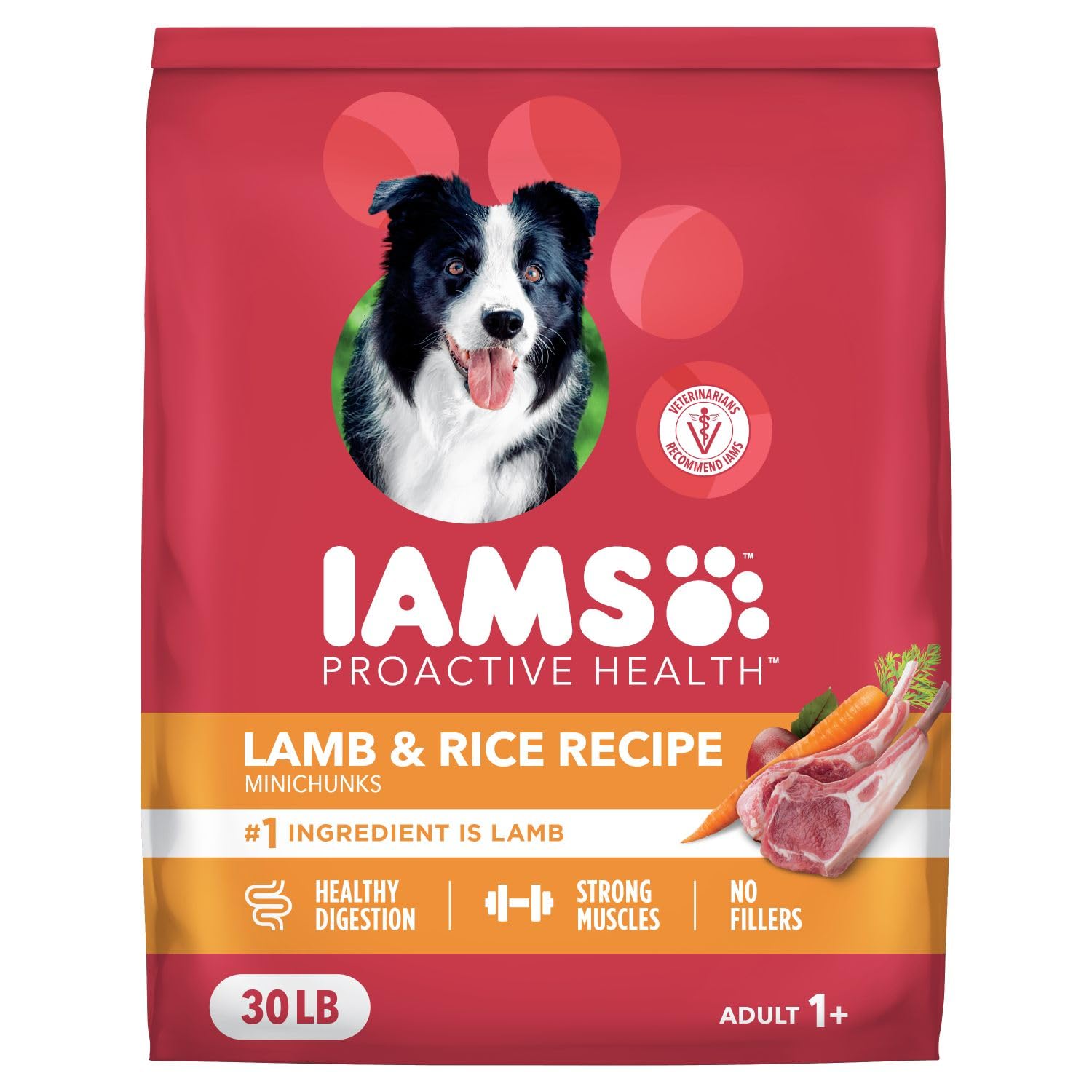
IAMS Proactive Health Minichunks 30 lb

IAMS Proactive Health Minichunks 30 lb

Small mouths

Our Score 9.4/10
Check Price

Worth Noting

  • Some dogs refuse the lamb
  • Loose stools in some dogs
Fillers
0%
Bag Size
30 lb
Kibble Size
Minichunks
First Ingredient
Lamb
Read the full review

Minichunks are exactly what they sound like, and the name undersells them. Pieces this small suit a ten-pound dog, a senior with a worn molar and a dog that inhales dinner without chewing, and watching a small dog push a normal kibble around the bowl is what convinced us the size matters. Thirty pounds of it, lamb and rice, with no fillers and a fiber-and-prebiotic blend aimed at digestion.

Lamb instead of chicken is the reason it earns a spot beyond the kibble size: for a dog that itches or gets loose stool on poultry, it is a straightforward swap that does not blow the budget. Glucosamine is in there too, which we like for the bigger dogs eating from the same bag, and the small pieces mean the little ones are not left out. It is a 30 lb bag rather than a 40, so the reorder rhythm is tighter than with our top pick.

Bottom line: The bag we hand to anyone with a small dog, a senior or a speed eater: kibble small enough that nobody has to work at it, in a 30 lb sack.

3

Pedigree Choice Cuts Pouches 48 ct

Pedigree Choice Cuts Pouches 48 ct

Toppers and travel

Our Score 9.4/10
Check Price

Worth Noting

  • 3.5 oz pouch is small for big dogs
  • Loose stools in some dogs
Flavors
Beef, chicken, filet mignon
Pack Count
48 pouches
Pouch Size
3.5 oz
Water Content
Over 50%
Read the full review

A 48-count box of 3.5 oz pouches solves something cans do not: nothing to refrigerate, nothing to wrap, and a portion already sized for a small dog. Tear, tip, done. For a Chihuahua, a toothless terrier or a dog whose kibble needs wetting, that is most of the argument right there.

Each pouch is complete and balanced on its own, more than 50% water, with 36 vitamins, minerals and amino acids, so it works three ways — a full meal for a small dog, a mixer through dry kibble, or a topper when a dog has gone off its dinner. The rotation of beef, chicken and filet mignon flavors does more for mealtime interest than it sounds like it should.

Practical detail: 3.5 oz is not a meal for a Labrador, and a case of pouches is nowhere near the cheap way to feed a big dog the way a 40 lb dry bag is. Wet food is mostly water — that is the point of it — so treat the 48-count as a convenience case for small mouths and difficult appetites rather than a budget staple.

We keep a box in the cupboard for the weeks when a dog stops eating, because a spoonful of this through kibble ends more dinner strikes than anything else we have tried. The pouches also pack flat in a travel bag, which is more than the cans manage. Our advice: buy it as a topper case first, and let it become a full meal once you know the dog agrees.

Bottom line: The case we keep on hand for small dogs, seniors and anyone who needs a dependable topper without opening a whole can.

4

Purina Moist & Meaty 36 ct

Purina Moist & Meaty 36 ct

Senior dogs

Our Score 9.4/10
Check Price

Worth Noting

  • No crunch; nothing for teeth
  • A large dog needs more than one pouch
Texture
Soft and moist
Life Stage
Adult
Pack Count
36 pouches
Total Weight
216 oz
Read the full review

The dog this is built for has stopped finishing kibble: worn molars, a bad mouth, or a little dog that licks the gravy and leaves the crunch. Moist & Meaty is soft enough to eat without effort and still complete and balanced, which is the part that actually matters when an old dog starts losing weight.

Thirty-six individually wrapped pouches, 216 ounces in total, made with real beef. Nothing to open and refrigerate, nothing to guess at — the portion is fixed, which makes it easy to hand the dog to someone else for a weekend. It works as a topper too, when a dog needs to eat more than it feels like eating.

We reach for this when a dog needs convincing, not when it needs the cheapest calories: there is no crunch at all, so it does nothing for teeth, and a dog that likes to work at its food loses interest fast. As a complete diet for an old dog, or a reliable topper for a fussy one, it is the softest landing in this group.

Bottom line: The senior-dog pick we trust: soft sealed pouches a dog with worn teeth can finish, and complete nutrition rather than a treat in a bag.

5

Taste of the Wild Pacific Stream 28 lb

Taste of the Wild Pacific Stream 28 lb

Grain-free feeding

Our Score 9.4/10
Check Price

Worth Noting

  • Smallest dry bag here at 28 lb
  • Costs more per pound than most bags here
Diet
Grain-free
Protein
32%
Bag Size
28 lb
First Ingredient
Salmon
Read the full review

Thirty-two percent protein is the highest figure any dry bag here prints on the label, and salmon is the first ingredient behind it. That combination is why it sits in the premium tier: it is built for active dogs, and for anyone who reads the protein line before anything else.

Grain-free, with sweet potatoes and peas instead of corn or wheat, plus the brand's own K9 Strain probiotics, prebiotics and omega fatty acids. For a dog that itches on chicken or beef, a fish formula is the usual first move, and this one is put together to make that move easy.

The trade-off is size and cost. Twenty-eight pounds is the smallest dry bag in this guide, and it sits near the top of the group on cost per pound, so a single medium dog is reordering often and paying for the privilege. We think the arithmetic works better for a big active dog, because you are buying protein density rather than filler.

For a dog that cannot do chicken, this is the bag: fish first, no grains, and enough protein to hold weight on an active dog. The Diamond Naturals salmon bag does the same job for less, but it does not print a protein number, and that is the difference you are paying for here.

Bottom line: The grain-free, fish-first bag we recommend for active and chicken-sensitive dogs, as long as a 28 lb sack fits your reorder rhythm.

6

Nutrish Real Chicken & Veggies 40 lb

Nutrish Real Chicken & Veggies 40 lb

Multi-dog homes

Our Score 9.2/10
Check Price

Worth Noting

  • Corn in the recipe; not grain-free
  • Some dogs refuse it or need a slow switch
Bag Size
40 lb
Life Stage
Adult
First Ingredient
Chicken
Artificial Preservatives
None
Read the full review

Of the large dry bags in this guide, the 40 lb Nutrish sack costs least per pound, and that arithmetic is the main reason it takes the top spot. It is also the second-biggest bag here, which for a two-dog household means restocking every few weeks instead of every few days. Bulk buying only pays off if the food is worth feeding, though, and this one clears that bar.

Real chicken leads the ingredient list, with no artificial preservatives, no artificial flavors and no poultry by-product meal. Taurine and omega-3s are in the formula too, which matters more in a food you serve every single day than any one headline ingredient. It is not grain-free — corn is in there — and that is the compromise the price asks of you. We think that is the right trade for a bulk bag; the corn-free options here cost more per pound for less food.

Picky eaters are the one thing to watch. Most dogs go straight at it, but a fussy one may need the switch spread over a week with a little of the old food mixed through, because a 40 lb bag is a long commitment to something your dog turns its nose up at. What keeps it at the top for us is the size-to-cost ratio: the same outlay buys noticeably more weeks of food than the premium bags, and the bin stays full.

Bottom line: We recommend it as the default bulk buy for multi-dog households: real chicken first, no artificial preservatives, and the lowest cost per pound of the big bags here.

7

Purina Pro Plan Shredded Blend 47 lb

Purina Pro Plan Shredded Blend 47 lb

Large-breed feeding

Our Score 9.2/10
Check Price

Worth Noting

  • Premium price tier
  • Picky dogs leave the shreds
Kibble
Shredded blend
Bag Size
47 lb
Probiotics
Guaranteed live
First Ingredient
Chicken
Read the full review

The 47 lb sack is the biggest bag in this guide, and that alone earns it a place. Between a 47 lb bag and a 28 lb one there is a whole extra reorder in every cycle, and that gap compounds over a year. If storage space is fine and trips to the pet shop are not, start here.

Inside, real chicken leads and the probiotic level is guaranteed rather than implied, which we like and which is rarer than it should be in a bag this size. The kibble is a shredded blend — firm pieces mixed with tender strips — more texture than most bags at this size bother with. On a schedule the mix does its job: high protein for muscle, vitamin A and omega-6 for coat. It sits in the premium tier, and the formula is the reason.

Two things to know before you commit. Picky dogs sometimes eat around the shreds and leave them in the bowl, and a bag this size is hard to inspect once it is in the bin — large sacks shipped from a warehouse are exactly where pantry moths turn up. Open it over a tray, look before you pour, and keep it sealed. Buy it for the size and the protein; check it on arrival.

Bottom line: The bag we reach for when reorder frequency is the problem: 47 lb, real chicken first, guaranteed live probiotics and the biggest sack in this guide.

8

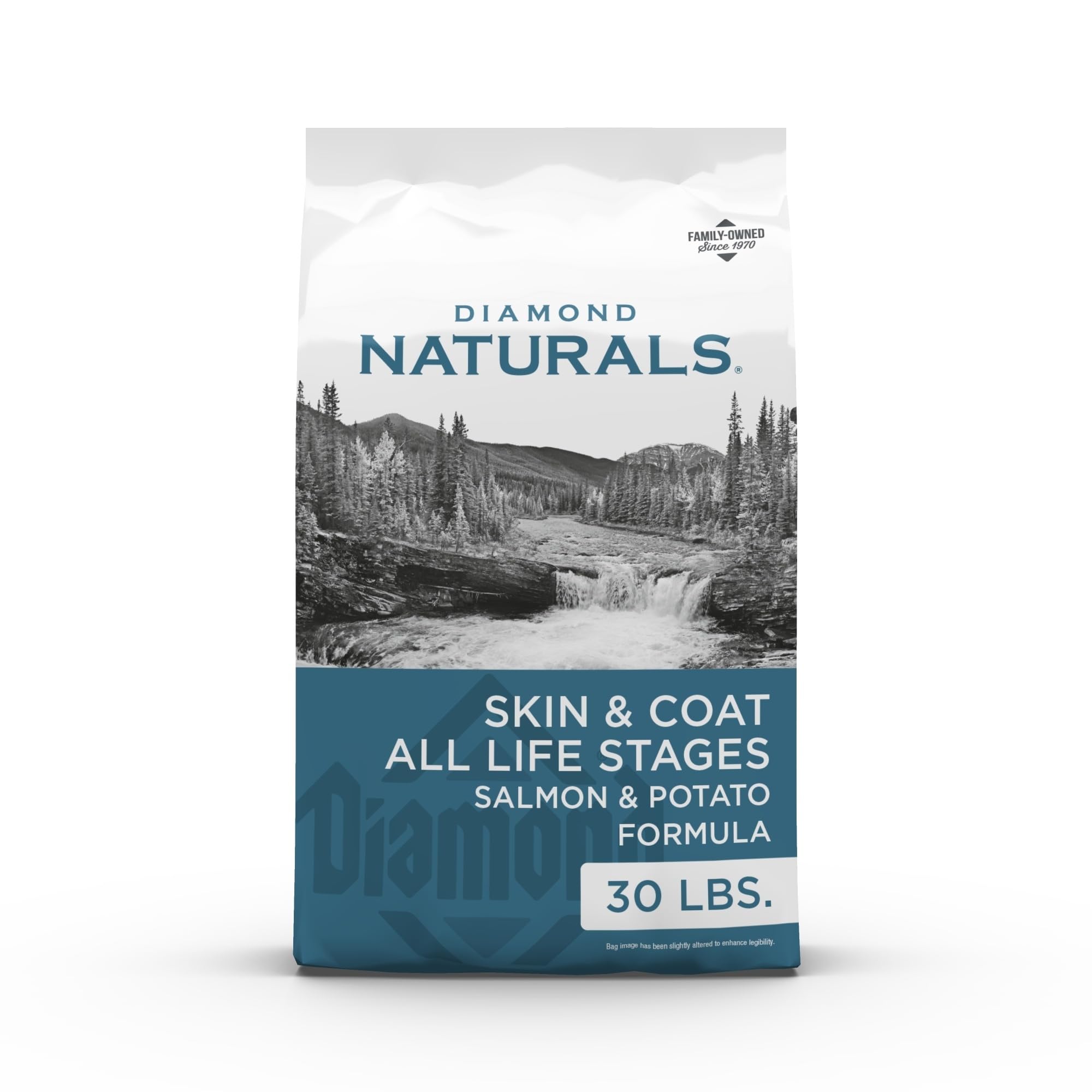
Diamond Naturals Skin & Coat Salmon 30 lb

Diamond Naturals Skin & Coat Salmon 30 lb

Itchy, sensitive skin

Our Score 9.2/10
Check Price

Worth Noting

  • Pickier dogs refuse the salmon smell
Bag Size
30 lb
Life Stage
All life stages
Probiotics
K9 Strain
First Ingredient
Salmon
Read the full review

Salmon leads the ingredient list and there is no chicken anywhere in the formula, which is why this is the bag we point itchy dogs at first. Skin is where it earns its keep, and the improvement is slow — weeks rather than days — so give it a full bag before deciding. Coats come back softer and shinier after a month or so, and dogs that were chewing at their paws often stop.

The other half of the pitch is all life stages. One bag covers a puppy, an adult and a senior, which is genuinely useful in a mixed-age house and unusual among the big bags here, where most are adult-only. Thirty pounds of salmon and potato, with K9 Strain probiotics, prebiotics and the omega fatty acids doing the skin work, and no artificial colors.

The judgement call is this: it is the pick when the problem is skin, not when the problem is price. It costs more per pound than our top pick and earns that when a dog stops scratching. If your dog has been on poultry since puppyhood with no trouble at all, there is no reason to pay the premium.

Bottom line: The bag we point itchy dogs at first: salmon leading, no chicken anywhere, and all life stages so one sack covers a mixed-age house.

How We Tested Bulk Dog Food (and What Actually Mattered)

We started with roughly 40 formulas sold in 24-pound bags or larger and narrowed by reading guaranteed analyses: protein and fat percentages, the first five ingredients, whether a named meat meal appeared near the top, and calories per cup. That filtered the field to 12 bags, all large-format and all reasonably easy to buy without a special order. Each one was fed out over consecutive weeks rather than a meal or two, because most of what matters about bulk food only shows up after the tenth scoop.

In my kitchen that meant morning and evening feedings for a 50-pound mix and a terrier with strong opinions. I weighed every scoop on a kitchen scale to see how far a bag actually stretched, then did the math on cost per day instead of cost per pound. At the bowl I noted whether either dog ate on the first offer or sniffed and walked away, how much water they drank afterward, and how much kibble dust and broken pieces collected near the bottom of the bag. A neighbor with two labs ran the same bags through her routine, so the food also got tested at higher volume and in a house where the bag lives in a garage bin.

Digestibility got the least glamorous test: two weeks on each formula, watching stool consistency, gas, and whether anyone got loose or itchy. For pests, I kept each open bag in the pantry with the top folded but unsealed and checked the seams and kibble for webbing, moths, or beetles before every scoop. We also logged how each bag arrived — torn corners, a zipper that split on day three, a seal that stopped closing — since a bulk bag you can't reseal is already going stale.

How to Choose the Right Bulk Dog Food

Match the bag to how fast you empty it

The biggest sack is not automatically the best buy. A 40 lb bag disappears in a busy multi-dog house and stands open for a long stretch for a single small dog, and kibble loses its appeal once it has been breathing air for months. Ask how long the sack will sit before the last scoop, and if the answer is measured in months, drop a size.

Households with one small or medium dog are usually better served by the 28 to 30 lb bags here than by the 47 lb sack, even though the bigger bag looks like the better deal on the shelf.

Compare cost per pound, not cost per bag

The number on the shelf tells you very little. Divide it by the pounds in the bag and the order flips: the cheapest-looking sack in this guide is not the cheapest per pound, and the 40 lb bag that wins that calculation also happens to be a real-chicken formula. Do the division once in the aisle and it holds for every reorder after that.

Wet food is a separate sum. A case of pouches is mostly water, so it costs far more per pound than dry kibble and should be judged on what it does — feeding a small dog, tempting a fussy one, wetting a senior's dinner — rather than on weight.

Read the first ingredient and the grain line

Chicken, lamb and salmon all lead a bag here, and the useful question is which one suits your dog rather than which sounds best. Chicken is the default and usually the cheapest. Lamb or fish is the sensible swap for a dog that scratches or gets loose stool on poultry, and it is worth paying a little more for if that is your problem.

Grain-free is not automatically better. Corn and grains are a cost lever, plenty of dogs do well on them, and a grain-free label adds price before it adds anything you can measure in your own dog.

Kibble size and texture decide who can eat it

Small pieces suit small mouths, seniors and dogs that gulp their dinner whole. A standard kibble gives a bigger dog something to crunch. Shredded blends and soft pouches exist for dogs that have gone off dry food, and a moist pouch is often the difference between an old dog eating and not eating.

If your dog has bad teeth, buy for the mouth in front of you rather than for the label. A complete soft food beats a premium kibble the dog cannot pick up.

Plan where 40 lb of food is going to live

A big sack needs a lidded bin that holds the whole bag, in a dry spot off the floor. A garage that swings between damp and hot is the wrong answer, and so is leaving the bag rolled open in a cupboard for a month.

Decant on arrival: it keeps the food fresher than dipping into a folded bag and makes portioning faster. Buy the bin with the bag rather than after the first spill.

Frequently Asked Questions

Final Verdict

For most households the Nutrish 40 lb bag is the bulk buy to start with: the lowest cost per pound of the large dry foods here, real chicken first, and a size that keeps the bin full without constant reordering.

If the bin is the constraint rather than the budget, the 47 lb Pro Plan bag is bigger and higher in protein, and for a dog that scratches on chicken the Diamond Naturals salmon bag is the swap worth making.