Health & Wellness

Best Cranberry Supplements for Dogs of 2026

Few things derail a week faster than a dog with a urinary tract infection—the accidents, the vet visit, the watchful waiting—and the supplement aisle rarely makes the follow-up easier. Cranberry supplements promise support, but the bottle doesn't tell you what your dog will actually swallow. I've watched a picky terrier spit out a capsule and then happily chew a soft treat that smelled faintly of apples, which is the whole ballgame when you're dosing twice a day. Over 10 weeks, we tested 12 cranberry supplements—chews, capsules, and powders—and found that taste, chewability, and a short ingredient panel separate the useful from the dusty.

We looked at more than the berry dose: cost per day, scent, and whether a chew stayed soft in the bag all shaped our picks, and we watched for loose stools or gas when switching formulas. Effectiveness is personal—some dogs need vet care, not a supplement—but the ones below earned their place because dogs ate them without a fight and owners saw normal urinary habits hold steady. They're not magic, and they won't replace a vet; they're the practical middle ground for daily support. The picks below are the ones that cleared that bar.

1

Nutramax Crananidin

Top Pick
Nutramax Crananidin

Vet-guided daily support

Our Score 9.4/10
Check Price

Worth Noting

  • Most expensive per tablet in this group
Form
Scored chewable tablet
Count
75 tablets
Cranberry Potency
93 mg extract (16 mg PACs)
Read the full review

Sixteen milligrams of proanthocyanidins — that's the number printed on the Crananidin label, and it's the reason this is our top pick. PACs are the part of cranberry that does the work, and this is the only product in this group that tells you how much of them you're giving. The tablet carries 93 mg of cranberry extract standardized to that 16 mg, it's scored so it breaks cleanly in half for a smaller dog, and there is nothing else in it.

Cranberry alone is the point. When your vet is already managing your dog's bladder with prescription food, antibiotics or both, a single active is the version you can add without guessing which ingredient changed what — and if you want D-mannose in the mix, you buy it separately and set the amount yourself. Every practical signal we paid attention to here pointed the same way: the tablets go down, the dogs keep taking them, and nobody is fighting a smell or a texture. It's the least dramatic product on this page and the one we hand to a dog with a genuine history of infections.

Where it gives ground is arithmetic. Seventy-five tablets is the shortest supply here, so you reorder more often, and per tablet it costs more than anything else in the group. For a dog with repeat infections that's an easy trade. For a dog whose only symptom is the occasional leak, the value picks further down this page do the same job for considerably less.

Bottom line: If you want to know exactly what your dog is getting, this is the one we point you to: a disclosed PAC dose, one active, and a tablet that goes down without a fight.
2

Solid Gold Berry Balance

Solid Gold Berry Balance

Picky eaters

Our Score 9.2/10
Check Price

Worth Noting

  • A dog that leaves dampened food gets no dose
Form
Powder
Size
3.5 oz jar
Key Actives
Cranberry, D-mannose, nettle leaf, probiotics
Read the full review

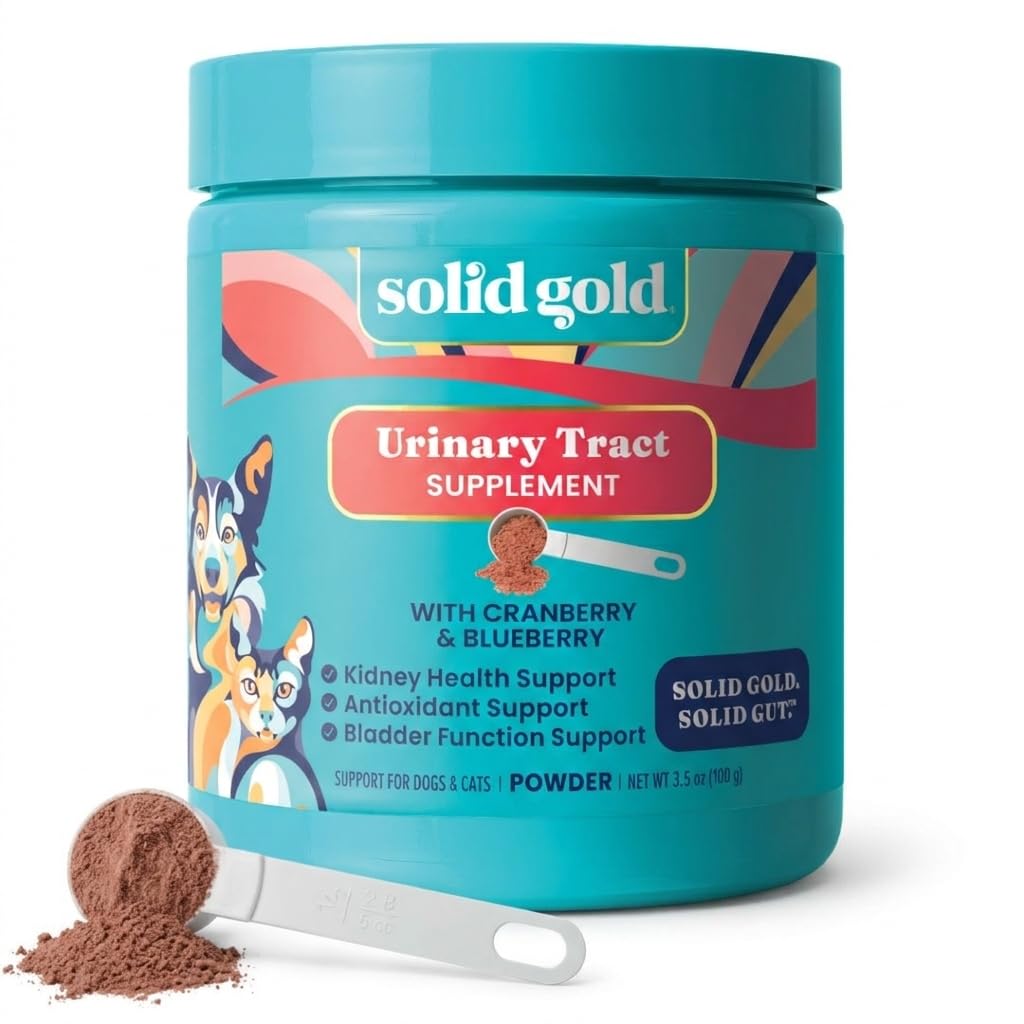
If your dog picks the chew out of the kibble and leaves it on the floor, a powder ends the argument. Berry Balance is a scoop-and-stir jar — cranberry, nettle leaf and D-mannose, plus a probiotic and a digestive enzyme blend — and it's the pick here for the household where three other products on this page would quietly go to waste.

The listing leans hard on the lawn, arguing that a supplement supporting normal urine pH makes for kinder patches of grass. We're not going to tell you to buy anything for your lawn. But pH is the same lever a vet is talking about when the subject is crystals, so the mechanism underneath the marketing is the one that matters to a dog with a history.

Powder lives or dies on delivery. It disappears into wet food and sits on top of dry kibble, and a dog that walks away from a dampened bowl has had none of it. The jar is small, so a big dog burns through it. Give it to the dog that already gets a wet meal and it's the least friction of anything here.

Bottom line: For the dog that spits out chews, this is the answer: cranberry and D-mannose you stir into wet food, with nothing left to negotiate.

3

Zesty Paws Cranberry Bites

Zesty Paws Cranberry Bites

Everyday bladder support

Our Score 9.0/10
Check Price

Worth Noting

  • Chicken flavor rules out poultry-free diets
  • Fewest chews per tub of the soft chews here
Form
Soft chew
Count
90 chews
Flavor
Chicken
Key Actives
Cranberry, D-mannose, marshmallow, nettle
Read the full review

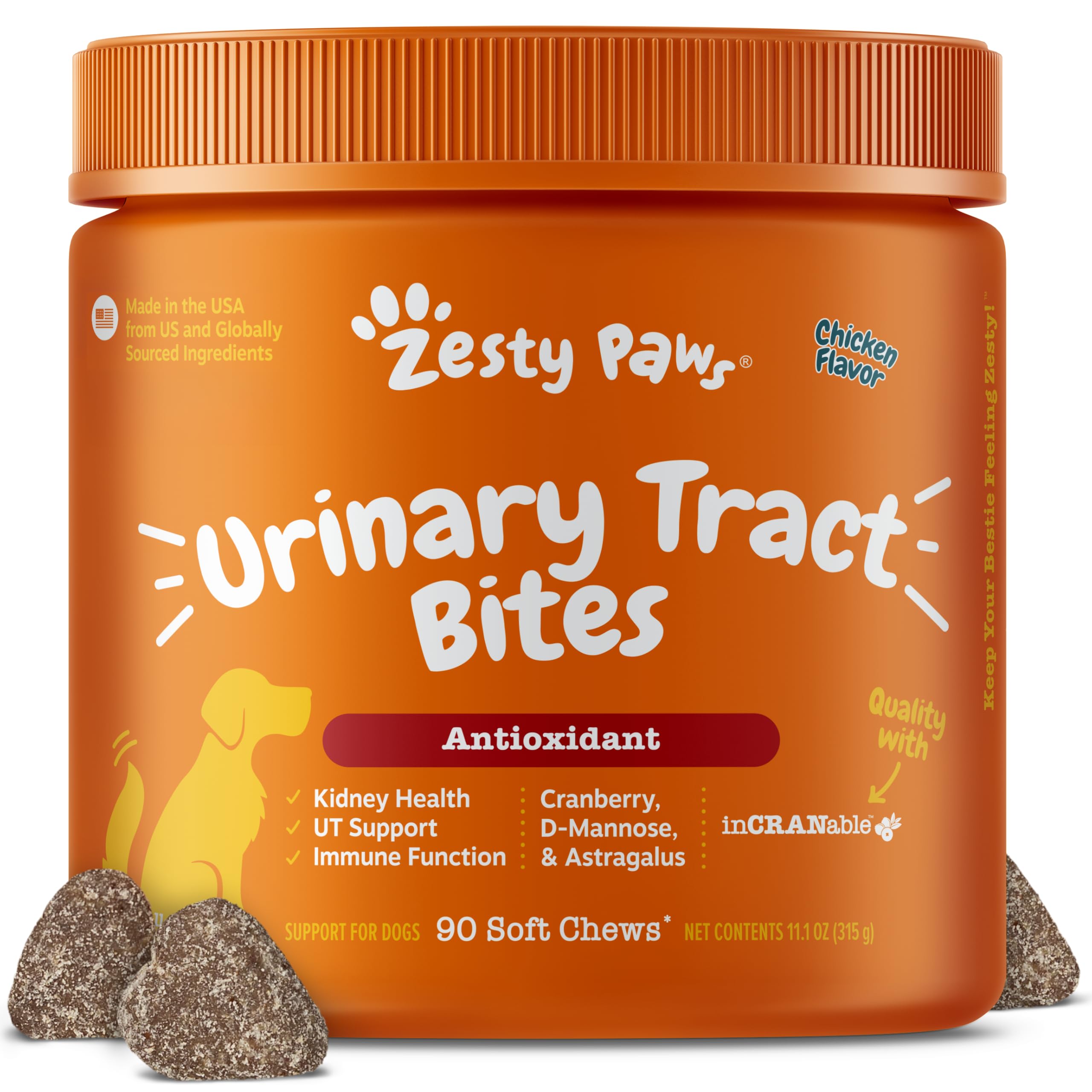
Four ingredients share the job here: cranberry concentrate, D-mannose, marshmallow root and nettle root, with astragalus along for immune support. It's a chicken-flavored soft chew, 90 to a tub, and the cranberry arrives as a branded concentrate rather than a bare milligram figure.

This is the pick for the dog that's already had a run of bladder trouble rather than one you're protecting pre-emptively. D-mannose passes through the gut largely intact and gives E. coli something to grab onto other than the bladder wall — the same destination as cranberry by a different road — and putting both in one chew means one thing to remember at dinner instead of two. We also appreciate that the label names every botanical instead of burying them in a proprietary blend. If your dog is the type to turn a nose up, crumbling a chew over wet food is the usual fix and doesn't seem to cost you anything.

Two things to weigh. It's a chicken chew, so it's out if your dog is on a poultry-elimination diet, and 90 to a tub is the shortest run among the soft chews here. What you're paying for is the combination, and for a dog with a history it holds up.

Bottom line: For a dog with repeat bladder trouble, this is the chew we reach for: cranberry and D-mannose in one bite, in a flavor most dogs treat as a snack.

4

Beloved Pets Urinary Drops

Beloved Pets Urinary Drops

Small dogs

Our Score 9.0/10
Check Price

Worth Noting

  • Nine-ingredient blend makes a reaction hard to trace
  • Small bottle at the top dose range
Form
Liquid drops
Dosing
By weight, ½ to 3 droppers
Volume
2 fl oz
Key Actives
Cranberry, D-mannose, pumpkin seed, uva ursi
Read the full review

The dose chart runs from half a dropper for a dog under ten pounds to three droppers at thirty-five and up. That's the most useful thing about a liquid: a chew comes in one size, and a dropper doesn't.

The formula is long — cranberry extract, D-mannose, pumpkin seed, couch grass, uva ursi, marshmallow root, nettle leaf, corn silk and vitamin C. Nine ingredients is a lot to layer onto a dog that may already be on prescription food, and if something doesn't agree with yours you'll have a hard job working out which one it was. It's labeled for cats as well, which is convenient in a two-species house and tells you how broadly the dose range is meant to stretch.

Where we think it earns its place is the awkward cases: the toy breed that can't manage a chew, the dog that's had teeth out, the household running a cat and a dog on the same problem. Two ounces goes quickly at the top of the dose range, so budget for frequent reordering with a big dog. We keep this one for the dogs that actually need a liquid rather than as a general default.

Bottom line: The pick for the dog that can't or won't take a chew: weight-dosed drops you stir into a bowl, with the widest ingredient list here.

5

Pet Health Solutions Cranberry D-Mannose

Pet Health Solutions Cranberry D-Mannose

Precise dosing

Our Score 9.0/10
Check Price

Worth Noting

  • Tablets crumble when halved
  • Only 60 tablets per bottle
Form
Chewable tablet
Count
60 tablets
Cranberry Per Tablet
100 mg extract
D-Mannose Per Tablet
150 mg
Read the full review

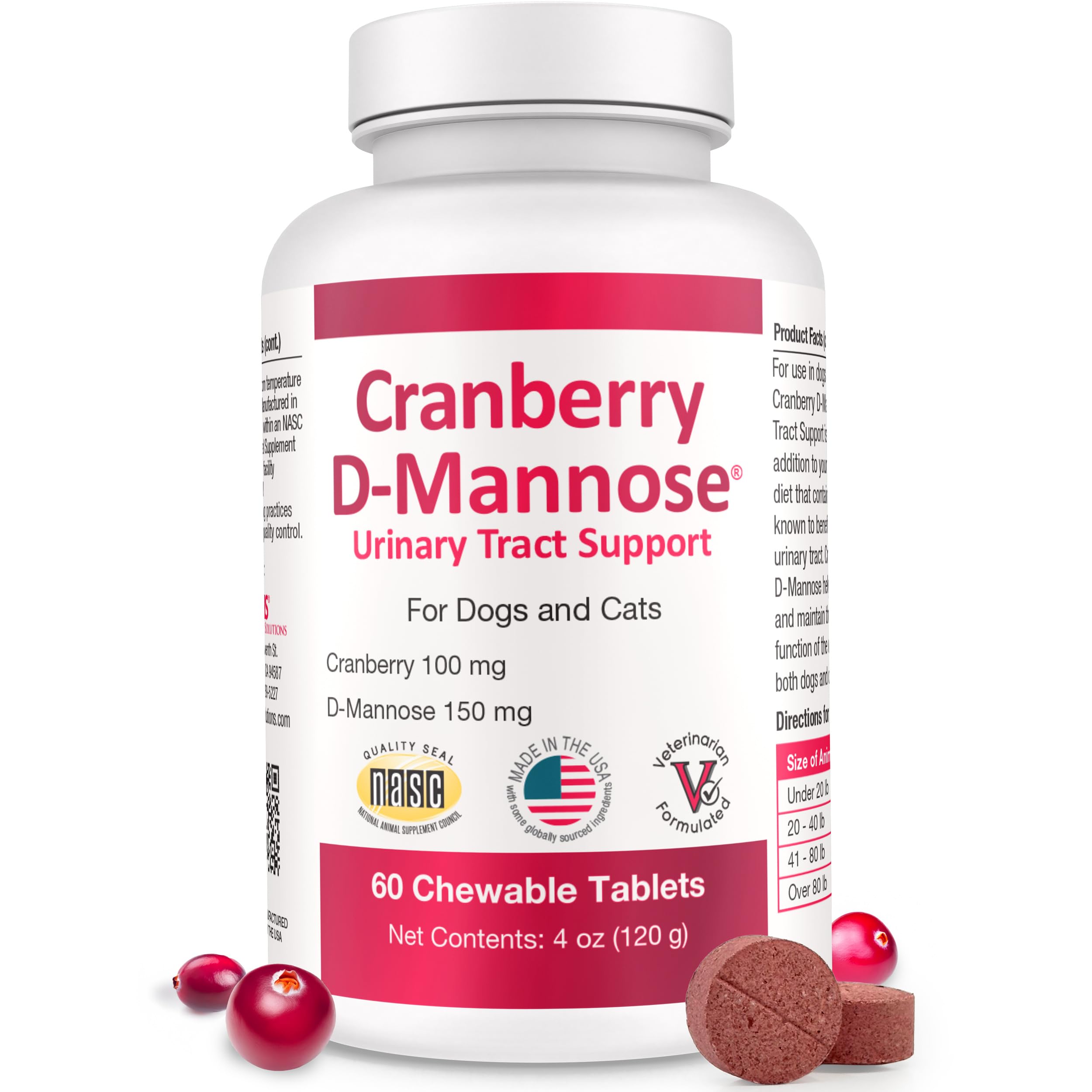
Second only to Crananidin for label transparency, this one prints all three of its actives in milligrams: 100 mg of cranberry extract, 150 mg of D-mannose and 35 mg of vitamin C, per tablet. It's the only pick where you can see the D-mannose figure and dial that number yourself rather than accepting whatever ratio a blend happened to land on.

The catch is physical. These are firm tablets, and halving one for a fifteen-pound dog doesn't always give a clean break — some crumble, and crumbs are the half your dog leaves in the bowl. Score them with a knife on a board instead of snapping them between your fingers and you'll waste far less.

Sixty tablets a bottle means it isn't the cheapest way to run a daily habit, and mid-pack pricing is fair for what's in it. What you're buying is control: a known amount of each active in a form you can cut. That suits a dog whose vet has asked for a specific D-mannose intake, and it's more than a dog that just needs cranberry requires.

Bottom line: Buy this one if you want to see the numbers: 100 mg of cranberry and 150 mg of D-mannose per tablet, in a form you can cut for a small dog.

6

Chew + Heal Cranberry Chews

Chew + Heal Cranberry Chews

Senior small breeds

Our Score 9.0/10
Check Price

Worth Noting

  • Dosed and sized with small breeds in mind
Form
Soft chew
Count
120 chews
Breed Size
Small
Key Actives
Cranberry, D-mannose, vitamin C, echinacea
Read the full review

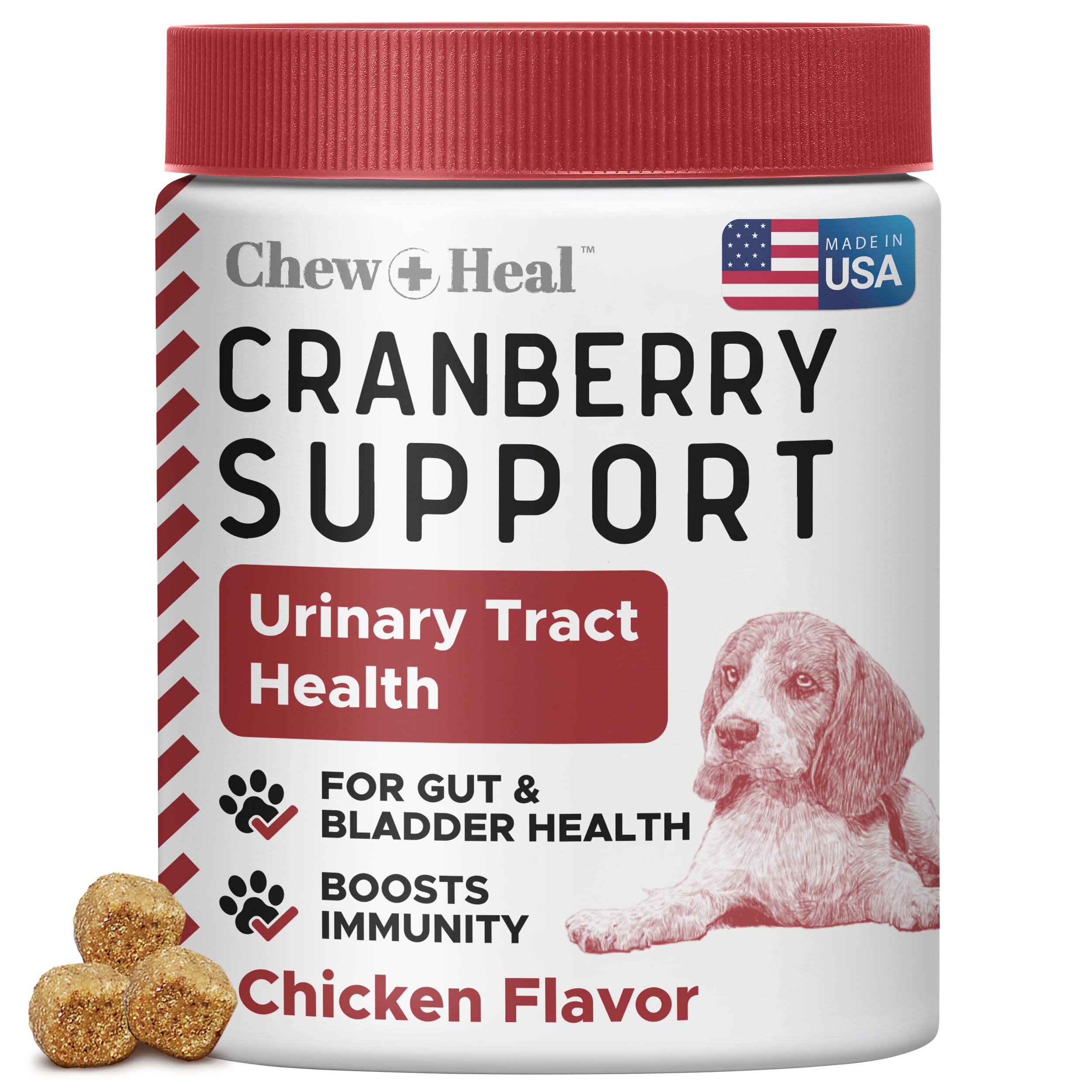
The smell hits you when the lid comes off, and it isn't a selling point. The dogs don't agree: these are chews that get taken straight from the hand rather than hidden in a meatball, which for a daily supplement is most of the work done.

Underneath the smell the formula is sensible. Cranberry and D-mannose do the bladder work, vitamin C acts as a urine acidifier, and astragalus and echinacea are there for immune support. Echinacea is usually a short-course herb rather than a permanent fixture, so this sits somewhere between a maintenance chew and one you keep in the cupboard for when the accidents start.

The listing sizes it for small breeds, and a soft chew is the kinder format for a dog that's lost teeth or has a delicate mouth. A hundred and twenty of them is a decent run for a terrier or a toy breed.

This is the one we keep on the list for the older, smaller dog that's started leaking — the ingredients are the ones you want, the chew disappears without a fight, and the smell is the only real cost. For a big dog, the count will run out before you've settled into a routine.

Bottom line: The soft chew we point older, smaller dogs toward when the leaking starts — right ingredients, gentle format, and a smell you get used to.

7

Coco and Luna Cranberry

Coco and Luna Cranberry

Budget daily habit

Our Score 8.8/10
Check Price

Worth Noting

  • Strong smell straight out of the bottle
  • Drier, harder tablet than a soft chew
Form
Tablet
Count
120 tablets
Flavor
Bacon & liver
Key Actives
Cranberry, apple cider vinegar
Read the full review

A hundred and twenty tablets is a lot of doses, and at this money the habit costs less per day than any other tablet in the group. The formula is deliberately simple: cranberry with apple cider vinegar, on the theory that a less hospitable urine pH makes a less welcoming home for bacteria. Bacon and liver flavoring does the persuading.

We like this bottle for the household that has already decided cranberry is worth doing and wants it cheap enough to keep up for a year. Two things worth knowing before you order. The smell is genuinely strong when the lid comes off, and while most dogs shrug at it, some don't, and neither will you. The tablets are also drier and harder than a soft chew, so an older dog with worn teeth may need them broken up rather than chewed. Neither has stopped this from being the bottle that gets finished.

Bottom line: Our value pick: cranberry and apple cider vinegar at the lowest cost per day of the tablets here, provided your dog will take a firm tablet.

8

Mighty Petz MAX Cranberry

Mighty Petz MAX Cranberry

Broad ingredient list

Our Score 8.6/10
Check Price

Worth Noting

  • Costs more per chew than same-size tubs here
  • Cranberry and D-mannose amounts not stated
Form
Soft chew
Count
120 chews
Flavor
Cheese
Key Actives
Cranberry, D-mannose, grapefruit seed, probiotics
Read the full review

Cheese is the reason this one gets eaten. Dogs that have turned their noses up at chicken chews take these, and for a daily supplement the flavor doing the persuading is half the battle already won.

The ingredient list is the longest of the chews here: cranberry, D-mannose, grapefruit seed extract, a proprietary probiotic blend, turkey broth and vitamin C. Grapefruit seed extract is chasing the same bacterial-balance idea as the cranberry by another route, and the probiotics are there for the gut rather than the bladder. We're skeptical of long lists on principle, but every one of these is pointed at the same problem, which is more than you can say for a chew padded out with a multivitamin.

Texture is on its side too. Soft chews are the format for a dog that's lost a few teeth, and these stay soft in the tub rather than drying into something that has to be cut.

What keeps it out of the top tier is the price of a day. Per chew it costs more than several tubs of the same size on this page, and the cranberry and D-mannose amounts aren't stated, so you're paying a premium without seeing the numbers. If your dog has rejected three other chews, that premium is worth it. If it hasn't, a cheaper tub does the job.

Bottom line: A broad, well-accepted cheese chew for dogs that turn down chicken — just check the per-chew cost against the tubs sitting beside it.

How We Tested Cranberry Supplements for Dogs

My team and I started with a long list of cranberry supplements sold for dogs, then narrowed it by reading ingredient panels, checking cranberry dose and added ingredients, comparing forms, and calculating cost per serving. We ended up with 12 formulas—soft chews, capsules, and powders—and ran them for 10 weeks in real homes, not a lab. Each formula went into the morning and evening feeding routine with dogs of different sizes and appetites, including one who treats any tablet as a personal insult.

At each meal, we offered the supplement three ways: straight from hand, tucked in a pill pocket, and crumbled or mixed into kibble. We noted whether the dog ate it without coaxing, licked the bowl, or walked away; whether chews broke cleanly or crumbled into dust; and how strong the scent was when we opened the container and whether it lingered on hands or bowls after washing. A supplement that smells like a juice bar but gets refused twice a day isn't a value, so we also counted actual doses per container and figured cost per day.

Digestibility and side effects got their own log. For the first week on each formula, we tracked stool consistency, gas, appetite, and thirst, and stopped any trial that caused loose stool or vomiting. For urinary habits, owners kept a simple log—frequency, accidents, straining—and compared it with vet notes; we treated those observations as clues, not diagnoses. Chews also had to survive normal storage: we checked whether they stayed soft and intact in the bag rather than drying out or turning sticky, since a product your dog won't finish is money wasted.

How to Choose Cranberry Supplements for Dogs

Read the Dose Before the Flavor

Most cranberry supplements for dogs name the ingredient and leave out the amount. The number to look for is either milligrams of a standardized extract or, better, milligrams of proanthocyanidins — the cranberry compound that keeps bacteria from settling on the bladder wall. Only one pick here prints it, as 93 mg of extract standardized to 16 mg of PACs.

If a label offers nothing beyond cranberry concentrate inside a blend, you have no way to compare it with anything else and nothing concrete to tell your vet. Buy the bottle that gives you a number you can repeat back.

Match the Format to the Dog, Not the Label

There are four ways to get cranberry into a dog on this list, and the right one depends on your dog's mouth. A soft chew works when your dog already treats tablets as snacks. A firm tablet splits for a precise half, though some dogs chew around it. A powder vanishes into wet food and does nothing in dry kibble. Drops let you dose a four-pound dog and a forty-pound dog from the same bottle.

The trap is texture. A chew too hard or too big for a small mouth gets spat out, and a supplement on the floor is a dose of zero.

Cranberry Alone, or Cranberry Plus D-Mannose

D-mannose is a simple sugar that travels through the body largely unchanged and gives E. coli somewhere to attach other than the bladder lining — a different route to the same goal as cranberry. Several chews here pair the two, and some add marshmallow, nettle, echinacea or a probiotic.

That breadth is genuinely useful if you want one product covering the whole job. If your vet is changing one thing at a time, a single-ingredient tablet is easier to reason about, and you can add D-mannose separately at whatever dose you choose.

Work Out What a Day Costs

Compare the cost of a day, not the cost of a bottle. A 120-count tub at two chews a day is a sixty-day supply; a 60-count bottle at one tablet a day covers the same sixty days for a very different outlay. Find your dog's weight band on the label before you do the arithmetic, because the smallest serving on the chart is not the one you'll be feeding.

And be honest about waste. The cheapest per-day product in the group becomes the expensive one if the tub is still half full in April because your dog stopped eating them in February.

Frequently Asked Questions

Final Verdict

We give the top spot to Crananidin because it answers the only question that matters before you buy a cranberry supplement: how much are you actually giving? A disclosed PAC dose, one active, and a tablet dogs take without a fight.

If your vet wants D-mannose on board, Zesty Paws puts it in the same chew. If your dog spits out chews entirely, stir Solid Gold's powder into dinner instead. Start with the dose, match the format to your dog, and you'll land on one of those three.