Apparel & Accessories

Best Dog Boots of 2026

A dog that sits down mid-walk and holds up one paw is telling you something: the pavement is too hot, the salt stings, or a burr is wedged between the pads. Boots solve all three, but only if they stay on — and most pairs bought in a panic end up spinning sideways, flapping loose, or kicked off within the first hundred yards. The ones that hold share a sole that flexes with the paw, a strap that cinches above it rather than across it, and a size that accounts for nails and fur, not just the flat of the pad.

That last part is where I got it wrong first: I measured a wriggling dog on the living room floor, came up half an inch short, and watched a boot rotate sideways on the very first walk. Over the past six months my team and I have fitted 12 pairs on dogs of wildly different sizes, through wet grass, salted sidewalks, and hot asphalt. The ones that earned a spot below are the ones the dogs eventually stopped noticing.

1

LUCKYPAW Dog Shoes

Top Pick
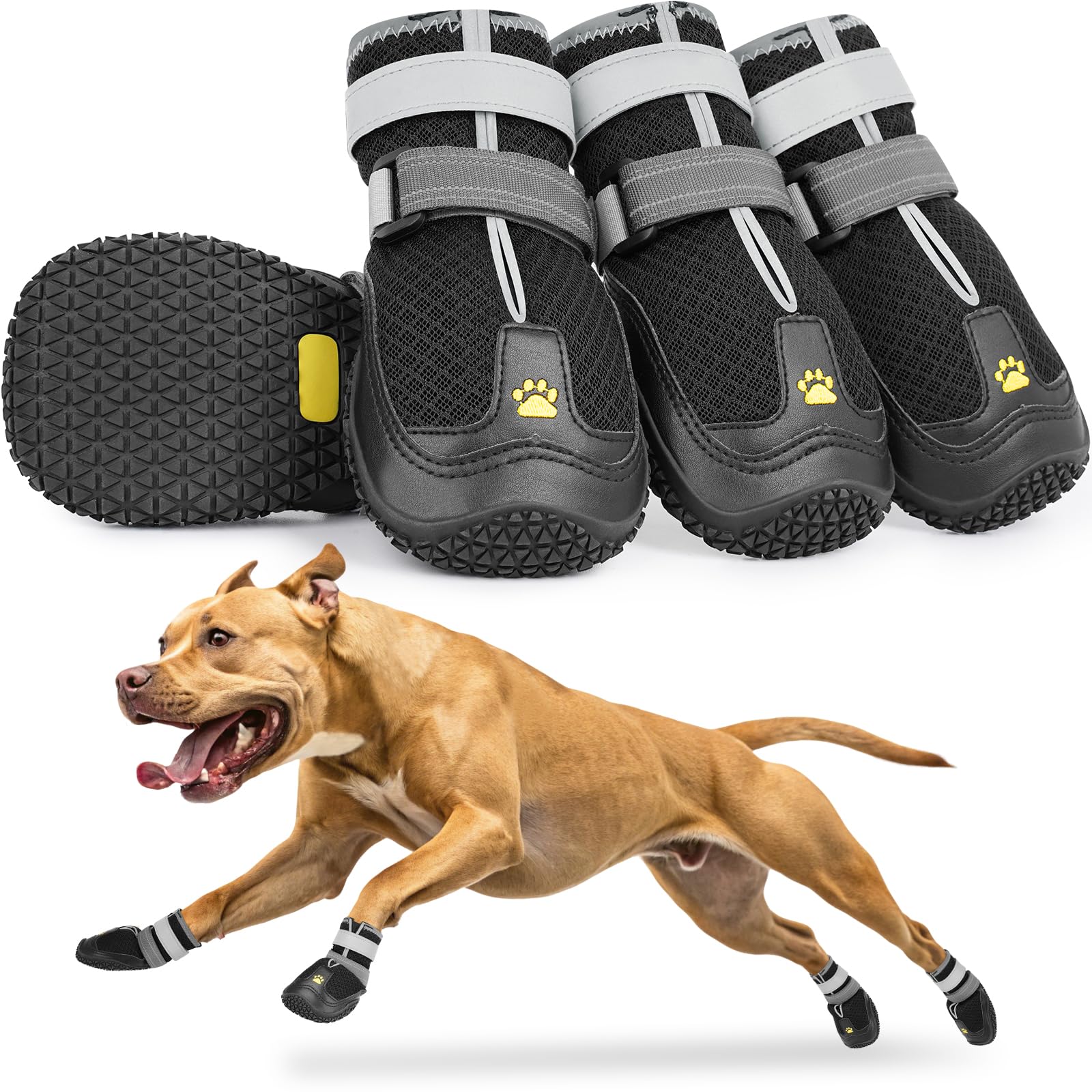
LUCKYPAW Dog Shoes

Hot pavement walks

Our Score 8.4/10
Check Price

Worth Noting

  • Mesh soaks through in slush and wet snow
Count
4 boots
Upper
Mesh with leather toe guard
Water Resistance
Water-resistant toe, not fully waterproof
Size (paw Width X Length)
Size 6: 2.6 x 3.0 in (W x L)
Read the full review

Summer pavement is the hardest test a dog boot faces: a coated fabric that keeps salt out in January becomes a sauna in July. The ultra-mesh upper here is the answer, and it is why this is our hot-weather pick — air moves through the boot, and the flexible rubber sole underneath grips slick tile and sun-baked asphalt without the stiffness of a trail boot.

Getting them on is quick. A wide slit opens the boot up, two reflective straps with plenty of length get it snug on a narrow paw, and the fit holds through a normal walk instead of rotating to the side. Sizing runs on width and length together — the size 6 is 2.6 inches wide by 3.0 long — so measure both and pick from the width first.

What the sole is not is armored. This is a grip-first design for pavement, tile and packed trail, and sharp rock is not its job; a rugged outsole like the Grip Trex's is the better call for scree. Within the walks most dogs actually do, though, the light, bendy sole is an advantage: a boot that flexes where the paw flexes is a boot a dog stops noticing.

Bottom line: The summer pick: a breathable mesh upper and a flexible, grippy sole that keep a dog comfortable on hot pavement and slick floors.

2

XSY&G Dog Shoes

XSY&G Dog Shoes

Budget four-pack

Our Score 8.2/10
Check Price

Worth Noting

  • Durability is uneven on rough ground
Care
Hand wash only
Sole
Rubber/plastic
Count
4 boots
Size (length X Width)
Size 6: 2.9 x 2.5 in (L x W)
Read the full review

The price gap between this four-pack and our top pick is the first thing you notice, and what sits on the other side of it is very nearly the same boot: a wide split opening, two long adjustable straps, a washable fabric upper and a rubber sole. For a dog who needs protection on ordinary neighborhood walks, that covers the job.

Sizing is the place to be careful. The number on the box is the inner diameter of the shoe, measured by hand, and the weight guidance in the listing — size 6 for 52 to 70 pounds — is a starting point rather than the answer. The brand asks buyers to allow for a little size error, which tells you how much the last half inch matters: match the measured width to the chart, and accept that a paw at the top of a range may want the next size up.

Durability is where the saving shows. Some sets come through a muddy winter and a hot summer intact; others split at the sole before the season is out. That is a trade we are content to make on a boot that goes on twice a day for suburban sidewalks and gets replaced without wincing, and it is why this is our value pick rather than a challenger for the top spot. What has been consistent is protection: stickers, broken glass, hot pavement and salt all stop at the sole.

Bottom line: Our value pick: nearly the same wide-opening, two-strap design as our top pick for a lot less, if you measure the paw instead of trusting the weight chart.

3

Ruffwear Grip Trex

Ruffwear Grip Trex

Hiking and trails

Our Score 8.2/10
Check Price

Worth Noting

  • Sold in pairs, so a full set is two boxes
Count
2 boots (pair)
Upper
Ripstop polyester
Outsole
Vibram rubber
Paw Width
2.00 in
Read the full review

Ruffwear sells these two boots at a time rather than four, and that packaging decision is the first thing to understand about them: a dog with wider front paws can wear one size in front and another behind, which is the fit problem a four-pack cannot solve.

What the money buys is the sole. A Vibram outsole is the real thing — it grips wet rock, slick tile and hot asphalt, and on a rocky trail the difference between it and a generic rubber sole is the difference between a confident dog and a hesitant one. The ripstop upper is breathable and blocks heat, snow, salt and moisture, and the hook-and-loop ankle strap holds through a strong puller's zoomies once it is set correctly with the cuff above the joint.

Fit is the caveat, and it runs both ways. These come up big, so a dog measuring between sizes wants the smaller one, and the cuff can rub at a dew claw or knuckle on a long day out. A thin sock underneath is the usual fix, and it is worth the extra minute on a dog with prominent claws or a dragging back leg.

What you get in return is grip that does not quit on wet rock, which is the whole reason a boot goes on a hiking dog. For pavement-only walks it is more boot than you need; for anything with scree, roots or a stream crossing, it is the one we want on the paw.

Bottom line: The boot we put on a hiking dog: real Vibram grip and a cuff that stays put, sold in pairs so the front and rear paws can be sized differently.

4

CovertSafe& Dog Boots

CovertSafe& Dog Boots

Snow and salt

Our Score 8.2/10
Check Price

Worth Noting

  • A determined dog can still kick one off
Count
4 boots
Closure
Two reflective hook-and-loop straps
Warranty
1 year
Size (length X Width)
Size 6: 2.9 x 2.5 in (L x W)
Read the full review

A February sidewalk crusted with road salt is the test these were built for, and the split-seam design gets them on fast when the wind is up: spread the opening, slide the paw in, pull the two reflective straps snug. The fabric upper keeps salt off the pads, and the red is far easier to spot in a snowbank than the black most boots here come in.

The sole is the other half of the story: a rugged rubber tread that takes sidewalk salt, wet pavement and the gravel at the edge of the park without letting any of it reach the pad. Two straps with real length mean the fit can be dialed in on a narrow paw as well as a broad one, and the reflective strips are the reason a dusk walk does not end with a search party.

What earns it a place is the combination: a familiar, easy-on design, a color that shows up against snow, a one-year warranty, and a price below our top pick's. Sizing deserves the same care as everything else here — the chart puts size 6 at 52 to 70 pounds, and the width is the number that actually decides it.

Bottom line: A red, slightly cheaper take on our top pick's design, with the same easy opening and a salt-ready sole — just budget for the odd boot coming loose.

5

Dimicoo Waterproof Dog Boots

Dimicoo Waterproof Dog Boots

Deep snow

Our Score 8.2/10
Check Price

Worth Noting

  • High cuff is slow to pull over narrow paws
Size
3#: 2 in insole width, 27-38 lb
Count
4 booties
Upper
Waterproof fabric with fleece lining
Closure
Dual straps with drawstring
Read the full review

A high cuff, a fleece lining and a waterproof shell add up to something that looks more like a tiny snow boot than the fabric slippers elsewhere on this list. The drawstring pulls the cuff closed around the leg, so slush goes around the boot rather than into it — which is the entire point of a winter design.

Two straps plus a drawstring is more securing hardware than most boots here carry, and the two do different jobs: the straps hold the boot to the paw, the drawstring seals the top. Reflective strips run down the side for dark walks, and the anti-slip rubber sole handles icy pavement and wet decking.

Sizing starts small. The size 3 listed here has a 2-inch insole width and is aimed at roughly 27 to 38 pounds, so a larger dog needs a different size from the same chart. The high cuff also takes a moment longer to work over a narrow paw than a low boot does, which is the cost of the seal.

This is a newer design than the big four-packs, so the case rests on the specification as much as on a long track record — but the specification is exactly right for a wet, cold city, and hand or machine washing means mud season does not finish the set. For a small or mid-size dog in a snowy place, it is the winter boot we reach for.

Bottom line: Our winter pick for small and mid-size dogs: a waterproof high-top with a fleece lining and a drawstring cuff that keeps slush out of the leg.

6

QUMY Dog Shoes

QUMY Dog Shoes

Everyday all-season walks

Our Score 8.0/10
Check Price

Worth Noting

  • Hand wash only
  • Can work loose in deep snow
Care
Hand wash only
Count
4 boots
Closure
Two reflective hook-and-loop straps
Size (paw Width X Length)
Size 8: 3.0 x 3.3 in (W x L)
Read the full review

A split seam runs down the front of each boot, and that one detail decides how they go on: the opening spreads wide enough to slide a paw in, then two reflective straps pull it closed above the ankle. QUMY is the set we recommend first because it is forgiving at both ends of the job — getting a boot onto a wriggling dog, and keeping it there for the length of a walk.

Protection is what earns the top spot. A faux leather, nylon and polyester upper sits over a rugged rubber sole, and the slip-resistant tread is the part that matters: it bites on wet pavement, hot asphalt and loose gravel, and everything the paw would otherwise touch stays on the wrong side of the sole. It is a simple design executed properly, which is most of what this category needs.

Sizing is the part to slow down for. The chart runs on paw width and length with body weight as a reference only, and the steps between sizes are small — the size 8 measures 3.0 by 3.3 inches — so a hasty measurement buys you a return. Measure a standing paw at its widest point, and measure front and back separately, because front paws run broader and a too-narrow boot is the one that spins.

Four boots in the box means you are not choosing which two paws get protected, which matters more than it sounds on a freezing morning. The reflective straps catch a headlight at dusk, and the embroidered paw on the side means the dog looks dressed rather than bandaged.

Bottom line: The set we recommend to most people: a wide opening, two straps, and a rugged sole that handles salt, hot pavement, and trail grit without fuss.

7

Ruffwear Summit Trex

Ruffwear Summit Trex

City walks year-round

Our Score 8.0/10
Check Price

Worth Noting

  • Sold in pairs, so four boots means two boxes
  • Light ripstop shortens the working life
Count
2 boots (pair)
Upper
150-denier polyester ripstop
Closure
YKK hydrophobic hook-and-loop
Paw Width
2.75 in
Read the full review

Think of this as the Grip Trex's lighter sibling. Same two-boot packaging, same hook-and-loop cuff, but a rubber outsole instead of Vibram and a 150-denier ripstop upper with a PFAS-free water-repellent finish — a boot aimed at sidewalks and wet grass rather than scree.

For a dog who walks the same three blocks every day, we actually prefer it. The non-marking sole is the detail that won us over: it grips wet pavement and polished floors without leaving black scuffs, and the engineered mesh panels keep grit out while letting heat escape, so a warm walk does not end with a dog trying to chew a boot off.

The closure is the most refined in this group — a YKK hydrophobic hook-and-loop strap reinforced with reflective webbing, set into a raised cuff that resists spinning. That matters more than sole material once a dog is trotting: a boot that rotates around the paw is the one that ends up in the road.

The open question is durability. This is a light boot, and light boots have a shorter working life than a heavy sole and thick fabric, so it is not the pick for a dog that paws at the ground or pushes through brush. For pavement, park path and the occasional muddy field, it is the boot we put on a city dog.

Bottom line: The city all-rounder: water-repellent ripstop and a non-marking sole in a lighter, cheaper package than its Vibram-soled sibling.

8

DcOaGt Dog Shoes

DcOaGt Dog Shoes

Giant breed paws

Our Score 8.0/10
Check Price

Worth Noting

  • Can run small against the listed width
Care
Hand or machine wash
Count
4 boots
Upper
Mesh with waterproof toe cap
Paw Width
3.2-3.3 in (Size 9)
Read the full review

Most of this list stops well short of a genuinely big paw. The size 9 here is built for a 3.2 to 3.3 inch paw width, and the wide slit opening is scaled to match — a paw that size does not slide into a boot with a narrow throat.

The reinforcements are in the right places. A space-leather toe cap that sheds water sits over a tightly woven fabric body, with a soft anti-slip rubber sole underneath; the toe and the sole are where boots fail first, so it is the correct pair of priorities. The reflective green mesh is a bonus on evening walks.

Two adjustable hook-and-loop straps do the securing, and the whole set is hand or machine washable, which is more than most here offer. Snow is the one condition to think about: powder can ball up on the woven upper and sit there, so for deep winter a coated or high-cuffed boot does the job better.

What this is not is a universal fit. At this end of the range a quarter inch decides whether a boot stays on or spins, and the sizes are not generous — some paws that measure into a size still want the next one up. Measure twice, and this is the set that solves a problem nothing else in the guide solves.

Bottom line: The big-paw option: a size 9 cut for a 3.2 to 3.3 inch paw width, with a waterproof toe cap, two straps, and a washable body.

How We Tested Dog Boots on Real Walks

We started with more than 40 styles and narrowed them using the specs that actually predict whether a boot stays put: a sizing chart that lists both paw length and circumference, a sole thin enough to flex, a closure that sits above the paw instead of cutting across it, and whether singles or replacement pairs are sold separately. From there we ordered 12 pairs across a range of shapes and prices and put them on dogs from a nine-pound terrier mix to a 95-pound shepherd over six months.

Fit and adhesion got measured on the hoof, so to speak. Every dog was measured standing, weight on the paw, nails included, and then we walked 20 minutes and counted how many times a boot needed re-seating. We noted spin, heel slip, and straps that loosened on their own, and we let dogs run off-leash in wet grass to see how far a loose boot could fly.

Comfort and mobility showed up as behavior: we timed how long each dog took to stop high-stepping and settle into a normal stride, and logged knuckling, refusal, or a leg held up on stairs. Ease of use we timed literally — one person, four boots, a dog that would rather be elsewhere. Durability was checked every tenth walk: seams, sole wear at the outer edge, frayed straps, and whether the closure still gripped after a wash. Protection was judged after salted sidewalks and hot asphalt, checking pads for moisture and irritation and looking for burrs packed around the cuff. Value came down to price per pair and whether one lost boot meant replacing one or replacing four. We're still walking in all 12 and will update if a sole wears through.

How to Choose Dog Boots

Measure a Standing Paw, Not a Breed

Boot sizes are built on the width and length of the paw, and the only reliable way to get them is to stand your dog on a sheet of paper, press down so the paw spreads, and mark the widest and longest points. Weight charts are a shortcut that often hands you the wrong size — QUMY treats body weight as a secondary reference, and XSY&G measures the inside of the shoe by hand and asks buyers to allow for a small error.

The trap is the word 'large' on a listing: it describes the boot, not the dog. A 70-pound dog with narrow paws and a 50-pound dog with broad ones do not wear the same size, and a boot that is too narrow is the one that spins. Measure front and back paws separately before you order anything.

What Actually Keeps a Boot On

Two things decide whether a boot survives a walk: how wide the opening spreads and what happens above the ankle. A split seam lets the paw in without a fight, which matters more than it sounds when your dog is hopping away from you. Two straps hold better than one, and a cuff sitting above the ankle joint resists rotation.

The dew claw is the fit detail most people miss. Watch where the cuff lands relative to that claw, and check the inside of the ankle after the first few walks — that is where rubbing shows up first, long before the sole wears.

Match the Upper to the Season You Walk In

Waterproof and breathable pull in opposite directions, and nothing here does both well. A coated or waterproof fabric keeps salt and slush out but traps heat, which is fine in January and miserable in July; an airy mesh keeps summer paws cool and lets February slush straight through. Buy for the season you walk in most — if you walk all year, plan on two sets rather than one compromise.

The sole deserves equal thought. A soft rubber sole grips tile and pavement and flexes with the paw; a rugged or Vibram-style outsole is what you want on rock, where a torn pad ends the outing. Non-marking soles are worth seeking out if the boots are coming indoors onto hardwood.

Four Boots or Two — and the Cost Per Paw

Four-packs are the default and the better buy for most dogs. Pairs, as Ruffwear sells them, exist because front and back paws are rarely the same size, and a dog with a broad front and narrow rear is genuinely better served that way — but a full set means two boxes, so compare the cost per paw rather than the cost per box.

Care is the last thing people check and the first thing that shortens a set's life. Most boots here are hand wash only; two are machine washable. Rinse salt off after a winter walk, dry them away from direct heat, and pick grit out of the hook-and-loop before it stops gripping.

Frequently Asked Questions

Final Verdict

Start with the QUMY four-pack. It has the most forgiving opening of anything here, two straps to get it snug, a sole that copes with salt, hot pavement and gravel, and four boots in the box so no paw gets left out.

If your walks happen on rock rather than sidewalk, the Ruffwear Grip Trex is the upgrade worth paying for, and in a wet, cold city a small or mid-size dog is better off in the Dimicoo high-top. The only reason to look past the QUMY is a paw that measures outside its size range — in which case start with the DcOaGt.