Apparel & Accessories

Best Dog Life Jackets of 2026

A dog life jacket has one job, and it happens fast: keeping a tired or startled dog's head above water long enough for you to get a hand on the handle. What struck me while testing is how many jackets float fine in calm water but slide up around the neck or roll forward the second a dog paddles hard. The good ones keep the chin clear, hold their shape when you haul a wet dog out by the handle, and don't rub under the front legs. In other words, they buy you a calm minute on the water instead of a scramble.

We spent four months on this — from a Memorial Day lake trip through the last warm weekends of September — trying 12 jackets on dogs ranging from a 12-pound terrier to a 95-pound Labrador mix, in pools, on lakes, and off a paddleboard. The lesson that cost us the most time: fit beats flotation specs every single time. Measure the girth right behind the front legs rather than around the neck, and make sure the hook-and-loop panels lie flat before you trust the buckles. The jackets below are the ones that stayed put.

1

Ruffwear Float Coat

Top Pick
Ruffwear Float Coat

Frequent swimmers

Our Score 9.6/10
Check Price

Worth Noting

  • Hand wash only; sand works into the shell
Care
Hand wash
Foam
Layered EVA and PE panels
Shell
800D ballistic polyester with DWR
Neck Closure
Adjustable telescoping
Read the full review

The telescoping neck closure is what puts the Float Coat at the top of this list. Most vests close at the neck with a fixed strap and a buckle, and on a deep-chested dog or a narrow-headed one that strap either pinches the throat or leaves a gap a determined dog can back out of. Ruffwear's collar slides to length and stays there, so the jacket sits on the chest and shoulders the way it should. Fit is the thing that decides whether a flotation vest works at all, and this is the only jacket here built around solving it rather than around a size chart.

The foam is layered EVA and PE, cut to follow a dog's swim position — support through the chest and shoulders, hindquarters free to kick. In the water that shows up as a dog sitting level instead of nose-down, which is the difference between a confident swimmer and one fighting the jacket. The handle is low-profile and reinforced, and it sits near the dog's center of mass, so lifting a wet dog back onto a dock does not tip the vest sideways.

Construction is where the premium starts to make sense. The shell is 800D ballistic polyester with a water-repellent finish over a nylon lining, and the stitching and edge binding are the neatest in this group. Nothing about its fit, comfort, or flotation gives us pause, which is more than we can say for the rest of the field.

The cost is real. This is the most expensive vest we recommend, several times the price of the value pick, and the care is hand wash only with a woven shell that holds sand until you rinse it. For a dog that swims weekly, or one shaped so awkwardly that nothing else stays put, that trade is easy. For two lake weekends a year, the VIVAGLORY below is the smarter buy.

Bottom line: We tell anyone whose dog swims more than a few times a season to buy the Float Coat: the telescoping neck fit, layered foam, and reinforced handle are the best combination in this set.
2

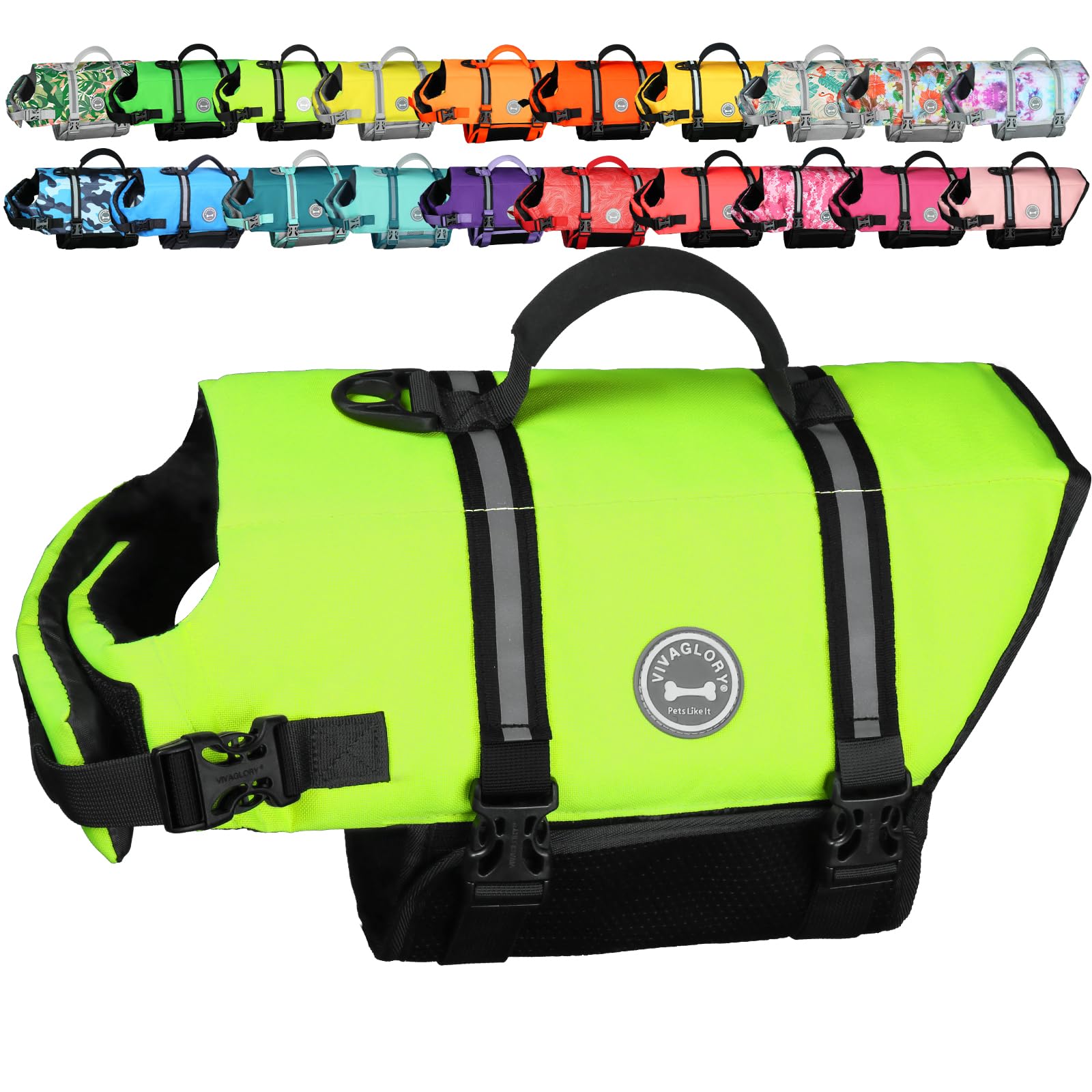
VIVAGLORY Ripstop Vest

VIVAGLORY Ripstop Vest

Everyday swimming

Our Score 9.4/10
Check Price

Worth Noting

  • Sizing runs tight near the top of a range
  • Hook-and-loop neck flap shifts on narrow heads
Sizes
6, XXS to XL
Closure
Hook-and-loop with buckles
Hardware
Top handle and D-ring
Ribcage Girth (M)
21-25 inch
Read the full review

If your dog swims a handful of times a summer — a week at the lake, a few afternoons on a boat — this is the vest we point to first. It is one of the least expensive jackets here and it does the core job without drama: a padded float under the neck, foam down the sides, a top handle that takes a wet dog's weight, and a D-ring for a leash.

The details hold up. Reflective trim runs along both sides, so a yellow shape is still findable at dusk, and the handle sits high enough to grab without hunting for it. The ripstop shell sheds sand and dries on a rail between swims. Where it gives ground to the Ruffwear is at the neck: a hook-and-loop flap and a buckle rather than a shaped collar, so on a narrow-headed dog you are relying on strap tension to keep the vest from shifting — and that is the compromise that comes with the price.

Sizing is the one place to slow down. The chart is measured by ribcage girth, not by the dog's usual apparel size, and the vest is unforgiving at the top of a band. The medium covers 21 to 25 inches, which is not the same medium as the Outward Hound's 21 to 27. Measure the widest part of the chest behind the front legs, and go up a size when your dog lands near the top.

Bottom line: We rate this the value pick: dependable flotation, reflective trim, a real handle, and a leash ring, provided you measure the ribcage and size up near the top of a band.

3

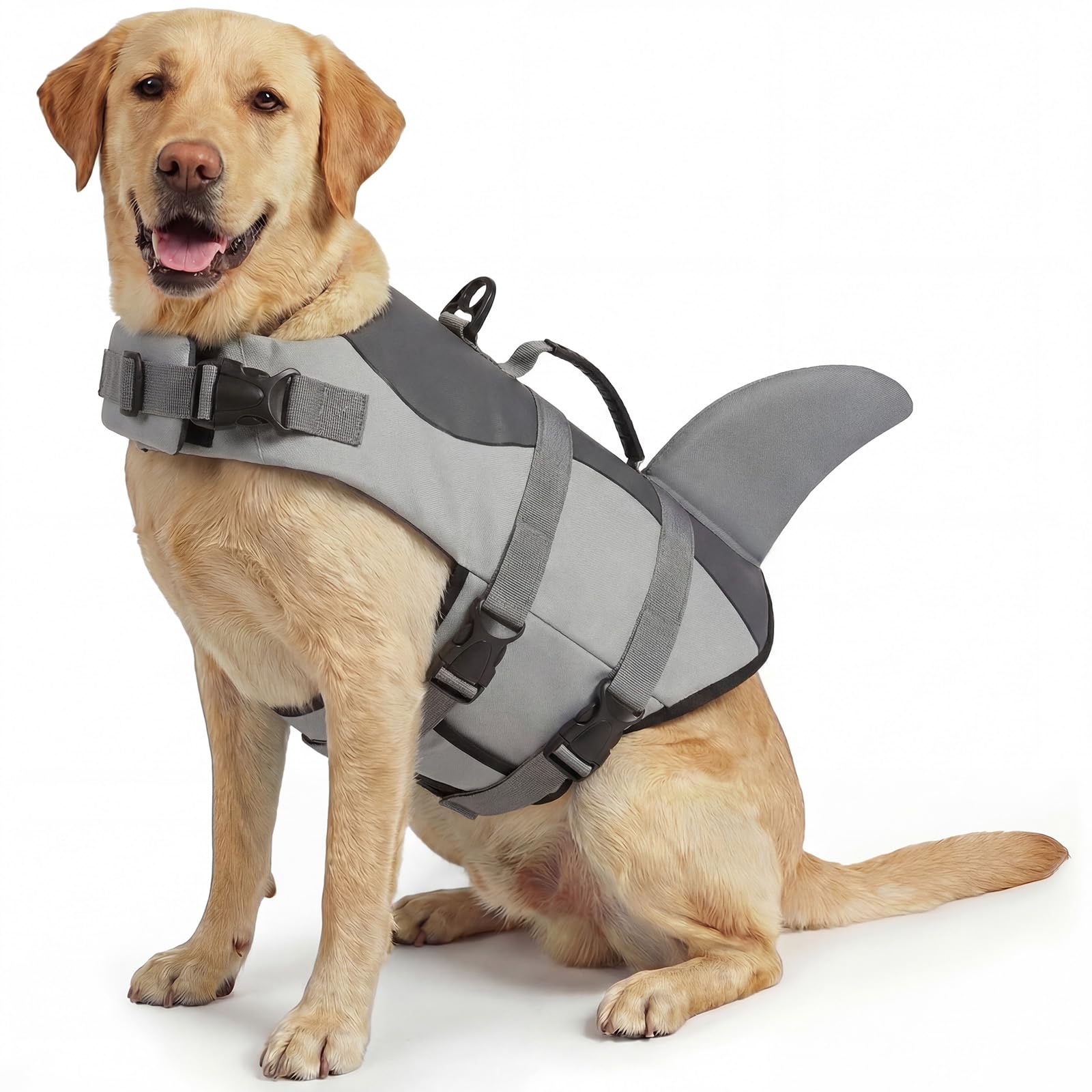
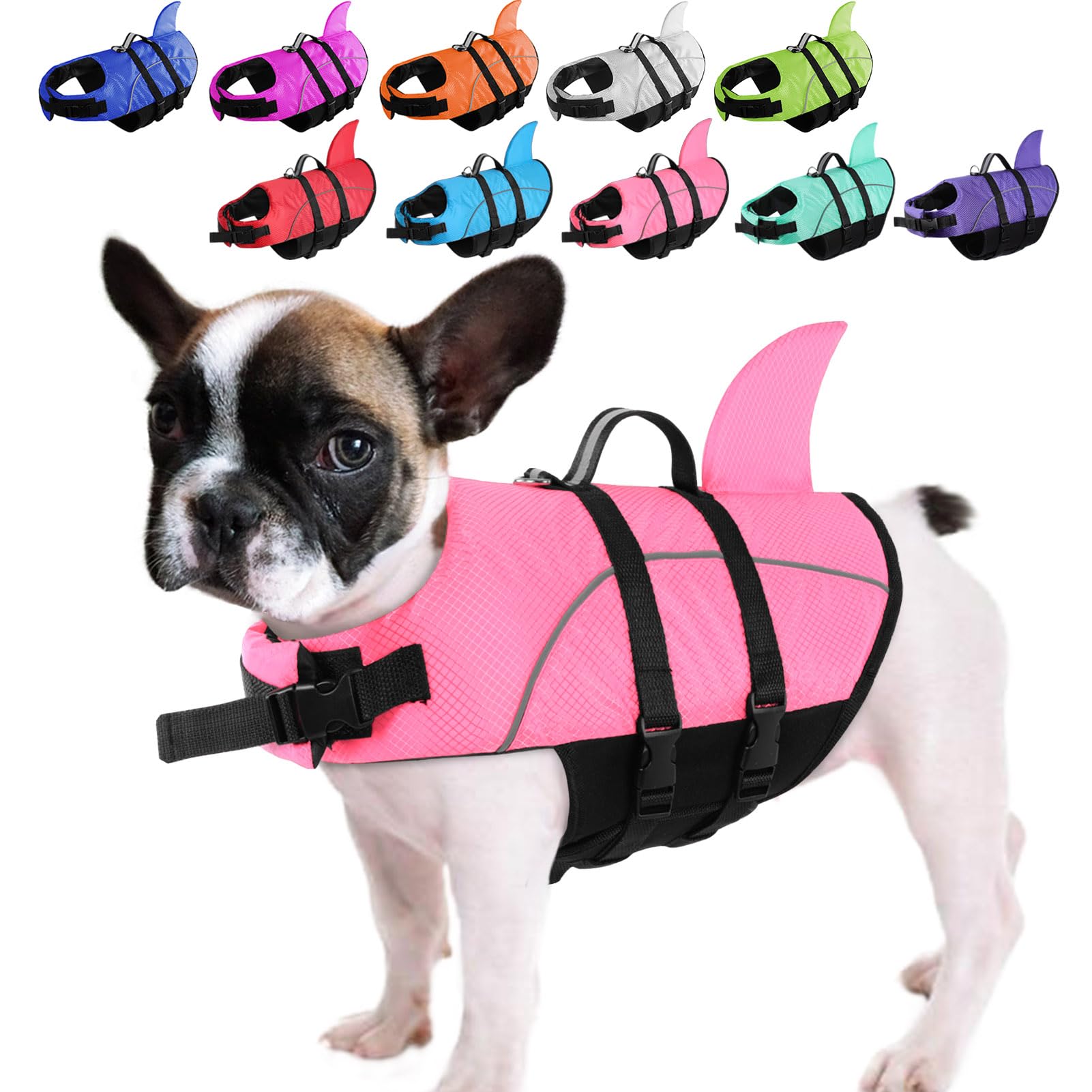
Queenmore Shark Vest

Queenmore Shark Vest

Puppies and toy breeds

Our Score 9.4/10
Check Price

Worth Noting

  • Narrow metric size bands
  • Light shell; buckles and handle wear first
Neck
34 centimeters
Chest
52 centimeters
Shell
Ripstop Oxford with neoprene
Minimum Weight
5 lb
Read the full review

A standing shark fin on a five-pound puppy is not a serious design feature, and we are not going to pretend otherwise. What did surprise us is how much of the rest of the vest is built for the size of dog it is sold to: a low foam profile that doesn't swamp a small chest, straps narrow enough to adjust without bunching, and a handle small enough to actually grip.

The neck opening is cut high and round, which stops a small dog sliding forward out of the vest when it paddles, and the reflective strip on the handle is the detail we appreciate most — a dark toy breed at dusk is invisible, and one with a bright fin and reflective trim is not. The chest is listed at 52 centimeters with a 5-pound minimum, which puts this in puppy territory rather than small-adult territory.

Sizing takes care. The bands are narrow and the chart is metric, so a dog measuring at a boundary needs the larger vest, and the foam sits best on a short-backed dog rather than a long one. The buckles and handle are stitched into a light shell, so inspect them before each swim — that hardware is where wear shows first. Neither point stops this being our pick for little dogs; it just means buying carefully and checking often.

Bottom line: For puppies and toy breeds, this is the one we reach for: a high, round neck opening that keeps a little dog in, foam that doesn't swamp the chest, and a handle sized for one hand.

4

ASENKU Shark Vest

ASENKU Shark Vest

Heavy dogs

Our Score 9.2/10
Check Price

Worth Noting

  • Strong hook-and-loop can pull at the shell
  • Strap ends dangle after tightening
Chest
29.53 inches
Shell
Waterproof polyester Oxford
Sizes
6, XS to 2XL
Minimum Weight
44 lb
Read the full review

ASENKU sells this as a flotation vest that doubles as a winter coat, which is the kind of claim we usually ignore. The waterproof Oxford does shed water and wind, and the foam holds some warmth, but a wet dog shivering on a dock is better served by a towel and an actual coat.

As a life jacket it is a solid shark-fin option for bigger dogs. The under-chin float is the useful part — it lifts the head rather than just the back — and foam runs through the front, sides, and back, so a heavy dog sits level instead of rolling. The XL is listed with a 29.53-inch chest and the line runs to 2XL, which gives more room at the top end than most vests here.

The fastening is what holds it back. The hook-and-loop is strong enough that peeling the vest off can pull at the shell, and the strap ends hang loose once tightened, which is worth trimming or tucking on a boat. It also sits above the other shark vests on price. Buy it for the look and the head support; take the Kuoser when the budget matters more.

Bottom line: We like this one for the shark fin and the run up to 2XL, and the under-chin float gives a heavy dog real head support; accept fussy hook-and-loop and loose strap ends.

5

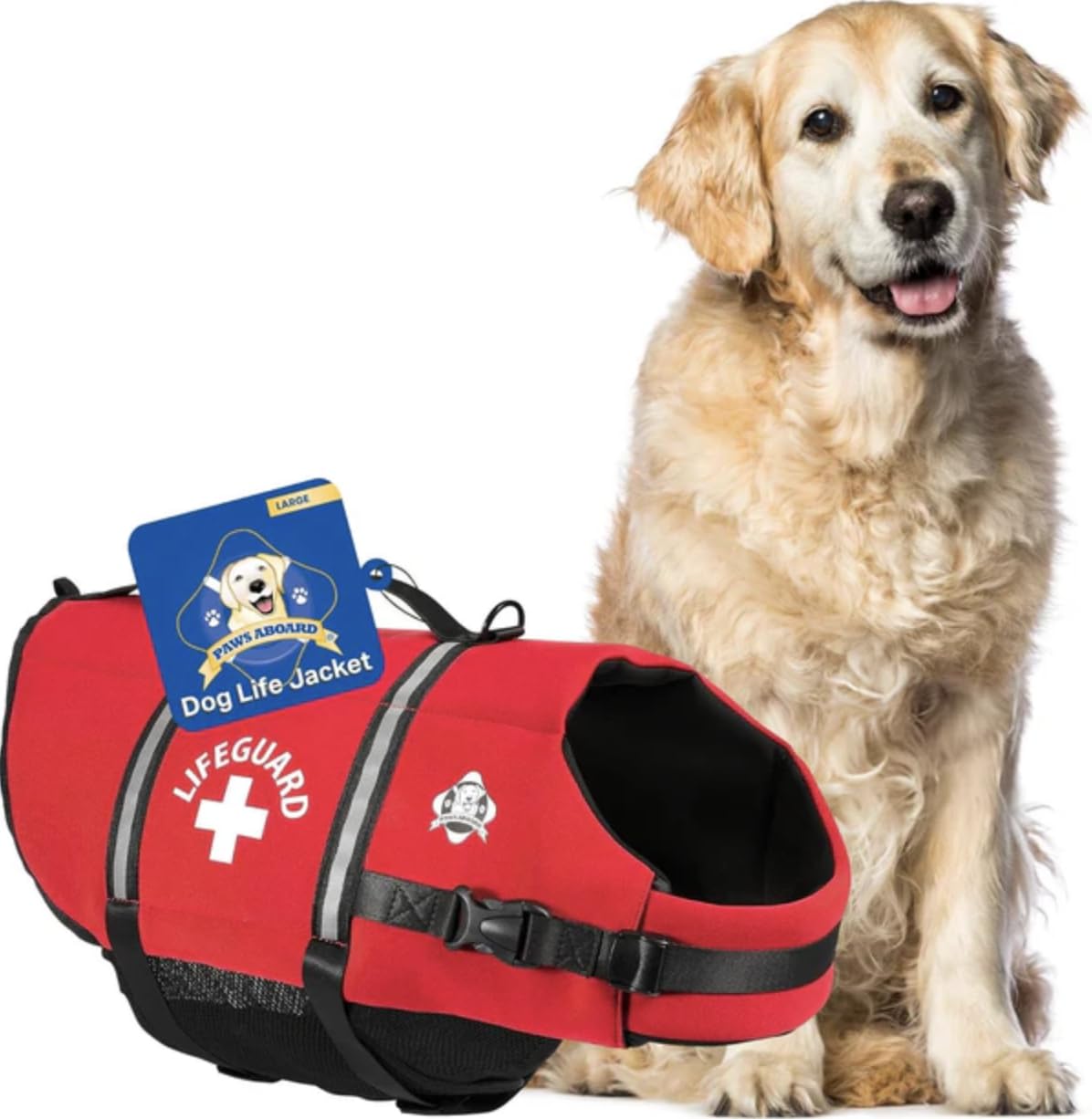
Paws Aboard Neoprene Vest

Paws Aboard Neoprene Vest

Boats and docks

Our Score 9.0/10
Check Price

Worth Noting

  • Sized on a weight band, not chest girth
  • Handle and seams can fail after a hard season
Care
Machine wash
Chest
38 inches
Shell
Neoprene and nylon
Size (weight)
Large: 50-80 lb
Read the full review

Under the jaw, Paws Aboard molds a float that lifts the head as a dog tires — which matters most for seniors, short-muzzled breeds, and any dog that swims nose-down. Most vests here put their foam across the back and sides; this is the most deliberate front float in the group.

The rest is wetsuit material — neoprene over a mesh underside, with nylon straps and buckles. We like that combination for boats: neoprene insulates a little when it is wet, the mesh drains instead of pooling, and the whole vest goes in the washing machine at the end of the season, which the ripstop jackets here will not tolerate. The handle sits near the dog's center of mass with a D-ring tucked beneath it, so a lopsided lift is harder to manage by accident.

The catch is the sizing. The Large is sold on weight, 50 to 80 pounds, and the cut suits a broad, deep-chested dog far better than a narrow one; the listed 38-inch chest leaves a slim Labrador with room to spare. Measure before ordering and treat the weight band as a rough guide. Give the handle and the seams a look before each trip, too — they are the parts that wear first on a vest that lives outdoors.

Bottom line: The jacket we take on boat days: a chin float that holds a tired dog's head up, wetsuit-grade neoprene, and machine washing, as long as you size by chest rather than weight.

6

Kuoser Reflective Vest

Kuoser Reflective Vest

Big, broad dogs

Our Score 9.0/10
Check Price

Worth Noting

  • Hook-and-loop grip fades with pool water
  • Buckles and straps can fail under load
Foam
High-density pearl cotton
Shell
Oxford and nylon
Minimum Weight
44 lb
Chest Girth (XL)
25.9-33.4 in
Read the full review

25.9 to 33.4 inches of chest girth is a lot of dog, and that range is why the Kuoser earns a place: the XL is the least expensive way here to fit a broad-chested animal. A Pyrenees or a chunky Labrador is not squeezing into a medium-sized budget vest, and this one is cut to go around them without the price climbing with the size.

The build is what you want at this end of the market, done sensibly. Ripstop Oxford over dense foam, double quick-release buckles with hook-and-loop underneath, a reflective band across the back, and a grab handle that will take a large dog's weight. The belly strap is long enough to actually close on a barrel chest, which is more than we can say for some XL vests here.

Two things to know. The hook-and-loop loses grip after a season or two of pool water, and buckles and straps can fail, so check both before a trip and retire the vest when the closure stops holding. The chart also reads slightly large on some dogs, so measure the chest rather than choosing the size your dog wears in a coat. For a big dog that swims occasionally, neither is a dealbreaker at this price.

Bottom line: For a big dog on a budget we point to this Kuoser: a chest range up to 33.4 inches, dense foam, and a handle that takes the weight, with closures worth checking before every trip.

7

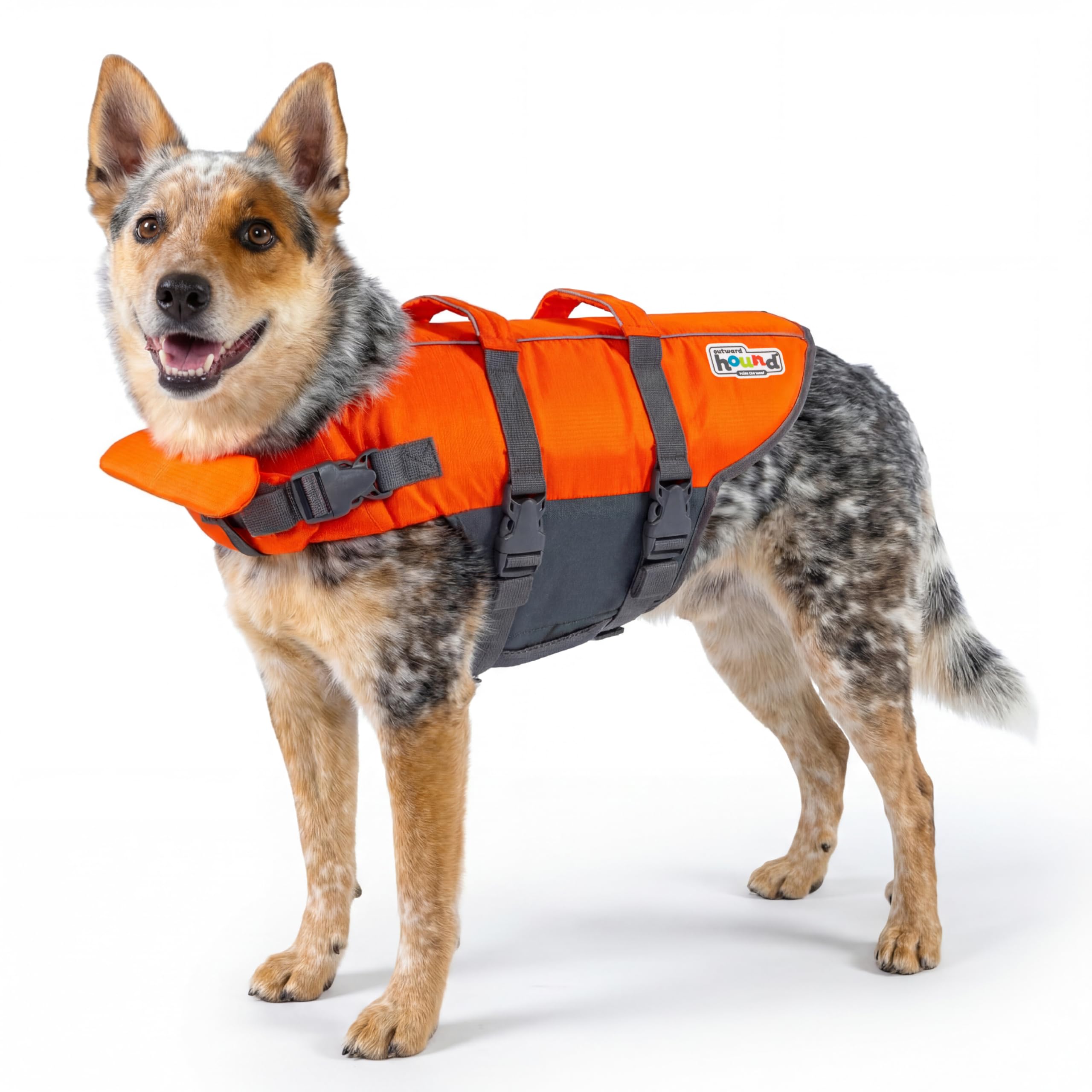
Outward Hound Granby

Outward Hound Granby

First vest

Our Score 8.8/10
Check Price

Worth Noting

  • Runs small against its own chart
  • Thin shell frays and stitching opens
Care
Hand wash
Shell
Ripstop polyester with PU foam
Hardware
Top handle, quick-release buckles
Chest Girth (M)
21-27 in
Read the full review

The Granby is the vest most people picture when they think of a dog life jacket — orange, foam-padded, with a panel that sits under the chin. It is also one of the least expensive jackets here, which makes it the usual first buy.

A front float cut to sit under the neck and chest, rather than across the shoulders, gives a nose-first paddler lift where it needs it, and the top handle is big enough to grab with wet hands. Reflective piping down the sides and a bright orange shell make the dog easy to spot against dark water.

Fit runs small. The medium is listed at 21 to 27 inches of girth, and dogs that measure near the top of that band end up in the next size up; measure the ribcage rather than ordering the size your dog wears in a coat. The shell is also the thinnest of the ripstop jackets here, and the fabric and stitching are what retire first.

What you are buying is a cheap, visible, genuinely buoyant vest that you can replace without wincing, and for a growing puppy or a dog that swims a few times a season, we think that is a fair trade. Just don't hand it down to a second dog the way you would the Ruffwear or the Paws Aboard.

Bottom line: We recommend it as a first jacket or a spare: bright, easy to spot, with a useful front float, provided you size up and accept a shorter life for the shell.

How We Tested Dog Life Jackets

We started with a couple dozen jackets that kept turning up on docks, in breed-specific forums, and in reviews from people who actually boat with their dogs. Then we cut anything with a size chart that topped out around 80 pounds, a single belly strap, a handle that felt like it would tear free, or a price that made no sense for what was essentially foam and webbing. That left 12, spanning harness-style and vest-style designs.

Each dog wore its jacket dry first, so we could time how long it took to put on alone — one hand holding a wiggly dog, the other working the straps — and see how much slack was left after adjustment. Then came water. We tossed a toy and watched each dog paddle 20 to 30 feet, noting whether the chin stayed clear, the body rode level rather than nose-down, and the jacket crept forward or twisted. We lifted every dog out by the handle, first with two hands and then with one, and did a hard shake test on the deck to see whether the whole thing shifted. After 20 minutes of swimming we checked the skin under the front legs and armpits for rubbing.

Back on land, we hosed the jackets off, dried them in the sun, and kept using them across the summer — pressing sand and wet dog hair into the hook-and-loop to see whether it still grabbed, tugging the stitching at the handle and D-ring, and watching for fraying straps or foam that flattened out. That last part is where the cheaper jackets separated themselves: a few closures gave up by August, and several ran so small that we sized up twice for the same dog.

How to Choose Dog Life Jackets

Measure the ribcage, not the back

Girth is the number that matters: run a tape around the widest part of the chest, just behind the front legs, and write it down. Then ignore the size name, because a medium is not the same medium twice — the VIVAGLORY's medium covers 21 to 25 inches, while the Outward Hound's covers 21 to 27. If your dog measures within an inch of the top of a band, take the next size up: a vest that closes with the straps cinched all the way is already at its limit. Weight is a rough sanity check, not a measurement.

What foam placement does in the water

A dog swims with its chest low and its head up, so where the foam sits changes how the vest behaves. Side and back panels support the body; a front or chin float lifts the head, which is what tired, older, and flat-faced dogs need most. The Paws Aboard's raised chin collar and the ASENKU's under-chin panel are built around exactly that, while the Ruffwear spreads layered foam to support the whole swim position. A vest with all its bulk behind the shoulders tends to push the nose down — the opposite of what you want when a dog is already working hard.

Handles, D-rings, and getting a wet dog aboard

Every jacket here has a grab handle; what separates them is where it sits and how it is anchored. A handle over the dog's center of mass lets you lift straight up, while one at the back edge tips the vest and the dog with it. Use the D-ring for a leash on deck or on a paddleboard, never as a tie-out, and treat the handle as an emergency lift rather than a way to carry a dog any distance. Check the stitching at both points before each season.

Fastenings that hold in water

Hook-and-loop plus buckles is the standard fastening, and the buckles are what keep the vest on once the fabric strip loads up with sand and hair. Strap ends that hang loose catch on cleats and kennel doors, so look for keepers or trim them short. Tighten the belly strap until the vest cannot rotate on the dog, then check the neck: snug, not pinched, with room to slide a flat hand under the chest panel. Re-check the whole fit after a minute in the water, when wet foam settles and everything loosens a little.

How much jacket you actually need

Two lake weekends a year and a weekly boat afternoon pull in different directions. Occasional use is served well by the budget ripstop vests, where the shell and stitching are the parts that wear out first. A dog that swims weekly, or one shaped so awkwardly that nothing stays put, justifies the premium jackets with shaped collars, denser shells, and neoprene that can go in the machine. The middle of the range buys cuteness and head support more than longevity — a fine reason to buy if the dog is small and the photos matter.

Frequently Asked Questions

Final Verdict

If your dog is in the water often, buy the Ruffwear Float Coat. The telescoping neck closure handles shapes that defeat a standard strap, the layered foam keeps a dog level, and the handle sits where your hand wants it. It costs several times what the value pick does, and that is the honest case against it.

For a dog that swims a few times a summer, the VIVAGLORY Ripstop does the job for a fraction of the money — measure the ribcage and size up near the top of a band. For a broad-chested dog over 44 pounds, start with the Kuoser XL and check the closures each season.