Apparel & Accessories

Best Dog Paw Protectors of 2026

Every summer, I watch dogs do the hot-pavement shuffle—lifting one paw, then another, trying to find a cool spot. Winter brings its own hazards: rock salt that stings, ice that cracks paw pads. A good paw protector is a barrier and a balm in one, shielding pads from heat, cold, and chemicals while softening the skin so cracks don't stand a chance.

We tested 14 paw protectors over three months, from waxes and balms to adhesive pads, on daily walks and weekend hikes. The best ones went on without a fight, lasted a full walk, and left pads visibly softer—without a greasy trail or lingering smell. A tip: apply before you head out, not after, and always test on a small patch first. Below, you'll find the ones that earned a spot by the door.

1

Finn Paw Hero

Top Pick
Finn Paw Hero

Hot pavement

Our Score 9.4/10
Check Price

Worth Noting

  • Tin application leaves balm on your fingers
  • Smaller tin than the tubs here
Size
1.75 oz
Format
Balm in recyclable tin
Ingredients
Seven plant-based ingredients
Read the full review

Hot pavement is what sends most people shopping, and Finn's tin is built most squarely around it: it is labeled for scorching sidewalks, sand, and sun-baked surfaces, and that is the job it does best. The formula is seven plant-based ingredients — olive and avocado oil, chamomile, beeswax, aloe, vitamin E, and sarsaparilla — with no artificial fragrance, parabens, or dyes. A short list matters more here than in most products, because whatever goes on a paw ends up in a dog's mouth sooner or later.

It glides on and absorbs quickly, so you are not leaving greasy paw prints across the kitchen while you find the leash. There is a real botanical scent, herbal rather than perfumed, which we like and which is worth flagging if your dog reacts to strong smells. The tin is small enough to live in a walking bag, and 1.75 ounces covers a summer of regular walks for a medium dog.

The trade-offs are format and size. A tin means fingers, so apply it before you are dressed for the walk rather than at the door with a leash in one hand. At 1.75 ounces it is also smaller than a couple of the tubs here, so heavy daily use on a big dog will empty it faster than you might expect.

Bottom line: For summer walks on asphalt, sand, or a hot boardwalk, this is the balm we reach for, and the short ingredient list suits dogs that lick.
2

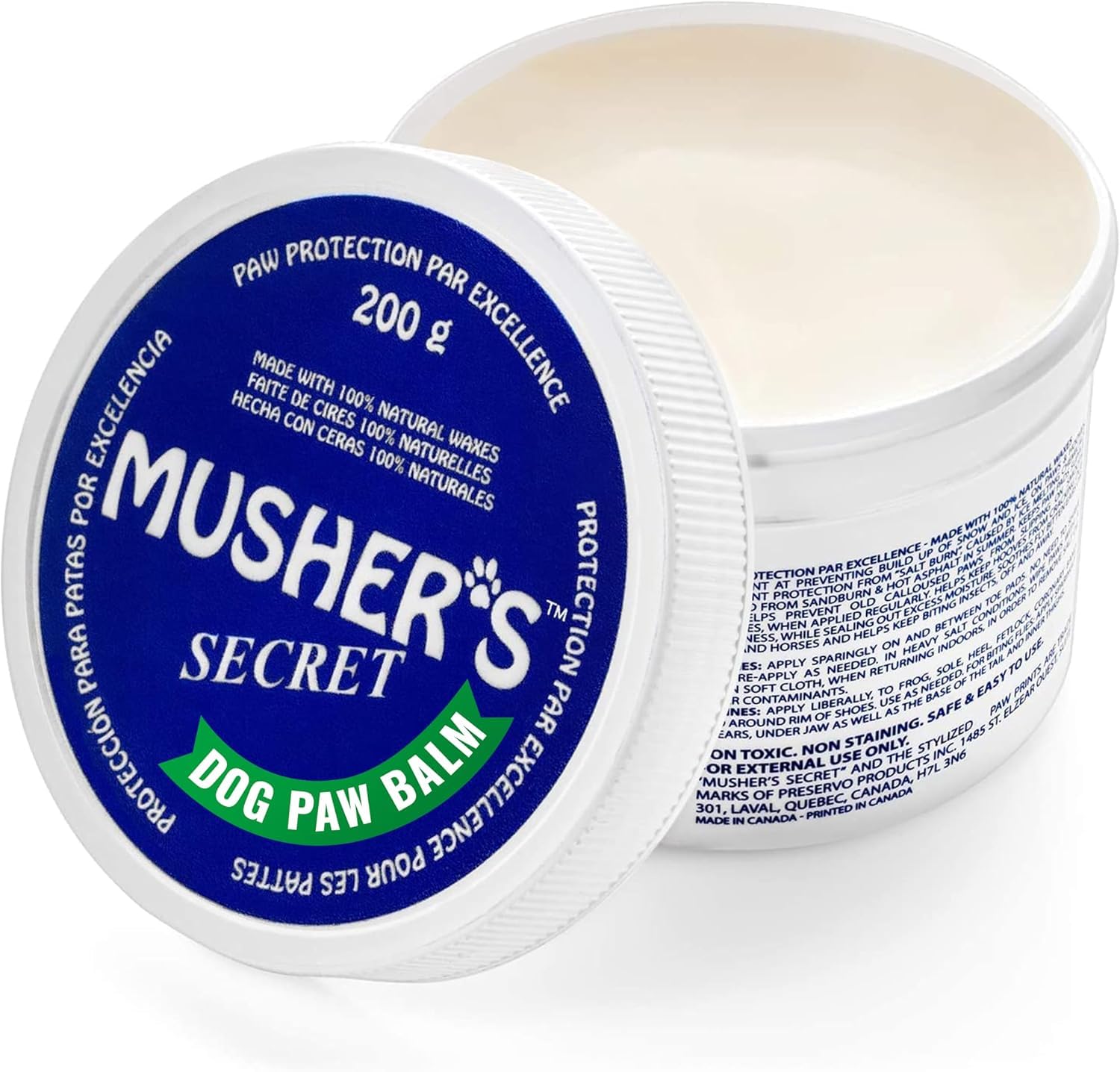
Musher's Secret Paw Wax

Musher's Secret Paw Wax

All-season protection

Our Score 9.2/10
Check Price

Worth Noting

  • Wears off on long or wet walks
  • Leaves hard floors slick right after application
Size
200 g (7 oz)
Format
Wax balm in tub
Recommended Use
Snow, ice, indoor and outdoor
Read the full review

A 200-gram tub is a serious amount of paw wax. With one dog and a few applications a week, it will carry you through multiple winters, and that changes how we think about it: not a seasonal add-on but a staple that lives by the door. It is a wax rather than a cream, so a thin layer goes a long way and you are never scraping the bottom of a tin in February.

We make it our top pick because it is the rare product here that covers both ends of the year. The maker lists snow, ice, and indoor as well as outdoor protection, and in practice it does two jobs well: it lays a wax barrier between the pad and salted pavement or sun-baked asphalt, and regular use softens pads that have gone rough. The dogs that stop mid-walk to chew ice balls out of their toes are the ones this earns its keep for.

Two practical notes. It wears through on long or wet walks, so plan on reapplying rather than treating one coat as a full day of protection. And it sits on the surface, which means a determined licker can take it off before it does much — give it a minute to set and offer a treat as distraction, and most of that disappears. The floor directly after application will be a little slick, too.

In cold weather, warm the tub in your hand for a moment before you open it; cold wax firms up and drags across the pad instead of spreading. The screw-on lid seals properly, which matters if the tub ends up living in a car, a barn, or a hiking bag.

Bottom line: This is the one we hand people who want a single wax for salted sidewalks and hot asphalt, as long as they will reapply after wet walks.

3

Natural Dog Company PawTection

Natural Dog Company PawTection

Pre-walk barrier

Our Score 9.2/10
Check Price

Worth Noting

  • A barrier only, not a treatment for cracked pads
  • Small stick for a daily winter habit
Size
2 oz
Format
Twist-up wax stick
Set Time Before Walks
10–15 minutes
Read the full review

The label tells you to apply it ten to fifteen minutes before a walk, and that single instruction decides whether this stick earns its place. Read it as a routine: balm the paws, then pull on your own boots and coat, and the timing sorts itself out. Skip it and you are sending a dog out in a wax layer that has not settled.

The format is what we appreciate most. It is a twist-up stick of firmer wax — sunflower, carnauba, and candelilla — so you roll it directly onto the pads with no fingers in a tin and no balm under your nails. Dogs that fidget through a cream application tend to tolerate this better, because it takes seconds per paw and there is nothing to smear.

We treat it as the pre-walk half of a two-product routine rather than a standalone cure. It is a barrier: it coats the outside of the pad and helps against snow, ice, and road salt, but it is not the thing to reach for when the pads are already cracked and rough, because a moisturizing balm does that job. If you walk salted streets every day in January, the stick keeps the salt off and the balm repairs the damage afterwards.

Two things to know before you buy. It is a small stick, and daily winter use on a big dog works through it faster than a tub of wax would. And the convenience is much of what you are paying for — the wax itself is not exotic.

Bottom line: Keep this stick by the door for winter walks: it is a barrier rather than a repair job, and it wants ten to fifteen minutes to set before you head out.

4

Palmer's for Pets Paw & Nose Balm

Palmer's for Pets Paw & Nose Balm

Sensitive skin

Our Score 9.2/10
Check Price

Worth Noting

  • Leaves marks on floors for some dogs
  • A moisturizer, not a salt-and-ice barrier
Use
Paws and noses
Size
3.5 oz
Format
Balm in tub
Fragrance
None added
Read the full review

Palmer's is the outlier here: a cocoa butter balm from a skin-care brand you have probably seen in a drugstore, sold for dog paws and noses, and priced well below everything else on this list for a 3.5-ounce tub. That combination makes it the one we suggest to people who are not sure their dog needs a dedicated paw product at all.

The fragrance-free formula is why it earns a spot rather than just a price tag. Dogs groom their paws constantly, and a scented balm sits inches from a very good nose; going without added fragrance is a real kindness to a dog with sensitive skin, and it is the first thing we look for in this category. Cocoa butter and vitamin E do the softening, and it is made without parabens, phthalates, or gluten.

It is a moisturizer more than a road treatment. On dry, rough pads and a cracked nose it does what you want within a few days of regular use; on a salted sidewalk in February it will not give you the wax barrier a dedicated protector does. Greasiness is the other split — some tubs absorb cleanly, and some dogs leave marks on the floor for a few minutes afterwards. A minute of distraction handles most of it.

The texture is thick and creamy, closer to a body butter than a wax, so warm a little between your fingers before working it into the pad. It also goes further than you expect: a small dab covers a whole paw and a nose, which is why a tub this size lasts.

Bottom line: If your dog has sensitive skin or a crusty nose and you want to spend very little, this fragrance-free cocoa butter balm is the sensible first buy.

5

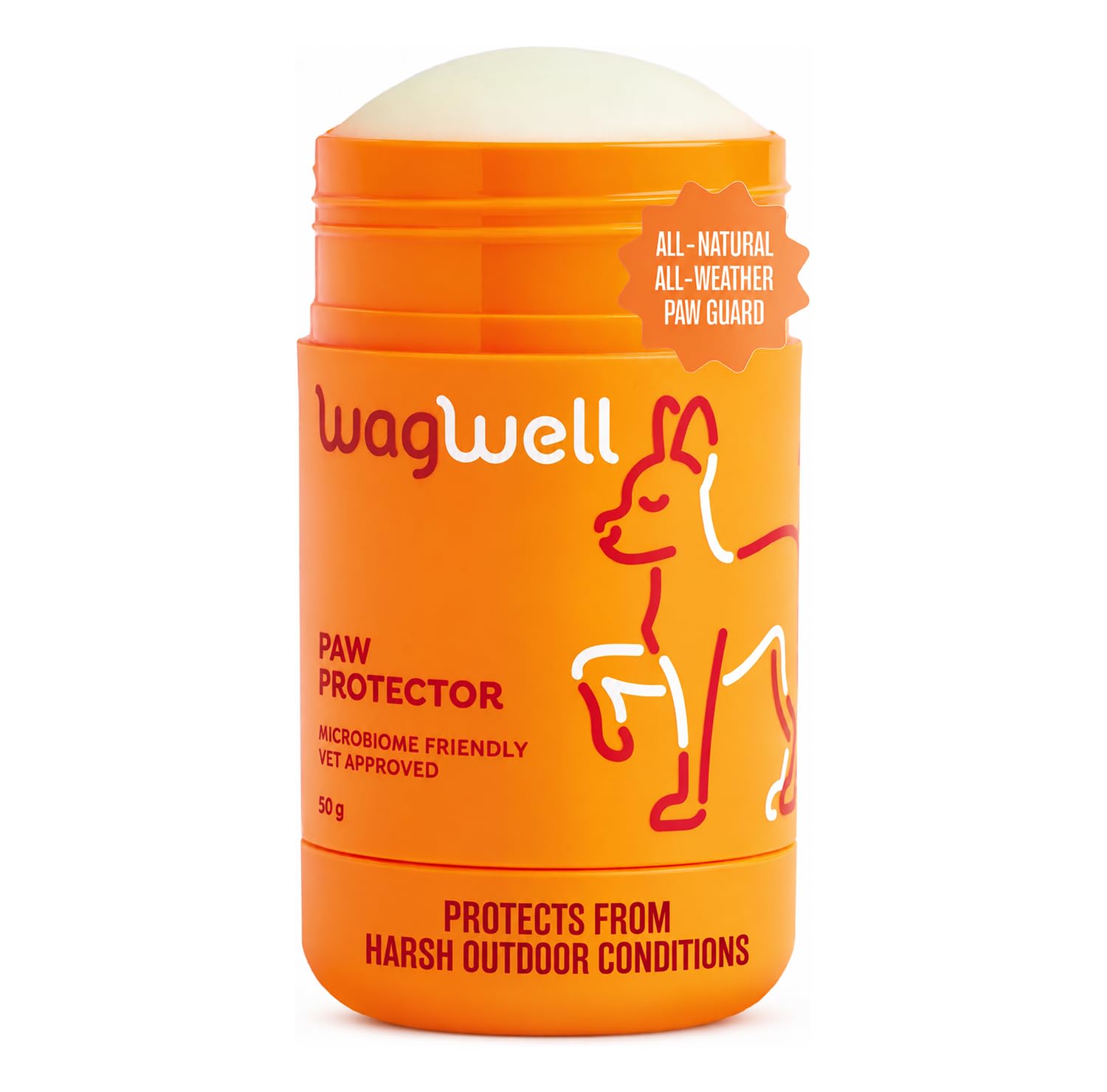
WagWell Paw Protector

WagWell Paw Protector

Mess-free daily use

Our Score 9.2/10
Check Price

Worth Noting

  • A thin swipe rather than a deep treatment
Use
Paws, noses, elbows, ears
Size
1.76 oz
Format
Twist-up stick
Read the full review

A twist-up stick is a small thing that changes how often you use a product. There is no lid to hold, no balm under a fingernail, and no wrestling a tin open with one hand while the other holds a collar — you twist the base, swipe the pad, and you are finished.

WagWell's version is 50 grams and works on noses, elbows, and ears as well as pads, which makes it the one here that is genuinely useful beyond the feet. The finish is light and low-scent, and it does not leave the greasy film that sends a dog sliding across the kitchen floor — the sort of detail that matters most in a small apartment or on a house full of rugs.

The formula is positioned for hot pavement, sand, snow, ice, and salted sidewalks, with a clean, lick-safe ingredient list. It is a generalist rather than a specialist: it conditions and it protects without laying down the thick wax layer a dedicated winter product does.

We like it best as the everyday stick — the one that lives in a bag or by the door and handles a nose and a paw without buying a second product. The swipe is quick and even, which is exactly what you want when the dog is already halfway out the door. Keep it somewhere visible, because speed is the whole advantage.

Bottom line: The tidy option: a twist-up stick that goes on without touching the balm, ideal for a dog that will not sit still for a tub.

6

Natural Dog Company Paw Soother

Natural Dog Company Paw Soother

Cracked pads

Our Score 9.0/10
Check Price

Worth Noting

  • Leaves greasy marks on fabric and pale fur
  • Appealing enough that some dogs lick it straight off
Size
2 oz
Format
Retractable stick
Key Ingredients
Coconut oil, cocoa butter, jojoba
Read the full review

Paw Soother is a repair job, not a shield, and that is the distinction that settles it for us. The pads that need this are the ones that feel like sandpaper, crack at the edges, or have gone hard over a summer of pavement. The stick carries coconut oil, cocoa butter, jojoba, chamomile, calendula, and vitamin E, and it is meant to be worked in after the walk rather than before it.

The retractable stick is a genuine convenience — no tin, no fingers, and you can hit four paws in under a minute at bedtime. It is also softer than the barrier waxes here, so it goes on thick and stays visible for a while, which is either reassuring or a sign you have used too much.

Two caveats are worth knowing. It can leave greasy marks on fabric and pale fur, so apply it where the dog sleeps rather than on the good sofa and give it a few minutes before anyone gets up. And it is appealing enough that some dogs go straight for their paws and lick it off; a few have had upset stomachs after eating a lot of it, so if yours is a determined groomer, put a sock on afterwards or apply it right at lights out.

Where it fits: dogs with genuinely damaged pads, and owners who want an overnight treatment rather than a walk-time barrier. If the pads are healthy and the problem is only the ground, a wax is the better buy.

Bottom line: If your dog's pads are already cracked and crusty rather than just exposed, this stick is a treatment, and it works best applied at bedtime.

7

Vets Preferred Paw Balm

Vets Preferred Paw Balm

Dry, calloused pads

Our Score 8.8/10
Check Price

Worth Noting

  • Strong patchouli scent divides dogs and people
  • Firm balm needs warming before it spreads
Size
2 oz
Format
Balm jar
Made In
USA, GMP facility
Read the full review

The patchouli reaches you before the lid is fully off. It is the most divisive thing about this balm, and we think it is worth saying plainly: some people love it, and a fair number of dogs want nothing to do with a paw that smells that strongly. If your dog is fussy about handling, weigh that first.

Underneath the scent is a solid formula. Beeswax and shea butter give it a barrier layer for hot pavement, ice, and rough ground, while coconut oil and vitamin E do the moisturizing, so one jar covers prevention and repair. It is a 2-ounce jar, made in the USA under GMP standards, and it has a long-running following among people who own large, heavy-pawed dogs.

We rate it a good all-rounder for dry, calloused pads and a slightly awkward one for daily walk-time protection, mostly because of texture. The balm is thick and firm in a cool room, so you are warming a dab between your fingers before it will spread, and that is the difference between using it nightly and leaving it in a drawer. Dogs that tolerate handling get noticeably softer pads within about a week of nightly use.

Buy it if you want one jar for paws, elbows, and a dry nose and you do not mind a strong herbal scent. Skip it if your dog already backs away when the tub comes out.

Bottom line: A capable barrier-and-moisturizer in one jar, but smell it first: the patchouli is strong, and some dogs refuse a paw that scented.

8

DOK TigerToes Dog Socks

DOK TigerToes Dog Socks

Slick floors

Our Score 8.4/10
Check Price

Worth Noting

  • Fabric gives out before the tread does
  • Stiff enough that some dogs resist them
Care
Machine wash
Size
Large, 2.5–2.8 in paws
Type
Grip socks, 4-pack
Material
Cotton and nylon
Read the full review

Tread on both sides is the detail that makes these socks work. Anyone who has watched a dog walk the grip patch around to the top of the foot knows the failure mode: the sock twists, the tread faces the ceiling, and the dog is sliding again. With grip on both faces, a twisted sock still holds the floor.

They are aimed at senior dogs on hardwood, tile, and laminate, and that is where they make the most sense — a dog with weak hind legs gets traction and confidence on a floor it has started to avoid. The four-pack also gives you a physical barrier for a dog that licks at its paws, which no balm can match, because the point is to stop the tongue reaching the pad at all.

Sizing is where these succeed or fail. The large fits paws measuring 2.5 to 2.8 inches, and that number has to come from a dog standing with weight on the paw — measure a lifted paw and you will order small. Snug is normal here, since the tread makes them stiffer than a plain knit, and the buttonless strap avoids the sores a buckle can leave.

Durability is the weakest in this group, and it is the thing to accept going in: the grip holds up, but the fabric is what goes, and a dog wearing them all day will work through pairs faster than you would like. We still recommend them, because nothing else on this list solves slipping indoors. Buy them as a consumable rather than a one-time purchase, and keep a spare pair washed and ready.

Bottom line: For a senior dog sliding on hardwood these grip socks are the most useful thing on this page, provided you measure a standing paw and accept that the fabric wears.

How We Tested Dog Paw Protectors

We started by researching the paw protectors with the most consistent customer reviews, then narrowed the field to 14 products that varied in form—balms, waxes, and stick-on pads—and price. We ruled out anything with ingredients known to irritate skin, and we made sure to include options for different paw sizes and coat types. Over three months, we tested each one on our own dogs, from a 10-pound terrier to a 90-pound Labrador.

Testing happened where paws actually go: daily walks on hot asphalt, weekend hikes on rocky trails, and winter strolls through salted streets. For each product, I applied it to all four paws solo and timed how long it took, noting whether the balm spread evenly or clumped. I watched for signs of discomfort—licking, lip-smacking, or the dreaded paw-drag—and I checked whether the product stayed put through a mile-long walk or wore off after a block. To test removability, I wiped paws with a damp cloth afterward and counted how many passes it took to get clean.

To assess moisturizing and softness, I felt each dog's paw pads before and after a week of daily use, looking for cracks that healed and pads that felt supple. Effectiveness meant testing on hot pavement (I used an infrared thermometer to confirm surface temps above 120°F) and on salted sidewalks, checking whether the dog showed any sign of stinging or slipping. Quality came down to texture and ingredients—did it absorb or sit greasy? Odor was noted at application and after an hour, and I made sure to test each balm on small and large paws to see if the fit worked for different shapes. Every product got the same routine.

How to Choose Dog Paw Protectors

Barrier, moisturizer, or sock

A barrier product sits on the pad and takes the abuse: waxes and firmer balms go on before the walk and meet salt, ice, sand, and hot asphalt on the dog's behalf. A moisturizer works the other way round, going on after the walk to soften pads that have already gone hard, rough, or cracked. A sock does neither — it covers the foot so the pad never touches the problem at all.

Match the product to the state of the paws. Healthy pads facing bad ground want a barrier; sandpaper pads want a moisturizer for a week or two before you worry about protection; a dog slipping on hardwood or obsessively licking wants physical coverage, because no balm can stop a tongue or give traction.

Tubs, sticks, and twist-ups

Tubs give you the most product for the money and the finest control over how thick a layer goes on, but they need fingers and a dog that will hold still. Sticks and twist-ups trade some of that value for speed and clean hands, and for a lot of owners that trade is the difference between a product used daily and one that dries out in a drawer.

Be honest about your dog. If it snatches its paw away or tries to lick everything off immediately, buy the stick — a slightly more expensive format you actually use beats a bargain tub that stays capped. If your dog stands calmly and you are treating four paws every night, the tub wins on cost and coverage.

Heat, snow, and salt

The biggest mistake buyers make is expecting a balm to buy them a hot-afternoon walk. A wax layer helps with brief contact on warm pavement, but it does not make scorching asphalt safe: put the back of your hand on the ground for five seconds, and if you cannot hold it there, walk the dog on grass or wait until evening. No product on this page changes that.

Winter has its own trap, and it is the ice that balls up between the toes rather than the cold itself. A barrier wax helps there, and so does rinsing the pads when you get home — road salt stays on the paw and ends up in the dog's mouth during the post-walk groom. Dry the feet properly afterwards, because a wet pad plus a wax layer is a slippery combination on a hard floor.

Fit and wear for grip socks

Sizing decides whether socks work at all, and the measurement has to be taken with the dog standing and weight on the paw; a lifted paw measures smaller and will get you a sock that will not go on. Snug is normal, since the tread makes the fabric stiffer than a plain knit, but you should be able to slide a finger under the strap.

Treat socks as a consumable. The tread usually outlasts the fabric, so buy a set with spares, rotate pairs, and wash them cold. Check the paws weekly for rub marks, and take the socks off for a few hours a day so the feet can breathe.

Ingredients, scent, and dogs that lick

Whatever goes on a paw ends up in a mouth, so look for a formula described as lick-safe, food-grade, or plant-based rather than assuming any pet product is fine to ingest. Fragrance is the other thing to weigh: a strong scent sits right under a very good nose, and dogs with sensitive skin or a habit of chewing their feet generally do better with a fragrance-free balm.

Then accept the mechanics. A determined groomer can remove most balms within minutes, so apply at bedtime, distract with a chew, or put a sock on afterwards. A product that stays visible on the pad is not doing anything wrong — it is sitting where it needs to be.

Frequently Asked Questions

Final Verdict

A tub of Musher's Secret is what we tell most people to buy. It handles salted sidewalks in January and sun-baked asphalt in July, it softens pads that are already rough, and the 200-gram tub lasts long enough that you stop thinking about the cost. It is the one product here that covers the whole year without a second purchase.

Buy the PawTection stick instead if you want a clean-handed barrier sitting by the door for winter walks, or Finn's tin if summer pavement is your only problem. And if your dog is sliding across the kitchen floor rather than facing rough ground, skip the balms entirely — the TigerToes socks are the only thing here that solves that.