Travel & Carriers

Best Dog Stroller for Hiking of 2026

Three miles into a rocky trail, my 11-year-old shepherd mix lay down in the shade and declined to go any further. I carried her the last half mile back to the car, which is not a sustainable hiking strategy. A good hiking stroller gives an older, smaller, or recovering dog a seat on the long miles while you keep both hands on the handle and your normal pace. Over the past eight months, my team and I have pushed 11 of them up gravel fire roads, over roots, and through trailhead mud.

What separates a genuinely trail-ready stroller from one that just looks rugged is mostly the wheels and the frame: pneumatic tires and real suspension swallow the chatter that hard plastic wheels send straight into your dog's seat and your wrists. Then there's size — it has to fold into a trunk and lift over a fallen log solo, with a basket tall enough for your dog to stand up and turn around. We weighed all of that against price, and the picks below are the ones I'd take back out tomorrow.

1

EchoSmile Dog Stroller

Top Pick
EchoSmile Dog Stroller

All-round trail use

Our Score 9.6/10
Check Price

Worth Noting

  • 89-pound rating is generous for a 29-inch cabin
  • Shock absorption at the front only; solid rear wheels
Folded Size
18.9 x 13 x 24 inches
Front Wheel
7 inches, swivel
Rear Wheels
10 inches
Weight Capacity
89 lb
Read the full review

Gravel and roots are where a stroller earns its keep or doesn't. The EchoSmile carries the weight on 10-inch rear wheels, steers with a 7-inch swiveling front wheel, and damps the front fork, which is the combination that kept the cabin quiet when we pushed it over loose stone. It's the one we take onto a trail without first checking what the surface is like.

What settles it for us is how much dog it handles while still behaving like a trail stroller. The cabin measures 29 by 17 by 24 inches and the frame is rated to 89 pounds, so a 50- or 60-pound dog rides lying down with room to sit up and watch the world, and two small dogs share it without a fight. The 600D Oxford shell and reinforced carbon steel frame feel right for the job, and the front and rear doors mean a stiff or senior dog walks in rather than being lifted over a wall.

The fold is a genuine one-hander and lands at 18.9 by 13 by 24 inches, small enough to live in a car between trips. The one caveat is the cabin: an 89-pound rating is generous for 29 inches of length, so measure your dog nose to tail while lying down rather than trusting the number. A Labrador will ride in it; a giant breed won't do it comfortably.

Bottom line: Our pick for trail days: 10-inch rear wheels and a shock-absorbing front fork make rough ground ordinary, and the 89-pound cabin covers most dogs.
2

Canine Canyon All-Terrain

Canine Canyon All-Terrain

Large dogs

Our Score 9.6/10
Check Price

Worth Noting

  • Tires carry little tread for wet roots and mud
Cabin
33 x 18.5 x 21 inches
Rear Wheels
11 inches
Front Wheels
8 inches
Weight Capacity
130 lb
Read the full review

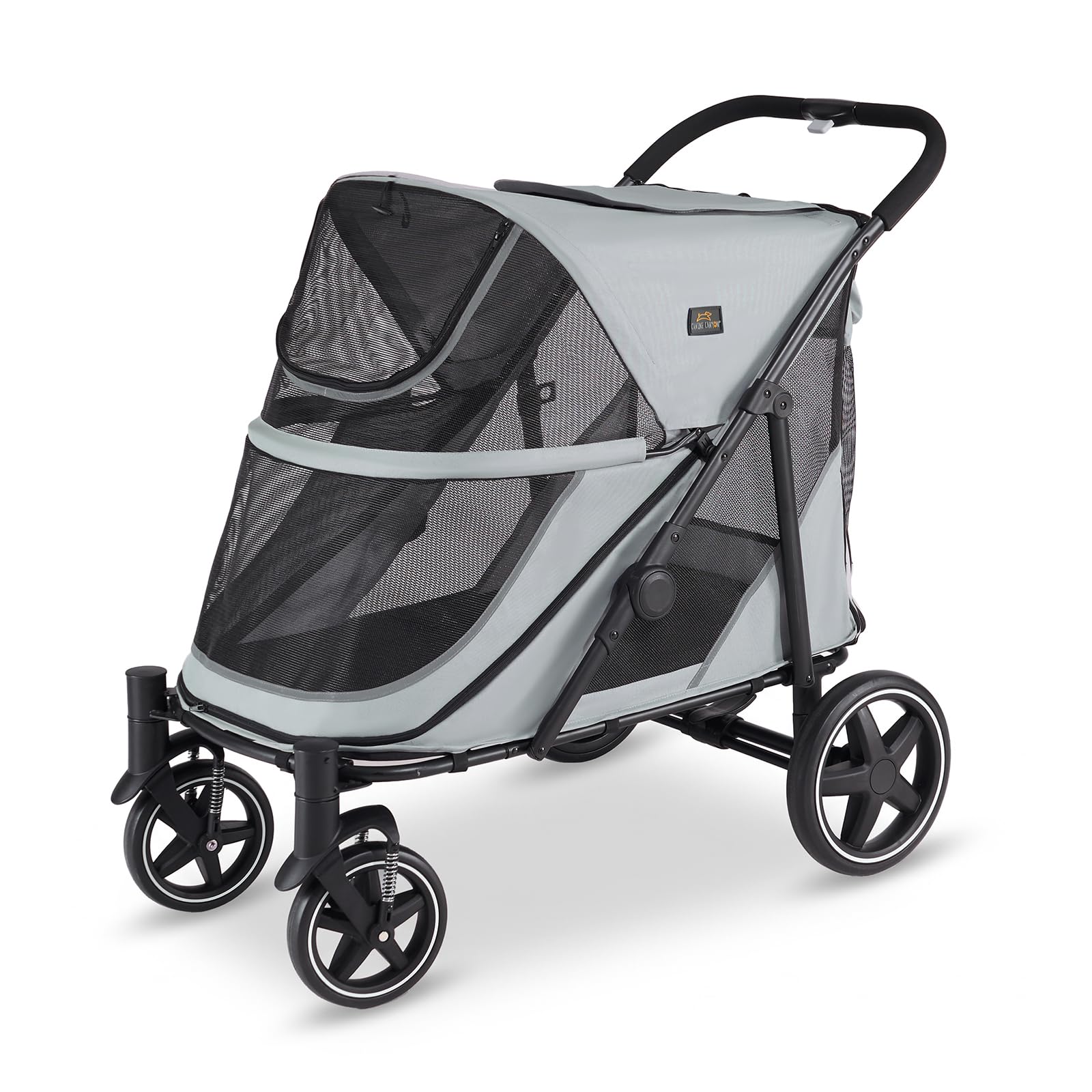
If your dog is a hundred pounds, most of this category simply isn't for you, which is why the All-Terrain earns its place: a 130-pound rating and a cabin of 33 by 18.5 by 21 inches, the roomiest here by a wide margin. We choose it for a large or giant dog, or for two dogs who have never once agreed to share a small space.

The rolling gear is a step behind the cabin. You get 11-inch rear wheels and 8-inch fronts with shock absorption, a one-foot brake, mesh on every side plus a sunroof, and a padded handle with two cup holders. On packed paths and park gravel it's steady and easy to push. The tires carry very little tread, though, and that's the honest boundary: wet roots, mud and loose climbs want more bite, and dry packed trail is where this one belongs.

Setup takes minutes, the fold is a one-button job, and the sunroof is the detail we appreciated most, because you can check on a dog without unzipping anything on a cold morning. For a big dog on dry, packed trails, this is the pick.

Bottom line: Choose this for a big dog: a 130-pound rating and a cabin 33 inches long, on 11-inch rear wheels that carry the weight.

3

Bicystar Dog Stroller

Bicystar Dog Stroller

Car-to-trail trips

Our Score 9.6/10
Check Price

Worth Noting

  • Carrier is 9.4 inches tall, so dogs ride lying down
  • About 27 pounds with the carrier attached
Wheels
10-inch rear, 7-inch front, rubber
Folded Size
34.6 x 23.6 x 10 inches
Weight Capacity
50 lb
Carrier Interior
26 x 14.2 x 9.4 inches
Read the full review

The moment that sells the Bicystar happens at the trailhead: the carrier unclips from the frame, you carry the dog the last stretch to the overlook, and the stroller stays with the car. That detachable 7.5-pound carrier is the whole idea, and it's executed well. It lifts out, clicks back in, and stays put once seated.

On the move, the rubber wheels do the work. There are 10-inch rears and 7-inch fronts with four anti-shock stabilizers, and the aluminum and steel frame stays composed over grass and packed gravel. It's the most polished stroller here in the hand, and folding is straightforward once the carrier comes off.

Where it lands for hiking is narrower than the marketing. The carrier interior is 26 by 14.2 by 9.4 inches, and that 9.4-inch height means a dog travels lying down rather than standing to watch. For a small or medium dog happy to curl up, that's fine, and the low sides make getting in easy. For a dog who wants to stand at the mesh for three miles, it's the wrong cabin however good the wheels are.

Two practical notes. It weighs roughly 27 pounds with the carrier in, so it's a two-hand lift into a tall trunk, and the 50-pound rating means one medium dog or two small ones. The cup holder is shallow enough to tip a bottle when you roll over a root, so keep the water in the basket underneath.

Bottom line: If your day starts in the car, the detachable carrier is the reason to buy: you lift 7.5 pounds of dog and leave the frame behind.

4

Kicari All-Terrain Stroller

Kicari All-Terrain Stroller

Small dogs

Our Score 9.4/10
Check Price

Worth Noting

  • 20-pound limit rules out medium dogs
  • 6- and 8-inch wheels are small for rough trails
Cabin
21.5 x 12.5 x 11 inches
Rear Wheels
8 inches
Front Wheels
6 inches
Weight Capacity
20 lb
Read the full review

Start with the number that decides whether the Kicari is for you: 20 pounds. This is a small-dog stroller with a cabin of 21.5 by 12.5 by 11 inches, and the small-to-medium wording on the listing is optimistic. For a 10- to 18-pound dog, though, it's the most thoughtfully equipped stroller here.

The suspension is what we keep coming back to. All four wheels are sprung and fitted with PU all-terrain tires, more suspension than anything else in this group, so rough asphalt and gravel arrive in the cabin as a hum rather than a rattle. The canopy is the other standout: waterproof 600D with eight positions and four stages of coverage, so a dog can ride with the front open and the sun still off its face.

The rest is sensible. It folds one-handed to 8.7 inches tall, the seat liner lifts out and goes in the machine while the canopy stays on the frame, and there's a basket under the seat plus a cup holder. At 17 pounds it's an easy one-person lift. The reservation is the wheel package: 8-inch rears and 6-inch fronts are small for real trail work, so this is a stroller for towpaths, packed gravel and park loops rather than rocky climbs.

Bottom line: Buy it for a dog under 20 pounds: four-wheel spring suspension and a four-stage waterproof canopy in a 17-pound package.

5

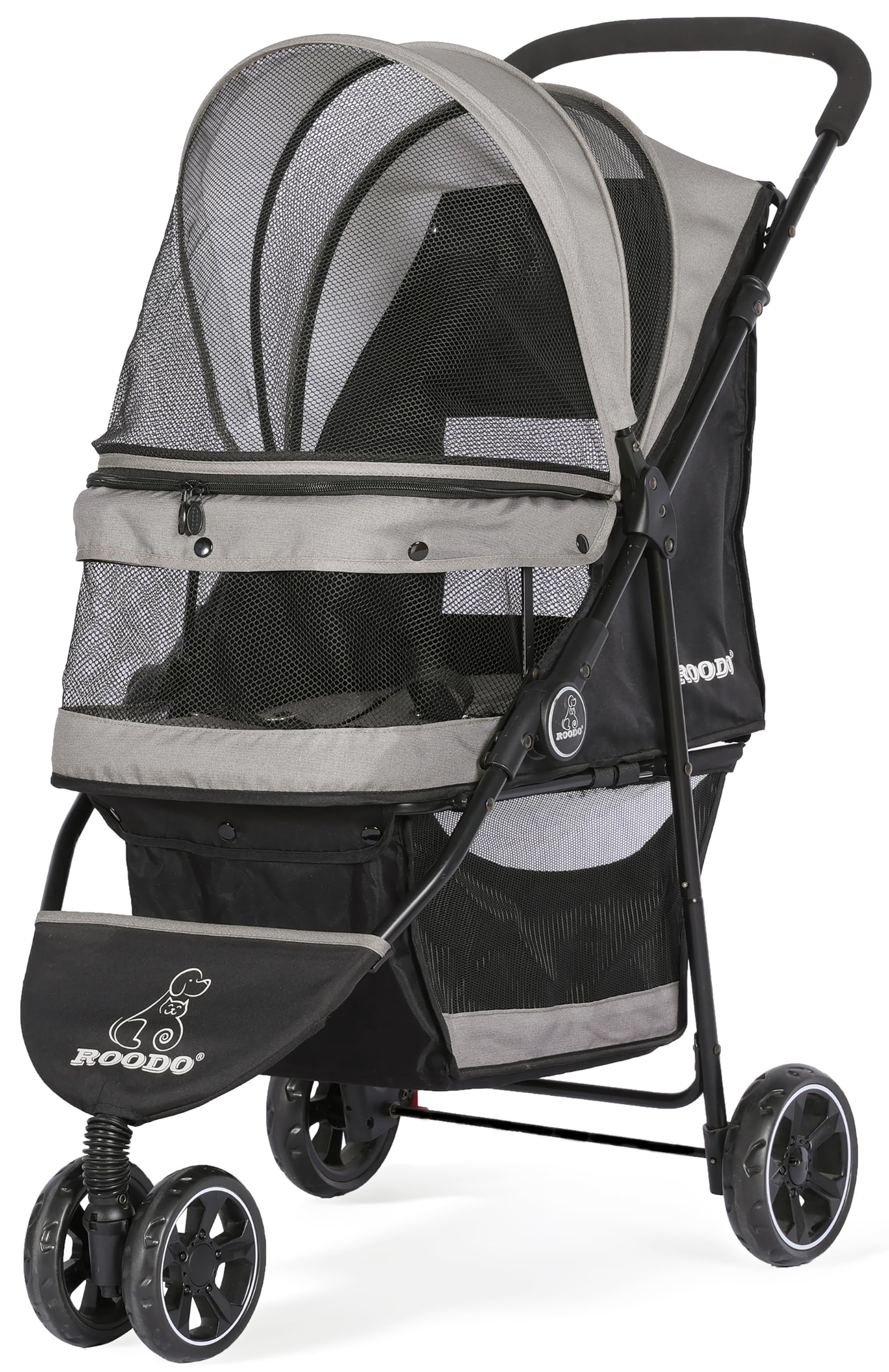
ROODO Escort

ROODO Escort

Budget trails

Our Score 9.2/10
Check Price

Worth Noting

  • 5.5-inch front wheel catches on roots and ruts
  • Cabin suits dogs well under the 30-pound rating
Folded Size
18.5 x 6.5 x 33 inches
Front Wheel
5.5 inches
Rear Wheels
12 inches
Weight Capacity
30 lb
Read the full review

The ROODO is the least expensive stroller in this group, and by enough of a margin that it changes what the purchase feels like: an experiment rather than a commitment. It's also the lightest, at 5.5 kg, roughly 12 pounds, which is why it's the one that lives in the car on the off-chance.

For a small dog on an easy trail, it does the job. The three-wheel layout puts a 12-inch wheel at each rear corner and a 5.5-inch swivel up front, the frame is alloy steel, and it folds to 18.5 by 6.5 by 33 inches, which is umbrella-stroller size. It's the value pick of the group for a dog under 20 pounds on gravel paths and packed trails.

The limits are the point. The 30-pound rating is optimistic for a 33-inch cabin, and the dogs that fit best are under about 20 pounds. The 5.5-inch front wheel is the other one: it finds every root and rut a 10-inch wheel rolls over, and it wanders a little when you push one-handed on uneven ground. On a flat gravel path with a 15-pound dog, neither shows up.

Bottom line: The cheapest, lightest way onto gravel: 12-inch rear wheels and an umbrella fold for a small dog on easy trails.

6

My Duque COOPER

My Duque COOPER

Tall handlers

Our Score 9.2/10
Check Price

Worth Noting

  • Sold without a stated warranty
  • 24 pounds to lift into a car
Frame
Stainless steel
Handle
Height-adjustable
Wheels
3
Weight Capacity
70 lb
Read the full review

The COOPER is the only stroller here whose handle adjusts for height, and if you're tall that single detail decides more long walks than wheel size does. Push a fixed-handle stroller for three miles and you feel it between your shoulder blades; set this one where your hands fall naturally and the same walk is unremarkable.

The rest of the design aims at the same buyer. It's a three-wheel stainless steel frame on spring-mounted tires, so the roll over uneven ground is damped rather than passed straight to the cabin, and the 70-pound rating covers a Labrador or a pair of terriers. Zippered doors front and back mean you load a reluctant dog from whichever side is easier, and there's a large basket underneath for a day's gear.

Two details we appreciate as much as the handle: the reflective stripes and wheel trim, which matter on a winter afternoon when the light goes early, and the mesh inserts on both sides, which keep air moving without turning the cabin into a greenhouse.

Where we hesitate is the support around it. It's a 24-pound stroller sold without a stated warranty, and the listing doesn't spell out an internal tether, so confirm one with the seller if your dog rides standing. The design is right for tall handlers and mixed-size dogs; the backup behind it is thinner than the price suggests.

Bottom line: For tall handlers, the adjustable handle alone justifies it: a 70-pound steel three-wheeler that fits your hands and your dog.

7

JOYCOW Pet Stroller

JOYCOW Pet Stroller

Senior dogs

Our Score 9.0/10
Check Price

Worth Noting

  • Handle sits low for tall handlers
Canopy
180-degree adjustable
Entry Height
7.6 inches
Stroller Weight
15.9 lb
Weight Capacity
70 lb
Read the full review

The JOYCOW sits low to the ground, and that's the whole argument for and against it. With a 7.6-inch entry, a dog with arthritis or a bad hip walks in rather than being hoisted. The same low-slung frame puts the handle low too, and tall handlers feel it in their shoulders after a mile.

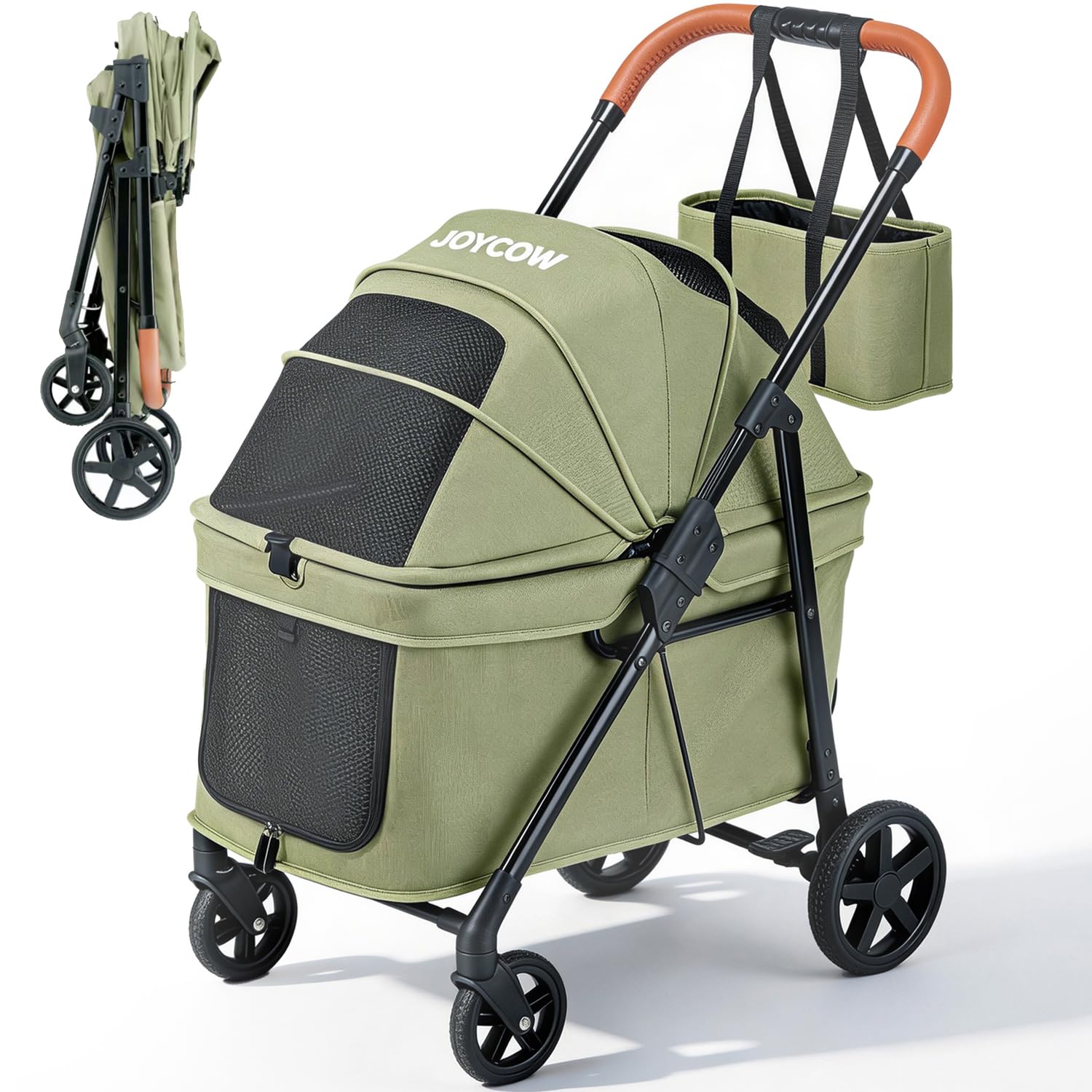
For the right household, the rest is well thought out. The 600D Oxford shell is the only one here described as chew-resistant, which is the difference between a stroller that survives a bored puppy and one that doesn't. The canopy rotates through 180 degrees and there are four oversized mesh windows, so you can block the sun on one side and leave the dog a view out the other. There's shock absorption in the frame as well.

At 15.9 pounds with an aluminum frame it's a one-hand lift into the car, and the cabin is 26 by 15 inches with a 70-pound rating, enough for a big senior dog who needs the low step. A low floor and a light frame together are harder to find than they sound.

This is the stroller we choose for one job: an older or recovering dog who can't step up, on paths gentle enough for a low frame. The height is where it lives or dies, though. If you're tall, push one before you commit, because the handle doesn't come up to you.

Bottom line: The stroller for an arthritic dog: a 7.6-inch entry lets them walk in, as long as your own reach suits a low handle.

8

Pet Gear No-Zip AT3

Pet Gear No-Zip AT3

Packed paths

Our Score 8.0/10
Check Price

Worth Noting

  • Front wheel can wobble or work loose
  • 27 pounds, and the most expensive here
Tires
12-inch E.V.A.
Handle Height
42 inches
Stroller Weight
27 lb
Weight Capacity
60 lb
Read the full review

The Pet Gear AT3 looks the part more than anything else here: three wheels, 12-inch airless tires, a no-zip entry and a 42-inch handle. It's the closest thing in this group to a proper jogging-style stroller, and the no-zip lid is a genuinely good idea. You flip it open with one hand instead of wrestling a zipper with a dog under one arm.

The geometry works. A three-wheel layout on 12-inch tires rolls over roots and packed gravel more easily than any of the small-wheeled strollers here, the front wheel swivels for tight turns and can be fixed straight for a long push, and the elevated paw rest gives a dog something to stand against. Airless EVA is the right call for a trail: no pump, no punctures, no flat tire two miles from the car.

What holds it back is that front end. The wheel can develop a wobble on rough ground and in some cases works loose over months of use, so check the axle and the bolts before a trail day and treat any shimmy as a stop-and-fix. The rest of the build is good, with a water-resistant 600D shell, a removable liner and a big storage basket. But it's the most expensive stroller in this group, and a front wheel you have to watch is why it sits below the top picks.

It's also 27 pounds and folds to 20.5 by 17.3 by 7.1 inches, which is manageable and still noticeable when you lift it into a taller car. If the biggest tires and a no-zip lid are what you want, they're here. If you want the front end you never think about, they're not.

Bottom line: The biggest tires and the best entry here, held back by a front wheel that can wobble. Buy it if you'll check the axle.

How We Tested 11 Dog Strollers on Real Trails

We started by pulling every stroller marketed for trails, large dogs, or both, then filtered out anything rolling on hard plastic wheels, rated under 50 pounds of dog, or too long to fit in a mid-size SUV cargo area. That left 11 strollers, from light three-wheelers to heavy-duty jogging frames, which we ran for eight months.

Each one logged the same loop: a packed gravel rail trail, a rooty stretch of singletrack, a steep grass hill at the park, and one weekend trip where it lived in a trunk and was set up and broken down in a parking lot twice a day. We timed the fold with one hand while holding a leash in the other, then lifted each stroller over a fallen log and into a car to see whether it truly worked solo. On the hills we set the brake and pushed hard to check for roll, and after every outing we went over the frame for rattles, loose bolts, and seams starting to pull.

Smooth ride got judged mostly by the dog — we watched whether she settled and stayed settled on washboard gravel or kept bracing her feet against the basket. We measured handlebar height against testers from 5'2" to 6'1" and cabin height with a tape measure, then watched a 45-pound dog try to stand and turn in each one, since a low canopy turns a rest stop into a wrestling match. At the end of eight months we set the wear we'd seen — tires, axles, zippers, sunshade hinges — next to each stroller's price.

How to Choose the Right Dog Stroller for Hiking

Wheel size is the real terrain rating

All-terrain on a listing means grass, gravel and the odd curb, not roots and mud. Diameter tells you more. A stroller with a front wheel under 7 inches, like the ROODO's 5.5-inch one, is a pavement-and-packed-path machine, and you feel every stone through the frame. We treat 10-inch rear wheels as the entry point for real trails and 7 inches at the front as the useful minimum; the EchoSmile, the Canine Canyon and the Pet Gear clear that bar, and the small-wheeled picks here don't.

Suspension and brakes decide the downhill half

Suspension is what stops a dog standing up every hundred yards. The Kicari springs all four wheels, the EchoSmile damps the front fork, and the COOPER rides on spring-mounted tires. Any of those beats a rigid frame on gravel, and for a dog with joint trouble it's worth prioritizing over almost anything else.

Brakes matter just as much going down. A stroller left unbraked on a slope with a dog half in it is an accident waiting to happen, so set the parking brake before you unzip anything. On a side-slope, a swiveling front wheel will follow the camber and pull you toward the edge; take the wider line.

Match the cabin to the dog, not the rating

Weight ratings run ahead of cabin size. An 89-pound rating on a 29-inch cabin, or a 70-pound rating on a 26-inch one, tells you what the frame will hold, not what your dog will fit into. Measure your dog lying down, nose to tail, and add a couple of inches.

Height matters as much as length. The Bicystar's carrier is 9.4 inches tall, so a dog rides lying down, while the Canine Canyon gives 21 inches and lets a big dog stand and look out. For a dog who stands the whole way, a tall cabin is worth more than extra capacity.

The weight and fold you actually live with

Every stroller here folds; what separates them is what the fold weighs and where it goes. The ROODO comes in around 12 pounds and folds like an umbrella stroller, while the Bicystar and the Pet Gear sit near 27. If the stroller lives in the car and gets lifted twice a weekend, that gap matters more than most of the spec sheet. Check the folded length against your trunk before you buy, because an 18-inch fold and a 34-inch fold are different purchases.

Handles, doors, tethers and storage

Long pushes expose handle height, and only the COOPER adjusts. If you're tall, that's a feature worth paying for. Door layout matters for a stiff or senior dog: the JOYCOW's 7.6-inch entry and the front-and-rear openings on several picks here let a dog walk in rather than be lifted.

Confirm an internal tether before you order, and plan on clipping it to a harness rather than a collar. Look at storage honestly too, because a day's water and layers don't fit in a side pocket.

Frequently Asked Questions

Final Verdict

If you hike with a dog who can't manage the whole distance, our default is the EchoSmile. Ten-inch rear wheels, a shock-absorbing front fork and an 89-pound cabin cover most dogs on most trails, and it folds small enough to live in the car between trips.

Two requirements change the answer. A dog over about 70 pounds belongs in the Canine Canyon's 130-pound cabin, and a 15-pound dog on a tight budget is better served by the much lighter, much cheaper ROODO.