Crates & Gates

Best Freestanding Dog Gates of 2026

A freestanding dog gate promises to solve a dog problem without touching your house: no drilling, no brackets sunk into the trim, no patching holes when you rearrange the furniture. You unfold it, park it in the doorway, and the kitchen stays dog-free while you carry something hot to the table. The catch is that a gate nothing is anchoring has to hold itself up, and plenty of them don't once a determined dog leans on the bars or noses the latch until it gives.

My team and I have spent the past six months living with ten of these gates — in doorways, at the bottom of stairs, and as a temporary wall between a dog and a dinner plate. What separated the good ones wasn't panel count or price tag: it was how wide and how low the base sat, how the latch felt in one hand, and whether it read as furniture in the living room or as camping gear you forgot to put away. The gates that earned a place here are the ones that stayed upright when a dog hit the end of them, and that I never once wanted to move out of sight.

1

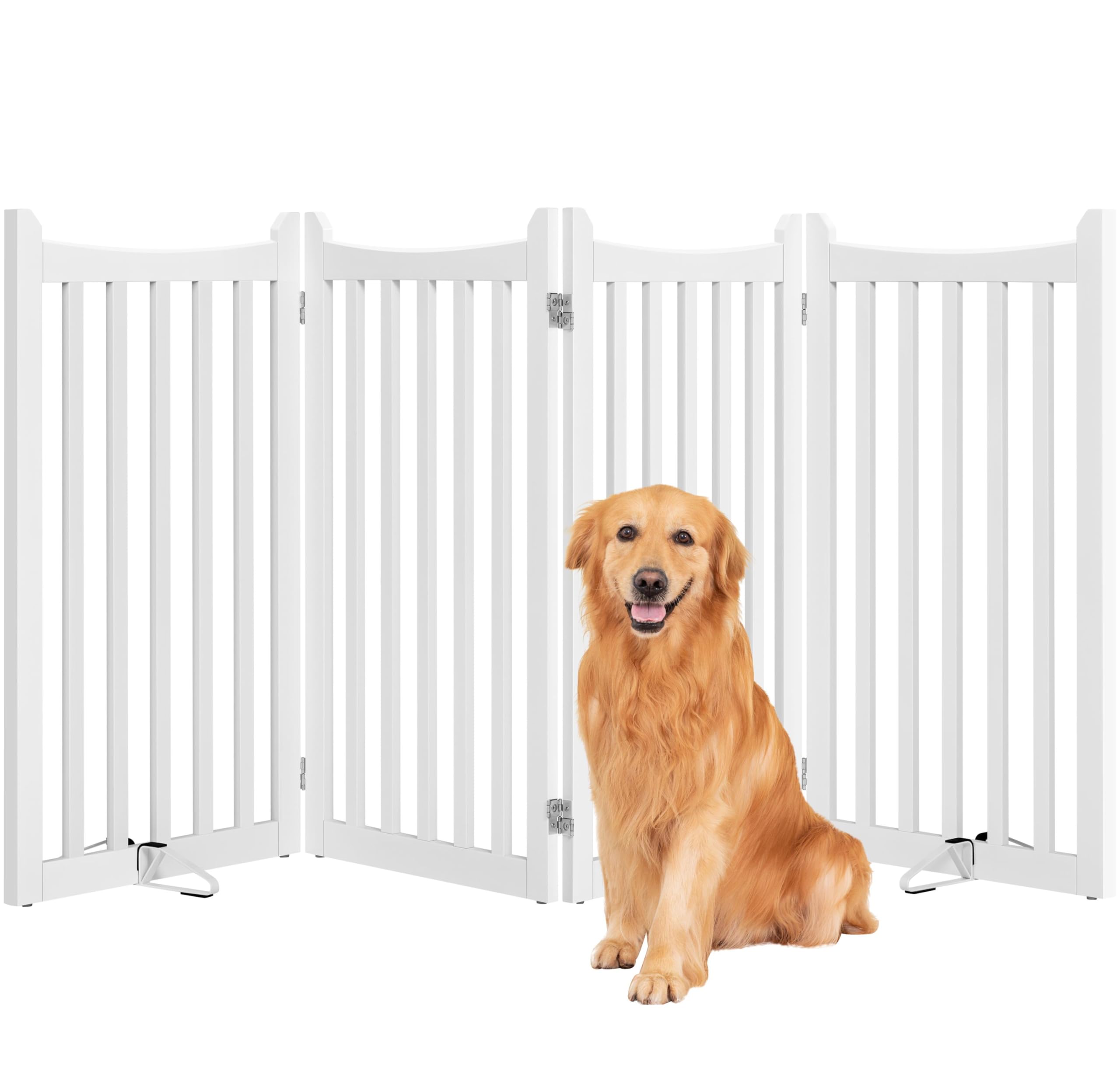
PAWLAND 4-Panel Wooden Gate

Top Pick
PAWLAND 4-Panel Wooden Gate

Small dogs

Our Score 9.4/10
Check Price

Worth Noting

  • Only 24 inches tall, so a jumper clears it
Open Size
80.3" W x 24" H
Folded Size
20.5" W x 3" D x 24" H
Usable Span
Up to 72"
Slat Spacing
2"
Read the full review

Puppies, small breeds, and old dogs with stiff hips don't need a chest-high barrier. They need a rail they'll respect and you can step over with a laundry basket in your arms, and that is exactly what this gate is. Nothing else on this list does the low-gate job with as much coverage.

Fully open, four panels give you 80.3 inches, though the usable span is closer to 72 once the panels are angled enough to stand. That's still enough to close off a hallway, a double doorway, or the mouth of a living room, and it's more coverage than any other 24-inch gate here. The espresso finish is the warmest of the wood gates in this set — with black metal detail it looks like a piece you chose rather than safety equipment you settled for — and the 2-inch slats suit a small dog.

It arrives assembled. The panels fold accordion-style into a stack about 20.5 inches wide and 3 inches deep, so it lives behind a couch or in a closet between uses instead of leaning in a corner, and the non-slip rubber feet keep it from walking across a wood floor when a dog leans on it. It's the one we reach for when the gate goes up and down twice a day.

Bottom line: We recommend it for puppies, small breeds, and senior dogs: a 24-inch rail you step over without thinking, with enough span to close a hallway.
2

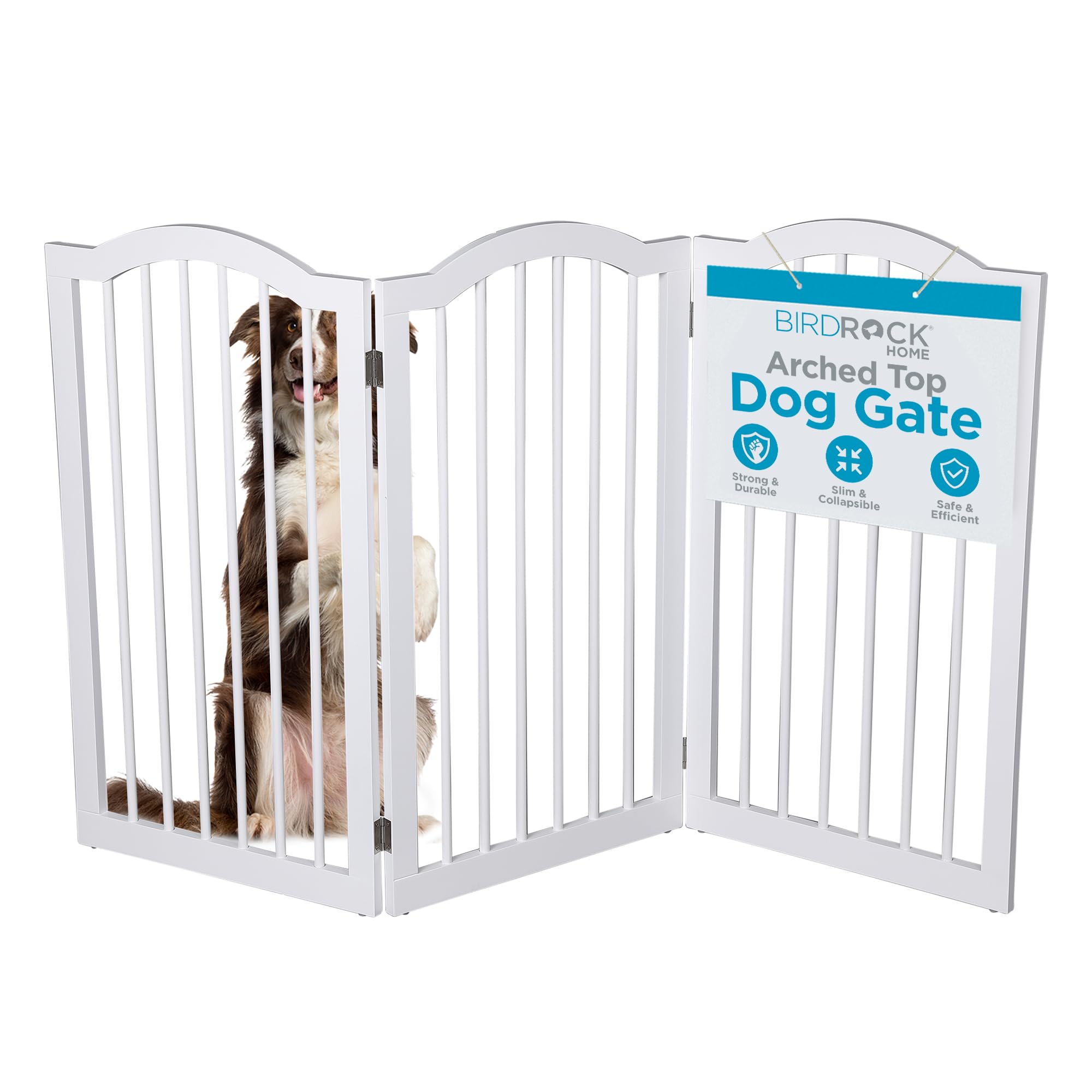
Internet's Best Arched Top Gate

Internet's Best Arched Top Gate

Most doorways

Our Score 9.2/10
Check Price

Worth Noting

  • No walk-through door on a 36-inch rail
Open Size
60" W x 0.75" D x 36" H
Folded Size
20.5" W x 2.25" D x 36" H
Slat Spacing
2"
Material And Finish
MDF wood, white
Read the full review

Height is the first thing to settle, and this gate settles it at 36 inches. Two of the gates here top out at 24, which is a step-over height for people and, for a determined dog, an inconvenience rather than a barrier. At 36 inches the arched top rail lands around chest height on a medium dog, and that is the whole reason this one is our default for a doorway or the end of a hallway.

The panels are MDF in white with an arched top rail, and it's the best-looking gate of the six on this list. The arch and the slim slats read as a garden trellis rather than a piece of baby equipment, which matters when the thing is going to sit in your hallway for the next three years. Two-inch slat spacing is tight enough to keep a small dog from pushing a shoulder through, and the hinges turn both ways, so it takes a Z-shape against a wall or a shallow U around a doorway.

Setup is a matter of unfolding it. It arrives assembled and folds to about 2.25 inches deep — thin enough to slide behind a sofa or stand in a closet — and at 36 inches tall it moves from room to room without dragging. On hardwood, set the panels at a real angle instead of stretching them into a straight line. A straight run of a freestanding gate has nothing bracing it, and that's when the feet start to skate.

Five feet of span is the limit. If your opening runs wider, this one leaves a gap at the end, and the 80-inch unipaws or Yaheetech is the better buy. For the standard doorway, hallway mouth, or room divider it was built for, we haven't found a reason to look further — the height, the finish, and that thin fold do more for daily life than an extra panel would.

Bottom line: The gate we tell most people to buy: 36 inches tall, wide enough for a doorway, and finished well enough to leave up permanently.

3

Yaheetech 36-Inch 4-Panel Gate

Yaheetech 36-Inch 4-Panel Gate

Wide tall openings

Our Score 9.2/10
Check Price

Worth Noting

  • MDF panels rather than solid wood
Open Size
79.5" W x 36" H
Support Feet
2 included
Panel Material
0.7" MDF with iron frame
Floor Protection
Protective pads and EVA foam feet
Read the full review

There's no door on this one. It's a 36-inch panel you step over, and if the gate sits at the bottom of the stairs you take fifteen times a day, that gets old. Everything else about it is why it's on the list: 79.5 inches wide, 36 inches tall, four hinged panels in white MDF over an iron frame, and two support feet in the box.

Those feet are the detail that makes it work. A 36-inch gate that wide has real leverage working against it, and the two support feet, with EVA foam at the base, give it something to brace against on hardwood without scratching. The panels are 0.7-inch MDF — thicker stock than the cheaper wood gates here — and the hinges rotate both ways, so it folds into a stack or shapes into a zigzag across an opening. It comes assembled: you unfold it and stand it up.

Set against the unipaws, which is three inches wider and considerably more expensive, the honest answer is that most people won't notice the difference. Same 36-inch height, same 80-inch reach, same need to keep the panels angled, and less money out of the household budget. That trade is why it's here rather than in the also-consider pile.

Bottom line: We point tall-gate shoppers here when the budget is tighter: nearly 80 inches at 36 inches high, support feet included.

4

No Pawblems Freestanding Gate

No Pawblems Freestanding Gate

Walk-through access

Our Score 9.2/10
Check Price

Worth Noting

  • Latch is fiddly until you learn it
Door
Walk-through, opens both ways
Material
Alloy steel
Mounting
Freestanding or wall-mounted
Open Size
78" W x 30" H
Read the full review

Every other gate on this list is wood. This one is alloy steel in black, with metal hinges and metal support feet, and that changes two things: a dog that mouths the slats gets nowhere, and the frame doesn't care how hard it's leaned on. It measures 78 inches wide and 30 inches tall — the middle of this set on height, tall enough for most dogs, short enough that a serious jumper is worth thinking about.

The door is the feature that earns it a place. It swings in both directions, so you push through with an armful of groceries instead of lifting a leg over a rail, and it closes behind you. That turns a gate from a hurdle into a doorway, which is the difference between a barrier you resent and one you forget about.

It stands on its support feet, or you can bolt it to the wall with the hardware that comes in the box — worth knowing if you have a dog that leans hard and you'd rather not find out how the feet cope. Between the two setups it's the most adaptable gate here: a movable barrier in a doorway, a fixed rail on a landing.

Bottom line: For anyone tired of stepping over a gate, this is the one we hand them: steel panels, a two-way door, 78 inches of span.

5

LZRS 2-Panel Wooden Gate

LZRS 2-Panel Wooden Gate

Small spaces

Our Score 9.2/10
Check Price

Worth Noting

  • 40-inch span covers one doorway only
Feet
Rubber pads
Panels
2
Material
Solid hardwood, white
Open Size
40" W x 24" H
Read the full review

Two panels, 40 inches across, 24 inches tall — this is the smallest gate here, and for a bedroom door, a short stair, or the alcove where the litter box lives, that's the point. A four-panel gate that folds into a 20-inch stack is more gate than those spots can take. This one folds flat against a wall and comes back out in seconds.

It's solid hardwood in white rather than MDF, with rubber pads on the feet that grip a wood floor without marking it, and the hinges turn both ways so you can set it in a shallow V or open it out flat. No tools, no assembly, nothing to install: you stand it where you want it, and when the dog is in the other room it goes behind the door.

At roughly eight pounds it's the lightest thing on this list, and that's both the appeal and the catch. You can move it with one hand, tuck it in a closet, or take it to a friend's house. But a dog that leans on a gate will shift this one out of place, and a clever one will work out that the end panel pivots. Buy it for a small, calm dog, or for a barrier that's really a visual cue; for a pushy one, go up to something with weight and feet.

Bottom line: We like it for small, calm dogs and tight spots: 40 inches of solid hardwood that folds flat behind a door.

6

unipaws 36-Inch Free Standing Gate

unipaws 36-Inch Free Standing Gate

Wide openings

Our Score 9.0/10
Check Price

Worth Noting

  • Heaviest wood gate here to move alone
Finish
White
Open Size
80" W x 36" H x 0.71" D
Folded Size
20" W x 36" H x 2.84" D
Recommended Opening
48 to 75 inches wide
Read the full review

Openings between four and six feet are the awkward ones — too wide for a doorway gate, too narrow to bother dividing a room — and this gate is built for exactly that span. Eighty inches of 36-inch-tall panel, rated for openings of 48 to 75 inches wide, is what we recommend for a wide hallway, an open-plan living room, or the gap between a wall and the end of a sofa.

The hinges are the interesting part. They rotate a full 360 degrees in both directions, so the panels don't have to sit in a line: you can wrap them around a corner, follow the angle of a staircase, or fold the last panel back against the wall to shorten the gate without unclipping anything. It arrives assembled with floor-protecting pads already fitted, and the white finish is the cleanest of the tall gates here.

Two things to know before you buy. The folded stack is still 36 inches tall, so it wants a closet with height rather than a shallow shelf. And it only stands when the panels are genuinely angled — stretched into a straight run across six feet, it has nothing bracing it and the feet will slide. Give it a shallow V and it holds.

Bottom line: Our choice when the opening is wider than a doorway: 80 inches of 36-inch-tall gate that still folds into a 20-inch stack.

How We Tested the Best Freestanding Dog Gates

We started by pulling every hardware-free gate we could find that could clear a standard doorway, then narrowed by height and panel count so the shortlist covered everything from a small dog to a tall leaner, and by price so the group wasn't all one tier. Ten gates made the cut, and we lived with them for six months. Each one came out of the box, got assembled solo, and then moved around a house the way a gate actually gets moved: across the kitchen doorway in the morning, at the foot of the stairs after dinner, folded back against the wall when guests arrived.

Assembly and setup were timed, and we did both one-handed, since nobody unfolds a gate with a dog underfoot and both arms free. We taped out each footprint, checked whether the frame cleared baseboards and door trim without scraping, and then hip-checked the thing to see whether it slid across hardwood or held its ground. For the leaners, we pushed at shoulder height with steady weight and afterward checked the joints and hinges for wobble, then looked again at the four-week mark and again at the end.

Latch testing was repetitive on purpose: thirty open-and-close cycles on every gate, several of them done with a leash in the other hand, followed by a check for slack or a mechanism that had started to catch. Over the months we watched finishes for scratches where paws meet bars, noted whether panels still folded flat after weeks of use, and weighed what came in the box — extra panels, wall brackets, a carry bag — against the sticker price, since those add-ons often close the gap between two gates that look far apart on the shelf.

How to Choose Freestanding Dog Gates

Height Is About Your Dog, Not Your Doorway

A 24-inch gate is a step-over rail. You clear it without breaking stride, and it stops a puppy, a small breed, or an old dog that shouldn't be doing the stairs. A 30- or 36-inch panel is a real barrier, and it's what you need for a dog that has ever put its paws on the kitchen counter or cleared the back of the sofa.

If you're unsure, watch your dog next to a stack of boxes rather than guessing — most people come up an inch or two short. Between two heights, go taller; the only cost is a slightly higher step for you.

The Span You Get Is Shorter Than the Span You Buy

Every hinged panel has to sit at an angle to stand, and every angle eats inches. The unipaws opens to 80 inches but is rated for openings of 48 to 75 inches wide; the PAWLAND opens to just over 80 and gives you about 72 usable. Neither is a misprint — it's how a freestanding gate stays on its feet.

Measure the opening, then leave a foot of slack so the panels can sit in a shallow V. A gate stretched dead flat across its full span is a gate with nothing bracing it.

Weight, Feet, and the Surface Underneath

The difference between a gate that holds and one that skates usually lives in the base: support feet, rubber or EVA pads, and panels heavy enough that a shoulder doesn't shift them. On hardwood and tile, pads do double duty — they grip, and they keep the frame from marking the floor.

One rule we won't bend: a freestanding gate is not a top-of-stairs gate. It can be pushed or tipped, and a tumble down a flight is not a fair test of a rubber foot. Put a hardware-mounted gate at the top and a freestanding one at the bottom.

Step Over or Walk Through

At 24 inches, stepping over is nothing. At 36 inches it's a small hurdle you'll take dozens of times a day, and if anyone in the house is unsteady on their feet, that alone can decide it. A walk-through door solves the problem — the No Pawblems has one that swings both ways — but a door is a mechanism, and a mechanism means a latch for something to go wrong with.

Our rule of thumb: if the gate sits in a doorway you cross constantly, pay for the door. If it's blocking a room you enter twice a day, skip the complication and take the taller panel.

Finish and Color, Since It Lives in the Room

These gates end up in hallways and living rooms, so appearance earns its place on the list. A wood gate in a finish that echoes your trim disappears into the room; the wrong one looks like equipment parked in your house. White and espresso cover most interiors.

The arched top on our overall pick is the clearest example of the difference — it reads as a trellis rather than a barrier, which is why it's easy to live with in a hall you walk through every day.

Frequently Asked Questions

Final Verdict

Most people need one gate for one doorway, and the Internet's Best arched top is the one we point them to: 36 inches tall, 60 inches wide, thin enough to fold behind a door, and finished well enough that nobody asks why there's a gate in the hall.

Go elsewhere for a reason. If the opening runs past about five feet, the unipaws closes it at full height. If the gate sits where you walk all day, the No Pawblems door earns its keep.