Tech & Gadgets

Best GPS Dog Collars of 2026

A dog that slips the gate doesn't come back on the first call, and the ten minutes you spend walking the block calling her name feel like an hour. A GPS collar exists for that gap — the stretch between "she's gone" and "I know exactly where she is." What separates a good one from a frustrating one isn't the map on the app. It's whether the battery is still alive on hour three, whether the alert fires before she's out of the yard, and whether the signal holds when she crosses into the woods behind the neighborhood.

I've been the person refreshing a tracker app at 11 p.m., so I had opinions going in. My team and I have spent the past seven months living with 11 collars, from city sidewalks to a farm with one bar of service, and the pattern showed up fast: the box price is only half the cost — the monthly subscription is the other half, and the cheapest plan is rarely the one you want. The picks below are the ones that held a signal, kept a charge, and gave me a reason to put my phone down.

1

Garmin Alpha 300i Bundle

Top Pick
Garmin Alpha 300i Bundle

Remote fieldwork

Our Score 9.4/10
Check Price

Worth Noting

  • Premium price only fieldwork justifies
  • Topo map downloads take patience
Range
Up to 9 miles
Satellite
inReach messaging and SOS
In The Box
Handheld and TT 25 collar
Dogs Tracked
Up to 20
Read the full review

This is the only pick that does not assume a phone. The Alpha 300i is a rugged touchscreen handheld, and the TT 25 collar arrives in the box with it. The handheld holds the map itself, shows up to 20 dogs on one screen and reaches nine miles without a cellular bill. The inReach side adds satellite messaging and an SOS button, the sort of feature you buy for a day you hope never arrives.

We keep coming back to it for one situation: real ground, no bars and a dog that ranges out of sight. Hiking, hunting, search work, a backcountry camp with no service. The handheld keeps working where a phone-based tracker is a paperweight, and the satellite messaging is a genuine safety net rather than a line on the box.

The cost runs in both directions. This is the most expensive kit here by a wide margin, and the handheld is a device you have to learn, charge and carry. Downloading the topo maps takes patience the first time you do it. What comes back is a system that does not care whether the cell network exists, with battery life that holds up across a long day in the field.

The bundle also throws in a car adapter, a battery bank and a field travel bag, which says plainly who Garmin expects to buy it: someone leaving the truck for hours at a time. If that is your week, the price is the least interesting thing about this kit. If it is not, you are paying for capability that will sit in a drawer.

Bottom line: For working dogs in country with no bars this is the complete kit: a handheld that holds its own map, satellite messaging when things go wrong, and twenty dogs on one screen.

2

Garmin Alpha TT 25 Collar

Garmin Alpha TT 25 Collar

Existing Alpha owners

Our Score 9.4/10
Check Price

Worth Noting

  • Requires a compatible handheld sold separately
Fit
Large and small breeds
Weight
1.3 oz
Requires
Compatible Alpha handheld
Training Levels
18
Read the full review

The TT 25 is the collar half of Garmin's Alpha system, and it needs a compatible handheld, sold separately, before it will tell you anything about where your dog is. That single fact decides who should read on. Once it is on the table, this is a nicely judged piece of hardware: 1.3 ounces, slim enough for small and large breeds, and a flexible band you can replace yourself instead of sending the whole collar back.

The details we check first are practical ones. The one-inch orange strap is easy to spot in cover, contact points come in two lengths for different coats, and the training side offers 18 levels of momentary or continuous stimulation plus tone and vibration. Paired with an Alpha handheld it tracks to nine miles with updates as quick as 2.5 seconds, and dynamic tracking slows the reporting rate when the dog is standing still, which is where the battery life comes from.

As a second collar for a household already carrying an Alpha handheld, we think it is the sensible buy: same handheld, same app, one more dog on the list without buying another controller. As a first tracker it makes no sense at all, because the handheld is the other half of the purchase and it is not a small one. That is the line to hold when the rating tempts you.

Bottom line: The collar to add to a handheld you already own, slim, light and trainable, but on its own it cannot find anything, so it is not a first purchase.

3

Dogtra Pathfinder 2

Dogtra Pathfinder 2

Long-range off-leash

Our Score 8.8/10
Check Price

Worth Noting

  • Map tracking depends on a paired phone
  • You pay for training features you may not use
Range
Up to 9 miles
Connection
Radio link, no cell signal needed
Monthly Fees
None
Dogs Supported
Up to 21
Read the full review

Nine miles of range with no monthly bill is a combination nothing else here offers. The Pathfinder 2 pairs a GPS connector, a small handheld transmitter, with a collar, and your phone becomes the map. The app carries general, satellite and terrain views, the offline maps are free, and the whole thing runs on a radio link rather than a cell network, so a dead zone does not end the search.

The money is the argument. You pay more up front than you would for a subscription tracker and then nothing, month after month, so the longer you keep it the better the arithmetic looks. That only works if you want what the extra buys: line-of-sight range instead of cell coverage, and a collar that will nick, tone or vibrate on command when the dog is ignoring a whistle.

We like it best on a big property, with a hunting dog, or anywhere phones lose signal. Pushing a track through thick cover is where the radio link earns its keep, and being able to reach the dog without a signal bar is worth the weight on your belt. If all you want is to know where the dog got to on the evening walk, this is more machine, and more money, than the job needs.

Setup runs through the app and takes a few minutes of pairing. After that the collar corrects independently, but the map still lives on your phone, which is fine in a vest pocket and awkward in the rain. One button on the connector does the everyday correction, and everything more detailed means getting the screen out, so it rewards someone who plans the session before the dog is off the lead.

Bottom line: The pick for long-range work on big ground: nine miles of line-of-sight tracking, proper offline maps and no monthly bill, as long as you accept that you are also buying a training collar.

4

Tractive GPS Tracker TG6

Tractive GPS Tracker TG6

Everyday tracking

Our Score 8.2/10
Check Price

Worth Noting

  • Live tracking needs an active subscription
  • Cellular dead spots interrupt live tracking
Plan
Subscription required
Battery Life
Up to 14 days
Live Updates
Every 2-3 seconds
Minimum Dog Weight
8 lb
Read the full review

Two seconds between position updates sounds like a spec-sheet detail until you need it. A tracker that pings once a minute can put a running dog a block away before the dot on your screen moves, and the whole difference between following a dog and guessing where it went lives in that interval. Tractive refreshes every two to three seconds over a cellular connection, which also means no range limit: the collar reports from as far away as there is a phone signal, whether the dog is two streets over or in a passing car.

Battery is the trade. The listing promises up to 14 days, and that is a figure for light use. Leave live tracking running in patchy signal and you will be reaching for the charger most weeks, so treat it like a phone and top it up while the dog sleeps. The upside is size: at 2.8 inches long it clips onto the collar you already own, with two attachment clips in the box, and Tractive rates it for dogs from 8 pounds, which covers everything from a Jack Russell upward.

We are fonder than we expected of the extras. Sleep and activity tracking, bark alerts and heart and respiratory-rate monitoring all arrive on the same collar, and the health monitoring learns your dog's own baseline rather than comparing it to a breed average. Treat any alert as a nudge to call the vet, not a diagnosis. The housing is fully waterproof, so a wet walk or a pond is not a problem.

The plan is the part to weigh before you order. Tractive runs on cellular, so an active subscription is part of ownership, and over a couple of years the plan outruns the hardware on cost. What it buys is coverage and cadence with nothing to carry. If your regular walk is a canyon with no bars, the plan will not save you, and one of the radio systems below is the better tool.

Bottom line: For everyday locating this is the one we reach for: two-second updates, a light waterproof body and the lowest entry cost here, once you budget for the plan that makes it work.

5

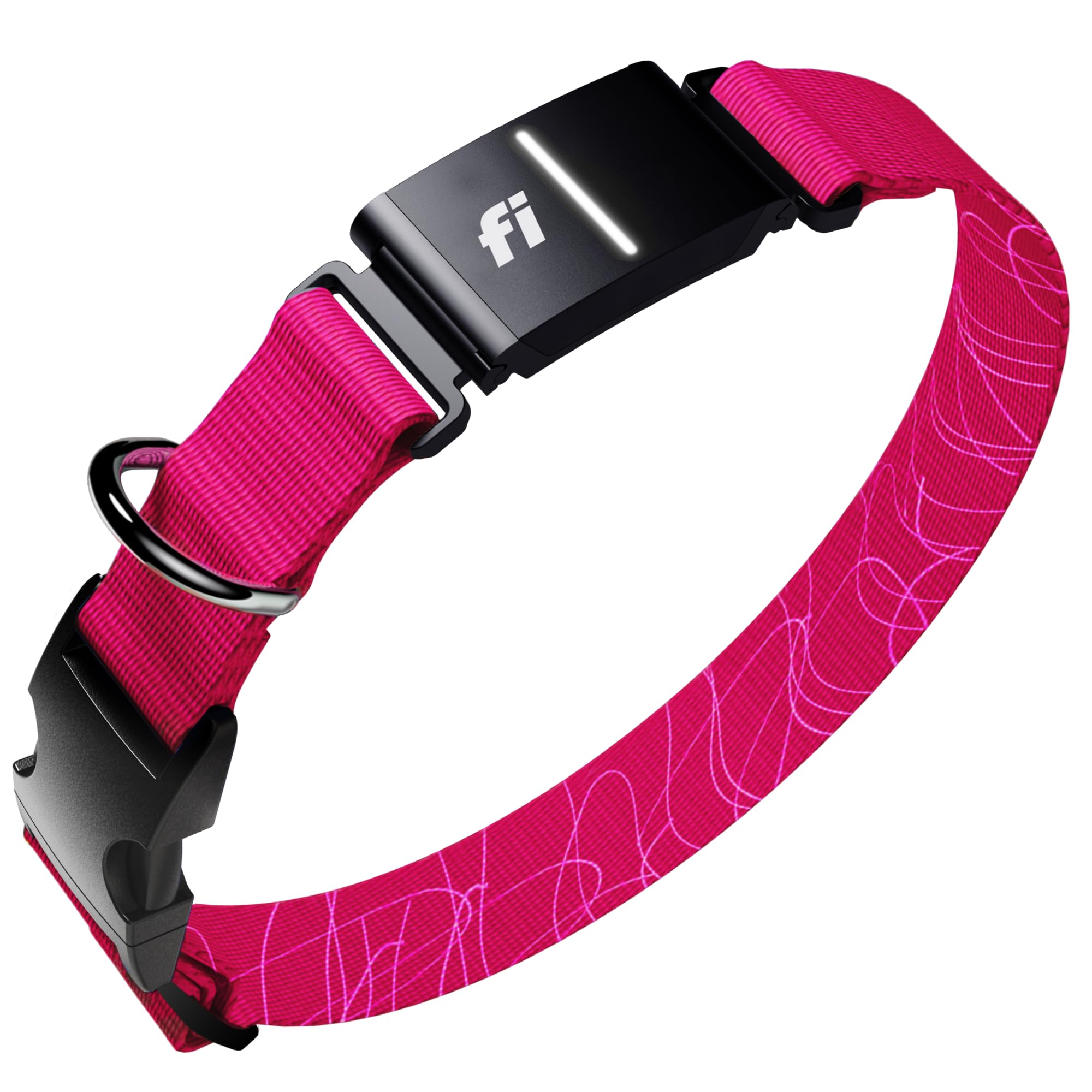
Fi Series 3+ Smart Collar

Fi Series 3+ Smart Collar

All-day wear

Our Score 8.2/10
Check Price

Worth Noting

  • Membership required for tracking and alerts
  • Live updates slow away from the home base
Plan
Membership required
Sizes
XS to XL
Battery Life
Up to 3 months per charge
Waterproofing
IP68/66K
Read the full review

Most trackers here are a plastic box clipped to the collar you already own. Fi builds the tracker into the collar instead: a stainless steel frame, a proper buckle, an LED for night walks and sizes running from XS to XL. On a dog that wears a collar around the clock anyway, that is a tidier answer than a lump swinging off a D-ring, and it is the version most likely to still be fastened when the gate is left open.

The charging base is the other thing we appreciate, and it is the reason this one earns a place. Fi quotes up to three months per charge on conservative settings; push live tracking hard and you are plugging in every few days instead. But the everyday pattern, collar near the base overnight, topped up without ceremony, is a real improvement on hunting for a cable every week.

Where we are less convinced is the locating itself. Near home the collar leans on your Wi-Fi and the base station, which is quick and precise. Away from both it falls back to cellular and updates far less often unless you switch on Lost Mode. That is fine for working out where the dog has got to, and less fine for following a direction of travel in real time.

The membership is mandatory for the location, the alerts and the health graphs, so the purchase price is only the start of the bill. In exchange you get something that behaves like a collar rather than a gadget: 77 grams, IP68 rated, worn all day, and far more likely to be on the dog at the moment it matters than a tracker that gets left on the hook after the first wet walk.

Bottom line: A proper collar with a steel frame and a charging base, the tidiest way to keep a tracker on a dog permanently, provided you accept the membership and the coarser location away from home.

How We Tested GPS Dog Collars in the Real World

We started with a working list of about 30 collars sold in the U.S., then cut anything whose hardware-plus-plan cost made no sense, models that only report location by Bluetooth, and units whose companion app hadn't been updated in over a year. That left 11, ranging from basic trackers to full fence-and-train setups. Each one went onto a real dog — a 45-pound mix with a thick ruff — and stayed there.

For seven months, every walk, hike, and backyard session doubled as a test. We logged battery percentage at the start and end of each outing with live tracking running rather than standby, because a collar that dies at hour four is useless on the day the dog actually gets out. We compared the app's pin against a hand-held GPS reading at fixed spots around the neighborhood, then noted how far off it drifted under tree cover or between houses. One deliberate backyard escape let us time how long an alert took to reach a phone and whether the collar switched from fence mode to live tracking on its own.

Connectivity matters more than any spec sheet suggests, so we recorded where each collar lost the network or fell back to a slower one, and how the app behaved when that happened. We read the fine print on every plan, tallied the true monthly cost, and checked how annoying it was to pause or cancel during a month we didn't need it. Then we looked at hardware: whether the buckle held after a dog rolled in the mud, whether the strap rubbed, and whether the charging contacts still clicked home after dozens of reconnects.

How to Choose GPS Dog Collars

Update Speed Versus Battery

The update interval decides whether you are following a dog or reconstructing where it went. Two or three seconds is quick enough to watch a dog turn a corner, which is what the Tractive manages; once-a-minute reporting is fine for finding a dog that has settled down somewhere and close to useless in the first thirty seconds of a chase. Every extra fix costs charge, so a collar that reports constantly is one you plug in weekly.

Decide which failure you are insuring against. A door-left-open dog on a suburban street needs speed. A dog that wanders a fenced acre and comes home needs stamina. Ask what the interval is with live tracking switched on, not on the most conservative setting in the manual.

Cellular Coverage or Radio Range

There are two ways to get a position off a collar. Cellular trackers like the Tractive and the Fi use the mobile network, so they work anywhere there is signal and nowhere there is not: no handheld to carry, but a subscription and a blind spot at the bottom of a valley.

Radio systems like the Dogtra Pathfinder 2 and the Garmin Alpha pair a collar with a handheld, and the range they quote is line of sight. Nine miles across open ground shrinks fast in dense timber or behind a ridge. That is still the better tool for a working dog, as long as you know what the number means before you rely on it.

Price It Over Three Years

Nothing here is a one-off purchase. Subscription systems put the cost in the plan: modest hardware, a bill every month, and a collar that stops reporting the day you cancel. No-fee systems put it in the hardware, so the Dogtra and Garmin units cost more on day one and nothing after that.

Add it up over the life of the dog rather than the life of the return window. Keep a system three or four years and the no-fee radios stop looking expensive; want to try tracking without committing, and the subscription route keeps the exit cheap.

Fit, Weight and What the Dog Will Tolerate

A tracker only works if the dog wears it. Tractive sets a floor of 8 pounds and clips onto the collar already in use. The Fi collar runs XS to XL, and at 77 grams it is nothing on a lab and noticeable on a small terrier. The Garmin TT 25 comes in at 1.3 ounces. Match the housing to the dog, not to the marketing photo.

Two traps catch people here. Waterproof covers rain and a pond, not a dog that swims daily, so check the actual rating where one is quoted rather than the word on the box. And an integrated collar has to fit properly to work at all, so measure the neck instead of guessing a size.

Frequently Asked Questions

Final Verdict

For most dogs on most days, the Tractive is the one to buy. It updates fast enough to follow a dog in real time, it is light enough for a small terrier, and the hardware is the least expensive route into proper tracking here. The plan is the real cost, and it buys coverage that does not depend on you carrying a handheld.

Fi is the upgrade for a dog that wears a collar anyway and a household that wants charging to disappear into the background. If your ground has no bars at all, skip both and buy radio instead: the Pathfinder 2 for tracking that doubles as training, the Alpha 300i bundle when you want satellite messaging in the same kit.