Crates & Gates

Best High Anxiety Dog Crates of 2026

A dog with separation anxiety doesn't just chew — it works the same welded bar until it bends, then goes at the gap it made. I watched a foster dog pop a standard wire crate's door latch in under four minutes, and that was the day I stopped trusting "heavy-duty" as a label. What a crate actually fixes isn't confinement; it's keeping a panicking dog from hurting itself while you're gone. That takes welded seams that hold, a latch a nose and a paw can't work open, and walls that don't bow when 60 pounds slams into them.

Over the past seven months, my team and I have lived with 10 crates built for dogs that don't take no for an answer. Here's what first-time buyers rarely hear: bigger isn't kinder. An anxious dog often settles faster in a crate sized to stand, turn, and lie down, because too much room is just more space to pace in. The picks below hold up on that count and on the things you'll deal with every day — latches, weight, assembly, and what you actually get for the money.

1

KOKOTANGS 48-Inch Crate

Top Pick
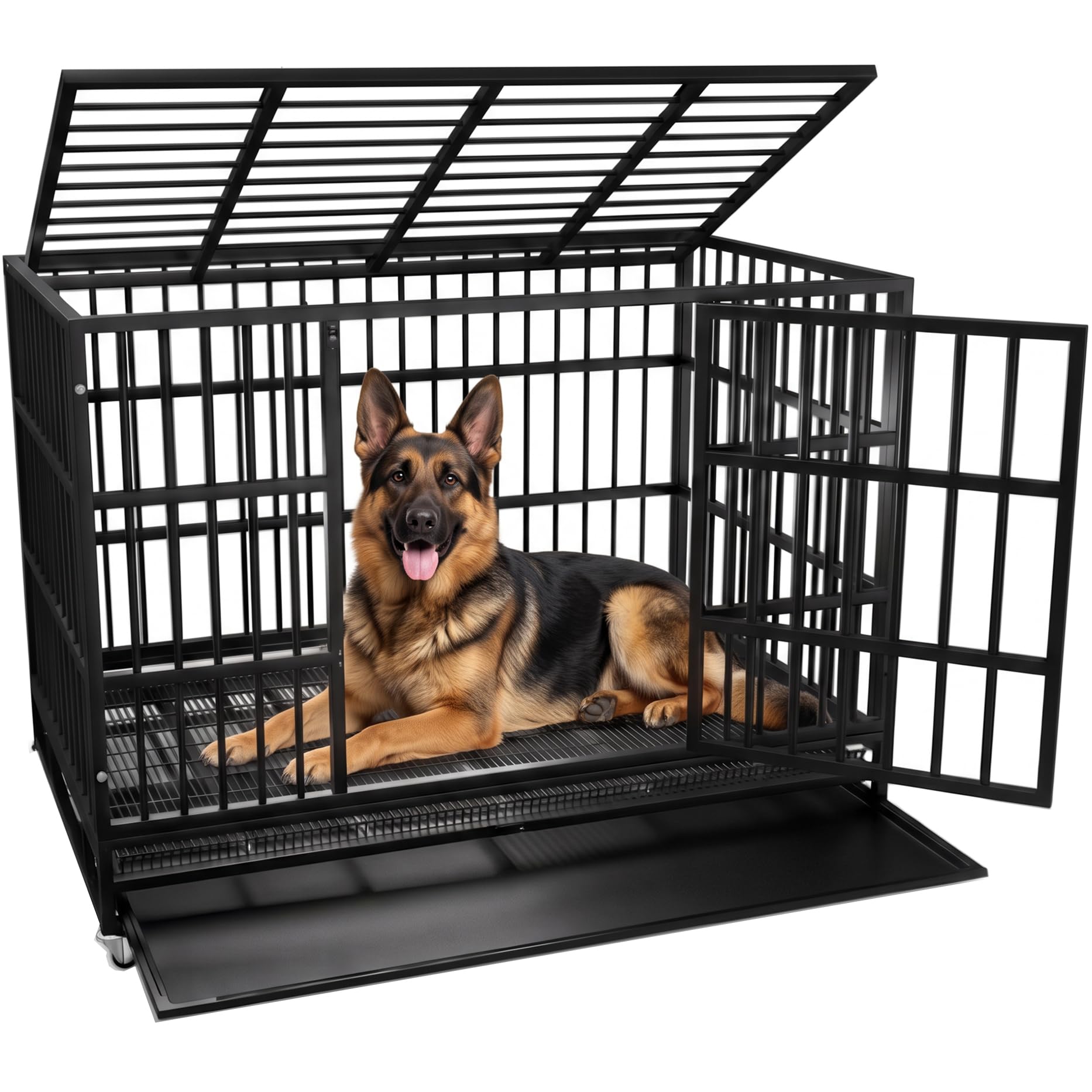
KOKOTANGS 48-Inch Crate

Giant breeds

Our Score 9.2/10
Check Price

Worth Noting

  • 88 pounds is a two-person lift
  • Only two of four casters lock
Doors
Front and top
Frame
20-gauge steel, 0.6" tube
Weight
88 lb
Exterior Dimensions
48"L x 31"W x 35"H
Read the full review

Forty-eight inches long, 31 wide and 35 tall is the number that settles this one. That is more usable room than anything else here, and for a dog that panics in a crate, space to stand, turn around and lie flat matters as much as the steel does. The frame is 20-gauge with 0.6-inch tube, and at 88 pounds it does not skate across the floor when a dog hits the door.

It is the crate we recommend first, and no single figure is why. This is the one place in the set where room, build and hardware land in the right order at once: panels, door frames and top hatch are all steel, there are four latches rather than one, and nothing about it feels like a wire crate with heavy duty in the title.

Setup is short — the panels arrive partly together and the rest is casters and a handful of bolts, a ten-minute job for one person. Casters are the part we watch on any crate this heavy: they make 88 pounds movable, which matters every time you sweep underneath, but only two of the four lock, so brace it against a wall if your dog throws itself sideways.

The honest caveat is the latch itself. Slide bolts are the right design for a strong dog — simple, visible, unlikely to jam — but they do nothing if the door was not quite shut, and a dog that has already learned to nose one open will try again. A clip through the handle is the cheapest insurance there is, and with that added it is as close to a buy-it-once crate as this group gets.

Bottom line: For most people shopping for an escape-risk dog, this is the crate to buy: the most interior room in this set, a 20-gauge steel frame that stays put, and a top hatch for feeding without opening the door.
2

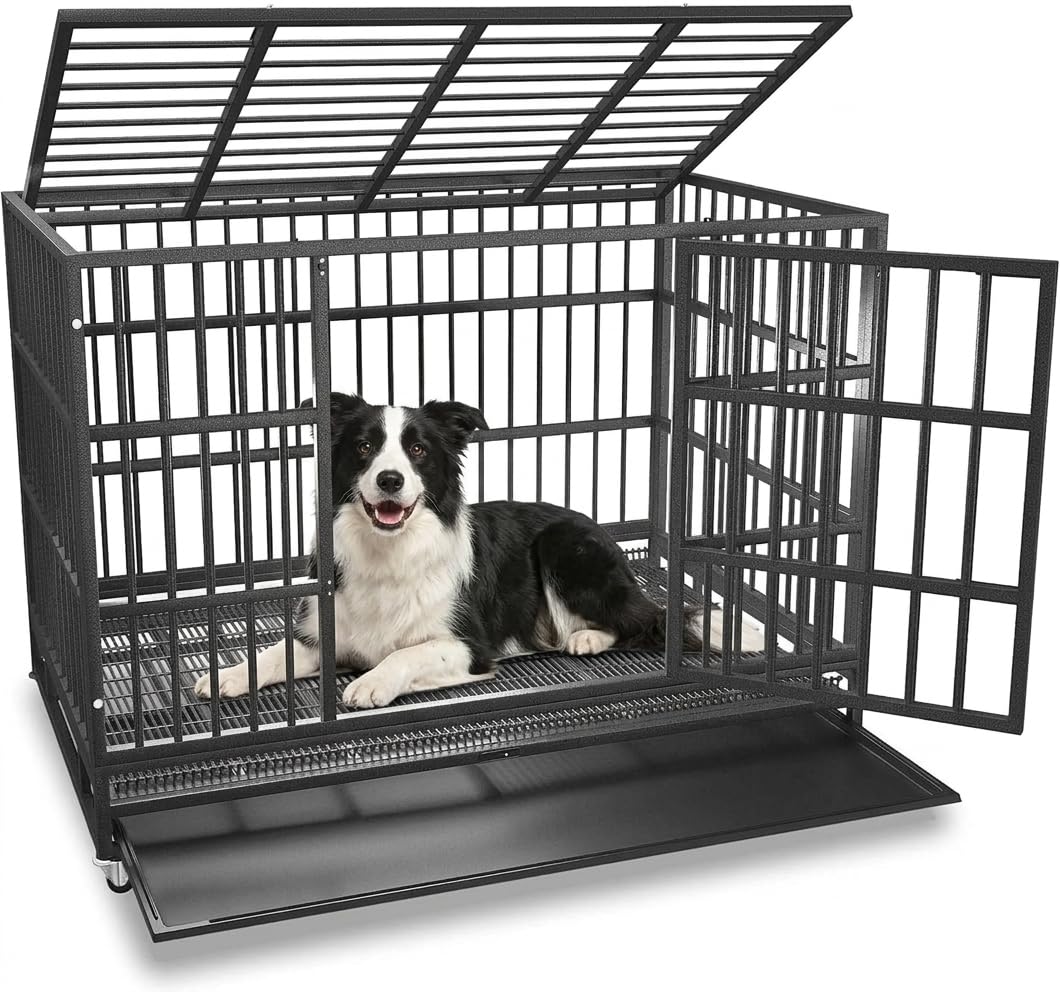
BOLDBONE 38-Inch Crate

BOLDBONE 38-Inch Crate

Medium-large dogs

Our Score 9.2/10
Check Price

Worth Noting

  • 38-inch length is tight for giant breeds
Doors
Double front doors
Frame
20-gauge steel, 0.5" tube
Weight
58 lb
Exterior Dimensions
38"L x 26"W x 31"H
Read the full review

The strongest sturdiness signal in this set belongs to its smallest crate. Fifty-eight pounds of 20-gauge steel, half-inch tube, welded panels and a hammer-tone finish that shrugs off teeth and damp — for a dog in the 50-to-90 pound range, this is the crate we point to first.

It is also the least annoying to own. Most of the frame arrives already assembled, one person finishes it in about ten minutes, and the double front doors swing wide on a low threshold — a detail we appreciated once we pictured a nervous dog stepping over a lip every time it went in. The pan lifts out, and the casters lock.

Then there is the length. Thirty-eight inches is generous for a medium dog and tight for a tall one, and a crate that is too short is a crate a dog will fight. Measure nose to the base of the tail and floor to the top of the head; if your dog sits at the top of the large-breed range, go to a 48-inch crate instead, and the KOKOTANGS is the one.

One thing to do on arrival: the front-door welds carry the load when a dog charges the door, so look them over along with the latch bolts before the dog goes in, and again after the first month, which is when anything loose tends to show itself.

Bottom line: We point people with a 50-to-90 pound dog here first: the sturdiest crate we handled in this size, and the ten-minute one-person setup is real.

3

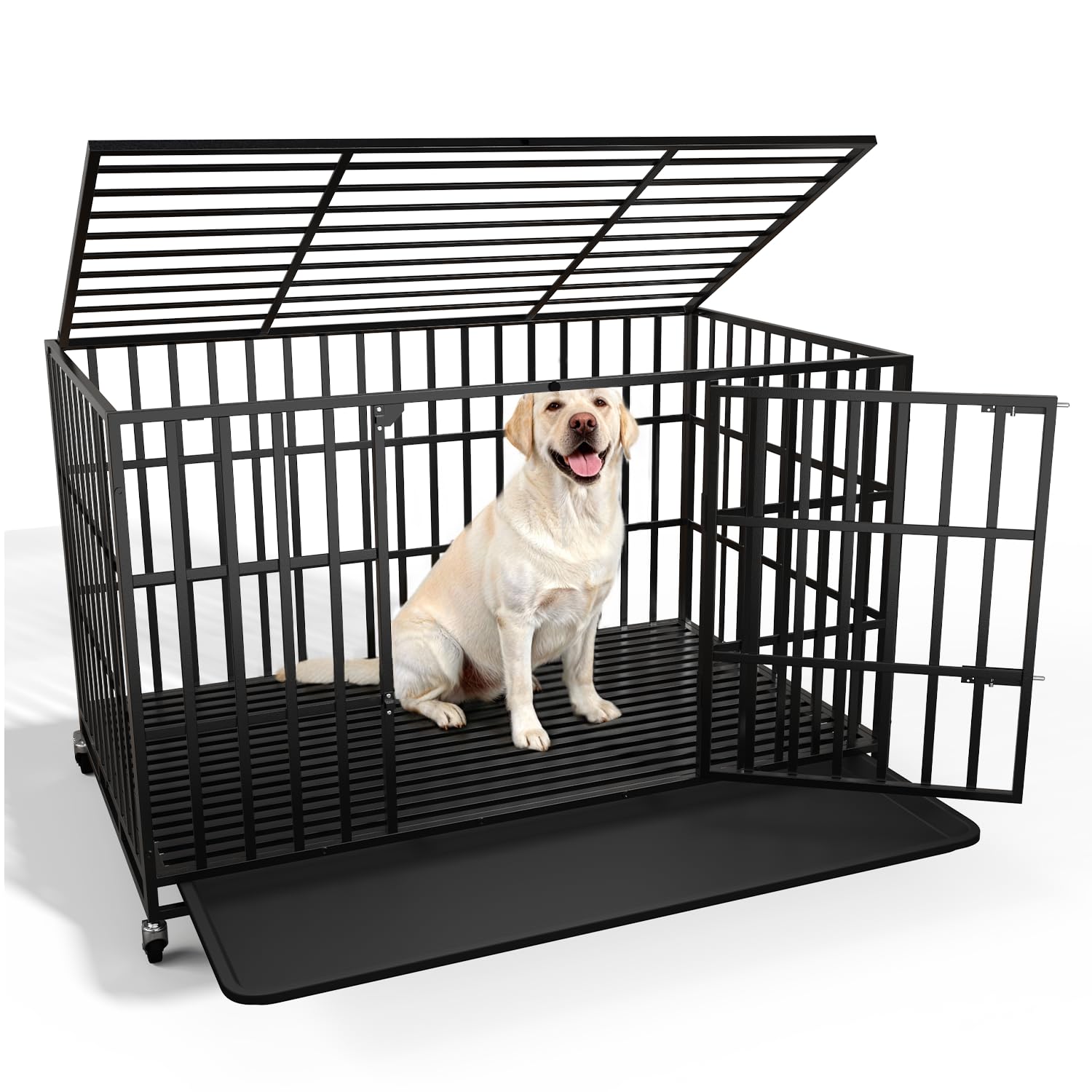
LEMBERI 48-Inch Crate

LEMBERI 48-Inch Crate

Budget setups

Our Score 9.2/10
Check Price

Worth Noting

  • Caster locks do not hold reliably
  • Top hatch latch can need adjusting
Doors
Front and top
Floor
Grate with slide-out tray
Weight
53.6 lb
Exterior Dimensions
47.24"L x 28.35"W x 30.12"H
Read the full review

This is the least expensive crate here, and it is a real steel crate — dual door latches, a top hatch, a slide-out tray under a floor grate — rather than a wire kennel with heavy duty in the title.

The numbers are 47.24 by 28.35 by 30.12 inches at 53.6 pounds, which makes it the lightest of the 48s and the easiest to wheel between rooms. The grate-and-tray floor is the kind you hose off, and the top hatch is genuinely useful for reaching in without swinging the whole front open.

Our honest read is that the money went into the panels rather than the hardware. The casters are listed as lockable and in practice they do not always hold, and the top hatch is the latch most likely to need a second look — open and close it a dozen times before you trust it with a dog who is already an escape artist.

It is not indestructible either, and nothing at this price is. A dog that has bent a door on a wire crate will eventually find the weakest latch here, which is why the heavier 48s cost more. For an occasional Houdini, or for a second crate in another room, it does the job for the least money in this group.

Bottom line: We recommend it to anyone who wants a full-size steel crate for the least money and does not need the last word in door hardware.

4

NUGRIART 48-Inch Crate

NUGRIART 48-Inch Crate

Solid floors

Our Score 9.2/10
Check Price

Worth Noting

  • Runs small for an extra-large label
Floor
Baseplate rated to 250 lb
Frame
20-gauge steel, 0.8" tube
Weight
77.2 lb
Exterior Dimensions
47.2"L x 29.8"W x 34.6"H
Read the full review

Nearly every crate here gives your dog a grid floor with a tray underneath. This one gives them a solid baseplate, braced and rated to 250 pounds, and the appeal is obvious the first time you picture a nervous dog's toes slipping between bars.

The rest aims at the same buyer: 0.8-inch steel tube, a 20-gauge frame, 47.2 by 29.8 by 34.6 inches, 77.2 pounds, and four casters with a brake on each one. That last detail is what we liked most — individual brakes keep a heavy crate from pivoting on a hard floor when a dog throws itself sideways.

It is an also-consider rather than a runner-up for a plain reason: there is far less history behind this crate than behind the ones above it, and a crate is a purchase you make on evidence. What there is, though, is consistent, and the floor is the most considered piece of design in this group.

If your dog digs at the floor, has caught a toe in a grate, or you are tired of hosing out a tray, this is the one to look at. Measure first — it runs small for something sold as extra large, and a dog that cannot stand up straight will let you know.

Bottom line: For a dog that digs at its bedding, the solid baseplate here is the best answer in this group; just measure carefully before you order.

5

VERIFURTY 48-Inch Crate

VERIFURTY 48-Inch Crate

Secure latches

Our Score 9.0/10
Check Price

Worth Noting

  • Pricier than the other steel 48s here
Doors
Front and side
Latch
Self-locking on close
Weight
71.5 lb
Exterior Dimensions
47.2"L x 29.5"W x 33.4"H
Read the full review

Push the door and it locks. That is the idea — the latch here engages as the door swings shut, so there is no bolt to slide and no way to leave the crate unsecured because your other hand was full.

The rest is a solid if unexciting 48: 47.2 by 29.5 by 33.4 inches, 71.5 pounds, steel tube and panels under a scratch-resistant coating, a front door and a side door so it can sit in a corner either way, and a floor that lifts out in panels instead of sliding as one long tray. We liked that floor more than we expected to — it comes out in pieces you can carry.

Assembly is the least fiddly of the big crates here, with fewer fasteners to line up. It is heavier than it looks once it is built, so pick the spot before you start rather than shuffling it around afterwards.

What tips it for us is that it fixes the most common cause of an escape, and that is not a strong dog — it is a door someone did not quite close. It is the priciest of the steel 48s, but if your dog has ever been found loose next to an open door, this is the crate that answers that.

Bottom line: Buy it if the door is the weak point in your house: it locks itself as it swings shut, which is the failure a slide bolt cannot prevent.

6

HIWOKK 48-Inch Crate

HIWOKK 48-Inch Crate

Thickest bars

Our Score 9.0/10
Check Price

Worth Noting

  • Latch hardware feels loose
Doors
Front and top
Floor
Grate with leak-proof tray
Frame
0.8" square steel tube
Sizes
Small to XXXL
Read the full review

The frame is as thick as anything here — 0.8-inch square steel tube — and you feel it the moment you lift a panel. The latches are the other thing you notice, and not in a good way: they are the one part of this crate we came away unsure about.

Around that frame it is a sensible 48: a front door for the dog, a top hatch for feeding and reaching in without opening the whole crate, a slide-out leak-proof tray over a grate, and an assembly that really is minutes rather than an afternoon. The tray seals, which matters when the alternative is wiping out the space under the floor. The steel is the argument — thick tube, industrial-grade joints, panels that do not flex when you press them.

Where it lands is somewhere between a bargain and a gamble. It is a lot of steel for the money and it does the containment job, but work the door and the hatch a dozen times when it arrives, check that both close with a solid click, and send it back if they do not. A loose latch undoes everything the frame is doing.

Bottom line: We recommend it for the steel and not the latches: check the door hardware on arrival, and it is a lot of frame for the money.

7

Rexwelten 42-Inch Crate

Rexwelten 42-Inch Crate

Living-room looks

Our Score 9.0/10
Check Price

Worth Noting

  • Wood panels can be chewed
  • Door hinges and latches are weak points
Panels
0.5-inch ventilation holes
Weight
81.5 lb
Material
Steel and wood panels
Exterior Dimensions
43.3"L x 29.5"W x 31.7"H
Read the full review

Some dogs never settle behind bars. If yours paces, drools or screams at the sight of a wire crate, this is the alternative: a panelled box with half-inch ventilation holes instead of a view, closer to a den than a kennel.

It is furniture as much as crate — 43.3 by 29.5 by 31.7 inches, an alloy steel frame with reinforced wood panels, a removable floor, double doors and locks worked from outside. In a living room it reads as a cabinet, which is entirely the point, and at 81.5 pounds it stays where you put it.

Living with it is easier than living with a cage. The floor lifts out for cleaning, the doors open wide, and the flat top and panelled sides are what let it pass as furniture rather than a pen. If the crate has to sit in the room you actually use, that changes how often the dog is in it.

So this is the pick for the anxious dog who is not a destroyer: the one who needs a quieter, darker space and a crate that does not take over the room. If your dog has already chewed through a wire crate, it is not the crate for you — take one of the steel boxes above and save yourself the repair bill.

Bottom line: We recommend it for the anxious dog that settles in a den and does not chew — not for the one that has already destroyed a crate.

8

Oranland 38-Inch Crate

Oranland 38-Inch Crate

Compact footprint

Our Score 8.8/10
Check Price

Worth Noting

  • Too short for tall dogs
Floor
Baseplate rated to 300 lb
Frame
20-gauge steel, 0.8" piping
Weight
62 lb
Exterior Dimensions
37.6"L x 25.7"W x 31"H
Read the full review

Silver rather than the usual black sounds like a small thing until the crate is sitting in a bedroom, and the lighter finish is a real part of why this one reads as furniture rather than gym equipment. Underneath it is serious: 20-gauge steel panels, 0.8-inch piping, a baseplate rated to 300 pounds, and 62 pounds of crate at 37.6 by 25.7 by 31 inches.

That baseplate is the reason to choose it over the similarly sized BOLDBONE — a digger or a paw-dragger gets a flat floor instead of a grate, and the whole thing feels denser than its size suggests. It is the heaviest small crate here, and that is the trade: harder to shove into a corner, better behaved once it is there.

The finish is the other thing to think about. Coated steel is only as good as its driest day, so keep this one out of a damp garage and dry the baseplate after cleaning. Rust at the welds is what ages a crate like this early, and it is the one maintenance job this one asks of you.

Bottom line: We recommend it for a medium dog in a bedroom where a black cage would be an eyesore; measure height first, because this one is short.

How We Tested the Best Crates for Anxious Dogs

We started by reading veterinary behavior guidance and pulling every crate marketed for escape artists and separation anxiety, then filtered by bar gauge, weld type, latch design, price, and available sizes. Anything with a single-point latch, a pan that cracked in owner reviews, or bar spacing wide enough for a muzzle to slip through came off the list. That left 10 crates, which we've now used for seven months in homes with dogs that have chewed their way out of lesser ones.

Every crate arrived unassembled, so we built each one alone with a stopwatch running, noting how many steps it took, whether the holes lined up, and how much of the job needed a second pair of hands. We weighed each crate, measured its interior against the listed dimensions, checked bar spacing and welds by hand, and pushed on the walls to see how far they flexed. We logged what came in the box too — tools, dividers, replacement parts — since that's often where the price gap between two similar-looking crates actually shows up.

Then the dogs moved in. We fed in each crate, closed the door for short absences, and used them overnight and on car trips. Latches got the hardest look: I worked every one one-handed, then with a treat-smeared glove to see whether a nose or paw could slide it, and checked for secondary locks and drop pins a dog could reach. We rolled each crate across hardwood and lifted it through doorways to judge mobility, and over the months we tracked weld failures, pan cracks, coating wear, and latches that loosened with use.

How to Choose High Anxiety Dog Crates

Measure the dog, not the product title

Every crate here is sold on its outside dimensions, and the inside is what your dog actually lives in. Measure from the base of the tail to the nose, and from the floor to the top of the head, then allow a couple of inches above the head and enough length to lie flat with the legs out. The NUGRIART lists 47.2 inches outside and 45.8 inside; that inch and a half is the difference between standing up and ducking.

A crate that is too short is the one problem no amount of steel fixes, because a hunched dog will fight the box. If your dog is at the top of the large-breed range, the 48-inch crates here are the starting point, not the 38s.

The door is where escapes actually happen

Crates fail at the latch far more often than at the panel. Slide bolts are simple and visible — you can see at a glance whether they are home — but they do nothing if the door was never shut. A self-locking latch, like the one on the VERIFURTY, engages as the door swings and removes that failure completely.

When a crate arrives, open and close every door a dozen times, including the top hatch if it has one. If a latch is loose, stiff or does not click home, exchange the crate rather than living with it. That part is the entire security system.

Gauge, tube size and what the weight tells you

Titles say heavy duty; the numbers say more. Look for the steel gauge (20-gauge is the standard across this set), the tube diameter (0.5 to 0.8 inch) and the crate weight, because an 88-pound crate has a lot more steel in it than a 53-pound one. Heavier crates stay put when a dog hits the door, and they are a two-person job on stairs.

Casters bridge that gap, but they are also the most common hardware failure in this category. Lock what you can, and brace the crate against a wall rather than trusting the wheels to hold a dog that throws itself sideways.

Grate and tray, or a solid floor

The usual floor is a metal grate over a slide-out tray: waste drops through and you hose the tray off. It works, it is easy to clean, and it is what most of these crates use. The risk is a dog that digs, which can catch a toe between the bars.

A solid baseplate — the NUGRIART and Oranland both use one — removes that risk and gives a nervous dog a flat surface to settle on, at the cost of a floor you lift out and scrub instead of sliding out and rinsing. If your dog scratches at bedding, pick the baseplate.

Frequently Asked Questions

Final Verdict

The KOKOTANGS is what we tell most people to buy. It gives the most interior room in this set, a 20-gauge frame with 0.6-inch tube, and a top hatch that lets you feed without swinging the front door open. It is not the cheapest crate here and it is not light, but it is the one that lets a big, anxious dog stand up and turn around.

If your dog is closer to 60 pounds than 100, the BOLDBONE does the same job in a shorter, sturdier box. And if the recurring problem in your house is a door someone forgot to close, the VERIFURTY's self-locking latch is the fix.