Grooming

Best Medicated Dog Shampoo of 2026

Somewhere around the third night of a dog scratching himself raw, you start reading ingredient labels by flashlight. Medicated shampoo is not a glamorous purchase — it's what you buy after the oatmeal bottle stops working and the vet bill is already a painful number. The catch is that a formula strong enough to calm a yeast flare or a bacterial hot spot is also strong enough to strip a coat or sting skin that's already cracked, so the good ones do their job without leaving your dog worse off.

I've been bathing dogs in my own tub for years — the current patient is a 70-pound shepherd mix who treats bath time as a personal betrayal — and my team and I spent the last four months working through 14 medicated formulas on dogs with flaky skin, itchy paws, and one stubborn ear situation. The differences show up fast: how the lather rinses out, whether the medicinal smell hangs around into the next week, and whether your dog stops scratching because the itch is gone or just because he's worn out. The ones below earned a second bottle.

1

Douxo S3 PYO Shampoo

Top Pick
Douxo S3 PYO Shampoo

Recurring infections

Our Score 9.4/10
Check Price

Worth Noting

  • Premium price compared with the rest
Scent
Coconut and vanilla
Volume
16.9 fl oz
Species
Dogs and cats
Active Ingredients
Chlorhexidine, 0.5% Ophytrium
Read the full review

Douxo S3 PYO sits at the top end of this group on price, and what that premium buys is the gentlest formula here. This is the shampoo you can put on a dog twice a week for a month without the coat starting to look like straw, which is exactly what a stubborn infection asks of you.

The active is chlorhexidine, which handles bacteria and the yeast that follows them, plus 0.5% Ophytrium, a soothing ingredient built to keep skin hydrated through repeated washing. What's missing matters as much: no soap, no sulfates, no parabens, no colorants, no phthalates. On a dog whose skin is already red and raw, that short ingredient list is the whole point.

Our one practical note is the rinse. The lather stays slippery on the coat long after it looks gone, so budget twice the rinsing time you think you need, especially on a double coat — a slick patch behind the ears is shampoo, not conditioner. Do that and Douxo earns its keep: it lets you treat aggressively without drying the skin out, and at 16.9 ounces it is the largest bottle in this group, so a full course doesn't leave you reordering mid-treatment.

Bottom line: If your dog is on a twice-weekly bathing schedule for a stubborn infection, Douxo's soap-free formula is the one we trust to keep treating without stripping the coat.

2

MiconaHex+Triz Shampoo

MiconaHex+Triz Shampoo

Stubborn yeast

Our Score 9.4/10
Check Price

Worth Noting

  • The priciest bottle in this group
  • A treatment course, not a maintenance shampoo
Scent
Unscented
Volume
16 fl oz
Species
Dogs, cats, horses
Active Ingredients
2% chlorhexidine, 2% miconazole
Read the full review

Yeast is the infection that keeps coming back. It shows up as a musty smell that survives a bath, brownish discharge in the ears, licking at the paws, or a greasy patch in a skin fold — and it is the reason a dog can improve on a chlorhexidine shampoo and slide right back a fortnight later.

MiconaHex+Triz pairs 2% chlorhexidine with 2% miconazole, and the miconazole is the piece most medicated shampoos here don't have. That is the antifungal half, the part that goes after a Malassezia overgrowth instead of only knocking down the bacteria sitting on top of it. The base is moisturizing rather than stripping, so a course of it doesn't leave the coat brittle.

Two things we appreciate beyond the actives: it is unscented, which matters on skin that is already inflamed, and it is labeled for cats and horses as well as dogs, so a multi-pet house can share one bottle. The 16-ounce size is standard for this group. The price is not.

This is a treatment, not a maintenance shampoo. Use it on a schedule while the flare is active, then step down to something milder, because running it indefinitely is expensive and unnecessary. For a confirmed fungal case — especially one that has already come back once — the extra spend buys the ingredient the cheaper bottles leave out, and that is usually the difference between clearing it and starting over.

Bottom line: Yeast that keeps coming back needs an antifungal, and the miconazole in this bottle is worth the premium over a chlorhexidine-only shampoo.

3

Zymox Shampoo

Zymox Shampoo

Sensitive skin

Our Score 9.4/10
Check Price

Worth Noting

  • 12 oz, less than the budget bottles
Volume
12 fl oz
Formula
Tear-free, no-sting
Species
Dogs and cats
Key Ingredients
Zinc, vitamin D
Read the full review

There is no chlorhexidine in Zymox, no coal tar, no sulfur. On a shelf full of harsh actives, that is the recommendation: it is the bottle for the dog whose skin gets redder every time you try to help.

What is in it instead is zinc and vitamin D, in a base free of harsh detergents, chlorine, and petroleum by-products. It is tear-free and doesn't sting, which sounds like a small thing until you are washing a face or a set of ears on a dog that has learned to fear the hose. It lathers well and rinses clean, and the scent is mild enough that the dog doesn't smell like a pharmacy afterward.

It is the mildest thing we recommend, and it behaves like it. On a seasonal itch or a nervous first-timer, that is plenty. On a confirmed infection with broken skin, it is the wrong tool and you will lose a week finding out. Twelve ounces also puts it behind the budget bottles on value. But for the dog that reacts to everything, a gentle formula you will actually keep using beats a strong one you are afraid of.

Bottom line: Zymox is the gentle option we keep in reserve: no chlorhexidine, no sting, and nothing that will make a reactive dog's skin angrier.

4

Vetoquinol Sulfur Shampoo

Vetoquinol Sulfur Shampoo

Greasy, smelly coats

Our Score 9.4/10
Check Price

Worth Noting

  • Premium price for a maintenance shampoo
Scent
Unscented
Volume
16 fl oz
Species
Dogs, cats, horses
Active Ingredients
Chloroxylenol 2%, salicylic acid 2%, sodium thiosulfate 2%
Read the full review

A dog that smells yeasty again three days after a bath usually has grease in the coat feeding the problem, not dirt. That is the dog Vetoquinol's sulfur shampoo is built for.

The formula pairs chloroxylenol 2%, salicylic acid 2%, and sodium thiosulfate 2%, a soluble sulfur source, in a pH-balanced, dye-free base. Together they degrease, deodorize, and exfoliate — the sulfur goes after the smell at its source rather than covering it, and the salicylic acid keeps surface cells moving so the coat doesn't stay tacky.

It is labeled for dogs, cats, and horses, and it is safe to use alongside flea and tick treatments, which saves you from pausing a preventive to fit in a bath. A little goes a long way: we got a full lather out of a small squeeze, it rinses out of a thick coat without a fight, and it leaves the fur soft enough that a conditioner feels optional.

The catch is price and purpose. It is a premium bottle, and the degreasing is the whole point — on a dry, brittle coat it is the wrong direction and an oatmeal wash will do more good. On a greasy, smelly dog with yeasty feet and unhappy skin folds, though, nothing else in this group works quite like it, and the stink stays gone for days rather than hours.

Bottom line: Greasy, yeasty skin and the smell that comes with it are what this sulfur shampoo fixes best, and it is the most effective degreaser we recommend.

5

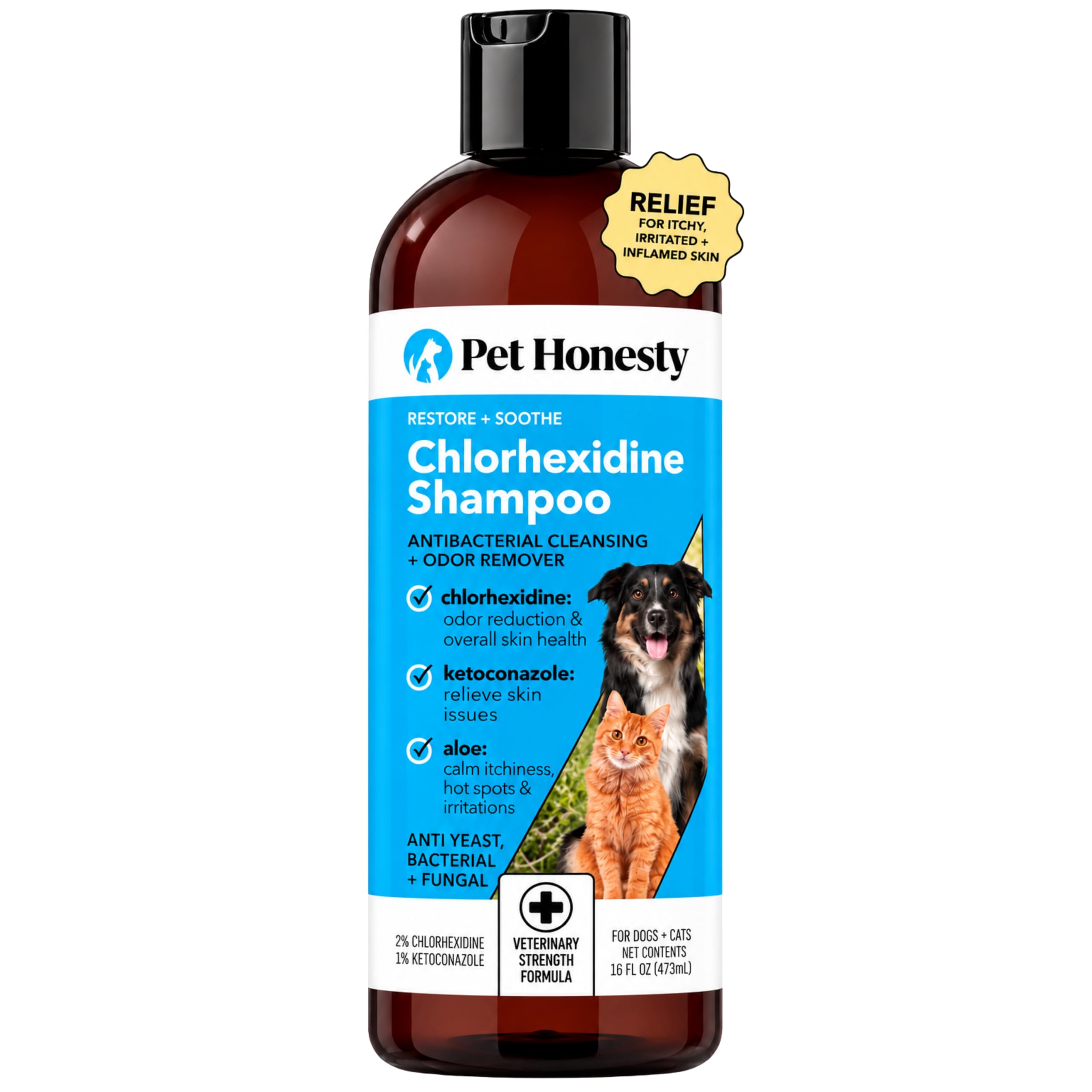
Pet Honesty Chlorhexidine Shampoo

Pet Honesty Chlorhexidine Shampoo

Bacterial and yeast

Our Score 9.2/10
Check Price

Worth Noting

  • Cucumber-melon fragrance is noticeable
  • Itching can return within a week of stopping
Scent
Cucumber melon
Volume
16 fl oz
Species
Dogs and cats
Active Ingredients
2% chlorhexidine, 1% ketoconazole
Read the full review

Turn the Pet Honesty bottle around and the case for it is on the ingredient panel: 2% chlorhexidine gluconate for the bacterial side of a skin problem and 1% ketoconazole for the yeast. Most medicated shampoos here carry one or the other. Having both in one 16-ounce bottle is why this is the bottle we recommend first to someone with an itchy, musty, or patchy dog and no diagnosis yet.

It is built to be used, not just tolerated. The formula skips sulfates, parabens, phthalates, and alcohol and includes aloe, so the coat comes out soft rather than straw-dry — the kind of thing you notice on the second bath, when the dog has stopped hiding behind the couch. The lather is thick and rinses clean, and the cucumber-melon scent is light enough that it doesn't announce itself across the room.

Plan on a course, not a single bath. Lather, leave it on for the better part of ten minutes — a lick mat on the shower wall buys most of that — and repeat twice a week while the skin is angry, then weekly to hold the result. That schedule is where the visible improvement comes from, and it is also the part people abandon early.

The one place it loses ground is fragrance: cucumber-melon is a choice, and a dog with genuinely reactive skin is better served by one of the unscented bottles here. Everyone else gets a formula that handles a hot spot brewing on a flank, the itch that never quite becomes a diagnosis, and the ordinary smelly dog. It is also the bottle we mind least sitting half-full in the cupboard once the flare passes, which is more of a compliment than it sounds.

Bottom line: With chlorhexidine and ketoconazole in one bottle, this is the medicated shampoo we point dog owners to first — it covers the two most common skin infections without a vet-brand price.

6

Curaseb Chlorhex 4% Shampoo

Curaseb Chlorhex 4% Shampoo

Hot spots

Our Score 9.2/10
Check Price

Worth Noting

  • Smallest bottle here at 8 oz
Scent
Blueberry
Volume
8 fl oz
Age Range
All life stages
Active Ingredients
4% chlorhexidine
Read the full review

Four percent chlorhexidine is the number that separates Curaseb from the rest of this group — double the 2% you'll find in most of the bottles here, in the smallest package on the page.

That concentration is aimed at the ugly stuff: hot spots, a paw the dog won't stop licking, chin acne, and the raw patches that appear after a weekend of scratching. On an active hot spot, a stronger chlorhexidine does in two baths what a mild shampoo takes a week to manage, which is why we keep this one on the shelf for flares rather than routine washing.

The trade-offs are size and consistency. Eight ounces is roughly half a standard bottle, so it runs out mid-course if you are bathing a large dog twice a week — though for a small dog or a single hot spot, a bottle you actually finish beats a giant one that goes off in the cupboard. It is labeled for all life stages and for cats, and the blueberry scent is the friendliest in the group, which helps when the patient is a wriggler.

Bottom line: A hot spot or a dog who won't leave a paw alone calls for the strongest chlorhexidine in this group, and that is what Curaseb is.

7

Veterinary Formula Antiseptic Shampoo

Veterinary Formula Antiseptic Shampoo

Budget first-aid

Our Score 9.2/10
Check Price

Worth Noting

  • No active strength printed on the label
  • Citrus scent is stronger than needed
Scent
Citrus
Volume
16 fl oz
Age Limit
12 weeks and older
Key Benefit
Antiseptic and antifungal
Read the full review

When there's a crusty patch on a dog and no diagnosis yet, this is the bottle we start people on. It is antiseptic and antifungal in one wash, it is budget, and it is gentle enough to use twice a week on a dog over twelve weeks old while you work out whether the problem is bacterial, fungal, or neither.

The routine on the label is the one to follow: lather, leave it on for five to ten minutes, bathe twice a week until the skin clears, then drop to once a week to hold it. That maintenance step is the one people skip, and it is usually why the itching comes back a month later. The citrus scent is strong out of the bottle, the lather is generous, and the coat comes out soft and shiny — the vitamin E and the pH-balanced base do that without soap or parabens.

What the label doesn't give you is a number. There is no active strength printed alongside the claim, so this is a shampoo you buy on faith and judge by the dog. Watch the skin rather than the calendar: if a patch is redder, or the coat is thinning where you have been washing after two weeks, stop and get it looked at. If the dog is simply calmer, you have your answer for a fraction of a specialist formula.

Bottom line: For a first medicated bath on an itchy dog with no diagnosis, this is the least expensive way to find out whether medicated washing helps.

8

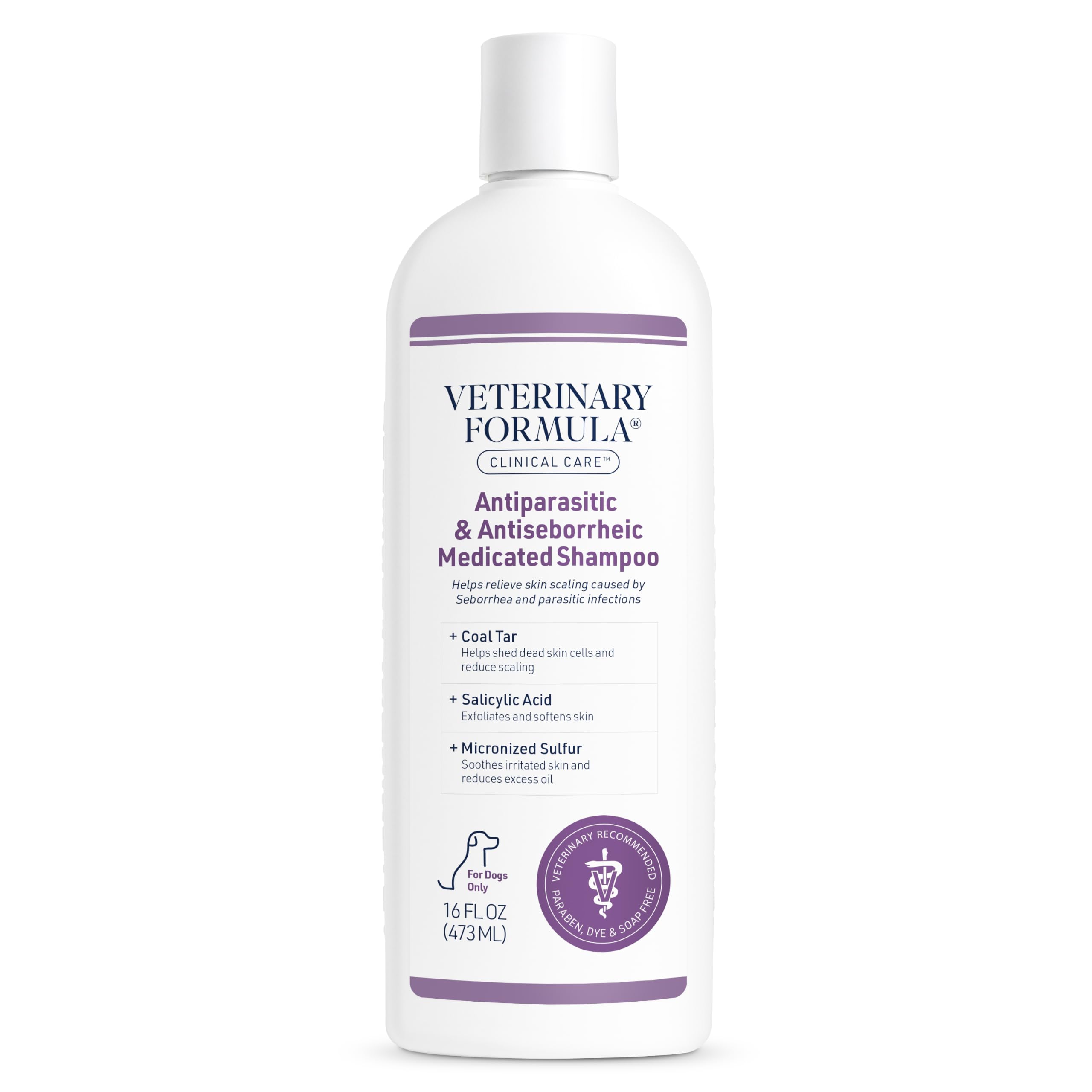
Veterinary Formula Antiparasitic Shampoo

Veterinary Formula Antiparasitic Shampoo

Flaky, oily skin

Our Score 9.0/10
Check Price

Worth Noting

  • Strong medicinal smell that lingers
  • Can dry the skin with repeated use
Scent
Medicinal
Volume
16 fl oz
Contact Time
10 minutes
Active Ingredients
Coal tar, salicylic acid
Read the full review

Unscrew the cap and there's no doubt what's inside: coal tar, sharp and tarry, the smell of a road being resurfaced. It hangs on the coat for a day or so after the bath. That's the price of admission, and for a dog with scaly, greasy skin, it's worth paying.

Coal tar and salicylic acid are the classic pairing for seborrhea — the salicylic acid lifts dead cells while the coal tar slows the turnover that keeps producing them, and oatmeal and allantoin soften the landing. We think it's the strongest value here for flaky, oily skin. One thing worth knowing before you panic: the first bath can make the coat look worse, with flakes coming loose in the towel. That's dead skin leaving, not a reaction. Leave it on for the full ten minutes.

Where it falls down is comfort. Repeated use can leave skin drier than it started, so this is a twice-a-week-until-clear shampoo rather than an everyday wash, and a dog whose coat is already dry and brittle is better off with an oatmeal formula. Everyone else gets a lot of medicine for very little money, and a coat that comes out shinier than it has any right to.

Bottom line: Scaly, greasy, seborrheic skin is what this bottle is built for, and nothing else here does that job for less.

How We Tested 14 Medicated Dog Shampoos

We started with a list of about 40 medicated shampoos and narrowed it by reading the back of the bottle instead of the front. Chlorhexidine, ketoconazole, miconazole, colloidal oatmeal, and salicylic acid turned up most often as actives, and we kept a mix of all five so we were comparing across skin problems rather than within one ingredient. Anything that put fragrance or a long conditioning list ahead of the active got set aside. That left 14 formulas, all bought at retail and each used for the full four months.

The baths happened where our dogs actually get washed: my tub with a handheld sprayer, a backyard hose when the weather cooperated, and a groomer's tub for the two heaviest shedders. Every shampoo got at least four baths, and we followed each label's contact time, usually five to ten minutes, since that dwell time does more work than the active ingredient does. Between baths we noted how many days passed before the scratching started up again.

Right after each rinse we checked the belly and the skin under the collar for redness, and watched whether the dog pawed at his ears or tried to leave. I also lathered a little of each one onto the inside of my wrist, where a scratch was still healing, to feel which ones stung. Over the following two weeks we counted scratching bouts at the same time each evening, tracked flaking and whether bald patches were filling back in, and sniffed the washed spot and the dog's bed on days one, three, and seven.

Bottle size and dilution got measured rather than guessed: we marked the level on every bottle and calculated cost per bath for a 60-pound dog, because a shampoo that swallows a quarter cup per wash isn't a value at any shelf price. At the end of four months we re-bathed the itchiest dogs with our favorites to confirm the flaking stayed away and the coats didn't dry out.

How to Choose the Right Medicated Dog Shampoo

Match the Active to the Condition

Chlorhexidine is the antibacterial workhorse, and it does some good against yeast on its own. Ketoconazole and miconazole are the dedicated antifungals, which is why a dog with a musty smell or brown ear discharge usually does better on a formula that includes one. Coal tar and salicylic acid are for scale and oil — dandruff, seborrhea, a greasy coat. Sulfur and chloroxylenol go after grease and odor.

If you don't know what you're treating, start with a dual-active bottle rather than guessing at a single ingredient. A week spent on the wrong active is a week the skin spends getting worse.

Give It the Full Contact Time

Every label here asks for something people skip: five to ten minutes of contact before rinsing. That is the difference between treating the skin and washing the coat. Lather, set a timer, and keep the dog warm and occupied — a lick mat pressed onto the shower wall is the cheapest piece of grooming kit we know of.

Rinsing matters just as much. Soap-free formulas stay slippery long after the suds disappear, so rinse until the water runs clear, then do the chest and armpits again. Anything left behind dries into an itch.

Think Cost Per Bath, Not Bottle Price

A 16-ounce bottle and an 8-ounce bottle can look like similar money and be nothing alike per wash. A thick formula that lathers heavily goes further; a thin one needs a second application. For a two-week course of twice-weekly baths on a Labrador, a small bottle runs out before the skin clears.

For one hot spot on a terrier, the small bottle is the smarter buy — a medicated shampoo that sits open in a cupboard for two years has lost most of its point.

Decide How Much Scent You Want

Medicated actives smell. Coal tar is unmistakable; sulfur is close behind. If your dog's skin is inflamed, unscented is the safer default, and there are bottles here that skip fragrance entirely.

A pleasant scent still earns its place for a reason that has nothing to do with medicine: a dog that smells good afterward gets bathed more willingly, and a dog bathed on schedule heals faster. Just don't let a nice smell stand in for an active that matches the problem.

Know When It Isn't a Shampoo Problem

Shampoo treats surface infections and supports the skin barrier. It does not fix mites, ringworm, hormonal conditions, or a food allergy, and it won't close a lesion that's oozing. If the skin is broken, spreading, or the dog is losing coat in patches, get a diagnosis before you buy anything.

The practical test: two weeks of twice-weekly baths with the right active, no improvement, book the appointment.

Frequently Asked Questions

Final Verdict

Pet Honesty's chlorhexidine-and-ketoconazole formula is the one we point most people to first. Two actives, a mid-range price, and enough volume to get through a full course is a combination nothing else here matches, and it covers the two most common skin infections without asking you to know which one your dog has.

If the infection keeps returning and your vet is already involved, Douxo's soap-free S3 is the gentler bottle worth the upgrade for a long bathing schedule. And if the coat is scaly and greasy rather than infected, the coal tar Veterinary Formula does that job for the least money in this group — as long as you can live with the smell.