Food & Treats

Best Pig Ears for Dogs of 2026

A pig ear is one of the great dog-chew bargains—cheap, engaging, and long-lasting enough to buy you a quiet half hour. But the range is wild: some are greasy and reek, some are so hard they worry you, and some disappear before you've finished your coffee. I've got a 70-pound lab mix who treats every chew like a competition, so I know the wrong ear means a mess on the rug or a dog that loses interest fast. What you're really shopping for is a chew that lasts, doesn't stink up the living room, and suits your dog's size and chewing style.

We spent three months testing 14 pig ears with a rotating crew of dogs, from a 12-pound terrier to a 90-pound shepherd. Price wasn't a reliable guide: the cheapest ears were often the smelliest, and a few pricey ones splintered early. The picks below earned their spot in the treat bin, whether your dog is a delicate nibbler or a power chewer.

1

Canine Butcher Shop Large Whole Pig Ears

Top Pick
Canine Butcher Shop Large Whole Pig Ears

Large dogs

Our Score 9.2/10
Check Price

Worth Noting

  • Ear sizes vary within the bag
Count
30 ears
Format
Whole pig ears
Weight
2.5 lb
Sourcing
USA pig ears
Read the full review

Size is the first thing that lands. These are whole ears at butcher-shop scale, the kind a big dog has to hold down with a paw, and thirty of them come in the bag. That matters more than any wording on the front: a large ear is a longer chew, and it's harder to gulp in one go than a thin strip. The ears are USA-sourced pork, slow cooked and then dried, with nothing else in the bag.

We were also struck by how clean they stay in the hand. The bake leaves them dry rather than greasy, so a session on the living room rug doesn't end with a patch to scrub, and the smell stays in the porky range instead of drifting through the house. In a category where the smell is the usual complaint, that counts for a lot.

How long one lasts depends entirely on the mouth it's in. A gentle chewer will work at a single ear across several sittings; a dog that inhales everything is through one quickly, and for that dog the answer is to take the ear away once it's down to a stub rather than expect the ear to outlast the enthusiasm.

With thirty ears in the bag, storage is worth a thought: keep it sealed and dry, and freeze what you won't use soon if your kitchen runs humid. A stale ear gets refused, and a refused ear is money in the bin.

Bottom line: For most dogs, this is the bag we tell people to buy: big whole ears that take real work to finish, a clean bake that leaves no grease behind, and thirty of them to a box.

2

Best Bully Sticks Pig Ears

Best Bully Sticks Pig Ears

Domestic sourcing

Our Score 9.2/10
Check Price

Worth Noting

  • Premium price for a 25-count bag
Count
25 ears
Format
Whole pig ears
Weight
1.83 lb
Sourcing
USA baked and packed
Read the full review

Where a pig ear comes from is hard to check once it's in the bag, which is why the label on this one does real work: the ears are baked and packed in the USA, and the only ingredient listed is pork. For anyone who has opened a bag and wondered what they were actually feeding, that's the pitch.

They're crisp rather than leathery, and they break into smaller pieces as a dog works, which is what you want from a chew meant to be digested rather than worn down over a week. A busy dog stays with one for a stretch without needing help from you.

Our reservation is scale. Twenty-five ears is a modest bag next to the forty-piece halves and the fifty-count cartons here, and it sits in the upper price band, so it's one for someone who has decided domestic sourcing matters more than volume. We think that's a fair trade, as long as you go in knowing it.

Several ears in our bag were big enough that we split them for a smaller dog, so a twenty-five count goes further than the number suggests. Count on needing a second bag if you're feeding a big chewer weekly.

Bottom line: We point shoppers who care about domestic sourcing here: baked and packed in the USA, single ingredient, and firm enough to keep a busy dog working.

3

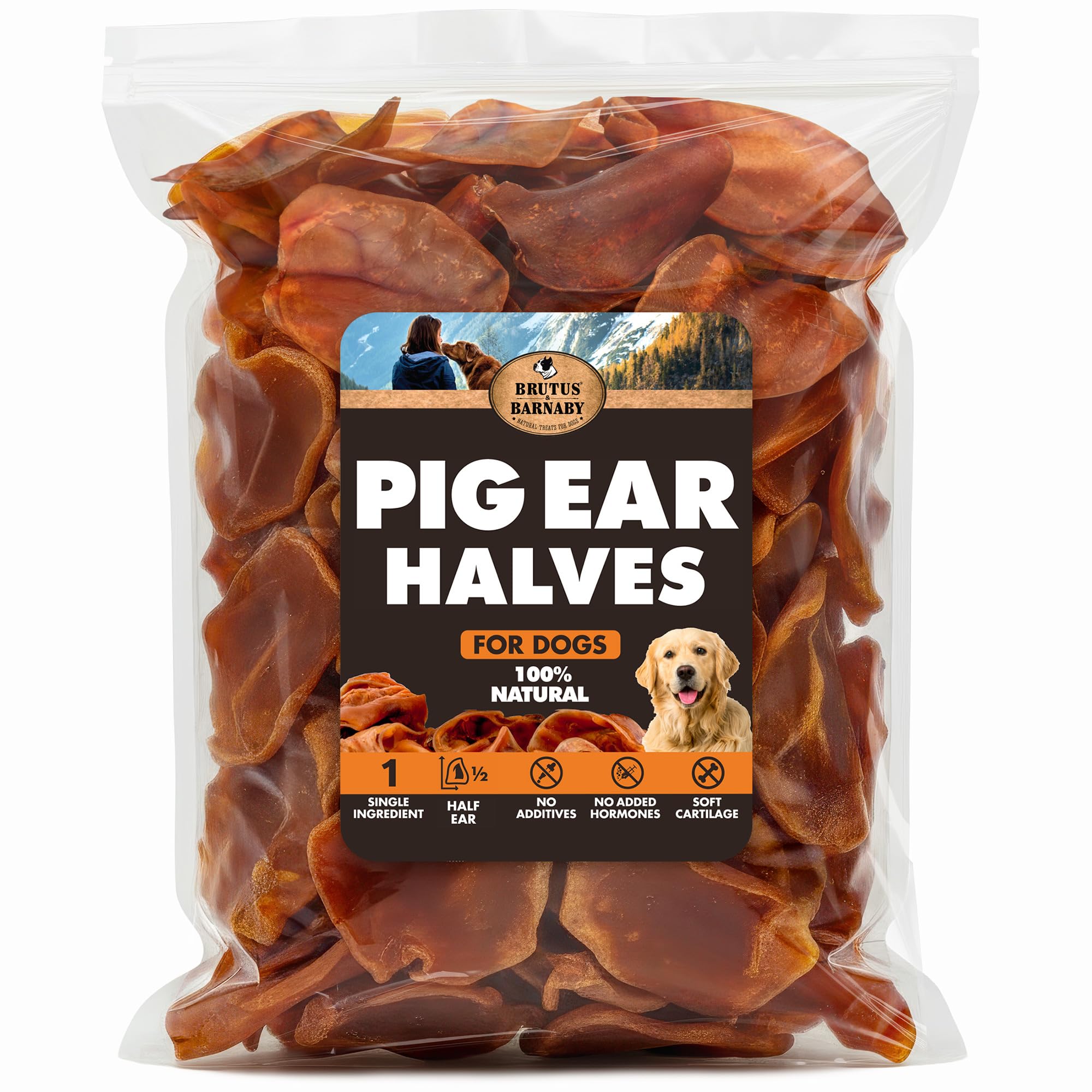
Brutus & Barnaby Pig Ear Halves

Brutus & Barnaby Pig Ear Halves

Multi-dog homes

Our Score 9.0/10
Check Price

Worth Noting

  • Some pieces are too hard for older dogs
Count
40 halves
Format
Halved pig ears
Ingredient
Single ingredient pork
Processing
Water cleaned, oven baked
Read the full review

Forty pieces is the practical argument. A half ear fits a small mouth, divides neatly between two dogs, and lets you hand out a treat without committing anyone to a twenty-minute project. If you've been buying whole ears and cutting them yourself, this bag does that work before it reaches you.

We think the cleaning is the quieter selling point. These are washed in boiling water rather than bleached, then oven-baked for days until they're dry and firm, and the result doesn't leave your fingers slick. Set against ears that come out of the bag shiny, that's a real difference in how pleasant it is to hand one over.

How long a single half lasts is a function of the dog: under a minute for a determined chewer, considerably longer for a lapdog that nibbles. That isn't a fault so much as a fact of the format. If what you want is a chew that eats an afternoon, whole ears are the better tool.

The pieces aren't uniform, which sounds like a flaw until you're the one sorting them: the bigger halves go to the bigger dog, the smaller ones become training rewards. A half also fits in a jacket pocket, which is more than you can say for a whole ear.

Bottom line: In a house with more than one dog, we reach for halves: forty pieces means everyone gets one, and a small dog isn't handed more chew than it can manage.

4

Nature Gnaws Pig Ears

Nature Gnaws Pig Ears

Strong chewers

Our Score 9.0/10
Check Price

Worth Noting

  • Only eight ears at a premium per ear
Count
8 ears
Format
Whole pig ears
Texture
Thick
Ingredient
Single ingredient pork
Read the full review

Some dogs treat a chew as a challenge and some treat it as a snack, and this bag is aimed squarely at the first kind. The ears are thick through the middle, whole rather than split, and big enough that a dog has to work around the edges before it gets anywhere. That's the right call for a hard chewer, and it's why these earn a spot despite the small count.

The texture is the point. These are dense, dry ears rather than brittle ones, so the chew breaks down gradually instead of shattering into shards a dog can gulp. Dogs stay with them, too — a single ear can hold a determined chewer's attention for a good stretch, which is the thing you're actually paying for.

Eight to a bag is the trade-off. It's the smallest bag here, which makes it a sensible first purchase and a poor one if you already know your dog loves pig ears and you're handing them out twice a week.

The upside of a small bag is that it gets finished before it goes stale, which is more than you can say for the fifty-count cartons. If you're testing whether your dog will take to pig ears at all, start here.

Bottom line: We keep these for the dogs that destroy everything in minutes: thick whole ears that give strong jaws a fight, in a bag small enough to try without regret.

5

Wonder Bound Whole Pig Ears

Wonder Bound Whole Pig Ears

First-time buyers

Our Score 9.0/10
Check Price

Worth Noting

  • Freshness varies between bags
Count
18 ears
Format
Whole pig ears
Weight
12.7 oz
Ingredient
100% pork, slow roasted
Read the full review

Same idea as the bag we recommend first, with a smaller commitment. These are whole, single-ingredient ears, slow roasted and packed eighteen at a time, which is about right for one dog and a couple of weeks of treating.

The ears themselves are the surprise. They run large and fairly consistent, so you aren't paying whole-ear money for strips, and the roast leaves them dry and savory rather than slick. These are the ones we hand to a dog that has never had a pig ear, because there's no leaner way to find out whether it will.

The recipe is plain: pork, no added hormones or antibiotics, no grain or artificial preservatives. Chewing is doing the dental work here, as with any ear, so don't expect it to replace a toothbrush. What you get for the money is a clean, simple chew in a size that suits most medium dogs.

It arrives as a pouch rather than a tub, so if your dog won't finish the bag quickly, decant the ears into something airtight. Small thing, but it's the difference between a fresh last ear and a stale one.

Bottom line: Same whole-ear format as our top pick in a smaller bag — the cheapest per-ear route into whole ears here, and the one we hand a first-timer.

6

Natural Farm Half Pig Ears

Natural Farm Half Pig Ears

Puppies

Our Score 8.8/10
Check Price

Worth Noting

  • Some halves crumble instead of holding up
Count
25 halves
Format
Half pig ears
Ingredient
100% pork ear
Processing
Air dried, oven baked
Read the full review

Some ears in this bag hold together for a long session, and some break apart like a dried biscuit the moment a dog gets its back teeth into them. That inconsistency is the first thing to know, because it changes how you use the bag: the firm ones go out for a long chew, the crumbly ones for a quick reward.

Where the bag earns its place is with young dogs and soft mouths. The halves are big enough to be interesting, pliable enough for a puppy working through its adult teeth, and oven-baked rather than fried, so the smell stays manageable. One ear can occupy a dog for a good while.

The processing is about as bare as this category gets: fresh ears cleaned with water only, air dried and slow oven-baked, no additives or preservatives, one ingredient. Whether that shows up in your dog's digestion depends on your dog, but it makes the bag easy to justify.

We keep these in rotation for houses with a puppy and an adult at once: the puppy gets a half it can actually finish, the older dog gets the other, and nobody spends twenty minutes on the kitchen floor refereeing. Just don't buy them expecting a whole-ear session from a big, determined chewer.

Bottom line: We keep these halves around for puppies and gentle chewers: easy to manage, easy to break down, and not built for a hard-chomping adult.

7

Best Pet Supplies GigaBite Pig Ears

Best Pet Supplies GigaBite Pig Ears

Bulk buying

Our Score 8.8/10
Check Price

Worth Noting

  • Ears often arrive cut in half
Count
50 ears
Format
Whole pig ears
Weight
3.7 lb
Ingredient
Single ingredient pork
Read the full review

Fifty ears arrive in a carton, not a bag, and the first thing you notice is the weight of it: nearly four pounds of chew. For a house that goes through pig ears weekly, buying at this scale is the difference between ordering once a season and ordering every month.

The ears are single-ingredient pork with no preservatives, fillers, or added hormones, and the ones we handled had the uneven thickness of a real ear rather than the pressed uniformity of something manufactured. Dogs go at them hard, which is either the appeal or the problem depending on your dog.

The catch is what 'whole' means from box to box. Plenty of the ears inside arrive cut in half, which turns a fifty-count of whole ears into something closer to a hundred halves. If you're buying this specifically to get big whole ears for a big dog, that's worth knowing before you order.

Our view is that the carton earns its place on convenience, not savings — per ear it costs about what the smaller whole-ear bags cost. One delivery, one storage spot, no reordering. If what you actually want is a great ear rather than a full cupboard, start with a smaller bag and see what arrives.

Bottom line: We see this as a volume buy rather than a value one — fifty ears in a carton, best for a multi-dog house that already knows it likes pig ears.

8

Mighty Paw Half Pig Ears

Mighty Paw Half Pig Ears

Small dogs

Our Score 8.6/10
Check Price

Worth Noting

  • Strong smell in some bags
Count
12 halves
Format
Half pig ears
Length
About 5 inches
Ingredient
Single ingredient pork
Read the full review

Five inches is the number that matters. That's long enough for a small dog to hold between its paws and short enough that it isn't a two-day project, and it makes these the easiest of the halves here to hand to a dog under twenty pounds.

The recipe is as plain as it gets — pork ear and nothing else — which is what makes them worth a look for dogs that react to everything. High protein and low carb, they behave more like a chew than a biscuit, and a dog with a fussy stomach tends to handle them better than the glossy, processed alternatives.

What they don't do is the point: they don't overwhelm a small mouth, they don't leave a greasy film on your hands, and they don't need an hour of supervision. A dog with serious jaws will be through one in a couple of minutes, and that's the boundary of what this bag is for.

They're also hand-inspected and packed in the USA, which for something you hand over daily is a small reassurance worth having. Twelve halves fits in a drawer, which is where a bag this size belongs.

Bottom line: We like these for the dog under twenty pounds: five-inch halves that fit a small mouth, from a single-ingredient recipe that suits a touchy stomach.

How We Tested the Best Pig Ears

We started by researching single-ingredient pig ears—no flavorings, no rawhide wrapping—and filtering out anything with murky sourcing or oversized ears that seemed better suited to a horse than a dog. We also compared price per ounce and bag sizes, since a bargain bin ear that lasts ten minutes isn't a bargain at all. That left us with 14 varieties, which we tested over 12 weeks with a rotating panel of dogs ranging from a 12-pound terrier to a 90-pound shepherd.

Each ear went through at least three chew sessions: one after dinner in the living room, one during a quiet work-from-home afternoon, and one in the backyard where we could watch for choking hazards. We timed how long each ear lasted from first chomp to final nub, and noted whether our testers stayed engaged or wandered off. We also sniffed our hands and the rug after ten minutes of chewing—some ears left a distinct barnyard smell that lingered, while others were surprisingly neutral.

To judge durability and chewability, we bent and squeezed each ear before handing it over, then inspected the chewed ends for sharp shards or splintering. We paid attention to size relative to each dog's mouth—an ear that's too big can be intimidating, while a small one can be gulped down. Finally, we tracked value by weighing cost per ounce against how many minutes of chewing we got, and noted how easy each bag was to reseal and reorder. The ears that made the list were the ones our dogs kept coming back to, without the mess or the worry.

How to Choose Pig Ears for Dogs

Whole, Half, or Sliver: Match the Cut to the Dog

A whole ear is a project; a half is a treat. Whole ears give big dogs and hard chewers something to hold down and work at, while halves suit small mouths and households where three dogs are waiting at once. Slivers are for training and puppies, where the point is a taste rather than a session.

Read the count against what actually arrives. A fifty-count bag of halves is twenty-five ears, not fifty, and some listings cut ears down without saying so. If the size of the ear matters to you, buy a small bag first and see what comes out of it before committing to a case.

What Size and Thickness Buy You

Thickness decides how long a chew lasts far more than length does. A dense ear keeps a strong chewer busy; a thin one is gone in a couple of minutes. Size matters for a different reason: a piece small enough to be swallowed whole is a choking risk, so match the ear to the mouth and take it away once it's down to a stub.

Puppies and seniors do better with thinner, more pliable ears. A hard, thick ear is a lot to ask of a dog with small teeth or worn ones, and a dog that gives up on a chew has told you something useful.

Judge the Bag Before Your Dog Does

Open it and smell it. A dried pork ear smells savory and a bit farmyard, not pleasant but not offensive. A sour, chemical, or rotten note means the bag has turned, and the right move is to return it rather than talk yourself into feeding it. Grease is the other tell — a good bake leaves the surface dry.

Store ears sealed and somewhere cool, and freeze what you won't get through. Freshness is the thing that varies most between bags in this category, and it's the difference between a chew your dog dives at and one it walks away from.

Do the Per-Ear Math Before You Buy a Case

Bags here run from eight ears to fifty, and the cost per ear moves more than the cost per bag suggests. Halves look cheap per piece until you're using two for a big dog, so compare like with like: cost per whole ear or per half against how many your dog actually gets through in a week.

A big carton is only a bargain if it beats the smaller bag per ear. If it doesn't, you're paying for convenience — one delivery, one storage spot — and that's a perfectly good reason, as long as you know that's what you're buying.

Watch the Last Inch

The end of a chew is where accidents happen. Once a dog has softened an ear down to a two-inch stub, the odds of it going down in one piece climb, so take it away at that point and bin it — it has done its job. Give chew time when you're in the room and keep fresh water down.

If your dog has a sensitive stomach, one ear and a day of normal food tells you more than any label. Rich, high-protein chews don't agree with every dog, and a single ear is a cheap way to find out.

Frequently Asked Questions

Final Verdict

The Canine Butcher Shop bag is the one we point most people to. Whole, large, dry-baked ears give a dog real work to do, and they don't leave the house smelling of the farm or the rug looking like a crime scene. Thirty ears is enough to last a single dog a long while.

If you have small dogs, or several of them, the Brutus & Barnaby halves are the smarter format — you can dose the chew to the mouth. And if your dog treats every chew as a race, start with the thick whole ears from Nature Gnaws and keep an eye on the last inch.