Potty & Cleanup

Best Potty Bells for Dogs of 2026

A potty bell is a simple contract between you and your dog: a strap by the door, a nudge, and out you go. The trouble is that not every set holds up its end—some are too quiet from the next room, some buttons fire when a tail brushes past, and some straps become chew toys within a week. What a good set fixes is the guessing game: no more scratching, whining, or staring at you when the dog needs out.

I’ve bell-trained a dog, and over the past four months my team and I rotated 14 potty bell sets through door duty to see which made training clearer. The ones that worked rang with a light nose or paw touch, stayed put when a dog leaned into them, and were easy to hang and adjust without a manual. Volume and sound options mattered more than I expected—loud enough to carry through the house, not so loud that a shy dog bolts—and durability separated the sets that lasted. The picks below earned a permanent spot by the door.

1

KLOGTSIND Cotton Dog Bells

Top Pick
KLOGTSIND Cotton Dog Bells

Small dogs

Our Score 9.4/10
Check Price

Worth Noting

  • Chime may not carry from another floor
Bells
6 bronze-plated
Length
Adjustable
Weight
3.84 oz
Strap Material
Handwoven cotton
Read the full review

Six small bronze bells on a handwoven cotton cord, and the quietest set here. That is not a knock. If you have a Yorkie, a chiweenie, or a puppy that flinches when the mail slot snaps, a row of oversized jingle bells is the wrong first bell, and this one makes a soft, bell-like sound instead of a clatter. It is the one we hand to people who describe their dog as sensitive to noise.

The cotton is woven rather than stitched, the bronze plating has stayed bright, and the length adjusts enough to sit at nose height on a small dog or a leggy one. It is also the least expensive bell we recommend, which makes it the low-risk way to find out whether your dog will signal at all before you spend more. One caution: keep the bells clear of a sliding door's track, because a bell that catches there gets dragged and bent.

Bottom line: The pick for a small dog or a quiet house: gentle bronze bells, a woven cotton cord that adjusts, and the lowest price of anything we recommend.

2

BLUETREE 2-Pack Doorbells

BLUETREE 2-Pack Doorbells

First-time training

Our Score 9.2/10
Check Price

Worth Noting

  • Strap may not thread narrow or sliding-door handles
Strap Length
33.3 in
Straps In Pack
2
Bells Per Strap
7
Length Settings
3
Read the full review

The BLUETREE set announces itself. Each strap carries seven large jingle bells, and from the far end of the house, with the kitchen fan running, we could still tell a nose bump from a full-body shake. That is exactly what you are buying a potty bell for: a signal that reaches you wherever the laundry is.

What lifts it above the other straps here is the adjustment. Three settings on the nylon let us hang the bells at puppy-nose height and lift them as the dog grows, and at 33.3 inches the strap clears a standard handle without dragging the bottom bells along the floor. Two straps come in the pack, so the front door and the back door can both have one, and the thick-walled bells survive a dog that grabs and pulls instead of nudging.

Training is the usual sequence, touch and treat and open the door, and the hardware does not fight you while you run it. The stitching is tidy, the silver coating on the bells has stayed bright, and nothing about the set feels as cheap as it is. For a first bell on a rescue dog or an eight-week-old puppy, that combination is hard to argue with.

The size is the catch as well as the selling point. Seven oversized bells are a lot for a toy breed or a timid puppy, and the first ring can send a small dog backwards across the room. Ring them yourself from a distance and let the dog come to the sound before you ask for a touch. For a retriever, a shepherd, or any dog that hits the door with its whole body, the size is the reason you will hear it.

Bottom line: Our default for most homes: two loud, adjustable straps with bells big enough to hear anywhere, at a price that makes a second set for the back door painless.

3

GINIDEAR Handmade Dog Bells

GINIDEAR Handmade Dog Bells

Tall handles

Our Score 9.2/10
Check Price

Worth Noting

  • Gentle chime may not carry through a big house
Warranty
1 year, excludes chewing
Bell Size
3.5 cm
Rope Length
35 in (90 cm)
Strap Material
Handwoven rope
Read the full review

Thirty-five inches is a lot of bell strap, and that length is the GINIDEAR's reason to exist. Hung from a tall handle or a hook, the bottom bells still drop to a small dog's nose, and the snap lets you shorten the strap for a puppy that would otherwise be walking into a curtain of metal. On a standard door it hangs, adjusts, and stays put.

We expected a rope and a handful of hardware at this price. What we did not expect was how much better it looks than the nylon sets: the twisted rope in beige reads as an actual object rather than pet gear, and it disappears against a white door frame. The chime is clean rather than clattery, and the rope is hand washable, which starts to matter once it has been licked and dragged around.

The bells are on the large side for a very small puppy, so ring them from across the room before you ask for a touch and let the dog decide they are boring. Once that is done, this is the cheapest way into a bell that reaches properly and looks good doing it, and it is the one we suggest for a tall door in a small home.

Bottom line: At the budget end, this is the long rope we reach for: 35 inches that reaches a tall handle and a small dog, and a look that beats its price.

4

Kytely Leather Dog Doorbells

Kytely Leather Dog Doorbells

Visible doorways

Our Score 9.0/10
Check Price

Worth Noting

  • One strap per pack
Bell Material
Solid brass
Strap Material
Soft leather
Straps In Pack
1
Length Adjustment
Snap buttons
Read the full review

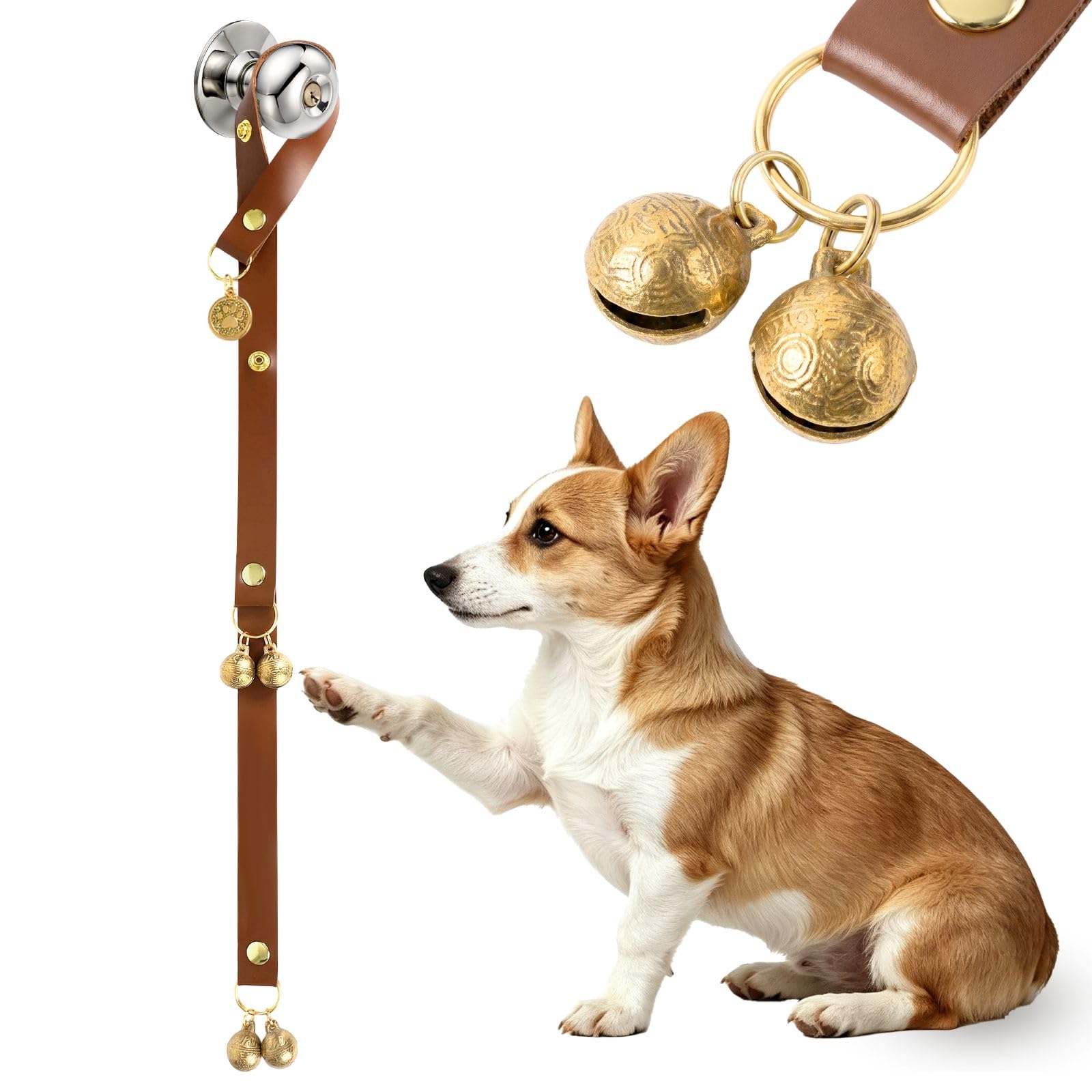
This is the one we suggest when the bells will hang where visitors can see them. A soft leather strap, polished brass bells, and smooth edges throughout: Kytely builds the hardware around a pawing dog, and the shape gives a claw far less to catch on than a row of pressed jingle bells. If your dog hits the door with a foot rather than a nose, that difference is worth the extra money.

The brass carries. It is a cleaner, more musical ring than the jingle sets, audible from another room without sounding like a fire alarm, and the snap buttons let you set the height for a Chihuahua or a Labrador. The whole strap weighs under five ounces, which helps it swing from a light tap rather than needing a full-body shove, and it hangs straight instead of bunching at the bottom.

A clicker comes in the box, and that is the routine we used: click the moment the nose lands, treat, open the door. Hang it where your dog already waits and the first week is mostly you ringing it and paying up with something small. It is a training tool that happens to look like a nice object, which is a rarer combination in this category than it should be.

Bottom line: The set we point to when the bells hang in plain sight: brass and leather that ring clearly, adjust to any size, and give a pawing dog nothing sharp to catch a nail on.

5

barkOutfitters Dog Doorbell

barkOutfitters Dog Doorbell

Door scratchers

Our Score 9.0/10
Check Price

Worth Noting

  • Three screws mean holes in the door
  • One bell per pack
Hardware
3 screws
Mounting
Door or wall
Bell Type
Solid metal
Bell Weight
1.13 oz
Read the full review

This one refuses to be a strap. The barkOutfitters bell is a single solid metal bell on a bracket, screwed to the door or the wall so it floats a few inches out from the surface, and your dog rings it with a nose or a paw. There is no hardware hanging at handle height for a puppy to grow into or a small dog to stretch for.

That standoff is the clever part. It puts the bell at the height your dog actually is, knee height for a corgi and shoulder height for a shepherd, instead of wherever the door handle happens to sit. Because the bell hangs away from the door, a dog reaching for it is not raking the paint at the same time, and there is no fabric to fray, no strap to chew through, and nothing to readjust once it is up.

We reach for it in two situations: a dog that already scratches at the door, and a household that has been through a couple of chewed straps. The trade-off is permanence. Three screws go into the door or the wall, so a renter will want a removable adhesive rated for the weight instead, and moving it later means new holes in a new spot. Decide where it goes before the drill comes out.

Bottom line: For a dog that scratches instead of nuzzling, this is the bell we mount: one solid bell at the dog's own height, with no fabric to fray or chew through.

6

TECKNET Wireless Dog Door Bell

TECKNET Wireless Dog Door Bell

Outdoor doors

Our Score 9.0/10
Check Price

Worth Noting

  • Most of the 55 melodies are novelty tones
Volume
5 levels, 0-120 dB
In The Box
1 receiver, 2 transmitters
Wireless Range
1,000 ft
Water Resistance
IP65
Read the full review

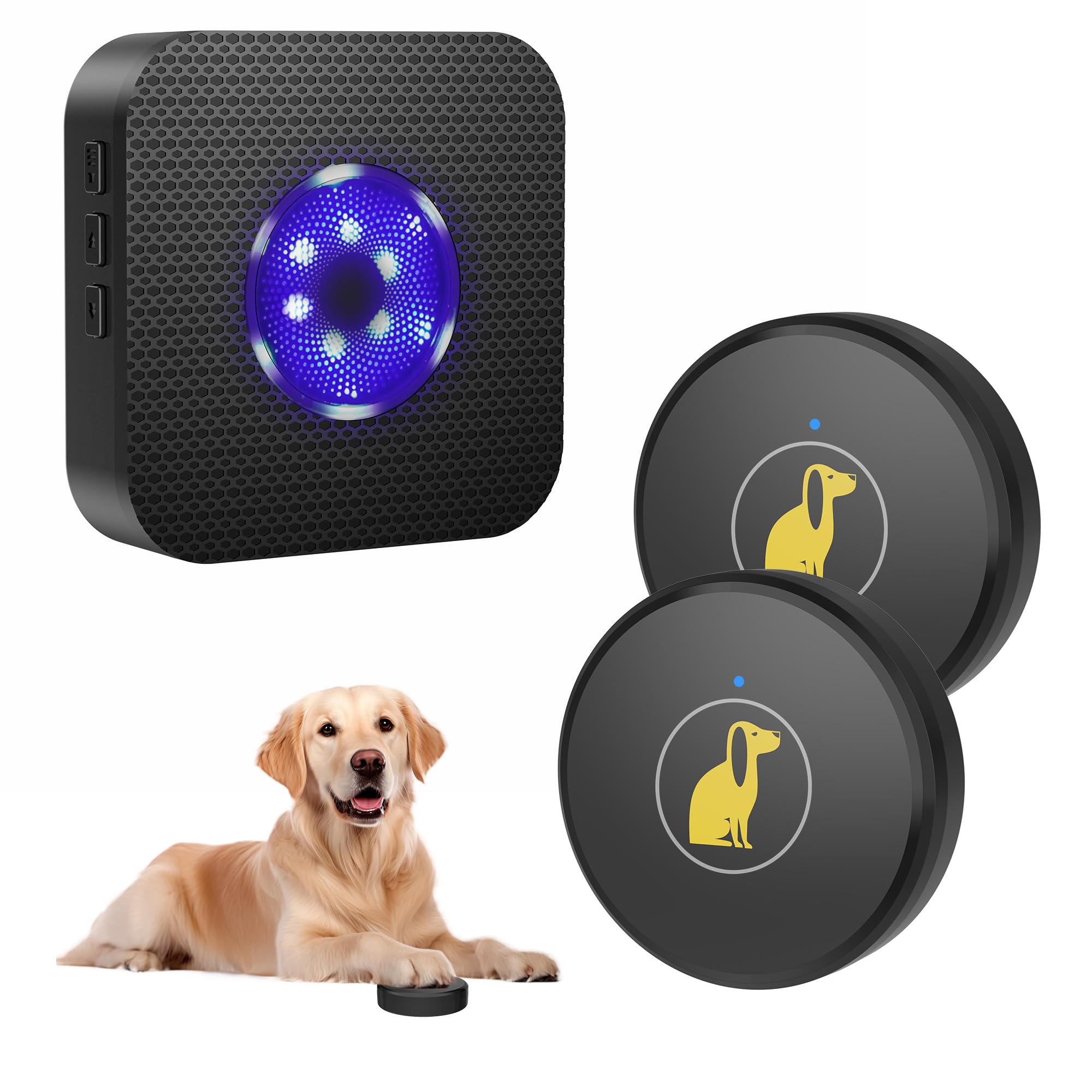
The TECKNET does most of what the Mighty Paw does for a good deal less money: two transmitters, a receiver, a rated range of 1,000 feet, five volume steps including a mute, and a button rated IP65 against weather. If you have been put off electronic bells by the price of the better-known one, this is the obvious second look.

The extras are where it separates itself. The mute setting is what you want at six in the morning when the dog asks and the house is asleep, and the top volume will find you at the far end of a yard. There are 55 melodies built in, roughly 52 more than anyone needs, but a couple of the plain chimes are perfectly good and those are the ones you will live on.

We reach for this one over the Mighty Paw when the button lives outdoors. The weather rating is the difference, whether that is a patio door, a back gate, or a fence post, and the three-year manufacturer warranty covers a longer stretch than the other electronic pick here. For an indoor door in a dry hallway, that advantage shrinks and the Mighty Paw's longer track record starts to look like the safer buy.

Setup is the part to think through. The transmitters mount with Velcro or double-sided tape, so put one where a nose actually lands, at chest height on the dog at the door frame, rather than at handle height where a dog has to jump for it. Plug the receiver somewhere you will hear it, not in the basement, and test both buttons from the far end of the yard before you call it done.

Bottom line: We take it over the Mighty Paw when the button lives outside: the weather rating, the mute setting, and the three-year warranty make it the better outdoor bet.

7

Mighty Paw Smart Bell 2.0

Mighty Paw Smart Bell 2.0

Multi-door homes

Our Score 8.8/10
Check Price

Worth Noting

  • Activators can go silent over time
Power
AA batteries
Activators
2 buttons
Wireless Range
Up to 1,000 ft
Activation Force
0.75 lb
Read the full review

No strap, no jingle: the Mighty Paw Smart Bell is two wireless buttons and a receiver that plugs into the wall. It is the pick for a dog that ignores hanging hardware, and for a house where the back door is two rooms away from wherever you sit.

Setup takes seconds. The activators stick to a door, a frame, or a wall, and the link is rated to 1,000 feet, which is enough for one button at the back door and one at the side gate. They are water resistant, so an outdoor door is fair game, and there are several tones and volume settings. Choose one of the plainer chimes: a couple of the tones sound enough like a real doorbell to confuse a dog that already alerts to visitors.

The button is the part to think about before you buy. It is meant to take about three-quarters of a pound of pressure, and we found that is fine for a determined nose but can push a very small dog into using a paw instead. Mount it lower than you think, at chest height on the dog rather than handle height, and spend the first session rewarding any contact at all. Most dogs seem to make the connection within a day or two once the treat lands.

Where it earns its price is convenience: a dog can ask from the far end of the yard, and you can move a second button to a new door without re-hanging anything. Treat it as the small electronic device it is. Keep a spare set of AA batteries and press each button with your thumb once a week so a dead activator never gets mistaken for a quiet dog.

Bottom line: We recommend it when a strap keeps getting ignored or the doors are far apart, provided you are ready to keep batteries on hand and check the buttons now and then.

8

Comsmart Training Bells

Comsmart Training Bells

Renters and travel

Our Score 8.6/10
Check Price

Worth Noting

  • Ding is easy to miss from another floor
Base
Non-skid rubber
Type
Freestanding
Material
Metal
Bells In Pack
2
Read the full review

No strap, no screws, no installation. The Comsmart bells sit on the floor by the door and your dog taps the flat button with a paw, which makes them the simplest thing here to set up and the easiest to move from room to room or pack in a bag for a weekend away.

The rubber base is the detail that makes a floor bell work. It grips a hard floor instead of skidding across it when a puppy slaps it, and it keeps bare metal off the finish. Two come in the pack, so one can live by the back door while the other goes wherever the dog is boarded, travels, or stays.

They suit a dog that already paws at the door and they suit a renter who cannot put a screw in anything. The risk with a freestanding bell is that some dogs decide it is a toy and carry it off, so put it where the dog naturally waits rather than in open floor, and put it on a shelf when the puppy is in a chewing mood.

Where it wins is as a first bell, a travel bell, or a signal at a door you would rather not hang anything on. A dog that will not touch a hanging strap will often paw at a bell on the floor, and finding out whether your dog signals at all costs almost nothing here before you commit to a bigger setup.

Bottom line: We suggest it as a first bell for renters, travelers, and dogs that already paw at the door, since it needs no installation at all and costs very little to try.

How We Tested the Potty Bells

We started by pulling together hanging bell straps, door-mounted chimes, and electronic button sets, then narrowed the shortlist by strap length, mounting method, volume control, and whether replacement bells or batteries were easy to find. Over four months, 14 sets lived by the back door of a house with two medium dogs and by the front door of an apartment with one small dog, so we could see how each handled different door frames, traffic, and dog sizes. Each set got the same routine: hang it at nose height, run short training sessions before morning let-out, after meals, and at late-night pee breaks, and reward the dog for nosing or pawing the bells before opening the door.

We kept a daily log of misses and false alarms—did a light nose touch set it off, did a tail brush ring it, did the dog have to press hard enough to back away? For electronic units, we pressed buttons by hand and with a treat pouch, checked whether the chime or whistle carried into the next room over normal household noise, and noted how many volume or sound options there were and whether a shy dog could be startled by the loudest setting. Setup got timed solo, including shortening straps and mounting hardware without tools.

Durability testing was less polite: we tugged each strap repeatedly, let dogs nose, paw, and lean on the bells, wiped them with a damp cloth, and checked for frayed webbing, loosened screws, cracked buttons, and batteries that died early. The sets that made the cut still rang clearly after weeks of daily use, stayed where we mounted them, and didn’t confuse the dog with a mushy button or a bell that only worked sometimes.

How to Choose Potty Bells for Dogs

Start With How Your Dog Asks

Watch your dog at the door for a day. A dog that stands and stares, or nudges the door with its nose, takes to a hanging strap quickly, because the bells are already where its head is. A dog that scratches or paws does better with a mounted bell or a floor bell it can hit. A dog that already targets a button, on a treat puzzle or a shop counter bell, is a natural for a wireless activator.

The trap is assuming your dog will adapt to the hardware you like. A five-pound dog and a stiff button are a bad match however good the electronics are, and so is a screw-mounted bell in a rental that forbids holes. Choose the trigger the dog can physically work, then work out how to attach it.

Hang It at Nose Height, Not Handle Height

The lowest bells should sit roughly at your dog's nose when it stands, with an inch or two of clearance so nothing drags on the floor. That is why strap length and adjustment matter more than bell count: a 33- or 35-inch strap reaches from a tall handle down to a small dog, and snaps or buttons take it up as a puppy grows into a Labrador.

Buy for the top of the range, not the bottom. A strap long enough for a big dog becomes a curtain of metal for a Chihuahua, and one that only reaches a Great Dane's knees will never be touched. If your door has a chunky lever or a sliding pull, check that a loop will actually go around it before you order.

Match the Sound to Your House and Your Dog

The bell has to be heard from where you actually are, not where you would like to be. A single-floor apartment and a two-story house with the laundry running need different volumes, before you even count a dog that startles at noise. Large jingle bells are the loudest thing in this category, brass rings clear with less clatter, and a small bronze bell is a polite chime that will not travel through closed doors.

More bells help a light touch register: six small bells will sound when one heavy bell would not move. The mistake is assuming louder is automatically better. A puppy that flinches at the first ring may refuse to touch the bells at all, so introduce the sound from across the room and reward the first contact long before you expect a proper ring.

Materials, Chewing, and Placement

Nylon is the budget workhorse and shrugs off most tugging; leather and cotton look better and soften the sound. What matters more is the dog's end of the hardware. Closed brass or bronze bells give a pawing dog nothing sharp to catch a nail on, while a long trailing loop can tuck under a door or drop into a slider's track. Shorten anything that reaches the floor.

Put the bell where the dog already waits, not where the door looks tidiest, and supervise a dog that mouths the strap. A bell that is awkward to reach gets ignored, and one that swings at eye level on a nervous puppy gets avoided, so hang it, watch the first few approaches, and move it if the dog hangs back.

Frequently Asked Questions

Final Verdict

Our default is the BLUETREE two-pack. It is the least expensive way to cover two doors with bells loud enough to hear from the back of the house, and the three length settings mean it still fits when the puppy turns into a dog. Start there unless you have a specific reason not to.

The reason to spend more is usually either looks or a small dog. The Kytely leather set rings just as clearly, gives a pawing dog smoother edges at claw height, and looks like something you chose on purpose. If a hanging strap keeps getting ignored, the Mighty Paw's buttons are the fallback, as long as you can live with batteries and a firm press.