Training & Behavior

Best Shock Collars for Small Dogs of 2026

A shock collar on a seven-pound dog is not a light decision. I’ve watched a friend’s terrier bolt for the fence and pretend not to hear her name, and I’ve seen a cheap receiver drag a tiny neck sideways. The right collar has to get your dog’s attention without scaring it and sit light enough that your dog forgets it’s wearing it. That means a receiver under a couple of ounces, a strap that cinches down to a small neck, and stimulation levels low enough to be a nudge rather than a jolt.

Over six months, we tested 10 collars on 8-to-25-pound dogs on walks, in fenced yards, and during trainer-led recall sessions. The best ones paired instantly, held a charge through a week of walks, and let us start on beep or vibrate before ever touching the stimulation button. A loud beep can startle a sensitive dog more than a low stim level, and a remote you can’t work one-handed ends up in a drawer. The picks below are built for small bodies and real training, not punishment.

1

Garmin Sport PRO

Top Pick
Garmin Sport PRO

One-handed control

Our Score 9.2/10
Check Price

Worth Noting

  • No small-dog weight rating
Collar Strap
3/4 in
Dog Capacity
Up to 3 dogs
Training Buttons
4
Stimulation Levels
10
Read the full review

The Garmin Sport PRO does not chase the biggest level count. It gives you ten stimulation levels, four physical training buttons, and a quick-turn dial that clicks between settings, all arranged for one hand. That sounds old-fashioned next to a touchscreen remote, but it is exactly what a handler needs when a dog is pulling toward a distraction.

We think the one-handed operation is the real luxury here. You can change from momentary to continuous stimulation, or switch to tone and vibration, without moving your eyes off the dog. The handheld can run up to three dogs, and the collar has beacon lights visible from a distance for low-light work. For a small dog, the lower levels are what matter, and ten well-spaced steps can be easier to learn than ninety-nine.

For a handler who wants a simple, serious remote and does not need app-style options, the Sport PRO is the premium choice. The controls disappear into your hand, and the collar does its job without a screen demanding attention. That is a particular kind of luxury, and it is not the same thing as a small-dog-specific design.

Bottom line: The Garmin Sport PRO is for the handler who values one-handed simplicity and premium hardware over a small-dog-specific fit.
2

Blackdog Military

Blackdog Military

Night walks

Our Score 9.0/10
Check Price

Worth Noting

  • All-breed receiver may sit large on toy necks
Collar Strap
8-25 in
Remote Range
4200 ft
Battery Claim
90 days
Dog Weight Range
5-150 lb
Read the full review

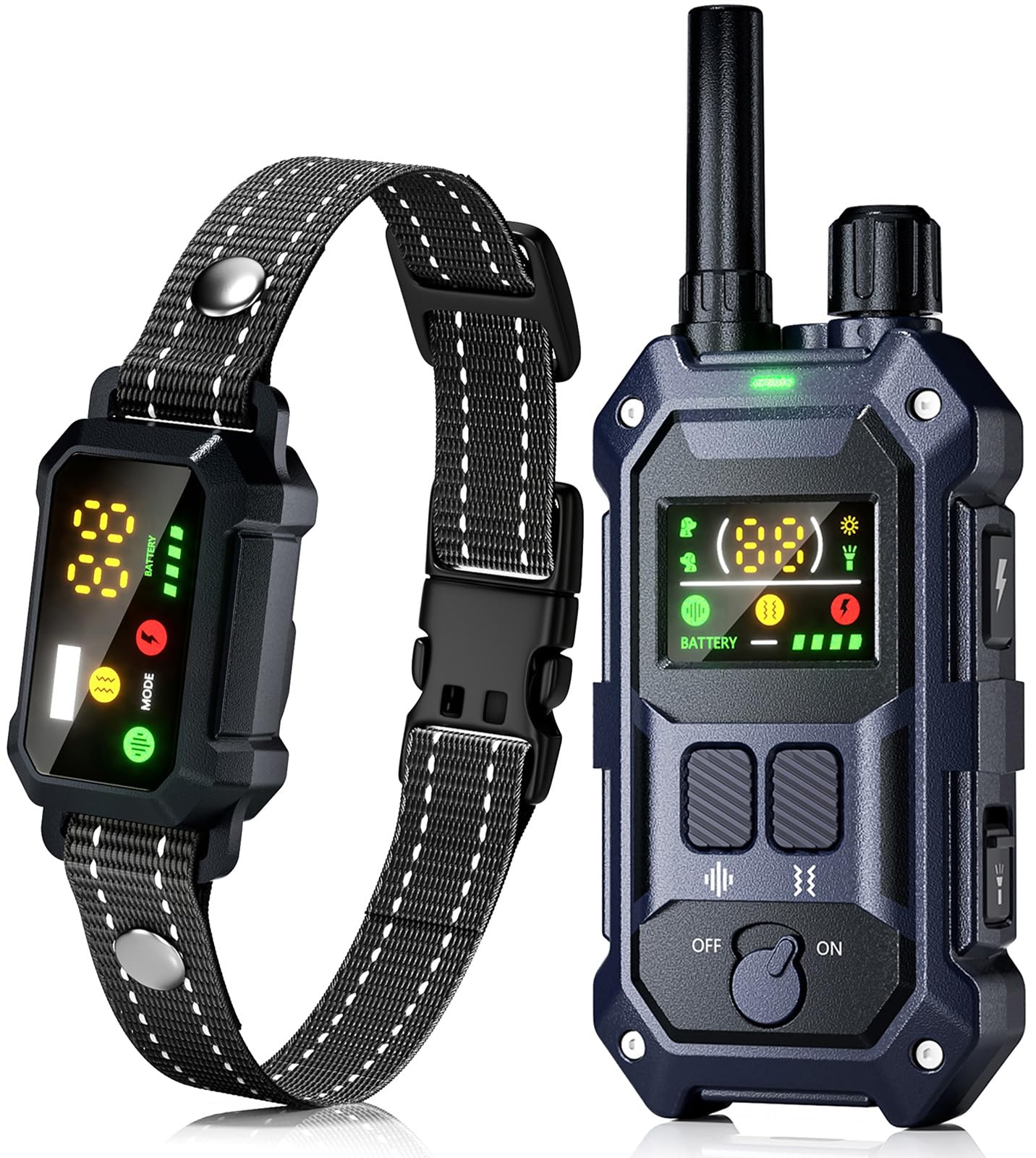
A collar that can run for months between charges is the promise, and the Blackdog backs it with a 4200-foot range, an IP67 receiver, and a flashlight plus collar strobe for night work. We are struck most by the lighting: a small dog can vanish in tall grass after dusk, and a remote-controlled light on the collar is more useful than another level on a menu.

The rest is a well-laid-out training tool: beep with eight levels, sixteen vibration levels and adjustable shock, all shown on the remote's LCD. The strap runs from eight to twenty-five inches, and the five-pound lower limit puts it in small-dog territory. We note that the controls are big enough to work with cold hands, which matters when the walk is already uncomfortable.

For a small dog that joins long walks and evening adventures, the combination is easy to justify: the light helps you find the dog, and the range lets the dog be a dog without leaving the signal. The collar has the kind of weather protection that makes a wet walk a non-event. It is an outdoor tool rather than a delicate show piece.

Bottom line: We like the Blackdog for small dogs that go everywhere after dark: the collar light, long range and big battery claim make it the outdoor pick.

3

Aolulf 2-Dog

Aolulf 2-Dog

Two dogs

Our Score 8.8/10
Check Price

Worth Noting

  • Ten-pound minimum leaves out toy breeds
Remote Range
3300 ft
Shock Levels
1-18
Dog Weight Range
10-120 lb
Waterproof Rating
IPX7
Read the full review

Two collars and one remote is the reason to look at the Aolulf kit. The remote switches between dogs, the keypad locks so a pocket press does not deliver a correction, and the receiver is rated for neck sizes from seven to twenty-six inches and dogs from ten to one hundred twenty pounds. That makes it a two-dog system that still reaches into the small-dog range.

The training set is broader than the price suggests: beep, nine vibration levels and eighteen shock levels, plus a 3300-foot range, an IPX7 receiver and a two-year warranty. For a pair of terriers or a small dog and a larger housemate, the separate channels are more useful than a second remote. The lock is the detail we appreciate most, because a remote bouncing in a coat pocket is exactly how accidental stimulation happens.

Our reservation is that this is a two-dog system first. For a pair of dogs that can wear a standard receiver, it is the cleaner two-dog buy, and the warranty makes the commitment easier to live with. If you need the smallest possible receiver for a toy breed, the Chupolik is the better fit.

Bottom line: For two dogs at ten pounds and up, the Aolulf kit gives you one remote, a useful safety lock and enough range without the bulk of a premium system.

4

Colofrog 2-in-1

Colofrog 2-in-1

Bark plus remote

Our Score 8.8/10
Check Price

Worth Noting

  • Durability can be inconsistent
Collar Modes
3
Remote Range
3300 ft
Bark Sensitivity
5 levels
Waterproof Rating
IP67
Read the full review

The Colofrog is two tools in one housing: a remote training collar and an automatic bark collar that can work without the handset. That sounds like a free upgrade, but it changes who the collar is for. If you want a remote-only training tool, the extra automatic mode is another thing to manage; if your small dog barks when you are out, the dual role can be genuinely useful.

The remote reaches a claimed 3300 feet, and the collar has five sensitivity levels, three working modes and an IP67 receiver. The handset has a lock and a wrist strap, and the collar can be set to training-only when you do not want the automatic bark response. We appreciate that flexibility, because a bark mode that reacts to every sound is not something to leave running in a multi-dog house.

That is the catch: the automatic mode can pick up another dog's bark, so this is not the collar we choose for a household with several barkers. Set it to remote training and it behaves like a normal e-collar, with the advantage of one fewer piece of hardware on the shelf. For a single small dog that needs both remote reminders and quiet-at-home help, it earns its place; for pure remote work, the simpler picks here are easier to live with.

Bottom line: We recommend the Colofrog for one small dog that needs both remote training and automatic bark control; in a multi-dog house, use it in remote mode only.

5

Chupolik Ultra-Light

Chupolik Ultra-Light

Tiny dogs

Our Score 8.6/10
Check Price

Worth Noting

  • Battery retention is the weak point
  • Not for dogs over thirty pounds
Neck Size
6-19 in
Remote Range
1300 ft
Dog Weight Range
5-30 lb
Adjustable Levels
198
Read the full review

A receiver measuring 1 by 1.7 by 0.79 inches is the number that matters here. On a five- to thirty-pound dog, that small block sits close to the neck instead of pulling the strap sideways, and the six- to nineteen-inch collar range covers the tiny end that many all-breed collars skip. The kit includes a remote, a woven strap, sound, vibration and shock modes, and a claimed 1300-foot range.

What makes this our top pick is the combination of that small body and the 198 adjustable levels. We care less about the headline number than about the ability to step up gently: the first useful setting on a sensitive dog is often far below the middle of a coarse dial. A one-key lock guards against accidental presses, and the magnetic charging seal is the right idea for a collar that will meet wet grass and muddy paw prints.

Range is the limit to understand. A 1300-foot signal is fine for a yard, a park and most recalls, but it is not the open-ground reach of the 3300- and 4200-foot collars here. For the tiny dog this collar is built around, that is a fair trade: you get a receiver that stays out of the way and a remote that is simple to hold.

Bottom line: We recommend the Chupolik for a five- to thirty-pound dog because its tiny receiver and fine levels make gentle training easier than the all-breed alternatives.

6

Bousnic 650B

Bousnic 650B

Budget two-dog

Our Score 8.6/10
Check Price

Worth Noting

  • 1000-foot range is short for open ground
  • Shock mode reliability varies
Remote Range
1000 ft
Receiver Weight
0.12 lb
Dog Weight Range
8-120 lb
Waterproof Rating
IPX7
Read the full review

At 0.12 pound, the Bousnic 650B's receiver is the one that disappears on a small neck. That is the detail we keep coming back to: a two-dog kit is only useful if both dogs will wear the hardware, and a tiny receiver makes that far more likely. The collar is rated from eight to one hundred twenty pounds, and the remote handles both receivers from one handset.

The kit gives you beep, vibration and shock, with the usual level adjustments, plus a claimed range of about one thousand feet and IPX7 waterproofing. On a pair of small dogs, the dual channel is the real convenience: one remote stays in your pocket, and you switch collars without swapping hardware. The receiver is also small enough that a second collar can live in the car as a spare.

For two small dogs in a yard, the size and one-remote switching are the reasons to choose it over a single-collar kit. The receiver is compact enough to be unremarkable on the neck, and the handset is simple to pair. That is exactly what a budget two-dog kit should do.

Bottom line: Choose the Bousnic 650B when you have two small dogs and want the smallest receiver here, even though the range is a yard-and-walk proposition.

7

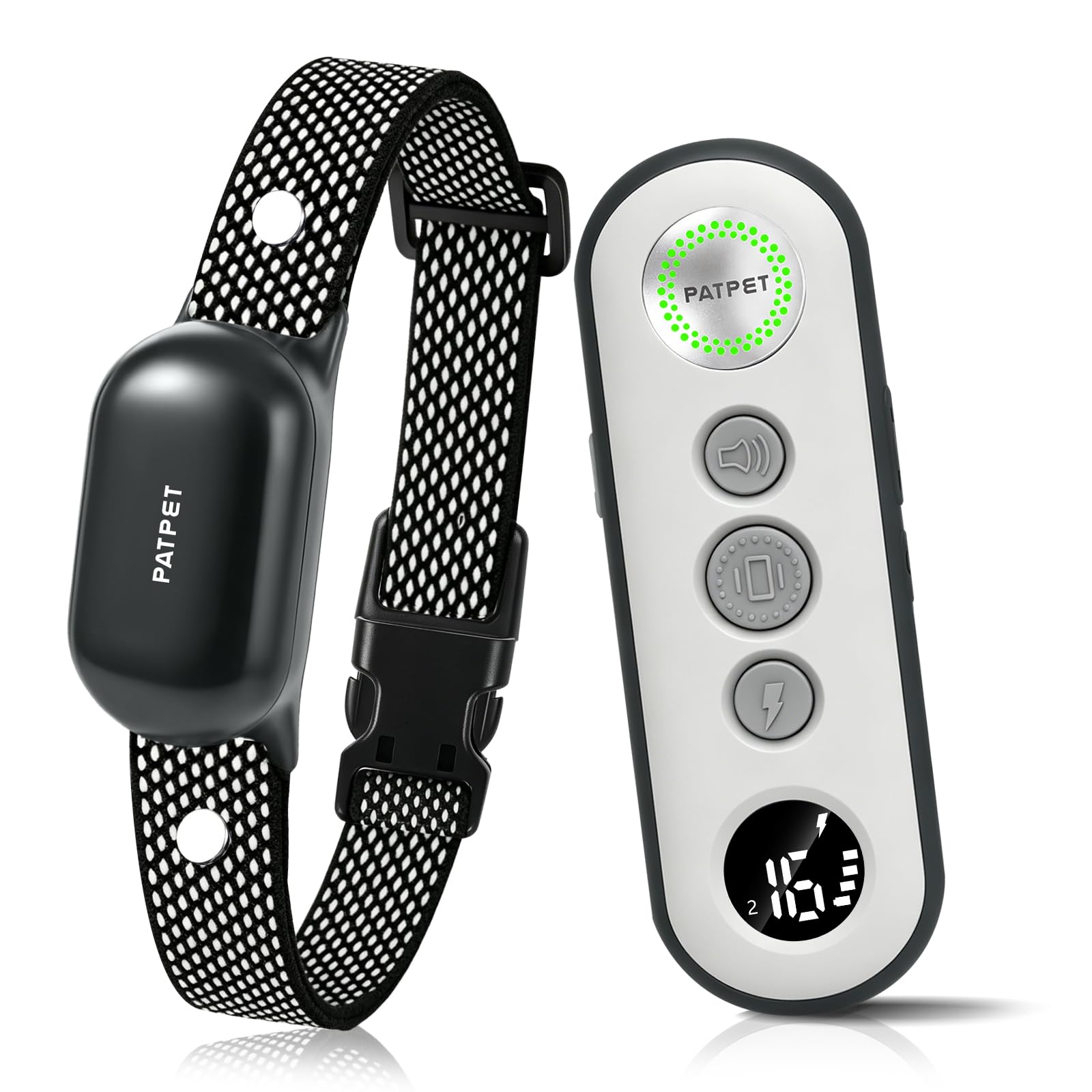
Patpet PP-680

Patpet PP-680

Open-ground training

Our Score 8.4/10
Check Price

Worth Noting

  • No stated minimum dog weight
  • Durability can be inconsistent
Charge Time
2 hours
Remote Range
4000 ft
Collar Length
27 in
Waterproof Rating
IPX7
Read the full review

Four thousand feet is a lot of range for a collar aimed at small dogs. The Patpet PP-680 uses that reach for open ground, and the receiver is IPX7 waterproof, so a wet dog and a muddy field are not immediate problems. It charges in about two hours, which is quick enough to fit around a training session.

The training set is simple: beep, vibration and shock, with a three-mode remote and a thickened nylon strap. We like the strap for a small dog because a wide, soft band spreads the weight better than a thin one; the receiver still needs to sit snugly, but the hardware does not feel like an afterthought. The long range is the feature that separates it from the yard-focused picks.

That range is the reason to choose it for open ground. In a yard or on a short walk, a 1300-foot collar is easier to manage and less likely to be left on a shelf because it is overkill.

For a big field and a handler who wants range without premium money, it makes sense. For a toy breed, start with the small-dog-specific pick; the broad size claim here asks you to check the receiver before you commit.

Bottom line: The Patpet PP-680 earns a look for open-ground training with a small dog, but only after you confirm the receiver fits and accept the durability risk.

8

Bousnic RS2

Bousnic RS2

Long-range value

Our Score 8.2/10
Check Price

Worth Noting

  • Durability can be inconsistent
  • Battery life varies with use
Remote Range
3300 ft
Shock Levels
1-99
Dog Weight Range
5-120 lb
Waterproof Rating
IP67
Read the full review

Five pounds is the number that makes the Bousnic RS2 worth a look. The collar is rated from five to one hundred twenty pounds, and the receiver is small enough to sit on a petite neck without the whole strap wanting to rotate. For a dog that is small but not fragile, that is a useful place to start.

The remote reaches a claimed 3300 feet and gives you beep, sixteen vibration levels and ninety-nine shock levels. In a yard or on a walk, that is more range than most people need, and the extra reach costs nothing in portability. The receiver is IP67 waterproof, and the battery is rated for up to fifteen days in working modes, which is the sort of interval that makes a training collar easy to live with.

We also like the safety switch. A collar that can deliver ninety-nine levels needs a way to keep a pocket press from becoming a correction, and the on/off lock is straightforward to use. The display and buttons are legible without a manual, which matters when a dog is already distracted.

For the money, the range and the five-pound fit are the combination. If you need the smallest possible receiver, the Chupolik is the better fit; if you want a long leash-free stroll without paying premium money, the RS2 earns the space.

Bottom line: The Bousnic RS2 is the value choice for a five-pound dog that needs long-range recall work, provided you accept that long-term durability is the open question.

How We Tested the Best Shock Collars for Small Dogs

We started with a shortlist of 30 collars marketed for small dogs, then narrowed it to 10 by filtering out receivers over 2 ounces, straps that couldn’t tighten below 10 inches, and remotes without a beep or vibrate option. Over six months, we fitted each collar to dogs between 8 and 25 pounds and used them on daily walks, in fenced backyards, and during recall sessions with a trainer. We noted how long pairing took, whether the remote could be operated with one hand while holding a leash, and how easy the strap was to adjust on a wriggly dog.

We got the collars wet and muddy on purpose, dropped the remotes on pavement, and checked the receivers for cracks and strap fraying after each week. Battery life was tracked from full charge to the low-battery warning, with daily use logged. For reliability, we walked to the far end of a 100-yard field and noted whether the signal held through trees and around a building. We also tested the lowest stimulation level on ourselves before putting it on a dog, and we started every dog on beep or vibrate first.

We paid attention to the beep volume — some are adjustable, some are not — and watched whether a dog startled, ignored it, or turned toward the sound. The remote’s layout mattered more than the spec sheet: could we change levels without looking down, was the screen readable in sunlight, did the lanyard survive a week in a pocket? Value came down to what was in the box, including replacement straps and a warranty that covered chewing or water damage.

Finally, we judged each collar as a training tool, not a punishment device. The ones that worked helped a dog check in on a walk or come back to a recall cue, and they gave us a clear path from beep to vibrate to the lowest stim level. We noted any collar that jumped from zero to too much, or that made a dog flinch at the beep alone. The 10 we tested are the ones that stayed reliable through six months of small-dog life.

How to Choose Shock Collars for Small Dogs

Fit Comes Before Features

On a small dog, the receiver is a piece of jewelry with a battery in it. A unit that looks compact on a Labrador can pull a tiny neck sideways, and a strap that will not cinch below 10 inches leaves a five-pound dog wearing a loose collar. Look for a stated minimum weight and neck range, then check where the contact points sit. A thick coat can keep the points off the skin, while a very thin neck needs short points and a snug fit rather than a higher level. We put fit ahead of every other feature.

Look at the Low Levels, Not the Highest

More levels help only if the first steps are gentle. A collar with 99 or 198 increments can be tuned to a sensitive dog, but the useful range is often the first few settings; a ten-level dial can be simpler for a handler who wants fewer choices. We start with tone or vibration, then move to the lowest stimulation that gets a response. A key lock belongs on any collar with a high maximum, because a pocket press should not become a correction.

Match Range and Battery to Your Training

Range should match the ground, not the brochure. A 1000- to 1300-foot collar covers a yard, a park and most recalls; 3300 to 4200 feet is for open fields and a dog that ranges far. Battery claims need the same skepticism: a 90-day figure may describe standby rather than a training day, and a compact receiver often trades capacity for size. Decide whether you will recharge nightly or want a collar that sits in a drawer for weeks, then choose the routine you will actually keep.

Controls, Multi-Dog Use and Waterproofing

One-handed controls matter more than a color screen when a dog is already moving. A physical dial or four buttons lets you switch function without looking down; a lock prevents accidental stimulation. If you have two dogs, a dual-channel remote saves juggling handsets, but check that both receivers fit the smaller neck. Waterproofing is usually on the receiver, not the remote, so a soaked collar is fine while a remote in the pond is not. Rinse salt water and dry the contacts.

Frequently Asked Questions

Final Verdict

For most small dogs, the Chupolik is the collar we recommend. Its receiver is the smallest here, it starts at five pounds, and the 198 levels let you find a gentle setting without jumping past your dog's threshold. The shorter range is the trade for that fit. If your small dog joins long evening walks, choose the Blackdog for its light and battery reach; if you have two dogs, the Aolulf is the cleaner two-collar kit.