Feeding & Watering

Best Slow Feeder Dog Bowls of 2026

A dog that inhales dinner in under a minute isn’t just a speed eater — it’s a dog headed for gulped air, hiccups, and the occasional upchuck. A slow feeder bowl gives those frantic bites somewhere to go, turning a flat pile of kibble into a maze your dog has to work through. The best ones stretch a meal from seconds to minutes, so your dog eats more calmly, swallows less air, and is less likely to bring dinner back up.

My own dog treats mealtime like a competitive sport, and a good slow feeder has to do more than just slow him down. Over the past three months, we tested 14 bowls, looking at whether they stretched mealtime, stayed put on a hard kitchen floor, were easy to fill and clean, and felt sturdy enough for daily use and worth the money. The pattern was clear: the useful ones are sized right for your dog’s muzzle, have a base that grips, and don’t create a maze so deep your dog gives up. The right pick is in the list below.

1

JASGOOD Slow Feeder Bowl

Top Pick
JASGOOD Slow Feeder Bowl

Medium and large dogs

Our Score 9.4/10
Check Price

Worth Noting

  • Hand wash only
  • Grip pads are stick-on, not molded
Care
Hand wash only
Non-slip
Six stick-on grip pads
Maze Design
Spiral maze
Bowl Diameter
9.6 in
Read the full review

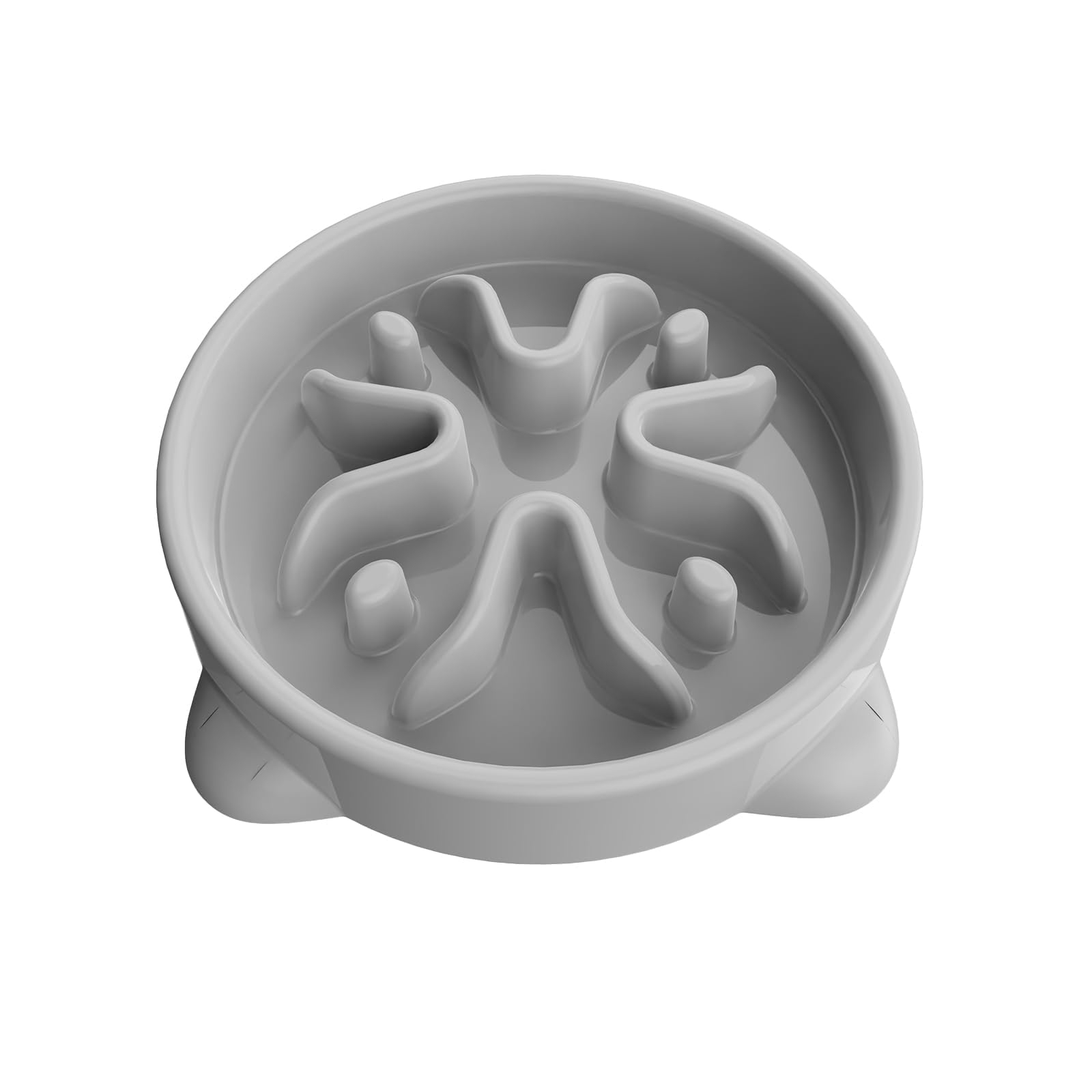
At 9.6 inches across, the JASGOOD is the widest of the plastic bowls here, and the extra inches matter more than anything printed on the label. The inside is one continuous spiral running from the rim to a small center well, so a dog can't push a pile of kibble against a wall and call it dinner; it has to follow the groove around. A meal that used to vanish in three gulps turns into a slow circling lap.

That width is why it takes the top spot. A slow feeder stops working the moment the food mounds above the dividers, and most of the plastic bowls in this group are built around a two-cup dinner at best. The 1.77-inch walls are low enough that a big dog isn't fighting the bowl, and the base is broad enough that a lab leaning into a meal doesn't walk it across the kitchen.

Cleaning is easier than the spiral suggests. The channel is shallow-sided, so a short soak and a brush gets it done, and there's nowhere for wet food to hide the way there is in narrow dead-end mazes. Tighter puzzles are the ones that end up left in the sink.

Where it doesn't fit: a four-cup dinner will crest the dividers, and a dog eating that much needs the meal split across two servings. A ten-pound dog can use it, but it's eating off something the size of a dinner plate. The low wall height is the quiet advantage — a short-legged or flat-faced dog can reach the bottom of the spiral without the bowl getting in the way.

Bottom line: We recommend it for medium and large dogs: the widest plastic bowl here takes a full dinner and still makes a fast eater work around a spiral.

2

LE TAUCI Ceramic Slow Feeder

LE TAUCI Ceramic Slow Feeder

Quiet, non-slip feeding

Our Score 9.4/10
Check Price

Worth Noting

  • Ceramic can chip if dropped
Care
Dishwasher safe
Capacity
1.5 cups
Diameter
8 in
Material
Ceramic
Read the full review

Ceramic changes the physics of a slow feeder. The LE TAUCI is a thick, glazed bowl, eight inches across with raised ridges spiraling toward the center, and what struck us first is how little it wants to move: no rubber feet, no suction cups, just weight and a slightly tacky base. On tile it sat there like part of the floor.

It holds 1.5 cups, which is a small-to-medium dinner, and the channels between the ridges are wide and shallow compared with the plastic mazes, so a brush gets through them and wet food wipes out instead of lodging. It goes in the dishwasher, and the glaze doesn't hold the smell of kibble the way plastic does after a few months.

We reach for it when the bowl lives somewhere visible. It's the only feeder here that looks like it belongs in a kitchen, and a dog can't send it skating across the room mid-meal. If your dog's dinner runs past a cup and a half, look elsewhere — the ridges eat into the usable volume, and a big meal mounds over them instead of settling between them.

Bottom line: We point ceramic buyers here: the heft keeps it still, the wide channels rinse clean, and it's the one feeder you won't hide when guests arrive.

3

Outward Hound Fun Feeder Slo Bowl

Outward Hound Fun Feeder Slo Bowl

Small dogs, puppies

Our Score 9.2/10
Check Price

Worth Noting

  • Small 5.8-inch bowl, so small dogs only
Care
Top-rack dishwasher safe
Diameter
5.8 in
Breed Size
Extra small to small
Maze Design
Wave
Read the full review

The version we tested is the small one — 5.8 inches across, a shallow wave rather than a full labyrinth — and that size is the whole point. It's the bowl we hand to someone with a new puppy, because it slows a meal without turning dinner into a puzzle the dog can lose. Watching a nine-week-old work a piece of kibble out of the trough and then go back for the next one is the entire appeal.

The wave is a single ridge, not a maze, so there's no dead end to get stuck in and no wall of food to give up on. It's top-rack dishwasher safe, it handles wet and raw food without complaint, and it sits still on a hard floor while a dog circles it. For a small dog or a cat, it's the least intimidating effective slow feeder in this group.

The pink is a strange choice for something that lives on a kitchen floor, but the plastic is the same food-safe material Outward Hound uses across its range and it shrugs off daily washing. Ours has been in near-constant rotation for small dogs and it still looks like a bowl rather than a chew toy, which is more than we expected at this end of the range.

Bottom line: We keep this small wave bowl for puppies and little dogs, because it slows a meal without frustrating a dog that is still learning to eat.

4

Feedoo Stainless Steel Slow Feeder

Feedoo Stainless Steel Slow Feeder

Dogs that chew

Our Score 9.2/10
Check Price

Worth Noting

  • Shallow wells slow a hard gulper only slightly
  • The most expensive bowl here
Base
Non-slip rubber
Capacity
3 cups
Diameter
8.5 in
Material
Double-wall stainless steel
Read the full review

Stainless is the answer to one specific problem: a dog that chews. The Feedoo is double-walled steel, 8.5 inches across and about two inches deep, with a flower-shaped hump in the middle and a rubber ring underneath. There's nothing to bite off and nothing to hold an odor, which is more than we can say for any plastic bowl that has spent a month on a kitchen floor.

It's the bowl we point at for chewers, and it's the steadiest thing in this group on a hard floor. The double wall puts the weight low, so a dog pushing into the hump doesn't send it sliding, and the matte finish doesn't show scratches the way polished steel does. Feedoo backs it with a two-year warranty, the longest of any bowl here.

The maze is the mild part of this bowl; the steel is the point. Food sits on top of the hump rather than sinking into deep channels, so a dog that inhales will still be quick, just less quick than from a plain dish. If chewing isn't the problem in your house, a plastic maze slows more for less money — but for the dog that has already eaten a bowl, this is the one we trust.

Bottom line: We suggest it for dogs that chew plastic to bits — the double-wall steel survives, even if the shallow maze won't defeat the fastest eater.

5

MateeyLife 2-Pack Slow Feeders

MateeyLife 2-Pack Slow Feeders

Multi-dog homes

Our Score 9.2/10
Check Price

Worth Noting

  • Plastic can crack under heavy chewing
  • Feet slide on smooth floors
Care
Top-rack dishwasher safe
Capacity
2 cups each
Diameter
7.87 in
Pack Size
2 bowls
Read the full review

Two bowls for about what a single ceramic one costs is the pitch, and for a two-dog house it's a good one. Each is 7.87 inches across with a two-cup capacity and rubber feet in the corners, which makes them easy to tuck against a wall or under a shelf.

The pattern is a spiral with deep outer grooves, and it does the job. A lab puppy that had been inhaling a bowl in seconds was taking long enough that we stopped standing over him. The mix of wide channels and tight corners keeps a dog working without the dead ends that make some mazes frustrating.

Both bowls are top-rack dishwasher safe and they nest when they're not in use, which matters more than it sounds when you're rotating two of them through the wash. A quick rinse before they go in the rack keeps kibble dust out of the corners.

For the money, this is the pair we recommend when two dogs eat at once, or when one bowl is always in the sink. The size lands in the middle — a full two cups for a medium dog, tight once you get past that — which is what makes it a pair for the household rather than a single great bowl for one big dog.

Bottom line: We recommend the pair for two-dog households: two usable two-cup mazes for less than one ceramic bowl costs.

6

TOKAYIFE Small Breed Slow Feeder

TOKAYIFE Small Breed Slow Feeder

Toy breeds

Our Score 9.2/10
Check Price

Worth Noting

  • Non-slip base slides on smooth floors
Care
Dishwasher safe
Capacity
1 cup
Diameter
6.42 in
Material
Polypropylene
Read the full review

TOKAYIFE's bowl is built around a one-cup portion, and that's the honest way to read it. It's 6.42 inches across with a flower of raised petals inside and a rubber-edged base, and it's the smallest feeder here that still does real work at a meal.

For a ten-pound dog on half a cup, the petals space the kibble out enough that dinner takes genuine effort instead of two snaps. The plastic is food-safe and free of BPA, PVC, and phthalates, and the whole thing goes in the dishwasher.

It's light — light enough to lift one-handed and to stack two on a shelf — and it rinses in seconds because the petals are broad rather than narrow channels. Small dogs get overlooked in this category, and this is the bowl that takes a toy breed's portion seriously.

If your dog eats a cup or less, this is the small bowl we point people to ahead of the bigger designs that leave a terrier working around a wall of food. Above that portion size, move to the 7.87-inch two-cup bowls here — this one fills up and stops being a puzzle.

Bottom line: We hand this to anyone feeding a cup or less, because a small dog deserves a maze built to its portion, not a scaled-down big bowl.

7

Lesipee Silicone Slow Feeder

Lesipee Silicone Slow Feeder

Travel and apartments

Our Score 9.0/10
Check Price

Worth Noting

  • Too small for a large dog's meal
Base
Suction cups
Capacity
1 to 2 cups
Diameter
7.8 in
Material
Food-grade silicone
Read the full review

Silicone behaves differently from everything else in this group. The Lesipee is a soft, flexible bowl, 7.8 inches across and 1.5 inches deep, with a maze molded into the floor of it and suction cups underneath. It doesn't clatter on tile the way ceramic or steel does, and there's nothing on it to chip.

The suction cups hold it down on smooth kitchen tile, which is where a light bowl would otherwise get pushed around. The silicone body is also the one here that goes in the freezer: fill the channels with broth and a little food, freeze it, and a hot afternoon gets noticeably quieter.

It suits a small dog in an apartment, or a bowl that travels — it flattens into a bag and it won't break on the way. A 60-pound dog will empty it in a pass or two; this is a bowl for portions up to about two cups, not a big dog's dinner, and we'd rather say so plainly than pretend the suction makes up for the volume.

Bottom line: We keep this one for small dogs and small kitchens: silicone is quiet, suctions down on tile, and freezes into a slow treat.

8

Mr. Peanut's Stainless Slow Feeder

Mr. Peanut's Stainless Slow Feeder

Large-breed portions

Our Score 8.8/10
Check Price

Worth Noting

  • Removable ring can work loose mid-meal
  • Oversized for small dogs
Base
Removable silicone ring
Capacity
3 cups
Diameter
11.4 in
Material
Stainless steel
Read the full review

Mr. Peanut's asks you to dry the bowl completely after washing, so rust doesn't form where the silicone ring meets the steel. That instruction tells you most of what you need to know: this is a steel bowl with a seam, and it asks for a small amount of care. It's also 11.4 inches across with a bundt-cake interior and a removable rubber ring, and for a big dog that inhales dinner, it does the job.

The bundt shape — a central column with a channel running around it — makes a dog chase food in a circle instead of scooping it up, and the wide rim means a long snout can reach the far side without the edge getting in the way. The ring lifts out, which is genuinely useful, because the crevice under it is exactly where wet food collects.

Hand washing is the safer read of the care instructions, and drying it properly is the price of steel. It's the biggest bowl here by a clear margin, which is the point for a lab or a shepherd and a waste of kitchen floor for a terrier. Set it down on tile and it announces itself; this is not a quiet bowl.

Bottom line: We like it for a big dog with a long snout: 11.4 inches of steel gives a lab-sized meal room to spread out.

How We Tested Slow Feeder Bowls

We started by pulling together 14 bowls from brands we kept seeing in customer reviews and vet-recommended roundups, then filtered out anything with a flimsy base, a maze too shallow to matter, or a shape that looked impossible to clean. Over three months, those bowls rotated through weekday breakfasts and weekend dinners in real kitchens — on tile, hardwood, and one very old rug — with my speed-eating dog and two borrowed dogs of different sizes and muzzle shapes. We filled each with the same measured cup of kibble, noted whether kibble spilled over the edges during filling, and timed how long the dogs took to finish compared with a flat bowl.

At each meal, we watched whether the bowl skidded across the floor when a dog pushed into it, whether the rubber ring or non-slip feet actually held, and whether the bowl tipped when a dog nosed under the edge. We checked depth and width against each dog’s snout — a deep, narrow maze frustrated the flat-faced terrier, while a shallow pattern barely slowed the Labrador. We also noted whether the dogs figured out the pattern in a few meals or simply gave up and walked away.

After meals, we scraped out leftover kibble and hand-washed each bowl, then ran the dishwasher-safe ones through a normal cycle and checked for trapped food in the corners. We flexed the plastic, looked for sharp seams or cracks after repeated washings, and weighed whether each bowl’s construction felt worth its cost. Along the way, we logged the less obvious stuff: fewer gulped-air episodes and calmer post-meal behavior from the dogs who had to work for their food.

How to Choose Slow Feeder Dog Bowls

Match the Bowl to the Meal, Not the Breed Label

Slow feeders fail in one specific way: the food mounds above the dividers and the dog simply scoops the top off, often faster than from a plain bowl. Sized correctly, the whole serving sits below the maze walls. So measure before you shop — scoop your dog's normal dinner into a measuring cup and note the number.

Then discount whatever the product page claims by a little. A bowl labelled for large breeds may take a big meal comfortably or barely, and the width in inches plus the wall height tell you more than the word large does. If a meal runs past three cups, plan on splitting it across two servings; our top pick is one of the few here that handles a big single serving, and even it has a ceiling.

How Much Difficulty Your Dog Can Handle

Mazes range from a single ridge to a full spiral. Start easier than you think you need, because a frustrated dog flips the bowl, barks at it, or walks away, and a slow feeder that gets abandoned slows nothing. Puppies, flat-faced breeds, and older dogs with a stiff neck do better with wide, shallow channels and low walls; a healthy adult that has already beaten a simple wave is ready for a spiral.

The trap here is buying the hardest maze as a point of pride. Difficulty is the one thing about a slow feeder you cannot dial back later — you buy a bowl, not a setting — so err toward the easier pattern and size up when your dog clears it without losing interest.

Plastic, Ceramic, Steel, or Silicone

Each material solves a different problem. Plastic is the cheapest and lightest, comes in the widest range of maze shapes, and is the one a determined chewer can eventually damage. Ceramic is heavy enough to stay put without rubber feet and quiet on a hard floor, but it chips and it is heavy to lift, so it suits a kitchen where the bowl stays in one spot.

Steel is the chew-proof answer and the heaviest hitter for stability, though some designs need drying to keep rust out of a seam and the material is louder. Silicone is soft, silent, freezer-friendly, and best for small portions. If your dog has already destroyed a plastic bowl, paying more for steel is the sensible move.

Grip Is About Weight and Floor, Not Suction Alone

Non-slip bases are not one feature; they are a match between a bowl and a floor. Suction cups need smooth, clean tile, and they do nothing on a rug or a textured mat. Rubber feet help on hard floors but wear, collect hair, and lift over time. A heavy bowl beats both, because nothing has to stick — mass does the work.

So think about where the bowl actually lives. If your dog pushes it across a hard kitchen floor mid-meal, prioritize weight, a broad base, or a bowl with a low center of gravity. If it eats on carpet, none of the grip features here will do much, and a wider bowl that will not tip is the better answer.

Cleaning Is Where Slow Feeders Get Abandoned

Narrow channels and tight corners are where wet food turns into a scrubbing job, and a bowl that is a chore stops getting used. Dishwasher-safe matters more than it sounds: it is the difference between a bowl in rotation and a bowl at the back of the cupboard.

If you feed raw or wet food, look for wide, shallow channels and a smooth surface, and rinse the bowl as soon as it is empty rather than letting residue dry in the grooves. A hand-wash-only bowl is perfectly workable for dry kibble and a poor choice for anything sticky, so be honest about what goes in the bowl.

Frequently Asked Questions

Final Verdict

The JASGOOD's 9.6-inch spiral is the bowl we point most people to, because it takes a full meal for a medium or large dog and still makes the dog work for it — that combination is rarer here than it should be.

If you are feeding a small dog or a puppy, the Outward Hound wave is gentler and easier to live with. If your dog chews plastic to bits, go straight to the Feedoo and accept a milder maze in exchange for a bowl that survives.