Collars & Leashes

Best Tactical Dog Collars of 2026

A collar is the one piece of dog gear that absolutely cannot fail, and I found that out the ordinary way — on a sidewalk, when a plastic clasp let go and my dog got three houses down before I caught her. Tactical collars are built for that moment: a wide band that spreads pressure instead of cutting into the throat, metal hardware instead of molded plastic, a grab handle across the back, and usually a Velcro strip for patches or a little extra hold. They started with working dogs. Now they're the everyday pick for strong pullers, hikers, and any dog who has figured out how to back out of a collar.

What they fix is a fit that stays put and a handle you can grab when you need your dog close right now. My team and I spent four months with 14 of these collars on dogs from a 30-pound terrier mix to a 90-pound shepherd, and the differences came down to unglamorous things: whether the buckle opens with cold hands, whether the Velcro still bites after a wet walk, whether the handle is sewn at both ends or just tacked on. The picks below are the ones that held.

1

ADITYNA Heavy Duty Collar with Handle

Top Pick
ADITYNA Heavy Duty Collar with Handle

All-round control

Our Score 9.2/10
Check Price

Worth Noting

  • No built-in AirTag holder
Handle
Traffic handle
Closure
Two-prong metal buckle
Band Width
1.5 in
Neck Range
18-23 in
Read the full review

Nine adjustment holes across an 18-to-23-inch range is more slack than most collars in this group give you, and that is why this one sits at the top. A wide band only works when it sits where it was designed to sit; when a dog's neck lands between the sizes marked on another collar, those extra holes are the difference between a band that stays put and one that rotates until the D-ring is under the chin.

We recommend it as the default for most strong medium and large dogs. The 1.5-inch webbing is wide enough to spread leash pressure without swamping a 60-pound dog, the neoprene lining is soft enough for a whole day, and the grab handle sits close enough to the band that a hand finds it by feel when the dog lunges. Against the two-inch Spark Paws, this is the friendlier everyday collar; the Spark Paws is the one for a genuinely huge neck.

The finishing is better than the tier suggests. Reflective stitching runs along both edges, which earns its keep on dark winter walks, and three hook-and-loop ID patches come in the box so you can mark a dog as working or in training without buying anything extra. It also carries a two-year warranty, the longest of any pick here.

The buckle is the one thing to know about. It is a two-prong belt buckle rather than a quick-release clip, so it takes two hands and a few seconds to fasten until the motion becomes automatic, and in exchange the strap stays exactly where you set it. That is the right trade for a dog that pulls. For a dog that stands still to be harnessed, one of the clip-closure collars here is quicker.

Bottom line: The tactical collar we recommend first for most strong dogs: the widest adjustment range here, a grab handle that is easy to find, and padding for long days.

2

Spark Paws Tactical Collar

Spark Paws Tactical Collar

Giant breed necks

Our Score 9.2/10
Check Price

Worth Noting

  • Clasp can pop open on a hard shake
Size
M: 18"-22" [2" wide]
Closure
Metal alloy buckle
Padding
Neoprene
Read the full review

Two inches of webbing across the back of the neck is a lot of collar, and on a giant breed it is exactly right. The extra width spreads leash pressure over a bigger patch of neck instead of concentrating it under the D-ring, and the neoprene lining stops that width turning into a chafe strip. If your dog is a broad-chested 90-pounder who leans into the lead, this is the one we point you to.

Everything else is built to match. The metal alloy quick-release buckle is the easiest closure in this group to work one-handed, the handle has room for a gloved hand, and the whole collar goes through the machine on cold. The colourways are the loudest here by a distance, printed across the full width of the band rather than just along the edges.

The clasp is the part that gives us pause. It is a spring-loaded clip, and a hard shake can pop it open, so fit matters more here than anywhere else on this list: a band that stays high and snug keeps the buckle from being levered sideways. If your dog is a bolter, one of the double-closure collars here is the safer call.

Bottom line: Our pick for giant and broad-chested dogs: two inches of padded webbing spread the load, and the handle has room for a gloved hand.

3

PLUTUS PET Personalized Collar

PLUTUS PET Personalized Collar

Built-in ID

Our Score 9.2/10
Check Price

Worth Noting

  • No padding under the webbing
  • Strap can work loose over a few weeks
Closure
Metal quick-release buckle
Material
Double-layer 1000D nylon
Personalization
Name and phone number
Read the full review

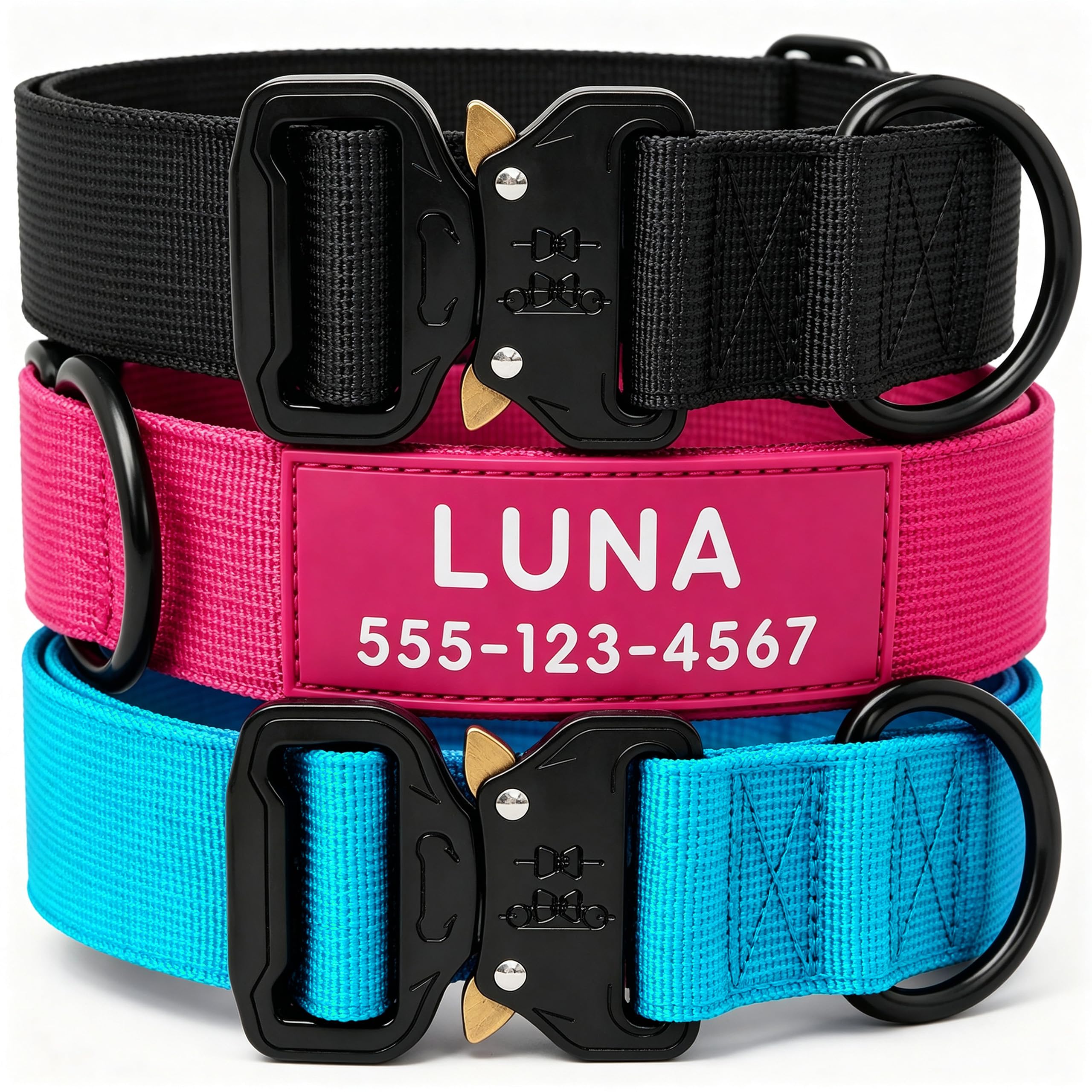
No tag, no jingle, no missing rabies disc: the dog's name and your phone number are printed on the band itself, and the lettering is large enough to read from the far side of a street. For a dog with a talent for getting out, that is the most useful thing a collar can carry.

We point people to this one when identification is the job. The print sits on a silicone strip stitched into the webbing rather than dyed straight into the nylon — a detail that surprised us, and one that explains why the lettering reads as raised and slightly glossy instead of soaking into the fabric. You can choose the font and the text color too, which matters more than it sounds when the band is dark. Double-layer 1000D nylon and a metal quick-release buckle fill out the build.

Colors run from black and grey through army green and khaki to a pink that photographs almost neon, and the buckle closes with a clean, positive click. It is a walking-and-tagging collar rather than a training tool — the kind of thing you buy because the tag on your dog's collar has gone missing twice and you are finished replacing it.

Bottom line: Our pick for dogs who wander: the name and phone number sit on a stitched-in panel, so the ID cannot rattle off in the bushes.

4

dazner Personalized Tactical Collar

dazner Personalized Tactical Collar

Readable ID

Our Score 9.2/10
Check Price

Worth Noting

  • Sizing letters run inconsistent, so measure first
Sizes
Small to XLarge
Buckle
Zinc alloy quick-release
Webbing
Double-layer nylon
Personalization
Name and phone number
Read the full review

The print is the reason to look twice. The name and number sit on the band in large, high-contrast lettering — the kind you can read across a street — and it is one of the few personalized collars here where the readable option is also a color you might actually choose for its own sake.

Underneath it is double-layer nylon with a zinc alloy quick-release buckle, which is the right hardware for a dog that chews through plastic clips. Hand washing keeps the color, the lettering stays sharp rather than blurring into the weave, and the 1.5-inch band sits in the middle of this group: wide enough to look the part without overwhelming a fifty-pound dog.

We keep it on the list for the dog whose collar is mostly an address label with a bit of style attached. It is a simpler collar than the working picks here — no patch field to build on, no extra hardware to maintain — and the print does the job a dangling tag does without the noise. If a panel or a handle is what you need, the picks above serve you better; if it is a legible number on a bright band, this is the one.

Bottom line: The one we point to when the name and number matter most: big, legible print, metal hardware, and colors that stay bright.

5

Elite Spanker Tactical Collar

Elite Spanker Tactical Collar

Patch and ID

Our Score 9.0/10
Check Price

Worth Noting

  • Largest size stops at a 21-inch neck
  • 90-day warranty is the shortest here
Closure
Metal quick-release with hook-and-loop
ID Panel
Hook-and-loop patch panel
Band Width
1.5 in
Neck Range
L: 17-21 in
Read the full review

The panel arrives stiff, flat and slightly proud of the neck, which is the whole character of this collar. It does not fold in on itself the way a plain nylon strap does, the stitching is even and close, and the hook-and-loop field on the outside runs far enough around the band to take a proper ID patch rather than a decorative one.

The detail we appreciated most is the small tab that stows the handle flat against the band. A loose handle swinging under a dog's chin is one of those minor annoyances that compounds over every walk; here it lies down until you reach for it, and then it opens into a full hand's width.

We rate this as the best patch platform here and the most substantial build in the group. It holds its shape instead of going floppy, the edges have not curled, and the hardware feels like it belongs on a working dog. That rigidity is also the trade: on a medium dog with a short neck, there is simply a lot of collar there.

The buckle is the part we keep an eye on. It is a chunky metal quick-release with a positive click, and it is the component most likely to be this collar's undoing over a long life. Check the latch after a hard pull, and keep the hook-and-loop brushed clean so the panel grips the way it did on day one.

Bottom line: The most substantial build here and the best platform for ID patches: a stiff, flat panel that looks and wears like duty kit.

6

Odokele AirTag Tactical Collar

Odokele AirTag Tactical Collar

AirTag tracking

Our Score 8.8/10
Check Price

Worth Noting

  • Size L stops at a 20.5-inch neck
Handle
Widened control handle
Closure
Metal quick-release with hook-and-loop backing
Neck Range
L: 16.5-20.5 in
AirTag Holder
Built-in, sealed
Read the full review

The AirTag pocket is the reason this collar exists, and it is done properly. The holder is moulded into the band with a sealed lid rather than clipped on as an accessory, so the tracker sits flat against the neck, and the seal is there for dogs that swim rather than dogs that get caught in the rain.

Around that pocket is a legitimate tactical collar: 1000D nylon, a breathable padded lining, a widened handle that is noticeably easier to get a fist into than the narrow loops on the cheapest collars here, and a metal quick-release buckle.

The clasp has a strip of hook-and-loop behind it, so a bumped release leaves the collar on the neck rather than in the road. That combination — clip plus backup — is what makes it workable on a dog that thrashes the moment it sees another dog, and it is the design detail we came away trusting most.

We send people here when tracking is the point: a fence-climber, a door-bolter, a dog that goes missing on walks. Having the holder built into the band means there is no second item to lose, and the tracker rides where the collar rides instead of swinging on a ring. Of everything on this list, it is the one we trust most for a dog that gets out.

Bottom line: The pick for dogs you track: a sealed AirTag pocket built into the band, a wide handle, and a clasp with a backup behind it.

7

DAGANXI Tactical Dog Collar

DAGANXI Tactical Dog Collar

First tactical collar

Our Score 8.8/10
Check Price

Worth Noting

  • Hook-and-loop can let go under a hard pull
  • Handle is small for a gloved grab
Handle
Control handle
Closure
Metal quick-release with hook-and-loop
Included
AirTag case and two patches
Material
1000D nylon, padded
Read the full review

Nothing else in this group arrives with as much in the box: a padded 1000D band, a grab handle, an AirTag case and two swappable ID patches. It is the budget pick we are comfortable recommending, and it is the sensible way to try the tactical format if you are not yet sure your dog will tolerate a wide collar.

The AirTag case is the piece we did not expect to care about. It is a separate cover rather than a pocket sewn into the band, so the tracker is protected from scratches and keys without the whole collar being built around it. The padding is genuine as well — the inner face is soft enough that a short-coated dog does not come back from a long walk with a rubbed neck, which is the corner budget collars most often cut.

Adjusting it is a two-minute job you do once. There is a lot of hook-and-loop to peel back before the buckle appears, and the strap threads through the buckle rather than clipping around it, so setting the length takes a couple of attempts. Once it is set, the metal buckle carries the load and the hook-and-loop backs it up. The patches are the fun part: a plain one for town, a working one for the park.

Bottom line: The budget pick we are happy to recommend: padded 1000D webbing, a usable handle, and an AirTag case included rather than sold separately.

8

Joytale Tactical Dog Collar

Joytale Tactical Dog Collar

Training and mud

Our Score 8.6/10
Check Price

Worth Noting

  • Webbing fuzzes at the buckle and D-ring
  • Hook-and-loop weakens once it fills with hair
Handle
Traffic control handle
Closure
Zinc alloy quick-release
ID Panel
Hook-and-loop patch panel
Material
Double-layer 1000D nylon
Read the full review

A padded tactical collar with a traffic handle at the bottom of the price range is a fair summary, and it explains why this one keeps turning up on dogs in training. The handle is a reinforced nylon loop with room for a fist, set high on the band where a hand finds it, and it is the best thing about the collar.

The build is double-layer 1000D nylon with a zinc alloy quick-release buckle and a hook-and-loop panel that takes the two patches in the box. Next to the Elite Spanker it is a softer, more flexible collar — easier to fold into a bag, less like a plank on a young dog's neck, and quicker to get around a wriggling puppy.

Wear is where it gives ground. The webbing fuzzes at the edges where it runs through the buckle, and the finish on the D-ring rubs through first, so a collar that looks sharp in month one looks scuffed by month three. Treat a fraying edge as the signal to replace it rather than something to trim and ignore.

We rate it as the collar to buy for a dog still in training, or as a second collar that lives in the car, precisely because it is cheap enough to abuse. The handle is what sells it: at this tier most collars give you webbing and nothing else, and having a real grab point changes how you move a dog through a busy car park.

Bottom line: Our pick for training and muddy second-collar duty: a real traffic handle, padded webbing, and a build you will not mind getting filthy.

How We Chose and Tested These Collars

We started by pulling every tactical collar we could find — three dozen listings, from brands we already trusted and a handful we didn't — then cut the list by construction rather than marketing copy: 1.5-inch webbing, a metal D-ring, a handle stitched at both ends instead of tacked at the middle, and a buckle we could work one-handed. That left 14 collars, which we ran for four months.

Each one went onto at least three dogs of different neck sizes, and we measured the usable adjustment range with a tape before anything left the house. From there they went on morning walks, two overnight hikes, a rainy week that soaked every strap, a lake swim, and a vet visit where a tech had to unclip the collar while holding a wriggling dog. We grabbed each handle one-handed on the street, often while holding a leash and a coffee, to see whether it sat flat in the palm or rolled.

Buckles separated the field first: we opened and closed each one 50 times, then did it again with winter gloves on, noting which side-release clasps needed two hands and which metal buckles pinched. Velcro got pressed shut and peeled apart until we could tell whether it was still grabbing and whether it was collecting fur and burrs from the dog's ruff. Fit got rechecked at the end of every walk, since several collars crept loose by an inch or more, and each week we looked at the stitch lines under the handle and D-ring for fraying and at whether the webbing still looked sharp after mud and rain. By the end we knew which collars were worth the money and which were just an expensive patch panel.

How to Choose Tactical Dog Collars

Measure the neck, not the breed

Breed charts are a starting point and nothing more. Run a soft tape around the base of the neck, where the collar actually sits, add room for two fingers, and match that number to the collar's range rather than to a size letter. A good fit lands near the middle of the adjustment, not on the last hole, because the end of the range is where straps bulge and buckles sit crooked.

The picks here span roughly 16.5 to 23 inches, and the gaps between sizes are narrower than most people expect. If your dog measures just over a boundary, take the larger collar and use the holes — a wide band that is slightly long can be adjusted, and one that is slightly short cannot.

How the closure actually holds

Most collars here use a metal quick-release clip, and a few add a strip of hook-and-loop behind it as a second line of defence. That backup earns its place on a strong dog, but it is a wearing part: hair and grit fill the hook side, grip fades, and the strap starts to move. Brush the panel out and check it before you trust it.

Two-prong belt buckles are slower to fasten and more secure once closed, because the load sits on metal through two holes. If your dog has ever backed out of a collar, buy the buckle and skip the clip.

Width and padding: how much collar a dog will wear

A 1.5-inch band suits most medium and large dogs. Two inches is for broad-chested giants, where the extra surface spreads leash pressure and stops the band rolling under the neck. The cost is bulk and heat — a wide, stiff panel on a short-necked dog is a lot of collar in July, and a dog that fusses at the neck usually settles when the band gets narrower and the lining softer.

Padding is not decoration. It is what stops a wide band rubbing a thin coat, and it is the first corner cheap collars cut.

What the traffic handle is actually for

The handle is a close-control aid, not a lifting strap. It is for holding a dog steady at a kerb, easing it past another dog, or keeping it between your legs in a crowd, and for those jobs it changes a walk. It should never take a dog's full weight.

Put your hand through the loop before you commit. Some are cut wide enough for a gloved fist and some are not, and a handle you cannot find in a hurry is decoration. Handles that stow flat against the band with a tab are the ones that stay out of the way.

Decide the identification before you buy

There are three routes and they barely overlap. A hook-and-loop panel takes patches and swaps in seconds, which suits a dog that works or is in training. A printed name and phone number means no dangling tag to lose or listen to. A built-in tracker pocket keeps an AirTag on the neck instead of swinging from a ring, and a sealed holder is the version to choose for a dog that swims.

Pick the one you need now. Adding identification later usually means buying a second collar.

Frequently Asked Questions

Final Verdict

We recommend the ADITYNA for most people. It does the three things a tactical collar has to do: it fits a wide spread of necks, the closure stays where you set it, and the handle is where your hand expects it.

If your dog is a genuine giant, the Spark Paws and its two-inch band is the better shape. If the dog is a fence-climber, the Odokele's sealed tracker pocket is worth the step up. Fit first, extras second.