Health & Wellness

Best Tick Remover Tools for Dogs of 2026

Finding a tick on your dog is unnerving partly because the clock is already running: the longer it stays attached, the higher the risk it passes something along. Grab it wrong, though, and you leave the mouthparts behind, which is its own small mess to deal with. What you need is a tool that slides under the tick's body, grips close to the skin, and pulls straight out without squeezing anything back into your dog.

I spent four months on this, from the first warm weekend of spring into high summer, working through 16 different tick removers with my dog. The gap between a flimsy one and a good one showed up where I didn't expect it: whether the fork slid under an engorged tick without pushing it deeper, whether the plastic bowed when I twisted one-handed while holding a wriggling dog still. Size cuts both ways — a tool built for a nymph is useless on a fat adult, and the ones that live on a leash clip are the ones you'll actually have with you. The picks below are the ones I'd trust in tall grass with nobody around to help.

1

TickCheck Value 3 Pack

Top Pick
TickCheck Value 3 Pack

Everyday tick removal

Our Score 9.4/10
Check Price

Worth Noting

  • Short handles put fingers close to the tick
Sizes
3 sizes
Extras
Tick ID card, resealable pouch
Tools Included
3 tick hooks
Package Dimensions
5 x 3.35 x 0.43 inches
Read the full review

Three hooks in three sizes is why this set is the one we recommend to most households. The small hook is sized for the poppy-seed nymphs that hide in a short coat, and the large one opens wide enough to sit around an engorged adult without pinching the body. On our own dogs we reached for the middle size most often, which is exactly the point of a set: you do not have to guess right while the dog is squirming.

The motion is simple and, we think, easier to get right than tweezers. You slide the notch under the tick flat against the skin, then lift straight up, so nothing crushes the tick's abdomen, which is the part that matters if you are worried about what gets pushed back into the bite. It copes with a thick, curly coat as well, because the hook parts the fur instead of needing a clear line of sight.

What surprised us is how much work the extras do. The pocket-sized ID card separates a deer tick from a dog tick at a glance, which is useful when you are deciding whether a bite is worth a call to the vet, and the resealable pouch means the hooks live in the glove box instead of rolling around in it.

It is one of the least expensive multi-size sets here, and the Tick Twister's rotating method, while popular, takes a technique to learn. For a first removal, a lift-and-pull hook is the easier thing to have in your hand. We keep one set in the car and one by the back door, which is roughly how we treat anything that has to work at short notice.

Bottom line: We recommend this set first: three hook sizes handle anything from a seed tick to a full adult, and the ID card earns its place the first time you need to know what bit your dog.

2

TickCheck Premium Kit

TickCheck Premium Kit

Tiny nymph ticks

Our Score 9.4/10
Check Price

Worth Noting

  • Fine tips need good light and a steady hand
  • Costs more than the simple hook sets
Case
Leatherette carry case
Material
Stainless steel
Tools Included
Tick fork and fine-tip tweezers
Package Dimensions
5.24 x 1.97 x 0.48 inches
Read the full review

The reason to buy this kit is the tweezers, not the fork. Their tips close to a point fine enough to take a pinhead nymph off the thin skin inside an ear, which is exactly where a notched hook has nothing to scoop under. On the fat, obvious ticks the fork does the work; on the ones that make you swear, it is the tweezers.

Both tools are stainless steel, so they wipe down with alcohol and go back in the case, and the leatherette sleeve is about the length of a glasses case, flat enough for a glove box and tidy enough to leave on a shelf. The tick ID card rides along, as it does with the brand's hook set.

The fork is the more forgiving of the two and the one to try first on an adult tick; the tweezers come out when the fork cannot get under the body. We think of this as the kit for a household that finds ticks often enough to want both options in one place, rather than the one to clip to a leash.

Bottom line: The kit for small, half-buried ticks: the fine-tip tweezers reach what a hook cannot, and the steel wipes clean for the next time.

3

Ticked Off Tick Remover

Ticked Off Tick Remover

No-touch disposal

Our Score 9.4/10
Check Price

Worth Noting

  • Colors vary, so you cannot choose
  • Long handle is awkward in a pocket
Colors
Assorted, colors vary
Design
Notched tip with tick-catching bowl
Intended Use
Dogs, cats, and people
Tools Included
3 removers
Read the full review

The Ticked Off looks like a spoon with a chip taken out of it, and the chip is the whole idea. You slide the notch under the tick at skin level, keep pushing, and the tick ends up in the shallow bowl behind the notch instead of on your fingers or the kitchen floor.

Three come in a pack, and the orange ones are easy to spot in a drawer full of leashes and tennis balls. The bowl is the best piece of design in this group: once the tick is in there you can carry it to the toilet or a sealed bag without touching it, and it cannot crawl off your hand.

The spoon shape also keeps your fingers out of the fur, and it lies flat against a shoulder or hip. In an ear crease or between the toes it is the wrong tool, because the bowl needs more clearance than a slim hook does, so this is one to buy alongside a hook rather than instead of one.

Colors vary, so you do not get to choose, and the long handle is awkward in a jacket pocket. Neither bothers us much for a tool that lives in a drawer or a car door. It is the priciest pick here, and the three-pack means one can sit wherever the dog sleeps.

Bottom line: The least unpleasant way to take a tick off: the bowl catches it on the way out, and the long spoon keeps your fingers out of the fur.

4

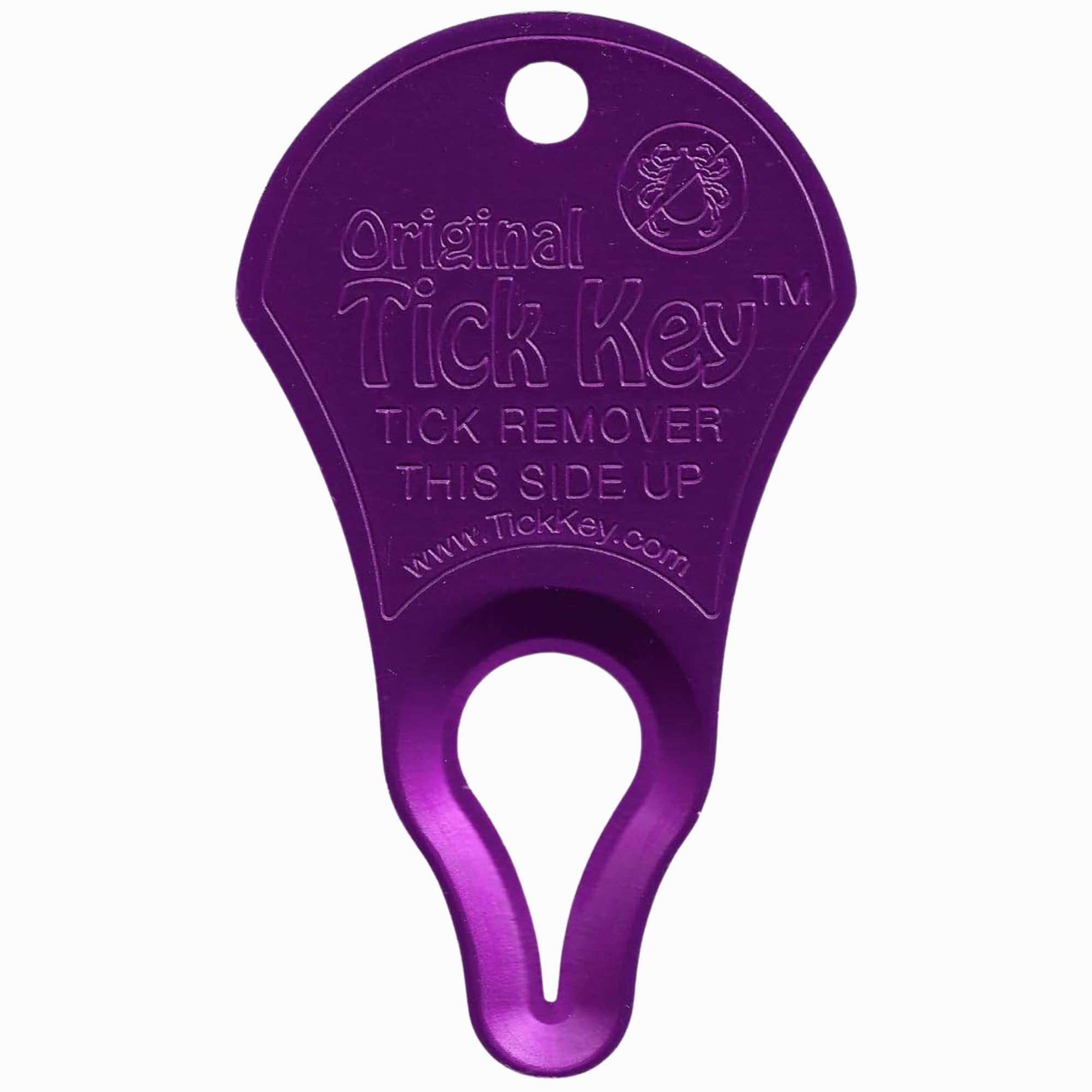
The Original Tick Key

The Original Tick Key

Keyring carry

Our Score 9.4/10
Check Price

Worth Noting

  • One slot has to fit every tick size
Color
Purple
Design
Tapered notch with forward leverage
Origin
Made in the USA
Tools Included
1 tick key
Read the full review

Flat is the feature. The Original Tick Key is a thin metal plate with a tapered slot and a hole for a keyring, and the point of that shape is that it rides on your keys without making a lump in your pocket.

You thread the tick into the narrow end of the slot and push the key forward, so the tick is levered out against the skin rather than pinched and pulled. Done properly it takes a few seconds, and your fingers never touch the tick.

Where it shines is easy real estate: the back, the shoulder, the outside of a thigh, anywhere there is room to lay the key flat against the coat. Where we stopped reaching for it was the face. Ears, muzzle, and the skin between the toes are too curved and too tight, and a hook gets in there where the key does not.

It is a single tool, one size, sold on its own. If your dog collects ticks on the back after a walk in the woods, that is a fair trade for something you will actually have with you. If they collect them around the head, put a hook on the keyring instead.

Bottom line: The one we clip to a leash: thin, light, and quick to use one-handed when the tick is on a flat stretch of back.

5

Acronde 3-Piece Kit

Acronde 3-Piece Kit

Budget steel kit

Our Score 9.4/10
Check Price

Worth Noting

  • Third tool overlaps the other two
Weight
2.11 oz
Material
Stainless steel
Tools Included
Hook, double-ended tweezer, fine-tip tweezer
Read the full review

A stainless hook, a double-ended tweezer, and a super-fine pair, all in one small case, for a good deal less than the premium kits here. The Acronde kit is the sensible answer for anyone who wants steel tools without paying case-and-leather money.

The super-fine pair is what earns the kit its place. It grips a nymph that the hook cannot scoop, and the point is fine enough that you can wipe it with alcohol and reuse it. The hook is ordinary but does the job on anything engorged, and the case keeps the points from bending in a drawer.

This is the right buy for someone who wants steel, wants a case, and does not want to spend TickCheck Premium money. The catch is overlap: the double-ended tweezer sits between the hook and the fine-tip pair without doing anything they cannot, so what you are really carrying is a hook and one good pair of tweezers.

The kit measures about four inches and weighs a couple of ounces, so it lives in a glove box or a first-aid pouch rather than on a keyring. That suits us fine, because this is the kit that stays in the car, not the one on the leash.

Bottom line: The steel kit we point budget-minded buyers to: a hook and a genuinely fine pair of tweezers for a good deal less than the premium kit.

6

Tick Twister Set

Tick Twister Set

Twist-style fans

Our Score 9.2/10
Check Price

Worth Noting

  • Smallest fork still struggles with seed ticks
  • Two loose pieces to keep together
Sizes
Small and large
Weight
0.64 oz
Tools Included
2 twist-out forks
Read the full review

The Tick Twister takes ticks out by rotation. You slot the fork around the tick, spin the handle a couple of turns, and the tick releases and comes up in the fork. That is deliberately different from the steady vertical pull most vets describe, and it is why this set has such a devoted following among people who have mastered the motion.

We found the spin easier to control on a dog that will not stand still, because the movement stays contained in the tool instead of travelling through your wrist. If you have ever pulled, felt something give, and come away with a body while the head stayed in the skin, that containment is worth having. The two forks, small and large, cover nymphs through engorged adults.

At well under an ounce the pair disappears into a backpack, and the bright color is easy to find in a dark drawer. The technique is the part worth rehearsing, so watch it done once before you are doing it on a dog at night. And keep the two forks together yourself, since they arrive as a loose set with nothing to hold them.

Bottom line: Buy this if you prefer twisting a tick out to pulling it: the rotation stays contained and quick, and two fork sizes handle most of what a dog brings home.

7

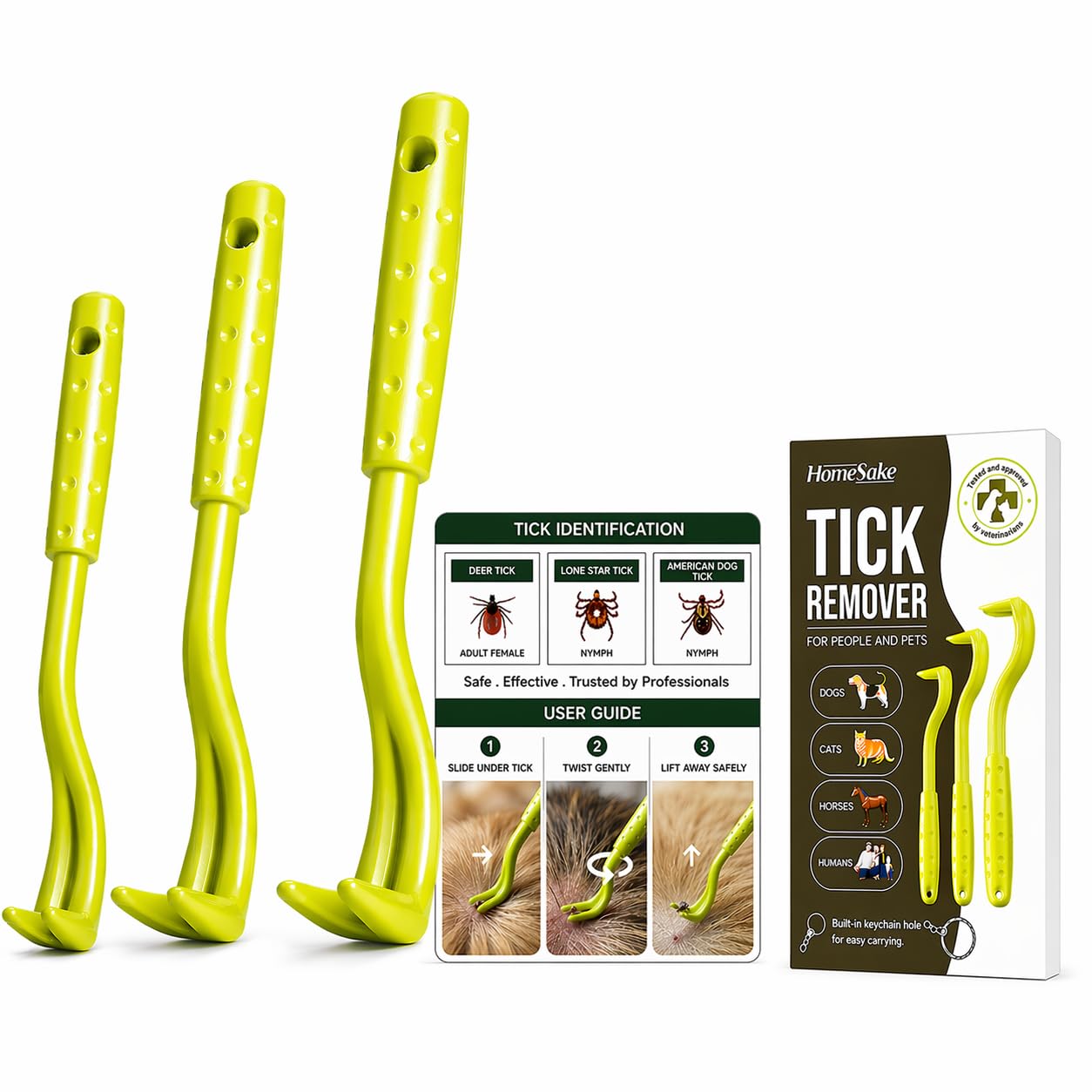
Homesake 3 Pack

Homesake 3 Pack

Tools everywhere

Our Score 9.2/10
Check Price

Worth Noting

  • Handles run small for adult hands
  • Easy to misplace between uses
Sizes
3 sizes
Extras
Tick ID card, keychain hole
Weight
0.63 oz
Tools Included
3 removers
Read the full review

A keychain hole runs through each of the three hooks in this set, which is the detail we want on every hook set here. Clip one to the leash handle and it stops being something you have to remember.

The rest is familiar ground: three sizes, a tick ID card, and a notch that slides under the tick rather than pinching it. Same lift-and-pull motion as our top pick, at a similar price.

Homesake's set is three hooks and an ID card, so the carrying answer here is the hole in the handle rather than a pouch. We like that trade for a walking tool, because a hook hanging off the leash is reachable without unzipping anything.

We treat this as the set to scatter rather than the set to rely on for a delicate removal on a big dog. One on the leash, one in the car, one in the kitchen drawer, and there is always a hook within reach when the dog walks in with something attached.

Bottom line: The set to scatter: inexpensive enough to keep one on the leash, one in the car, and one in the kitchen drawer.

8

Tick Patrol Tick Remover

Tick Patrol Tick Remover

One-handed trail use

Our Score 9.2/10
Check Price

Worth Noting

  • Single notch is a poor fit for tiny nymphs
Carry
Keychain attachment
Origin
Made in the USA
Material
Anodized aluminum
Tools Included
1 remover
Read the full review

The Tick Patrol remover is a single flat lever of anodized aluminum, made in the USA, with a hole at one end for a keyring. It works the way the flat key-style tools do: you thread the tick into the notch and push forward so the tick is levered out against the skin.

Aluminum makes it light enough to forget about on a collar or a backpack strap, and stiff enough that it does not flex while you are pushing. We appreciate the single-piece design for the same reason we like the Tick Key: nothing to assemble, nothing to lose separately.

Where it earns its place is the middle of a walk. Clipped to a collar or a strap it is light enough that the dog ignores it, and it works one-handed while you hold the leash in the other, which is more than we can say for a pair of tweezers.

We think of it as the second tool rather than the first: one clipped to the leash for the tick you find out on a walk, with a fine-tip tweezer back home for anything small. That is a job worth having covered, and the aluminum will outlast the novelty of carrying it.

Bottom line: A flat aluminum lever for the leash: light, stiff, and quick one-handed on the flat of a back, with no parts to lose.

How We Tested Tick Removers on Real Dogs, in Real Grass

We started by gathering the shapes vets and groomers actually reach for — slotted forks, twist-and-pull wands, tick keys, fine-tipped cards — and dropped anything that required two hands, a second person, or a flat surface to work against. From that pile we filtered by the range of tick sizes each tool claimed to handle, the material it was molded or machined from, and whether the maker would replace a unit that snapped. Sixteen tools made the cut, and we bought every one at retail so nothing arrived as a free sample.

Testing ran four months, from the first warm weekend of spring into high summer, which is when our dogs were picking up ticks on morning walks, weekend hikes through tall grass, and unsupervised patrols of a fenced backyard. Every find got logged: where on the dog, how engorged the tick was, and whether the tool pulled it out whole or left mouthparts behind. We ran the checks the way anyone actually does them — crouched on the floor with a phone flashlight, sometimes with gardening gloves still on, sometimes with a squirming dog and no second set of hands.

Ease of use was judged one-handed: could we seat the fork under the tick while holding the dog still, and did the tool slip on wet fur or a long coat? Quality got settled in the sink, where we washed each tool after every use and watched for rust, hairline cracks, and hinges that loosened. For size, we deliberately worked with both a short-coated dog and a heavy-coated one, comparing how each slot handled a pinhead nymph against a fully engorged adult. Value came down to whether a tool survived a whole season and kept its edge, since a cheap one that bends on the first fat tick ends up costing more.

How to Choose Tick Remover Tools for Dogs

Match the tool shape to where the tick is attached

If your dog picks up ticks on the back and shoulders after a walk in tall grass, a flat lever key or a spoon is quick and easy to use. If they turn up in ears, around the muzzle, or between the toes, which is where ticks actually settle, a slim hook or a fine-tip tweezer reaches places a flat tool cannot lie. There is no single perfect shape. Buy for the spot where you find them most, then add a second shape for everywhere else.

Whichever tool you choose, the removal itself works the same way: bring the notch or the tips as close to the skin as the tick's body allows and pull steadily away. The twist-style tools are the exception, since they are designed to rotate the tick out, and their own directions should win.

The smallest notch matters more than the biggest

An engorged adult is easy, a grey bean with an obvious grip point. The hard ones are nymphs, roughly the size of a poppy seed, and a single large key or spoon has one slot that a nymph can pass straight through. Sets with two or three sizes earn their extra bulk here.

Photos make every tool look larger than it is, so judge the notch rather than the overall length. If a listing will not tell you how narrow the slot gets, buy a multi-size set instead of guessing.

Plan for the moment, not the drawer

Realistically, removal happens at night on the floor, with one person holding a wriggling dog and the other holding a light and a tool. Anything that needs assembling costs time. That is why we favour a keychain hole, or a set that lives in the car as well as the house.

A premium kit in the bathroom cabinet is less useful than a budget hook hanging by the back door. Put one tool where the dog comes in, not where you keep the first aid supplies.

Steel, aluminum, and what happens afterward

Stainless steel wipes down with alcohol and lasts, at the cost of weight and price, and a dropped pair of fine tweezers can lose its alignment. Aluminum and lighter hooks cost less and are easier to scatter around the house and car, which is its own kind of reliability.

Replace anything whose notch has bent or burred, because a damaged edge is more likely to squeeze the tick. After removal, clean the bite, wash your hands, and save the tick in a sealed bag marked with the date if there is any chance you will want it identified.

Frequently Asked Questions

Final Verdict

The TickCheck Value 3 Pack is what we recommend to most people. Three hook sizes mean you are covered whether the tick is a speck or a bean, the ID card earns its keep the first time you need to know what bit your dog, and the pouch lets the set live in the car instead of a bathroom drawer.

If the ticks you find are routinely tiny or half-buried, add the TickCheck Premium Kit for its fine-tip tweezers. And if your dog's ticks turn up on the back after every walk, put the Tick Key on your keys, because you will use it far more often than a kit you have to go and fetch.