Training & Behavior

Best Training Collar for Stubborn Dogs of 2026

Training a dog who has already decided the rules don't apply to him is less about force and more about finding a signal he actually respects. The worry with training collars is understandable: too much correction and you can muddy the relationship; too little and you're just another noise in the backyard. What a stubborn dog needs is a clear, repeatable cue — one that reaches him at the moment he's locked onto a squirrel or pretending he can't hear you. The right collar closes that gap without turning every walk into a negotiation.

I've lived with a shepherd mix who treats recall as a suggestion, so I know the difference between a collar that nags and one that communicates. We spent six months with 14 collars, using them in daily training sessions, on neighborhood walks, and during backyard recall drills with real distractions. The surprise: maximum stimulation is not the answer; fit, a clear button layout, and a reliable signal at the lowest level a dog notices matter far more. The ones below held up for both dog and handler.

1

Herm Sprenger Prong Collar

Top Pick
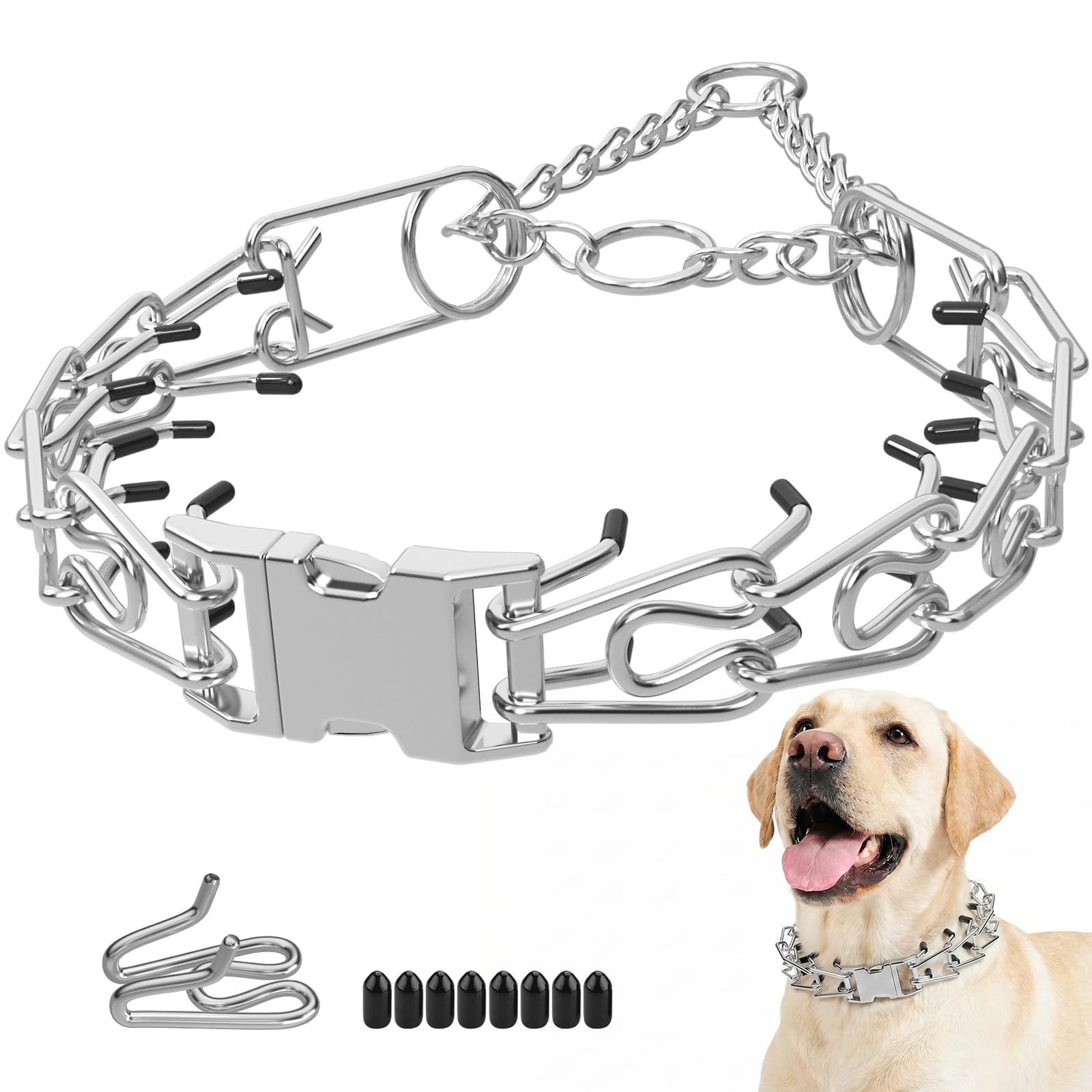
Herm Sprenger Prong Collar

Strong pullers

Our Score 9.2/10
Check Price

Worth Noting

  • Takes patience to slip on and off over the head
Neck Size
20 in (22 in chain)
Adjustment
Add or remove links
Wire Gauge
3.25 mm
Collar Type
Prong (pinch)
Read the full review

Three and a quarter millimeters of chrome-plated steel, a solid fastener plate, and a sizing system that consists entirely of adding or removing links. That is the whole collar, and it explains why the design has barely changed in decades while everything around it got a screen and a charging cable.

What it does to a hard-pulling dog is not subtle. The links close around the neck and spread pressure instead of loading the throat, and the correction arrives with a fraction of the leash pressure a flat collar needs. Among the collars here, it has the strongest record on pull control and on changing behavior, and dogs tend to get the message on the first walk rather than the tenth. That is what earns it the top spot: not features, but the shortest distance between a dog that drags and a dog that walks.

Fit is the part people get wrong. It sits high, right behind the ears, snug enough that it cannot slide down toward the shoulders, which usually means taking out one more link than looks sensible at first. Measure the neck, size to that number, and check where the prongs are sitting after five minutes of walking. A collar hanging low is uncomfortable for the dog and gives a muddier correction for you.

The rest is quiet advantage. No charging, no pairing, no battery that fades inside a year, and a wipe with a damp cloth is the entire maintenance routine. What it asks in return is that you learn to use it: light hands, a quick release of pressure, and a dog that already knows what a leash is before you add the correction.

Bottom line: For a strong dog that ignores a flat collar, this is the one we hand over first: instant pull control, no batteries, and a fit you tune link by link.

2

Garmin Sport PRO

Garmin Sport PRO

One-handed field work

Our Score 9.2/10
Check Price

Worth Noting

  • Battery life splits between units
  • Charging clip feels flimsy
Collar Type
Remote e-collar
Contact Points
Two lengths included
Dogs Per Handheld
Up to 3
Stimulation Levels
10
Read the full review

A click-stop dial instead of a screen full of buttons is the whole argument for the Sport PRO, and we think it is a good one. Ten stimulation levels, each with a positive click you can count by feel, plus four buttons covering continuous stim, momentary stim, tone and vibration, on a handheld that disappears into a jacket pocket.

Ten levels sounds thin next to the hundred-level units in this guide, but the number is not the point. The difference is between a correction you can deliver without breaking stride and one you have to hunt for on a display while the dog is already moving. The handheld runs up to three dogs, and the dog device has beacon lights rated visible from 100 yards in low light, which is a small thing until the evening walk runs late.

It is a premium kit and it behaves like one: a polyurethane-coated collar strap, a receiver built to be dropped, and two lengths of contact point in the box. Battery is the split subject here, with some getting days between charges and others finding the collar flat sooner than expected, and the charging clip is the flimsiest piece in the kit. Charge both ends after every session.

Where it earns the money is repetition: same click, same button, in the dark, with cold hands. Training a stubborn dog is mostly about being consistent, and this handheld makes consistency the easiest part of the day. What it cannot do is step down finely, so a very soft dog may find the bottom of the range is still plenty.

Bottom line: The pick for a handler who wants to correct without looking down: a click-stop dial, ten levels, and up to three dogs on one handheld.

3

Dogtra 1900X

Dogtra 1900X

Off-leash reliability

Our Score 9.0/10
Check Price

Worth Noting

  • Battery life splits between units
  • Single-dog kit at a premium price
Range
0.75 mi
Collar Type
Remote e-collar
Water Rating
IPX9K
Stimulation Levels
100
Read the full review

Dogtra builds this one for the dogs other collars give up on, and it is the pick here with the strongest record on training stubborn ones. Three-quarters of a mile of range, 100 stimulation levels, tone, vibration and a boost button for the moment a dog blows straight through a command.

The hundred levels are the reason. You step up one number at a time until the ear flicks or the head turns, then stop, and that is the level you train at. It is usually lower than people expect, and it stays put, so a correction means the same thing on Tuesday as it did on Sunday. Tone and vibration sit on their own buttons as a warning before any stim, and the safety lock keeps a fence post or a pocket from turning the dial.

Build is the other argument: a metal receiver case instead of a plastic shell, IPX9K waterproofing, and a Biothane collar strap. What holds it back is battery life, the subject here that splits hardest, with some units running for days and others failing to hold a charge inside a month. Durability is mixed as well. At the top of the price range, that is the gamble you take.

It is a one-dog system, so a two-dog household buys twice or looks elsewhere. For the owner of a single determined dog that needs a precise, repeatable correction at a distance, though, the fine steps and the metal case are worth more than the features you give up.

Bottom line: Buy this when the dog has already beaten everything else: a hundred finely stepped levels, a metal receiver, and enough range to work off leash.

4

Educator ET-300 Mini

Educator ET-300 Mini

Fine low-level tuning

Our Score 9.0/10
Check Price

Worth Noting

  • Shortest battery life in this guide
  • Rated for dogs 15 lbs and up only
Range
0.5 mi
Neck Size
10–26 in
Collar Type
Remote e-collar
Stimulation Levels
100
Read the full review

The pitch of the ET-300 is everything happening at the bottom of the dial: 100 stimulation levels you climb one at a time, plus tone and vibration, on a receiver small enough for a 15-pound dog and adjustable to a 26-inch neck.

That granularity is the point. Most dogs do not need a strong correction; they need one they can feel and a level they can predict, and a hundred steps let you land underneath the point where a dog panics. The training and behavior side of this collar's record is as strong as anything in this guide, including for off-leash work.

Two things keep it out of the top tier. Battery life is the weakest subject attached to any collar here, with plenty of people charging every couple of days and some units that stop holding a charge altogether, and at a premium price that is hard to plan around. We stop short of recommending it as a first remote for exactly that reason.

What you do get is a thoughtful kit: two sets of contact points with a removal tool, a remote that floats if it goes into the pond, and a receiver light for evening sessions. If you already know your dog works at level 6 of 100 and you want that exact number back every time, this is the collar that gives it to you.

Bottom line: Worth it only for the handler who needs the finest steps available and can live with charging every couple of days.

5

Aolulf 2-Dog E-Collar

Aolulf 2-Dog E-Collar

Two dogs, budget

Our Score 8.8/10
Check Price

Worth Noting

  • 18 stim steps leave big jumps
  • Two collars means two things to charge
Range
3,300 ft
Collar Type
Remote e-collar
Dogs Per Remote
2
Stimulation Levels
18 (vibration 9)
Read the full review

Two receivers, one remote, and a keypad lock so the buttons do not fire while the handset rides in a pocket. The Aolulf is the kit we point people toward when they are not yet sure an e-collar is the right answer for their dog and do not want to spend like they are.

What surprised us is how little it asks you to give up. Beep, vibration in nine steps and stim in eighteen cover what most dogs need, the receiver is IPX7, and the range is rated to 3,300 feet, far past anything a backyard or a park walk requires. It is also the remote in this guide with the fewest complaints attached to it, which at this price is the unusual part.

The limits are real and they are the right ones for the money. Eighteen stim steps are coarse next to a hundred-level unit, so fine-tuning a very soft dog is harder; the strap is nylon with a conventional buckle; and a two-dog kit means two receivers to charge and keep track of. None of that gets in the way of the actual job.

The part we did not expect to care about is the beep. On a dog that has had a handful of sessions, the tone alone often does the work and the stim button stays untouched. That is the version of e-collar training worth aiming for, and it is nice to reach it on a kit this cheap.

Bottom line: The budget remote we recommend without hesitation: two receivers, eighteen stim steps, and a beep that does more of the work than you expect.

6

SGODA Chain Collar

SGODA Chain Collar

Cheap slip chain

Our Score 8.8/10
Check Price

Worth Noting

  • ⚠️ Main ring can fail under a hard lunge
Material
304 stainless steel
Collar Type
Slip chain
Chain Length
24 in
Link Thickness
3.5 mm
Read the full review

Two rings and a length of 3.5 mm stainless chain. You feed one end through a ring to make the loop, and the slip action does the rest: no buckle, no links to count, no battery to remember.

A chain gives a faster, sharper correction than a prong and asks more of the handler in return. Light hands, a quick release of pressure, and no yanking. On a big, strong neck it is the roomiest collar in this group: the 24-inch chain is built for necks up to about 20 inches, which suits the dogs that make prong collars look undersized.

The criticism lands on fit and on the weld. Collars arriving shorter than expected are the recurring complaint, so measure the neck and add the two inches the listing recommends rather than ordering on breed. And check both rings before you trust it with a dog that lunges, because the ring weld is the part that has given way under a hard pull.

We rate it as a learning collar and a spare: the design that teaches a handler what timing actually means, for less money than anything else here. It is not the one to trust with the strongest dog on the block, and we would not pretend otherwise.

Bottom line: A cheap way to learn timing: the roomiest slip chain here for a big neck, provided you check the welds and keep your hands light.

7

Supet Prong Collar

Supet Prong Collar

Easy on and off

Our Score 8.8/10
Check Price

Worth Noting

  • ⚠️ Clasp can break or jam under load
Sizes
S to XL
Closure
Quick-release snap
Adjustment
Extra links included
Collar Type
Prong (pinch)
Read the full review

The reason to look at the Supet is the snap buckle: a prong collar you unclip instead of dragging over your dog's ears. Rounded contact points, extra links in the box, and a metal link body priced like an experiment rather than a commitment.

On the basic job it delivers. Dogs stop pulling, often on the first walk, and the effectiveness and pull-control side of its record holds up against collars costing several times more. The rounded tips are the part we appreciate most, because they give enough pressure to register without the sharpness that makes people wince at the idea of a prong.

Fit follows the usual rules and Supet states them clearly: high on the neck, just below the ears and under the jaw, snug but not tight, on for supervised training and off afterwards. Sizes run S through XL with extra links included, so measure the neck rather than ordering by breed. Plan on pliers for adding or removing links, because this is a kitchen-table job, not a roadside one.

Where we land is that this is a good first prong collar and a good second collar: cheap enough to try, easy enough to live with day to day, and honest about what it is. For a dog that is already walking politely, it is all the collar you need.

Bottom line: The prong collar we suggest for a first attempt: the snap buckle removes the daily wrestling match, and the rounded tips are forgiving.

8

Starmark Pro-Training Collar

Starmark Pro-Training Collar

Gentler no-pull

Our Score 8.4/10
Check Price

Worth Noting

  • ⚠️ Polymer link can break and release the dog
Size
Large, 21 in
Material
Nylon and polymer
Adjustment
Add or remove links
Collar Type
Polymer prong
Read the full review

Take a prong collar and make it out of polymer, round every tip, and link it like a watchband. That is the Starmark, and it is the version we suggest to someone who is uneasy about putting steel on their dog's neck.

The principle is identical to a metal prong: pressure around the neck, released the instant the dog stops pulling. What changes is the delivery, with duller, lighter links and a correction that reads more like a firm nudge than a pinch. On a hard-pulling adolescent it can still turn the first walk around, and the pulling-prevention record here backs that up.

We rate it as the gentlest collar in this guide that still gets a result on a dog that leans into the leash. Sizing is by link and the Large runs 21 inches, which is plenty for a big neck once a couple come out, though the links are stiff to snap the first time. Starmark also ships a backup nylon slip collar and says plainly that this is supervised equipment: on for the walk, off afterwards.

It is also the least expensive training collar here and the least intimidating-looking, which matters more than it should on a street full of other dog walkers. For a dog that pulls hard enough to hurt your shoulder but is still learning what a leash means, that combination is hard to beat.

Bottom line: Our recommendation for a moderate puller and a hesitant owner: prong-style pressure in polymer, gentle enough to try, supervised by design.

How We Tested Training Collars for Stubborn Dogs

We started by pulling every training collar we could find that was designed for dogs over 40 pounds and offered tone, vibration, and adjustable stimulation, then filtered out models with sealed batteries, vague manuals, or straps that topped out below 24 inches; we also compared what each kit included for the price. That left us with 14 collars. For six months, we used them on the same two dogs — a 45-pound terrier mix and a 90-pound shepherd mix — through daily 15-minute obedience sessions, two-mile neighborhood walks, and weekend recall drills in a park with squirrels, other dogs, and kids on bikes.

Ease of use showed up in small moments: could I change levels with one hand while a dog was lunging at the end of the leash, and did I ever hit the wrong button by accident? We noted whether the collar sat flush on a narrow neck and a thick one, whether the contact points needed trimming, and whether the strap stayed put after a full-speed run. For pulling, we watched the leash go slack — or not — when a squirrel crossed our path, and we logged how quickly we could redirect a dog back to a heel.

We tested range by walking behind a hedge and around a corner, then asking for a recall; we counted the times the signal dropped. Durability meant muddy walks, a dropped receiver on the driveway, and a strap that got chewed by a bored dog in the yard, plus a check of casing seams and buckle hardware. Battery life was tracked in days of normal use, not lab hours — we charged each collar on a Sunday and noted when it died. Value came down to what was in the box (case, lanyard, replacement contacts, a manual that explained the levels), while effectiveness was whether a dog responded to the lowest level he noticed and kept responding a week later.

How to Choose the Right Training Collar for Stubborn Dogs

Start with the mechanism, not the brand

A prong collar works by pressure that closes around the neck and releases the moment the dog yields. A slip chain does the same thing with a sharper, faster snap. A remote e-collar puts the correction in your hand at any distance. A dog that leans into a flat collar and tows you down the block is usually a prong or slip case, because the correction arrives through the leash the instant the pulling starts. A dog that walks politely but ignores you at 40 yards is an e-collar case. Buying the wrong one of those three for your dog is the expensive mistake we see most.

Fit decides whether it works and whether it's fair

Every collar here should sit high on the neck, just behind the ears, snug enough that it cannot slide down to the shoulders. That is not a style preference: low and loose turns a precise correction into a vague, uncomfortable one and puts pressure where you don't want it. Prongs size by links, so plan on removing one more than looks right. Slip chains are ordered by neck measurement plus roughly two inches. E-collars need contact points touching skin, which on a thick-coated dog means parting fur and using longer points. Measure the neck before you order.

Levels and range: buy for the work, not the number

More levels is not more power. It is finer steps, and fine steps are what let you work a strong dog at the lowest setting it notices rather than the highest it can survive. A ten-level dial is enough for a bold, driven dog; a hundred-level unit is easier to fit to a sensitive one. Range is the other figure people overbuy. A collar rated to 3,300 feet covers a park several times over, and a three-quarter-mile unit is a working-dog tool. Buy the range your off-leash work needs and ignore the box.

On, off, and off the dog

Most of the daily friction with a training collar is the two seconds of putting it on. A quick-release snap is genuinely easier on a dog that hates having anything dragged over its ears. A prong that slips over the head is secure and simple once it is on, but you do it twice a day, every day. Whichever you choose, the collar comes off when the session ends. These are supervised tools: leaving one on an unattended dog risks skin damage, and a slip or prong left on can catch on something in the yard.

Check the hardware, then check it again

Clasps, welds and strap loops are where training collars fail, and a failure here means a loose dog. Run a thumb over every joint when the collar arrives, put pressure on the ring where the leash clips, and look at the buckle under load. On a remote collar the usual weak spots are the plastic strap loop and the screws holding the contact points; on a prong or a chain it is the link plate and the weld. Replace rather than repair. The collar is the cheapest part of the setup and the only part holding the dog.

Frequently Asked Questions

Final Verdict

The Herm Sprenger is the collar we recommend first for a stubborn dog. It changes the walk on day one without a battery, a charger or a pairing routine, and it costs less than the electronics here. Fit it high behind the ears, take out one more link than feels right, and use it with a clear plan or a trainer.

If your problem is off-leash rather than on-leash, the Dogtra 1900X is the better buy: a hundred levels that let you work at the bottom of the range, three-quarters of a mile of reach, and a receiver that survives being dropped. The Garmin Sport PRO is the one for the handler who wants a dial instead of buttons.