Health & Wellness

Best Anti-Diarrhea Treatments for Dogs of 2026

It's almost never a convenient hour. The pacing wakes you first, then that sound on the hallway floor. By the time the light's on, you're already running the list — the garbage, the new food, whatever he found on the walk. A good anti-diarrhea treatment buys you time and comfort while you sort that out: it firms the stool, settles the gut, and gets your dog eating and drinking again. What it can't do is replace a vet. Blood, repeated vomiting, lethargy, or a puppy under a few months old means a phone call first.

We've spent the past four months putting 14 of these to work — powders, pastes, chews, and capsules — mostly at three in the morning, which is when they earn their keep. One pattern held across every household: palatability and size decide everything. A chew too big for a 12-pound terrier, or a paste your dog spits onto the rug, is no help at all. The picks below firmed stools quickly, went down without a fight, and didn't trade diarrhea for constipation.

1

Pro-Pectalin Chewables

Top Pick
Pro-Pectalin Chewables

Treat-taking dogs

Our Score 9.2/10
Check Price

Worth Noting

  • Large tablets need breaking for small dogs
  • Sixty doses is a lot to buy untried
Form
Chewable tablet
Count
60 tablets
Flavor
Beef liver
Active Ingredients
Kaolin, pectin, Enterococcus faecium
Read the full review

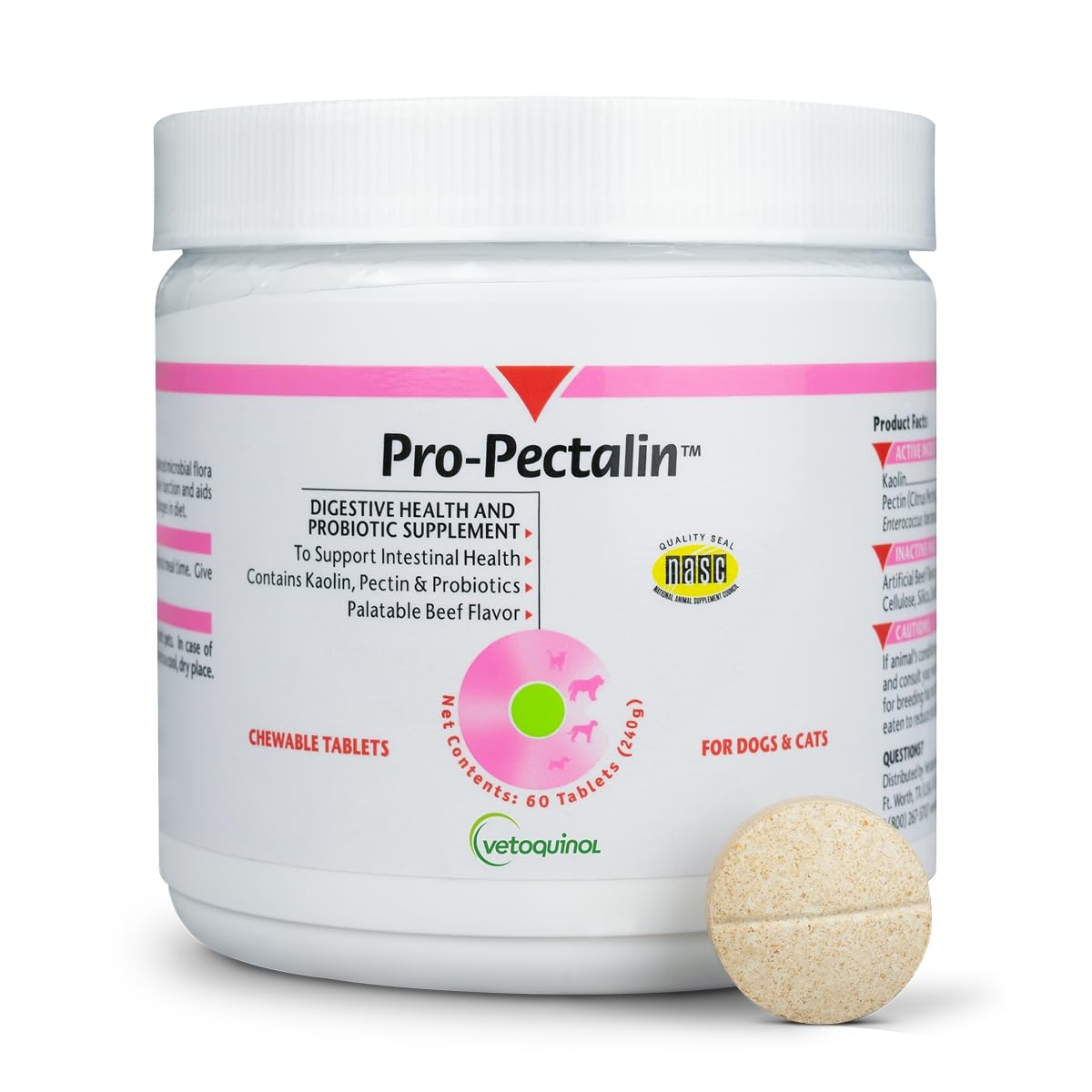
A liver-flavored tablet a dog takes from your hand like a biscuit solves the hardest part of treating diarrhea before you've even opened the tub. Sixty of them come in it, and each carries 1 g of kaolin and 0.05 g of pectin — a bigger single hit of absorbent than a milliliter of the paste delivers — plus 0.6 billion CFU of Enterococcus faecium.

For a house with more than one dog, or a dog who gets a loose week every few months, this is the format we prefer to keep on the shelf. One tub covers a lot of episodes, the tablets crumble easily over food for a dog that chews suspiciously, and nothing needs measuring at seven in the morning. The paste is quicker to get into a dog that's off food; the chewable is easier to live with.

Crumbled over a bowl of wet food, the liver flavor carries through rather than sitting on top of it, which is how we've used it on dogs that inspect everything. The one thing to think about is the tub itself: with sixty liver-flavored tablets in the cupboard, a dog who learns where they live will find them. Ours live on a high shelf, behind the flour.

Bottom line: If your dog takes tablets, this is the easiest way to treat a bad week — liver-flavored, crumbles into food, and sixty doses cover the whole household.
2

Pro-Pectalin Oral Paste

Pro-Pectalin Oral Paste

Refusing food

Our Score 9.0/10
Check Price

Worth Noting

  • 30 cc tube is a short course for large dogs
  • Contains powdered sugar and soybean oil
Form
Oral paste
Size
30 cc tube
Flavor
Chicken
Active Ingredients
Kaolin, pectin, Enterococcus faecium
Read the full review

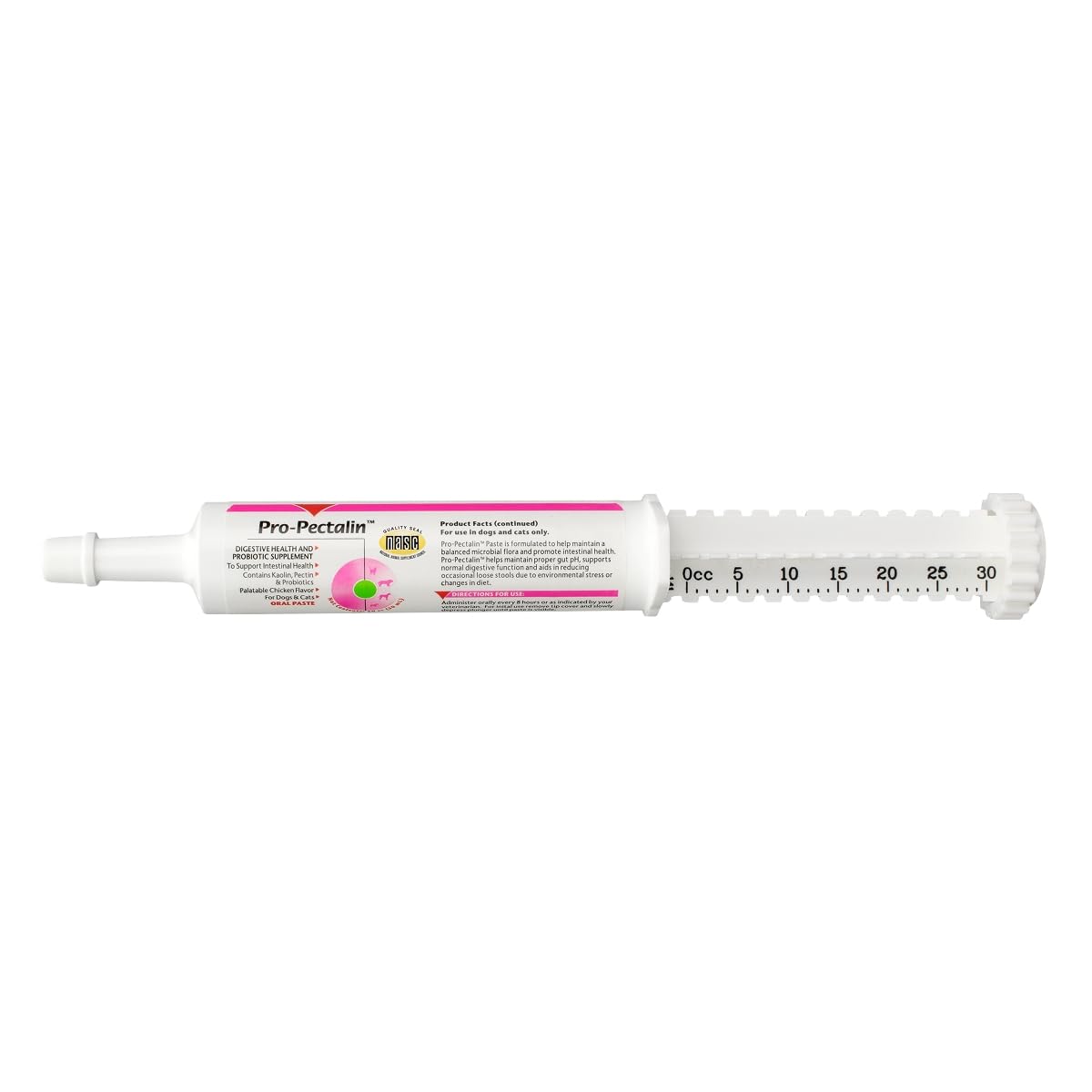
The question that decides most of these purchases isn't which formula is strongest — it's whether you can get anything into a dog that has stopped trusting its dinner bowl. A 30 cc tube of chicken-flavored gel answers that better than anything else here: you measure by weight and put it where it needs to go, no bargaining over a bowl required. That is why the Pro-Pectalin paste is our top pick.

The formula is the classic one. Kaolin is an absorbent clay that soothes an irritated gut; pectin is soluble fiber that picks up water and helps stool hold its shape. Each milliliter carries 0.6 g of kaolin and 0.025 g of pectin, plus 0.2 billion CFU of Enterococcus faecium. That probiotic dose is modest next to a dedicated daily supplement, so treat it as a small assist rather than the reason to buy.

Handling is where a paste earns or loses its place. This one is thick enough to sit on a finger or a spoon instead of running off it, and the chicken flavor is sweet enough that most dogs lick it up. The ones that won't can have it wiped inside the cheek rather than fought over — a two-person job with a fractious dog, but a thirty-second one. The tube itself is small enough to live in a glove box or a first-aid kit, unnoticed until the evening you need it.

Bottom line: This is the one we reach for first: a chicken paste you can dose by weight into a dog that won't eat, with kaolin and pectin to firm the stool.

3

FLORA-PECTIN Oral Paste

FLORA-PECTIN Oral Paste

Cats and small dogs

Our Score 9.0/10
Check Price

Worth Noting

  • Refused by some cats and fussy dogs
Form
Oral paste
Size
15 cc tube
Quality Seal
NASC
Active Ingredients
Kaolin, pectin, four probiotic strains
Read the full review

A 15 cc tube priced below the 30 cc one looks like the budget paste of the two, and it is the smaller commitment — but run the arithmetic per milliliter and the bigger Pro-Pectalin tube is actually the cheaper gel. What the smaller tube buys you instead is a wider formula and a size that suits a cat or a toy breed rather than a Labrador.

Four probiotic strains ride along with the kaolin and pectin here — Enterococcus faecium, Lactobacillus acidophilus, L. casei, and L. plantarum — plus inulin to feed them. Whether four strains do more for a dog than one isn't something we can settle from a label, but if the goal is getting a broad-spectrum probiotic in alongside an absorbent without opening two products, this is the only tube on the list that does both.

The tube is why it earns a place. Fifteen milliliters is first-aid-kit sized, dosing is a measured squeeze rather than a teaspoon, and it carries the NASC quality seal. Where it beats the top pick is a cat or a ten-pound dog: less volume to buy, less gel to get into a small mouth, and a chicken flavor that carries through a spoonful of wet food. Where it loses is a big dog — 15 cc is a short course and you'll be reordering.

Inspect the neck seal before you put it away. A paste tube that has been sitting open in transit isn't worth keeping, so check the foil and send it back if it's broken.

Bottom line: Our pick for cats and small dogs: a small tube with four probiotic strains, at a lower outlay than the paste we recommend overall.

4

Rx Vitamins Rx Clay

Rx Vitamins Rx Clay

Sensitive stomachs

Our Score 9.0/10
Check Price

Worth Noting

  • No pectin or probiotic alongside the clay
Form
Powder
Size
100 g jar
Dosing
1 scoop per 10 lb, twice daily
Active Ingredients
Single-ingredient clay
Read the full review

One ingredient, and the label makes a point of it: a fine clay powder in a 100-gram jar with nothing else in it. Depending on what's gone wrong with your dog, that's either the most appealing thing on this page or the least.

It works the way the others do — the clay binds water and material in the gut and slows things down — but the dosing is different. The label calls for one scoop per 10 pounds twice a day while diarrhea is active, then drops to one scoop per 25 pounds for maintenance. That taper is the one thing no other pick here offers, and it's useful for the dog whose gut stays grumbly long after the acute episode is over.

Mixing is the other advantage. Stirred through a pouch of wet food the powder disappears — no smell, no taste to argue with — which makes it the easiest of these to give to a dog that still eats but has stopped taking anything from your hand. A dog that's off food entirely still needs a paste.

Our reservation is measurement. A scoop per ten pounds means a fifteen-pound dog gets one and a half, and eyeballing half a scoop of fine powder is guesswork; a cheap kitchen scale is the honest way to split it, and a one-gram scale costs less than the jar. Do that, and this is the pick for a sensitive gut you expect to be managing on and off rather than for two days.

Bottom line: The pick for a gut you'll be managing for months, thanks to a maintenance dose the others don't offer — just weigh the powder rather than eyeballing it.

5

Vetality Stop the Runs

Vetality Stop the Runs

Small dogs

Our Score 8.8/10
Check Price

Worth Noting

  • Large tablets need breaking for small dogs
  • Six chews won't see a large dog through
Form
Chewable tablet
Count
6 chews
Flavor
Chicken
Active Ingredients
Bentonite, pectin, sodium chloride
Read the full review

Six chews in a bottle is not much product, and that's the whole idea: this is the pack you buy on the way home from a bad afternoon, sized for one short episode rather than a shelf. Each chicken-flavored chew carries bentonite clay and pectin rather than the kaolin most of the others use.

For a single bout in a small dog, six is about right, and we like it precisely because it doesn't ask you to commit to a tub. The chews are treat-like enough that most dogs take one straight from the hand, which means no syringing, no soggy dinner, and no negotiation. It's the format for the household that has never needed an anti-diarrheal before and hopes not to need one again soon.

Bentonite is the other point of interest. It's a different clay from the kaolin the rest of these are built on and the only chew here that uses it. Nothing on the label suggests it firms a stool faster, but if your dog has been through a couple of kaolin products without much change, a different clay is a reasonable next thing to try rather than a repeat of the same idea.

Bottom line: Six chicken chews are the right amount for one short episode in a small dog, and a different clay to try if kaolin hasn't helped.

6

Nutri-Vet Anti-Diarrhea Liquid

Nutri-Vet Anti-Diarrhea Liquid

Trying it out

Our Score 8.8/10
Check Price

Worth Noting

  • No probiotic cultures in the formula
  • Costs more per ounce than the big bottle
Form
Liquid
Size
4 oz bottle
Dosing
Every 12 hours by weight
Active Ingredients
Kaolin and pectin
Read the full review

Four ounces doesn't sound like much until you run the label's numbers. One teaspoon every 12 hours for dogs up to 15 pounds, two teaspoons for 15 to 50, a tablespoon over 50 — and a four-ounce bottle holds 24 teaspoons. A 30-pound dog on that twice-daily schedule gets about six days out of it, which is a full episode with a couple of days spare.

That makes this the smallest outlay here that still buys a proper course, and it's the version we reach for when the patient is a small dog or when the whole business is new. It's plain kaolin and pectin, easy to measure, and light enough to drop in a travel bag. Nothing about it is fancy, and for most short episodes nothing about it needs to be.

The twice-daily rhythm is the part to take seriously. Day two is when the stool has firmed up and it's tempting to stop, and the label's twelve-hour schedule is what the dosing is built around, so set a reminder rather than guessing. Bottles of this one have also arrived without a cap, so check the neck when the parcel lands and send it back if the seal has gone.

Bottom line: The smallest outlay that still treats a full episode: four ounces is about a week for a medium dog on the label's twice-daily schedule.

7

HomeoPet Digestive Upsets

HomeoPet Digestive Upsets

Multi-pet homes

Our Score 8.8/10
Check Price

Worth Noting

  • Dosing into a shared water bowl hides how much was taken
For
Dogs, cats, small pets
Form
Liquid drops
Size
15 mL bottle
Dosing
Three times daily
Read the full review

The label on this one is a different conversation from the rest. It's a homeopathic drops formula rather than an absorbent gel, and we're not going to sell it as a kaolin product in a prettier bottle.

It's here because of the delivery problem. Fifteen milliliters of tasteless, near-odorless liquid goes over a meal or straight into the mouth from the dropper, three times a day, and there is nothing for a suspicious animal to detect or spit out. For a cat, or a dog that has learned to eat around a pill, that's worth something no chew or paste can match.

The label covers dogs, cats, rabbits, and other small pets at every life stage, and the acute protocol is unusual: one dose every 15 minutes for up to four doses. That's a schedule built for a sudden upset rather than a week-long course, and it's the only product here you can dose a whole mixed household from.

Where it earns its place is the mild, transient grumble — a car ride, a new food, a stressful day — and the pet that will not take anything else. Where it doesn't is real diarrhea with volume behind it: there's no absorbent here to firm a stool, so start with one of the kaolin or clay products and keep the drops as a supporting act. If nothing has changed in a day or two, drops in the water aren't going to be the answer.

Bottom line: The one to try when nothing else can be given — tasteless drops that go in food or water, best kept for mild, short-lived upsets.

8

Vets Preferred Anti-Diarrhea Liquid

Vets Preferred Anti-Diarrhea Liquid

Large dogs

Our Score 8.6/10
Check Price

Worth Noting

  • No probiotic cultures in the formula
Form
Liquid
Size
8 fl oz bottle
Breed Size
All breeds and sizes
Active Ingredients
Kaolin and pectin
Read the full review

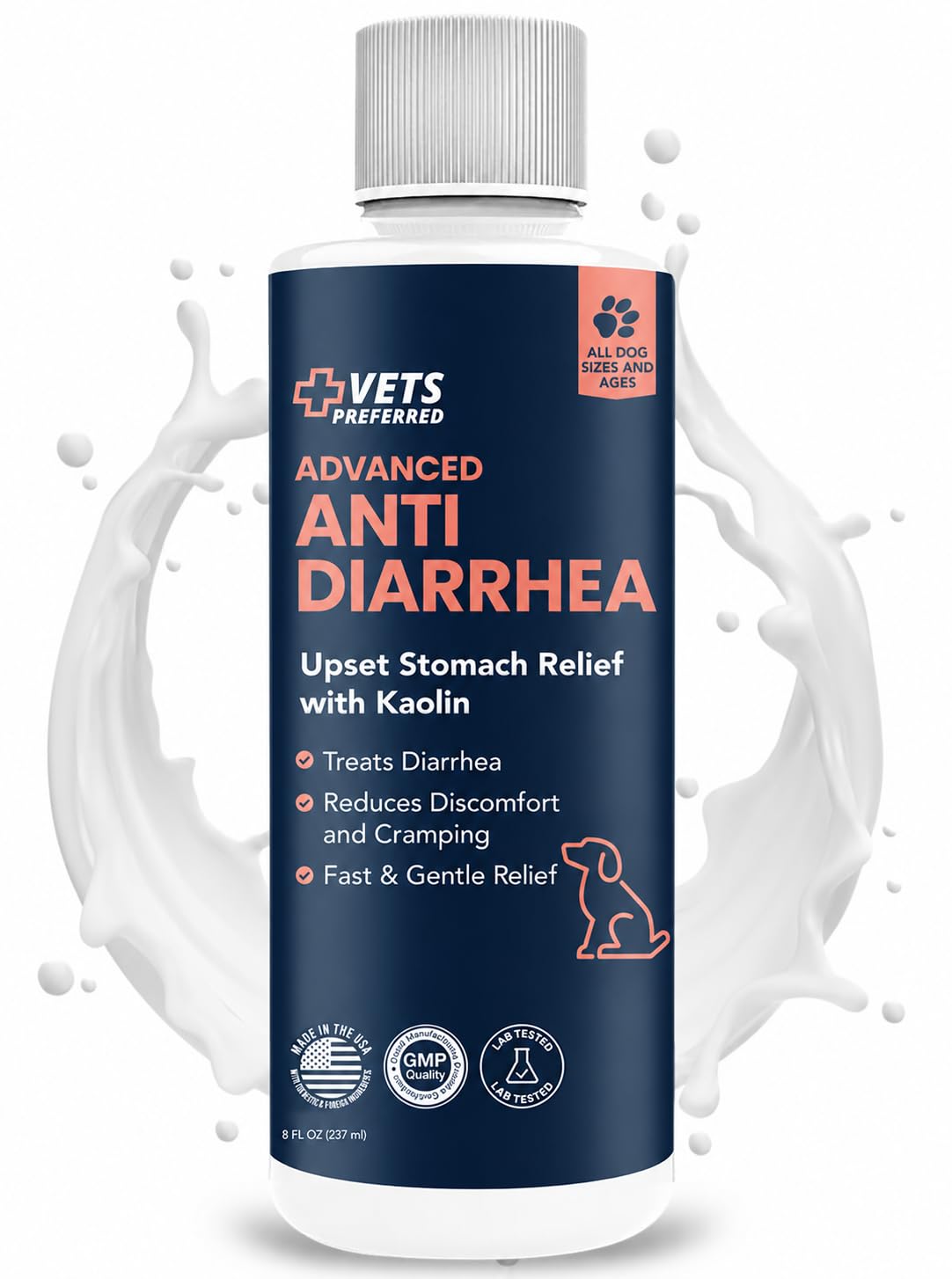
Where the paste asks you to get a tube into a dog's mouth, this one asks only that the dog still eat. Vets Preferred's kaolin-and-pectin liquid goes over a handful of food and that's the entire procedure, which makes it the least hands-on treatment here for a dog with a sour stomach and a healthy appetite. Eight fluid ounces is also the biggest bottle in this group.

The formula is the plain version of the idea: kaolin clay to absorb and soothe, pectin fiber to pick up water and firm the stool. What that simplicity buys is volume — enough to see a big dog through a whole episode, or to split between two dogs of different sizes by measuring capfuls instead of quartering tablets. For a two-dog household with one 80-pounder and one terrier, that flexibility is worth more than a fancier ingredient list.

The form is also the limit. A pour-over product is useless the moment your dog stops eating, and a dog with a bad gut often does exactly that, so this is the bottle to own alongside a tube rather than instead of one. The taste is mild enough to vanish into wet food; sprinkled over dry kibble it does less well, and you'll find the bottom of the bowl still full.

Bottom line: For a dog that's still eating, pouring a kaolin liquid over dinner is the least hands-on fix here, and the eight-ounce bottle covers a big dog.

How We Tested the Best Anti-Diarrhea Treatments for Dogs

We built the shortlist around what vets actually reach for — plain fiber like pumpkin and psyllium, kaolin-pectin pastes, probiotic blends, and fast-acting chews — then read every ingredient panel and dropped anything with an unclear dosing chart, an artificial sweetener, or directions written for a 50-pound dog. That left 14 products, tested over four months in our own homes, on dogs from a 9-pound senior to a 90-pound retriever.

Testing happened where diarrhea happens. We dosed at two in the morning on the kitchen floor, mixed powders into boiled chicken and rice, and timed how long a half-asleep person needed to get a squirming dog to swallow. Every product was offered plain first: we logged the dogs that walked away, the ones that drooled it onto the rug, and the few that licked the bowl and looked for more. Chews and tablets were laid against a ruler and tried whole, halved, and hidden in peanut butter, which told us more about pill size than any label did. We graded stools out on walks at 12, 24, and 48 hours, then kept watching for four more days.

Side effects got their own log. Stool that swung from loose to dry pellets counted against a product as hard as one that did nothing, and we noted gas, vomiting, and any dog that refused dinner afterward. We compared cost per dose rather than per tub, checked whether containers actually resealed — the powder that arrived without a lid turned into a brick within a week in a humid kitchen — and marked which tubs a determined cat could pry open, since a fair number of these households have one. Digestibility is what separated the field: fiber that eased a stool without gas or a middle-of-the-night wake-up went to the top.

How to Choose Anti-Diarrhea Treatments for Dogs

Start With How You'll Get It In

A dog with a churning gut often stops eating, and that one fact reorders the whole category. Chews and liver tablets only work if your dog takes tablets. A liquid poured over dinner only works if the dinner gets eaten. A paste goes in whether or not your dog is interested in food, and a powder stirred through wet food is invisible to a dog that still has an appetite but has stopped taking anything from your hand.

If you don't yet know which camp your dog falls into, buy a paste. It covers the worst case, and once you've seen your dog eat through a bad day you can graduate to a cheaper liquid or chew for next time.

Know What's Doing the Work

Most of these are built on an absorbent plus a fiber. Kaolin is a soothing clay that absorbs; pectin is soluble fiber that picks up water so stool holds its shape. Together they're the standard over-the-counter pairing for dogs, and you'll find them in both Pro-Pectalin products, the FLORA-PECTIN tube, the Vets Preferred liquid, and Nutri-Vet's bottle.

The alternatives are other clays — bentonite in the Vetality chews, a single clay in the Rx Vitamins powder. Probiotics are a bonus rather than the mechanism: they help repopulate gut flora, but they aren't what firms a stool overnight. A product with no absorbent in it is supporting a mildly upset stomach, not stopping a bad episode.

Count Doses, Not Price Tags

Containers here run from a 15 cc tube to an 8-ounce bottle, and the price on the listing tells you almost nothing about which is cheaper to own. Run the label's weight chart against the volume. Four ounces is 24 teaspoons, which on a twice-daily schedule is roughly six days for a 30-pound dog. The 15 cc paste tube holds half the gel of the 30 cc one for only a little less money.

Small packs have their place — six chews is the right amount for one short episode in a small dog — but if your dog has loose stools more than a couple of times a year, the bigger format wins on cost per dose every time.

Know When a Product Isn't the Answer

These are for occasional loose stool in a dog that is otherwise bright: eating a little, drinking, not vomiting. Blood in the stool, repeated vomiting, a flat and uninterested dog, a fever, or diarrhea that runs past a day or two is a veterinary problem, and no over-the-counter product changes that. Puppies and toy breeds dehydrate fast enough that a phone call comes before a dose.

The honest way to use any of these is as a bridge — firm the stool, keep the dog comfortable and drinking, and let the gut settle. If you're reaching for a second container, that's your signal to stop treating and start diagnosing.

Frequently Asked Questions

Final Verdict

The Pro-Pectalin paste is what we keep on the shelf: a 30 cc tube of chicken gel you can dose by weight into a dog that won't eat, built on the kaolin-and-pectin pairing most of this category rests on. If your dog is still cleaning the bowl, the Vets Preferred liquid does the same job with less handling and a lot more volume to spare.

And if you're treating one bad day in a small dog, six chews is enough. There's no reason to buy a tub for a single episode.