Grooming

Best Antibacterial and Antifungal Dog Shampoos of 2026

Two in the morning is when I first noticed it: my dog's paws smelled like corn chips, and he'd been licking them raw for a week. Regular dog shampoo doesn't touch that. Yeast and bacteria settle into paw pads, armpits, and the folds of the ears, and a wash that only lifts dirt and surface odor will have your dog scratching again by Tuesday. What a genuinely antibacterial and antifungal shampoo fixes is the itch cycle itself—the infection underneath—so the relief lasts longer than a day and the coat stops looking chewed-up and patchy.

Over four months, my team and I bathed our own dogs with 14 of these shampoos, deliberately choosing dogs with yeasty paws, hot spots, and skin that flushes pink at the wrong formula. The differences show up in the first bath: some lather thin and rinse clean, others leave a filmy residue, and a few smell so strongly of perfume that you start wondering what it's covering up. One thing worth knowing before you buy—medicated actives need contact time, usually ten minutes of suds sitting on the coat—so the fastest-rinsing bottle isn't automatically the best one. The picks below all earned a second bottle.

1

MiconaHex+Triz Shampoo

Top Pick
MiconaHex+Triz Shampoo

Mixed infections

Our Score 9.4/10
Check Price

Worth Noting

  • Can dry the coat with frequent use
For
Dogs, cats, horses
Size
16 oz
Scent
Unscented
Active Ingredients
2% chlorhexidine gluconate, 2% miconazole nitrate
Read the full review

The label on MiconaHex+Triz is unusually specific: 2% chlorhexidine gluconate and 2% miconazole nitrate. That's the pairing we want when a dog has both bacteria and yeast on the skin. The 16-ounce bottle is big enough to get through an initial course without rationing, and the unscented formula is the one we reach for when a dog's household is sensitive to fragrance.

That's why it's our top pick for a confirmed mixed infection. We like that it doesn't try to be a spa product. There's no perfume or dye to distract from the job, and the liquid formula is easy to work through a coat without turning bath time into a wrestling match. The catch is contact time: a medicated shampoo has to sit on the coat for the period your vet or the label specifies, or you've given the dog a nice bath and not much else.

The concentration is the detail that tips it: it's the only pick here that states 2% miconazole alongside 2% chlorhexidine. That's a more complete antifungal pairing than the chlorhexidine-only options, and it's why we start here when the skin is both infected and inflamed. The premium price is the trade-off, but you're paying for a clearly labeled treatment rather than a mystery blend.

Bottom line: For a dog with a confirmed mixed bacterial and yeast infection, MiconaHex+Triz is our top pick: it states both actives at treatment strength and skips fragrance.
2

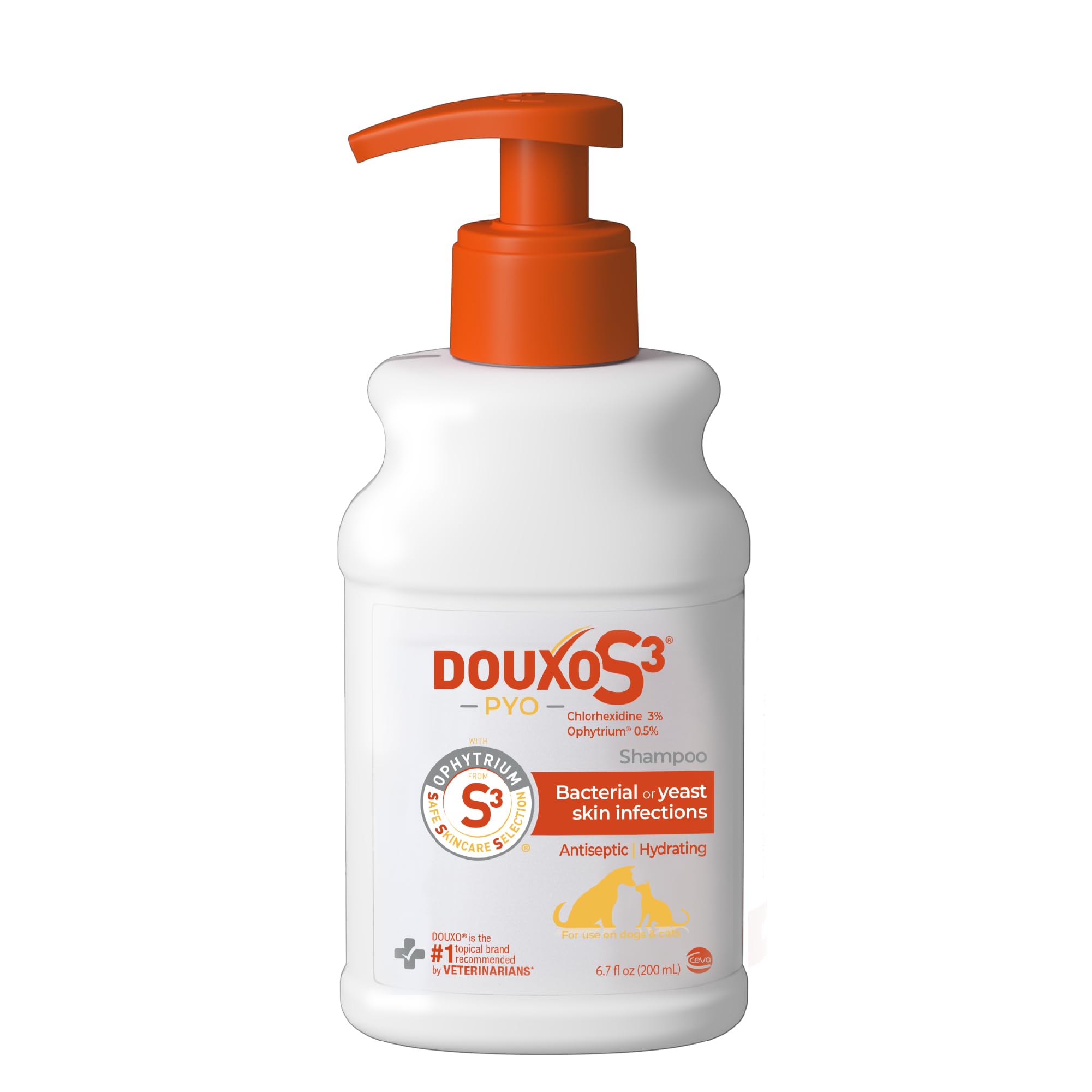
Douxo S3 PYO Shampoo

Douxo S3 PYO Shampoo

Yeast-prone skin

Our Score 9.4/10
Check Price

Worth Noting

  • Premium price for 6.7 ounces
Size
6.7 fluid ounces
Scent
Coconut, vanilla
Free From
Soaps, sulfates, parabens
Active Ingredient
3% chlorhexidine
Read the full review

Douxo S3 PYO leads with 3% chlorhexidine, the highest stated concentration in this group. That's the number we look at when the bacterial side of a skin problem is the stubborn part, and it's why this is our pick for a yeast-prone dog with a current flare-up. The 6.7-ounce bottle is easy to store and enough for a short course.

The formula adds 0.5% Ophytrium, which is there to soothe and hydrate rather than just strip the coat, and it's free of soaps, sulfates, parabens, colorants, and phthalates. We appreciate that kind of ingredient discipline on inflamed skin. The coconut-vanilla scent is mild, and it lathers readily, though you need to rinse thoroughly—it can feel slippery if you stop early.

The limitation is the antifungal side: the label names chlorhexidine but no azole, so for a confirmed fungal infection we point you to MiconaHex+Triz or CeraSoothe instead. For a dog whose problem is mostly bacterial with a yeast component, the higher chlorhexidine concentration and the seven-day claim make Douxo the more focused choice.

Bottom line: If your dog's flare-up is yeast-heavy and you want a vet-backed shampoo in a small, easy-to-store bottle, Douxo S3 PYO is our pick.

3

CeraSoothe CHX+KET Shampoo

CeraSoothe CHX+KET Shampoo

Dry, irritated skin

Our Score 9.4/10
Check Price

Worth Noting

  • Premium price
Size
16 oz
Scent
Cucumber melon
Added Ingredients
Ceramides, avenanthramides
Active Ingredients
Chlorhexidine 2% and ketoconazole 1%
Read the full review

CeraSoothe is the pick for the dog whose skin is dry, red, and itchy rather than oily. It pairs 2% chlorhexidine with 1% ketoconazole, then adds ceramides and avenanthramides to support the skin barrier. That combination makes it feel less like a harsh treatment and more like a medicated bath we don't dread using on a dog with already-compromised skin.

The cucumber-melon scent is light, and the 16-ounce bottle is the same practical size as our top pick. The formula is designed to support the skin barrier rather than just strip the coat. The catch is the antifungal strength: 1% ketoconazole is lower than the 2% miconazole in MiconaHex+Triz, so for a confirmed, stubborn fungal infection, the top pick is the more direct choice. For maintenance after a flare or for a dog that reacts to stronger formulas, CeraSoothe is easier to live with.

Bottom line: For a dog with dry, irritated skin and a mixed infection, CeraSoothe is our pick: it pairs two actives with barrier-support ingredients and a light scent.

4

Mal-A-Ket Shampoo

Mal-A-Ket Shampoo

Greasy, scaly skin

Our Score 9.4/10
Check Price

Worth Noting

  • Active ingredients not fully listed
  • Expensive per ounce
For
Dogs, cats, horses
Form
Cream
Size
8 oz
Key Ingredient
TrizEDTA
Read the full review

Mal-A-Ket is the degreaser in this group. If your dog's coat feels oily and scaly, and the skin has that yeasty smell that survives a regular bath, this is the bottle we reach for when we want a deep clean rather than a creamy lather. The cream formula is different from the thin gels here, and the pleasant scent stays mild.

It's not a first-line treatment for a confirmed infection on its own. Think of it as a support shampoo for the greasy, fungal-prone dog whose vet wants a degreasing wash in the rotation. The 8-ounce bottle is best saved for the greasy-skin weeks rather than every bath.

What we like is the focus: it degreases without stripping the coat, and it's the one here we choose when the problem is scale and oil rather than dry, angry skin. If you need a clearly labeled chlorhexidine-plus-azole formula, choose MiconaHex+Triz or CeraSoothe instead; if your problem is grease and scale, this is the niche pick.

Bottom line: Mal-A-Ket is the niche pick for a greasy, scaly coat that needs a degreasing wash, but not the first choice for a clearly labeled mixed infection.

5

Smiling Paws Medicated Shampoo

Smiling Paws Medicated Shampoo

Value dual-action

Our Score 9.2/10
Check Price

Worth Noting

  • Scented formula may bother sensitive dogs
For
Dogs, cats
Size
16 fluid ounces
Scent
Cucumber, melon
Active Ingredients
Chlorhexidine, ketoconazole
Read the full review

Smiling Paws puts chlorhexidine and ketoconazole on the label in a 16-ounce bottle, with a cucumber-melon scent and a price that sits below the veterinary brands. The bottle is the practical size for a dog that needs a course of medicated baths, and the formula lathers well enough to work through a thick coat. We also like that the scent is noticeable without turning the bathroom into a candle shop.

That combination makes it our value pick. The label doesn't state percentages for either active, which is the one detail we want before swapping it for a prescription-strength shampoo. If your vet has diagnosed a specific infection and given you a strength to match, show them this bottle first. For a mild, recurring itch or a maintenance bath between flares, the trade-off is easier to accept.

The scent is pleasant and it lingers, which helps with a dog that smells yeasty. For most dogs, this is the bottle that makes a two-week medicated routine affordable enough to finish.

Bottom line: Smiling Paws is the best value in this group: it pairs chlorhexidine and ketoconazole in a big bottle, with a pleasant scent and a price that leaves room for repeat baths.

6

Veterinary Formula Antiseptic & Antifungal Shampoo

Veterinary Formula Antiseptic & Antifungal Shampoo

Budget flare-ups

Our Score 9.2/10
Check Price

Worth Noting

  • Citrus scent won't suit every dog
Size
16 fluid ounces
Scent
Citrus
Formula
Antiseptic and antifungal
Pet Age
12 weeks and older
Read the full review

Veterinary Formula comes in a 16-ounce bottle and is labeled antiseptic and antifungal, pH balanced, and free of soap, parabens, and dyes. The citrus scent is fresh rather than medicinal, and the bottle is big enough for a two-week medicated routine. It's a straightforward liquid shampoo rather than a thick cream, so it moves through the coat quickly.

We like it for a dog with a mild, smelly itch, especially if you're bathing twice a week and watching the budget. It doesn't leave the bathroom smelling like a clinic. The catch is that the label doesn't name the active ingredients or their percentages, so it's not the bottle we choose for a confirmed infection. For everyday odor control or a first step before a vet visit, it's a sensible spend.

That makes it our budget pick. If your dog has a confirmed mixed infection, pay for the MiconaHex+Triz; if you need a big bottle for frequent baths and the skin issue is mild, this is the value play. It's the only pick here with a stated minimum age of 12 weeks, which makes it easy to use in a multi-pet house.

Bottom line: Veterinary Formula is the budget pick for a dog over 12 weeks with a mild, smelly itch: a big bottle, a fresh citrus scent, and a price that makes twice-weekly baths easier.

Our Testing Process: Four Months, 14 Shampoos, a Lot of Wet Dog

We built the shortlist by reading labels instead of marketing copy, keeping formulas that named a specific active ingredient for bacteria or yeast and setting aside anything that only promised to 'deodorize.' From there we cross-checked against veterinary dermatology guidance, cut the bottles priced absurdly per ounce, and landed on 14 shampoos spanning vet-channel and drugstore options.

Testing happened wherever baths actually happen: the tub at home on Saturday mornings, a hose in the backyard, and the groomer's basin for two of us. Each dog was bathed on its normal schedule for the full four months, with at least three consecutive washes on the same shampoo before we passed judgment. Before every bath we photographed redness around the paws, belly, and ears, and we noted whether the dog flinched, pulled away, or tried to climb out while we worked the lather down to the skin.

Afterward came the part that matters to anyone living with this: how many days passed before the scratching started again, whether the corn-chip smell stayed gone through day five, and how the coat looked a month in—especially those bare patches along the flanks, which we watched for new fuzz. Because value only reveals itself over time, we counted pumps per bath and tracked how far a bottle stretched on a fifty-pound dog. Anything that left skin pink or demanded half a bottle per wash came out of the rotation early.

How to Choose Antibacterial and Antifungal Dog Shampoos

Match the active to the infection

Chlorhexidine is the antibacterial workhorse in this category; miconazole and ketoconazole are the antifungals that go after yeast. A shampoo that names both is the safest starting point for a confirmed mixed infection, which is why MiconaHex+Triz and CeraSoothe sit near the top of our list. A chlorhexidine-only formula like Douxo S3 PYO can still be useful for a yeast-heavy flare, but it is not the same as a dual-active treatment. Read the ingredient panel, not just the front label.

The trap is the word medicated. It can mean antiseptic, antifungal, or both, and some budget bottles never name their actives at all. If your vet has diagnosed a specific organism, bring the bottle to the appointment or choose one that states the active and the percentage. If you're treating a mild, smelly itch without a diagnosis, a dual-action label is still the more sensible first choice.

Give it contact time

Most medicated shampoos need to sit on the coat for several minutes—Veterinary Formula's label specifies five to ten—and that waiting period is doing much of the work. Lather the shampoo into the coat, set a timer, and use the time to clean the paws and tail. Rinse until the water runs clear. A quick wash-and-rinse can make a good formula look useless, and leftover shampoo can irritate the skin.

Frequency matters too. Many medicated routines start with twice-weekly baths until the skin clears, then drop to weekly maintenance, but the label and your vet's plan come first. More frequent bathing is not automatically better; it can dry the coat and make itching worse.

Match the formula to the skin

A dry, cracked, angry skin does better with a formula that includes barrier-support ingredients such as ceramides, avenanthramides, or Ophytrium, and with a light or unscented fragrance. CeraSoothe and Douxo are the picks we reach for there. A greasy, scaly, yeasty coat calls for a degreaser like Mal-A-Ket, which cuts through oil rather than adding moisture. If the skin is both oily and irritated, treat the infection first and use the degreaser as a support wash, not the whole plan.

Fragrance is a personal call, but it is not a trivial one on inflamed skin. Unscented MiconaHex+Triz is the safest choice for a dog that has reacted to scented products; a light cucumber-melon or citrus scent is fine for many dogs, but patch-test first.

Size and concentration

A small bottle is not automatically a bad value. Douxo's 6.7-ounce bottle is enough for a short course on one dog, and the 3% chlorhexidine concentration is the highest stated here. A 16-ounce bottle like MiconaHex+Triz, CeraSoothe, Smiling Paws, or Veterinary Formula makes more sense for a multi-dog house or a longer routine. Check the percentage as well as the size: a larger bottle of a weaker formula can be false economy.

Estimate the number of baths before you buy. A twice-weekly routine for four weeks is eight baths, and a thick double coat can swallow more shampoo than you expect. If you're near the end of a course, buy the smaller bottle; if you're maintaining a chronic issue, the larger one is easier to live with.

When a shampoo is not enough

Medicated shampoo is a grooming tool, not a diagnosis. If the skin is spreading, oozing, painful, or losing hair in patches, or if your dog seems unwell, call your vet before continuing. The same goes for a dog that gets worse after the first bath. For a mild itch that has not improved after a week of correct use, stop guessing and get the skin checked.

Frequently Asked Questions

Final Verdict

For most dogs with a confirmed mixed bacterial and yeast infection, MiconaHex+Triz is the bottle we reach for first. It's the only pick here that states 2% chlorhexidine plus 2% miconazole, and the unscented formula is easy to live with. If you need a lower-cost 16-ounce option, Smiling Paws is the value choice; if the skin is dry and irritated, CeraSoothe's barrier support is worth the premium. Douxo is the focused pick for a yeast-heavy flare in a small bottle.