Grooming

Best Dog Brush for Labs of 2026

The trouble with brushing a Lab isn't that there's nothing to catch—it's that most brushes catch the wrong layer. A Lab wears a short, oily topcoat over a dense, woolly undercoat, and the undercoat is what lets go in gray tumbleweeds across the floor. A slicker that skims the surface will make your dog look tidy for an hour and leave the real shed behind. The right brush reaches through the topcoat, gathers the loose undercoat before it migrates to your couch, and does it without turning grooming into a wrestling match.

I've spent four months with 14 brushes on my own two Labs and a few patient friends' dogs. The difference comes down to hair grip and dog tolerance: a brush your Lab will stand still for is worth more than fancy tines, but only if it fills up with fur. A brush that skips the undercoat is just a massage tool. The ones that cleared both hurdles, and didn't fall apart after weekly use, are below.

1

Paw Brothers Slicker Brush

Top Pick
Paw Brothers Slicker Brush

Thick coats

Our Score 9.4/10
Check Price

Worth Noting

  • Long pins need a light hand on bony areas
Weight
4.32 oz
Head Size
4.5 x 3 inches
Pin Length
1 inch
Bristle Material
Stainless steel
Read the full review

One-inch stainless steel pins are the reason we kept the Paw Brothers slicker in the rotation. On a Lab, a standard slicker often skates over the topcoat; these longer pins part the fur and reach the undercoat without needing a heavy hand. The head is 4.5 by 3 inches, which is big enough to cover a flank in a few strokes but still manageable around the shoulders. At 4.32 ounces, it is light enough for a long session.

This is the finishing brush we reach for after a rake has done the heavy lifting. The flat slicker design doesn't dig out packed undercoat the way a rake does, but it smooths the coat and catches the looser hair the rake leaves behind. We liked the handle length, 4.75 inches, because it keeps your hand clear of the pins when the dog leans into the brush. It is also the best value among the slickers here, undercutting the premium options without feeling flimsy.

For the body coat, this is a very good second tool: it leaves the coat smooth without the scratchy finish some stiff slickers give. We also appreciated that the stainless pins are easy to wipe clean between strokes. It is not the brush we grab for a mat behind an ear; that is a comb job.

Bottom line: The best slicker here for a thick-coated Lab that needs a smooth finish after the rake.

2

Augwind 3-Piece Grooming Kit

Augwind 3-Piece Grooming Kit

First-time homes

Our Score 9.4/10
Check Price

Worth Noting

  • Flea comb sees little use on a Lab
  • Kit takes more drawer space than a single tool
Cleaning
Push-button slicker
Warranty
2 years
Rake Teeth
9 and 17 tooth
Kit Contents
Rake, slicker, flea comb
Read the full review

A rake, a self-cleaning slicker, and a flea comb in one box: the Augwind kit is the most sensible starting point if you are setting up a Lab grooming drawer from scratch. The rake has a 9-tooth side for mats and a 17-tooth side for thinner undercoat, and the slicker has a push-button cleanout. The flea comb is the odd one out, but it is useful for the face and for checking the coat after walks.

We liked the division of labor. The rake does the seasonal strip-out, the slicker smooths the coat, and the comb reaches the places a wide head can't. The tools are lighter than the premium singles here, and the kit doesn't have the heft of a pro slicker, but nothing felt disposable. The two-year warranty is a meaningful cushion at this price.

The coverage is what makes it a kit rather than a single tool. If you want one purchase that covers undercoat, finishing, and face detail, this is the one we point to. If you already have a slicker you like, buy the Maxpower rake and skip the extras.

Bottom line: The best one-box start for a Lab home that wants a rake, slicker, and detail comb together.

3

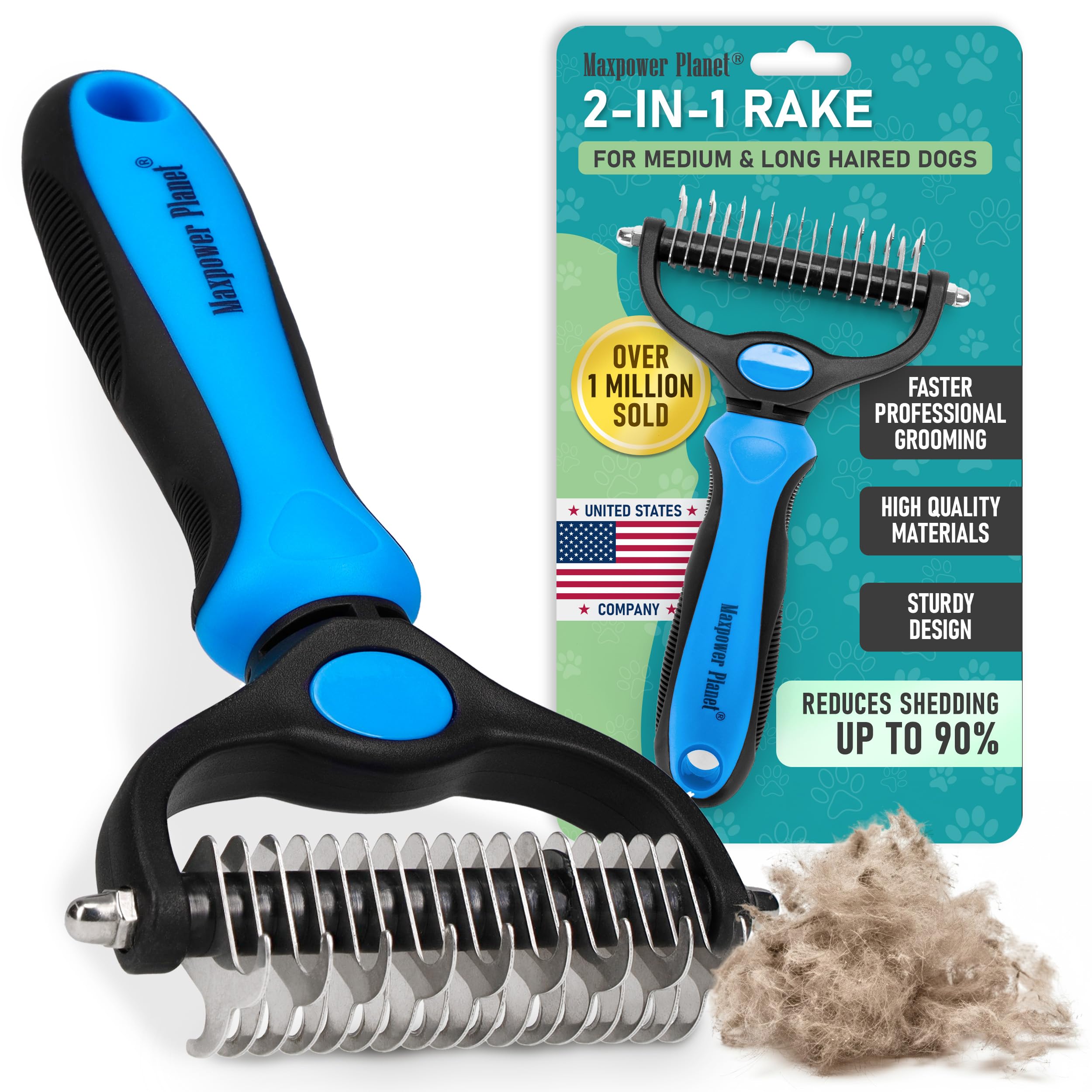
Maxpower Planet Grooming Rake

Maxpower Planet Grooming Rake

Heavy shedders

Our Score 9.2/10
Check Price

Worth Noting

  • Hair must be pulled off the teeth by hand
Teeth
9-tooth dematting side
Handle
Non-slip rubber
Weight
4 oz
Tool Type
Dual-sided undercoat rake
Read the full review

The Maxpower Planet rake is the tool we reach for first when a Lab is in full shed. Its dual-sided head gives you a 9-tooth side for the packed, matted patches and a second side for the long strokes down the back and flanks. At 6.6 by 3.9 by 2 inches and 4 ounces, it has enough width to cover a broad body without feeling like a garden rake. The rounded teeth are the detail we appreciate most: they move through the undercoat without the scratchy scrape some cheap rakes have. It also costs less than most of the picks here, which makes it the easy default for a heavy-shedding Lab.

We kept it on the body coat, where the wide head earns its keep. Long strokes down the back and flanks lifted loose fur without needing a second pass, and the 4-ounce body stayed comfortable in the hand. The handle stays comfortable when the coat is dense, and the simple one-piece build means there is nothing to adjust mid-session. Around the face, paws, and the thin skin inside the back legs, you want a smaller comb; the rake is simply too broad for those spots. For the main job of pulling loose undercoat, it is the one we recommend first.

Bottom line: The best default for a heavy-shedding Lab: a dual-sided rake that reaches packed undercoat without the premium price.

4

SleekEZ Dog Brush

SleekEZ Dog Brush

Short coats

Our Score 9.2/10
Check Price

Worth Noting

  • Five-inch blade needs extra passes on a large Lab
Weight
3.53 oz
Tool Type
Patented deshedding blade
Blade Size
5 inch
Coat Types
Short, medium, long
Read the full review

The SleekEZ is not shaped like a brush at all. It is a 5-inch strip of toothed metal on a handle, and you pull it with the coat rather than dragging a rake through it. On a Lab's short summer coat, that shape lifts loose hair in soft rolls and leaves the topcoat looking smoother. We liked it most after the coat had dried, when the dead hair was ready to come out. The 3.53-ounce body is light, and the handle sits naturally in the hand.

This is the pick for a quick daily pass, not a deep seasonal strip-out. The 5-inch blade is easy to control, and the hair mostly falls away instead of wedging between teeth. We found the angle matters: keep the blade flat and use light pressure, because the edge can catch if you tip it. It works on short, medium, and long coats, but on a dense Lab undercoat it is a supplement to a rake, not a replacement. That makes it a good second tool rather than the only one in the drawer. It is also simple to wipe clean; the hair comes off the metal in a strip, which is more satisfying than picking it out of pins.

Bottom line: The quick-pass pick for a short-coated Lab, especially between deeper rake sessions.

5

FURminator Grooming Rake

FURminator Grooming Rake

Dense double coats

Our Score 9.2/10
Check Price

Worth Noting

  • No self-cleaning mechanism; hair comes off by hand
Teeth
Rotating metal teeth
Handle
Ergonomic non-slip
Weight
6.56 oz
Tool Type
Grooming rake
Read the full review

Rotating metal teeth are the reason the FURminator rake earns a place here. Instead of a fixed row of pins, the teeth roll as they move through the coat, which makes the tool feel less like it is snagging and more like it is combing. On a Lab with a thick winter undercoat, that matters: the rake has enough reach to pull loose fur from the body without scraping the skin. It is heavier than the Maxpower at 6.56 ounces and longer overall, but the extra handle length gives you a secure grip when the coat is dense.

We liked the ergonomic non-slip handle for long sessions; it kept the wrist neutral when we worked down the back and hindquarters. The head is wide enough for a Lab's frame but not so wide that it feels like a snow shovel. The rotating teeth did the work without a lot of downward pressure, which is the part that matters on a dog with a sensitive back.

The price sits in the middle of this group, which is fair for a branded rake that feels solid in the hand. If you already have a slicker for finishing, this is a credible step up from the cheapest rake. If you want one tool that does everything, this is not it; it is a dedicated undercoat rake.

Bottom line: A solid step-up rake for a dense winter undercoat, with rotating teeth and a secure handle.

6

Swihauk Self-Cleaning Slicker

Swihauk Self-Cleaning Slicker

Sensitive dogs

Our Score 9.2/10
Check Price

Worth Noting

  • Fine bristles don't reach a packed undercoat
Handle
TPR
Weight
8.82 oz
Tool Type
Self-cleaning slicker
Bristle Material
Stainless steel
Read the full review

The Swihauk is the self-cleaning slicker we hand to a Lab who is older, thinner-skinned, or simply tired of being tugged at. The bristles are stainless steel but set with rounded tips, and the head has enough give that it follows the shape of a shoulder instead of jabbing into it. The push-button retraction is the other half of the appeal: press it and the hair drops off the bristles in one pad, no picking.

On a normal Lab coat, we used it as a finishing brush after a rake. The fine bristles pick up surface hair and smooth the topcoat, and the head follows the dog's shape without a lot of pressure. A lot of dogs tolerate this one when they won't sit still for a deeper tool. The 8.82-ounce body feels substantial, and the TPR handle stayed comfortable during a longer session.

We were pleasantly surprised by how cleanly the button released a full head of hair; that is the detail that makes this one easy to keep in rotation. It is the gentle daily-pass tool, especially on a senior Lab, and the one we reach for when the dog is not in the mood for a rake.

Bottom line: The gentle self-cleaning choice for an older or sensitive Lab that dislikes deep scraping.

7

Kong Zoom Groom

Kong Zoom Groom

Bath time

Our Score 9.2/10
Check Price

Worth Noting

  • Loose hair can fly rather than collect
  • Not a deep undercoat tool
Shape
Oblong
Tool Type
Grooming brush
Handle Material
Plastic
Bristle Material
Nylon
Read the full review

The Kong Zoom Groom is the brush we reach for when the Lab is already in the tub. Its flexible bristles work shampoo through the coat and pull loose hair at the same time, and the dog usually reads it as a massage rather than a grooming session. That makes bath time less of a wrestling match, which is worth something on a dog that hates standing still.

Dry, it is a different tool. The bristles are soft enough for a short coat, and the oblong shape fits a hand well. We used it as a supplement: a few minutes in the bath, then a rake once the coat was dry. On a Lab with a heavy shed, that combination gets more hair out than either tool alone.

The nylon bristles and plastic handle are simple to rinse, and it is easy to keep in the bath caddy. We also liked that the shape lets you work around the legs and chest without a lot of pressure.

What we liked most is the way it changes the dog's attitude. A Lab that sulks through a rake session will stand for this one, and the massage effect makes it easy to check the coat for lumps or sore spots. It is a good one to add if bath time is part of your routine.

Bottom line: A bath-time supplement for a Lab that hates standing still, not a replacement for a rake.

8

Docrok Grooming Combo

Docrok Grooming Combo

Mats and detail

Our Score 9.0/10
Check Price

Worth Noting

  • Two tools to manage instead of one
  • No self-cleaning mechanism on either piece
Comb Design
2-in-1
Rake Design
2-in-1
Kit Contents
Rake and comb
Teeth Material
Stainless steel
Read the full review

The Docrok combo is a rake and a comb, not a brush and a spare. The rake has a wide side for dematting and a denser side for deshedding, and the comb repeats that two-sided idea for finishing. On a Lab, the rake does the body coat and the comb gets into the legs, tail, and the short hair around the face where a wide head is useless.

We liked the metal teeth. They are stainless steel, stiff enough to move through a dense coat without bending, and the TPR handle gives you a secure grip when the dog leans away. The comb is the piece that surprised us: it catches the loose hair a slicker leaves behind and gives the coat a smoother finish.

The comb is what makes the combo worth considering. It reaches the legs, tail, and behind the ears where a wide rake runs out of road, and the two-sided design lets you switch from knot-breaking to smoothing without changing tools. For a Lab with mats in the feathering, that is a real advantage over a single rake.

What tips it for us is the detail work. A Lab's body coat is the easy part; the legs, tail, and behind the ears are where a single wide rake runs out of road. The Docrok gives you a second shape for those spots without asking you to buy a full grooming kit. That is why it stays in the also-consider list rather than the top tier: it is a useful specialist, not the first thing we hand a new Lab household.

Bottom line: A useful specialist for mats and detail work, especially around the legs, tail, and ears.

How We Tested the Best Dog Brushes for Labs

We started with a list of 40 brushes recommended by Lab rescue groups, vet techs, and our own readers, then filtered by tine length, coat type, and handle shape—anything too short to reach a Lab's undercoat or too fussy to clean was out. We ended up testing 14 over four months.

Every brush got a turn on my two Labs—a 70-pound male and a 55-pound female—and two friends' Labs during morning porch sessions after walks, evening TV brushing, and after a swim at the lake, when the coat is damp and the undercoat clumps. Each dog got ten minutes per brush; I watched for lip-licking, tail tucking, and attempts to leave, and gave any brush that spooked them a second try on a calmer day. For hair removal and grip, I brushed the same area in the same direction, then pulled the collected fur off into a paper bag to compare volume; I also checked whether the tines reached the skin without scratching and whether hair stayed on the brush or snowed onto the floor.

Ease of use came down to handle fit, thumb reach, and whether the release mechanism jammed mid-session; cleanup time mattered because a brush that takes five minutes to de-fur is one you'll skip. We tracked shedding by noting how much hair came off in ten minutes and how many days it took for the coat to look fuzzy again. Value and quality got judged at the end: after four months of twice-weekly use, I checked for bent tines, cracked handles, and whether each brush still worked as well as it did in week one.

How to Choose the Right Dog Brush for Labs

Start With the Undercoat, Not the Topcoat

A Labrador's soft undercoat is what mats and sheds; the coarser topcoat is what you see. A rake with rounded teeth gets between the layers and pulls the loose undercoat without shaving the topcoat. A slicker is for the finish, not the main event. If you buy one tool, buy a rake: the Maxpower Planet or the FURminator are the two we point to first. Add a slicker when you want a smoother finish or your Lab tolerates a lighter touch.

Tooth Depth and Spacing Matter More Than Tooth Count

A 9-tooth rake side is for mats and packed undercoat; a denser side is for routine work. On a slicker, one-inch pins like the Paw Brothers reach a Lab's undercoat, while fine bristles sit closer to the surface. More teeth is not automatically better: a dense row can clog in a heavy shed. Match the spacing to the job, and keep a comb for the face and paws where any wide head is clumsy.

Comfort Is a Handling Question

A Lab leans, turns, and shifts weight while you brush, so the handle matters as much as the head. A non-slip grip and a body around 4 to 7 ounces are easier to control than a heavy tool, especially when you are working down the back and hindquarters. The FURminator's longer handle and the Paw Brothers' 4.75-inch handle are examples of designs that keep your hand clear of the coat. If your wrist tires, go lighter, not wider.

Cleaning Between Strokes

Hair builds up fast on a Lab in season. A self-cleaning slicker with a push-button retraction, like the Swihauk or the Augwind kit, lets you clear the head without picking at pins. A rake or comb without that mechanism is not a problem, but you will pull the hair off by hand, so keep a waste bag within reach. The easier the tool is to clear, the more likely you are to finish the session.

Face, Paws, and Mats Need a Different Shape

A wide rake is the right shape for a Lab's back, not for the face, paws, or the thin skin inside the back legs. Keep a comb or a small slicker for those spots. For mats behind the ears or in the leg feathers, use the wide-toothed side of a comb first and work slowly; do not rip through a knot with a rake. The Docrok combo is built around that two-shape approach, and it is why a second tool earns its place.

Frequently Asked Questions

Final Verdict

Start with the Maxpower Planet Grooming Rake. Its dual-sided head has the reach for a Lab's undercoat, the rounded teeth are forgiving on a broad body, and it costs less than most of the tools here. If your Lab has a short summer coat and you want a quick daily pass, choose the SleekEZ; for a thick winter coat that needs more bite, the FURminator rake is the step up. The right brush is the one that gets used before the hair lands on the floor.