Food & Treats

Best Canned Puppy Food of 2026

A puppy's first weeks at home are a blur of chew toys, midnight potty runs, and one question that resurfaces at every mealtime: what actually goes in the bowl? Canned food earns its place there in ways kibble alone struggles to match. It is wet and fragrant enough to pull a distracted eater back to the bowl, it delivers the protein and fat a growing body needs, and it goes down easily for a puppy still learning to chew. Get it wrong, though, and you will know within a day or two: half-finished bowls, a puppy who suddenly turns up their nose at dinner, and stools that go from firm to something you would rather not scoop.

I have cleaned up after enough of those misses to be picky about what I recommend. Over four months, our team fed 10 canned puppy formulas to puppies at every stage of the transition off their mother's milk. One thing no one tells a first-time puppy owner: canned food is roughly three-quarters water, so the price on the label tells you very little until you check the calories and the guaranteed analysis. The cans below earned their spot at the bowl, and the notes on each explain who they suit best.

1

Royal Canin X-Small Puppy

Top Pick
Royal Canin X-Small Puppy

Toy-breed puppies

Our Score 9.4/10
Check Price

Worth Noting

  • Only fits puppies under 8 lb as adults
  • Costs more per serving than full-size cans
Texture
Thin slices in gravy
Can Size
3 oz
Age Range
2 to 10 months
Breed Size
Extra-small, up to 8 lb adult
Read the full review

Three ounces is the whole point. A toy-breed puppy eats small amounts, and a can this size means a fresh portion at every meal instead of the same half-can for two days. The thin slices in gravy are soft enough for a mouth that is still small, and there is enough liquid in the can to loosen dry kibble without adding water.

The formula is built for that niche rather than scaled down from a bigger one: prebiotics and highly digestible proteins for gut balance, vitamins E and C for the immune system, and DHA for brain development. It covers puppies from two to ten months, which is the window when a toy breed does most of its growing.

Two things we noticed. The slices give a puppy something to lap as well as chew, which we like for a breed that can be particular about texture, but a puppy raised on smooth pate may need a few meals to accept the change. And the portions are small enough that a growing puppy can empty a can in one sitting and look for more.

The line this one draws is weight. If your puppy is heading past a toy breed's adult size, the full-size Royal Canin can or our top pick makes more sense. For a Chihuahua, Yorkie, or Maltese puppy, it removes the half-can problem entirely, which is worth more than it sounds in the first few months.

Bottom line: Built for toy breeds: 3-ounce cans mean a fresh portion at every meal, with slices in gravy, prebiotics, and DHA for a puppy who will stay tiny.

2

Purina ONE Plus Puppy Wet Food

Purina ONE Plus Puppy Wet Food

All-breed puppies

Our Score 9.2/10
Check Price

Worth Noting

  • Stronger smell than the chicken recipes here
Pack
12 cans
Can Size
13 oz
Life Stage
Puppy, complete and balanced
Named Protein
Lamb
Read the full review

What settled this one for us was not a number on the label but the week after we started feeding it. Appetites held, stools stayed firm and predictable, and nothing about the switch needed managing. With a growing puppy you are building a diet a week at a time, and a food that leaves the routine alone is worth more than a longer ingredient list.

The can backs that up. Real lamb is the named protein, there are no poultry by-products, and every ingredient is on the panel for a reason rather than as filler. It is 100 percent complete and balanced for puppies, with high protein for growing muscles, antioxidants for the immune system, and support for brain and vision development — the same growth basics the premium cans here charge a good deal more for.

Classic ground is a fine, uniform texture, and that turns out to matter more than we expected. It stirs into kibble without clumping, it presses into a lick mat for a slow breakfast, and it does not leave strings of meat behind in the bowl. A 13-ounce can splits neatly into two or three meals for a medium puppy, and a case of 12 keeps a small household going for weeks.

Where it is not the answer: a puppy who turns his nose up at ground textures, or a household that wants single-serve portions. The stew-style cans and the small trays in this list cover those two cases, and everything else here is competing with a food that already does the job.

Bottom line: Our default for most puppies: a complete lamb-and-rice ground food that keeps digestion steady and costs less per case than the premium picks.

3

Purina Pro Plan Puppy Pate

Purina Pro Plan Puppy Pate

Chicken-first feeding

Our Score 9.2/10
Check Price

Worth Noting

  • Pricier per case than our top pick
  • Strong smell when the can is opened
Can Size
13 oz
Life Stage
Up to 1 year; 2 for large breeds
Key Nutrient
DHA for brain and vision
First Ingredient
Chicken
Read the full review

Chicken leads the recipe, and the rest of the panel reads like a growth formula rather than a maintenance one: DHA for brain and vision development, high-quality protein for lean muscle, antioxidants and omega fatty acids for immune and skin support. It is complete and balanced for puppies up to a year, or up to two years for larger breeds, which makes it the can here that most clearly extends to a big puppy's longer growth window.

The pate is dense and holds its shape, so it breaks into pieces for a young puppy and stirs through kibble for an older one without disappearing into it. We found a 13-ounce can generous for a single small puppy, so plan on splitting it across two meals. It is made in Purina-owned U.S. facilities and the case stacks neatly, which matters more when you are feeding a litter than a singleton.

Richness is the one thing to manage. This is a hearty pate, and switching a puppy onto it overnight is a good way to spend the next morning cleaning the crate; spread the change over a week, mixing it into whatever the puppy already eats. Once settled, bowls came back empty. If a puppy's stomach has already proven touchy on other foods, start with our top pick and revisit this one when he is steady.

Bottom line: Our chicken-first choice: real chicken leads the recipe, DHA supports brain and vision, and the firm pate is easy to portion for puppies from weaning to a year.

4

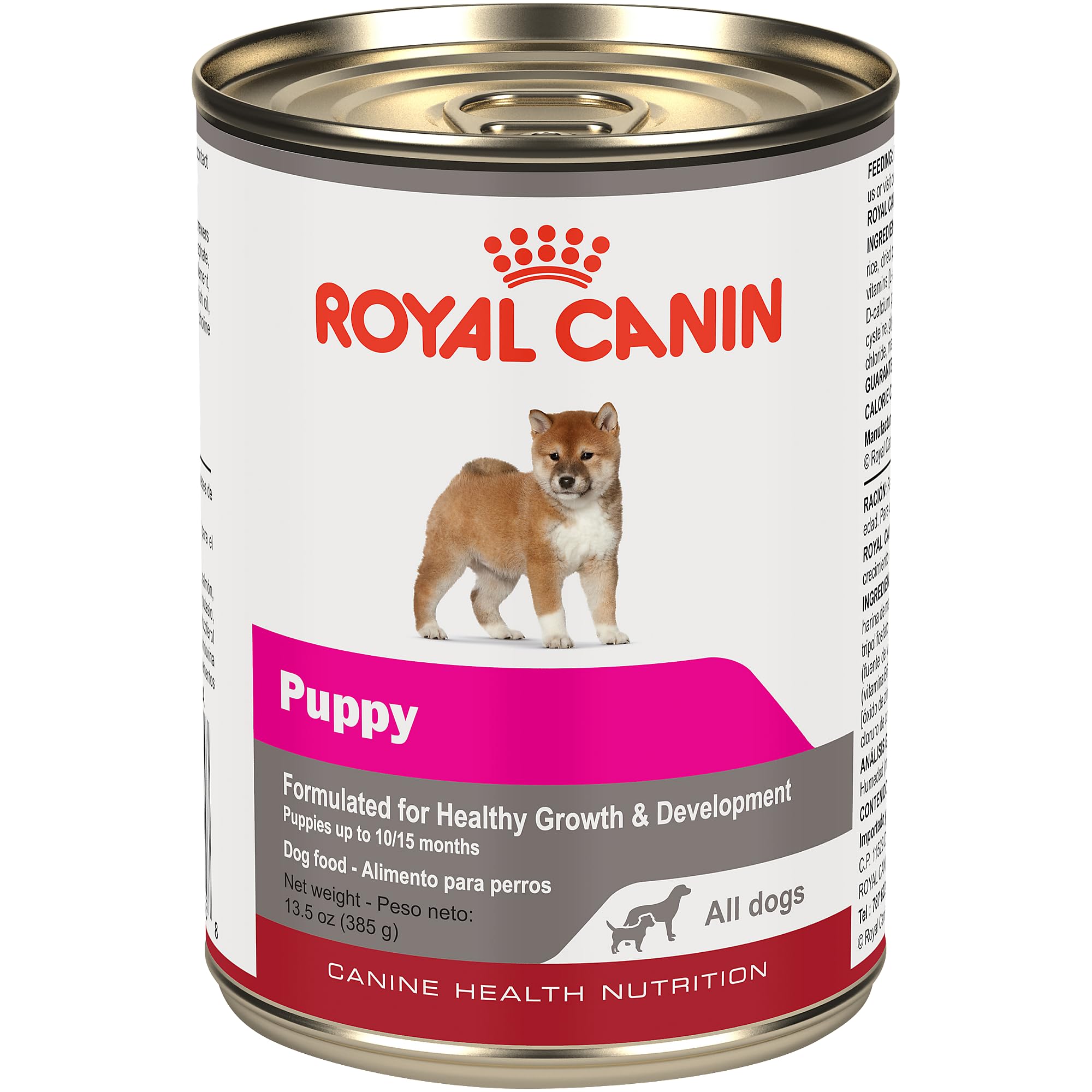
Royal Canin Puppy Loaf in Sauce

Royal Canin Puppy Loaf in Sauce

Premium all-breed feeding

Our Score 9.2/10
Check Price

Worth Noting

  • Most expensive full-size can here
  • Dense loaf clings to the can
Texture
Loaf in sauce
Can Size
13.5 oz
Life Stage
Puppies up to 10 to 15 months
Immune Support
Antioxidant complex
Read the full review

This is the priciest full-size can in the roundup, and it does not behave like one: puppies went at it without the circling and sniffing a strange new bowl usually earns. Some of that is the sauce, which carries the smell further than a dry pate does.

What the premium buys is a formula built around a developing system: a complex of antioxidants for immune support, beet pulp, fish oil and highly digestible proteins for the gut, and a loaf-in-sauce texture designed to be easy to eat. It is complete and balanced for puppies up to 10 to 15 months depending on expected adult size, and it can be fed alone or mixed with dry kibble. The nutritional thinking is aimed squarely at the first months, and that is the argument for paying more.

Portioning takes planning. At 13.5 ounces a can is more than a small puppy eats in a day, so you will be splitting it across meals and finding fridge space for the rest; the 13-ounce format our top pick uses is a little easier to finish. Fed alongside kibble, half a can goes further, and the loaf mixes in without leaving lumps.

Head to head with our top pick, you are paying for immune and digestive positioning rather than a different protein, since both are complete growth foods. If a puppy has had a rough start — a shelter stay, a bout of loose stools, a picky first month — we find the extra easier to justify than for a puppy who is already thriving.

Bottom line: Worth the premium if you want a breed-agnostic puppy food built around digestion and immune support — just budget for the price and keep a spoon handy.

5

Blue Buffalo Homestyle Puppy

Blue Buffalo Homestyle Puppy

Whole-ingredient shoppers

Our Score 9.2/10
Check Price

Worth Noting

  • Coarse grind takes more stirring
  • 12.5 oz can is smaller than most here
Can Size
12.5 oz
Life Stage
Puppy, complete and balanced
First Ingredient
Chicken
Grains And Produce
Whole grains and garden vegetables
Read the full review

Open this can and it does not look like a pate. There are shreds of chicken, peas, and pieces of carrot in a coarse ground base, and for a puppy who has grown bored with smooth textures, that is the whole appeal.

Real chicken is the first ingredient, and the recipe skips corn, soy, and wheat, leaning on brown rice, barley, and oatmeal for carbohydrates with flaxseed for omega fatty acids. It is complete and balanced for puppies, with DHA for development. If the ingredient panel is what you read first in the store, this is the can in this list that gives you the most to look at.

Texture is the trade-off. A coarse grind with visible pieces takes more stirring to blend through kibble than a smooth pate does, and a determined puppy can pick the vegetables out and leave them. Puppies who like something to chew go at it; puppies raised on smooth food can take a few meals to commit.

At 12.5 ounces it is slightly smaller than the 13-ounce cans that dominate this list, so a case covers a little less food. We reach for it when a puppy is already a good eater and the person buying wants recognizable ingredients — not as a fix for a fussy one, since texture is usually what the fuss is about.

Bottom line: The pick for an ingredient-minded shopper: real chicken first, vegetables you can see, no corn, soy, or wheat, and a coarse grind some puppies go wild for.

6

IAMS Proactive Health Puppy

IAMS Proactive Health Puppy

Budget feeding

Our Score 9.2/10
Check Price

Worth Noting

Can Size
13 oz
Age Range
1 to 12 months
Fatty Acids
DHA and omega-6
Main Protein
Chicken and rice
Read the full review

The least expensive chicken-and-rice can in this roundup does the same basic job as the ones that cost more: complete and balanced for puppies from one to twelve months, with real chicken for muscle and omega-6 for a soft coat.

What it does not carry is a long list of extras. There is DHA for brain and vision, whole grain rice for energy, and that is about the story. For a puppy already thriving on a simple diet, that is plenty — though a puppy who needs a novel protein or a texture he will actually finish is better served elsewhere in this list.

The grind is looser and wetter than the pates here, closer to a soft loaf, which makes it the easiest of the group to mash into kibble or spread across a slow feeder. We ended up using it as a mixer more than a standalone meal, and at that job the price is the point.

It is also a sensible first can for a foster or a weaning litter, when you are going through food fast and do not want to open a premium can for a puppy who may not finish it. There is nothing glamorous here; there is also nothing to work around.

Bottom line: The value buy: complete chicken-and-rice puppy nutrition from one to twelve months, with DHA and omega-6, in the least expensive full-size chicken can here.

7

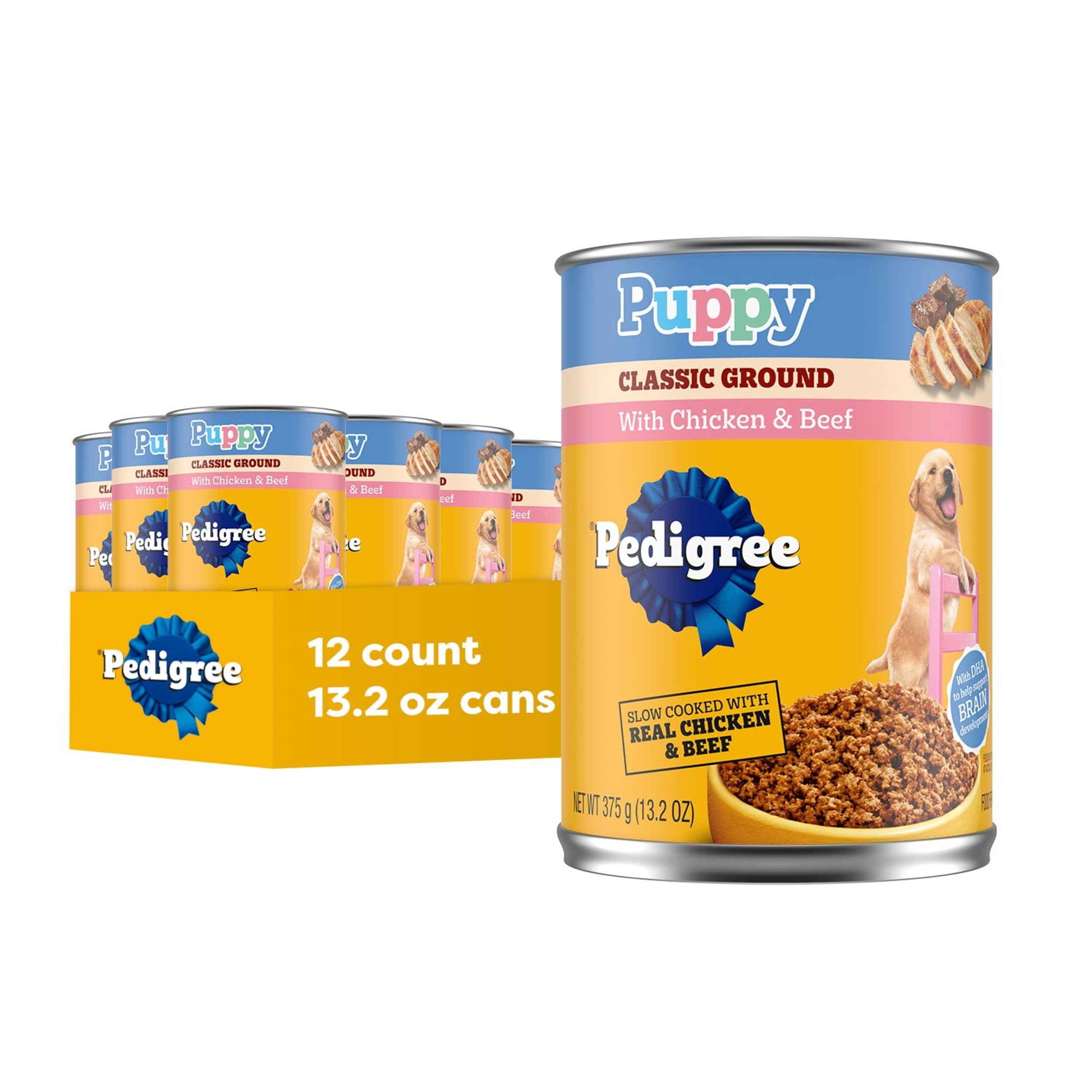
Pedigree Puppy Chopped Ground

Pedigree Puppy Chopped Ground

Low-cost feeding

Our Score 9.2/10
Check Price

Worth Noting

  • Plainer recipe than the premium cans
Case
12 cans
Can Size
13.2 oz
Life Stage
Puppy, excluding large breeds
Main Protein
Chicken and beef
Read the full review

Before the value case, the catch: this food is complete and balanced for puppies except the ones heading for 70 pounds or more as adults. If your puppy's adult weight lands under that line, this is the least expensive way here to keep a cupboard stocked with cans.

For that puppy it is a real option and not a compromise: slow-cooked ground chicken and beef with DHA for brain development and calcium for teeth and bones, built on easily digested animal protein, and soft enough that a young puppy does not have to work at it.

Where it makes the most sense is volume — a litter being weaned, a puppy eating three or four small meals a day, or a household that stretches a bag of kibble with a spoonful of wet at every meal. Fed at that rate, the case price does the deciding.

The format helps too. At 13.2 ounces a can, 12 to a case, the grind holds together well enough to bulk up a bowl of kibble without turning the whole thing soupy. For a medium-breed puppy on a budget, this is where we start.

Bottom line: A genuine budget case for small and medium puppies, with DHA and calcium — as long as your dog will finish under 70 pounds as an adult.

8

Hill's Science Diet Small & Mini Puppy

Hill's Science Diet Small & Mini Puppy

Small-breed puppies

Our Score 9.0/10
Check Price

Worth Noting

  • A case of small trays does not go far
Minerals
Balanced for bones and teeth
Breed Size
Small and mini
Pack Format
12 trays, 42 oz total
Key Nutrient
DHA from fish oil
Read the full review

A small-breed puppy runs into the same arithmetic with a 13-ounce can every day: half of it is a meal and a half, and the rest goes into the fridge to be forgotten. These single-serve trays are sized for that puppy, and that is most of why this one earns a place here.

The food is a chicken and vegetable stew with DHA from fish oil for brain and eye development and a balanced mineral set for bones and teeth — the growth basics, in a soft texture that suits a small mouth. Feeding is the part we appreciated: peel a tray, tip it into a bowl, and there is nothing left to scrape or store.

Cost is the sticking point. For a six-pound puppy the convenience is worth it; for a twenty-pound one, a full-size can and a refrigerator container are the better economics. If you are raising one small puppy at a time, the trays quietly remove a daily chore.

One comparison worth making: if your puppy will stay under eight pounds as an adult, the Royal Canin X-Small cans apply the same single-serve logic in a true can rather than a tray. Both solve the leftover problem, so choose on texture and on how small your puppy actually is.

Bottom line: The small-breed solution: single-serve trays sized for a little puppy, with DHA and minerals for growth, at a cost that only makes sense at small volumes.

9

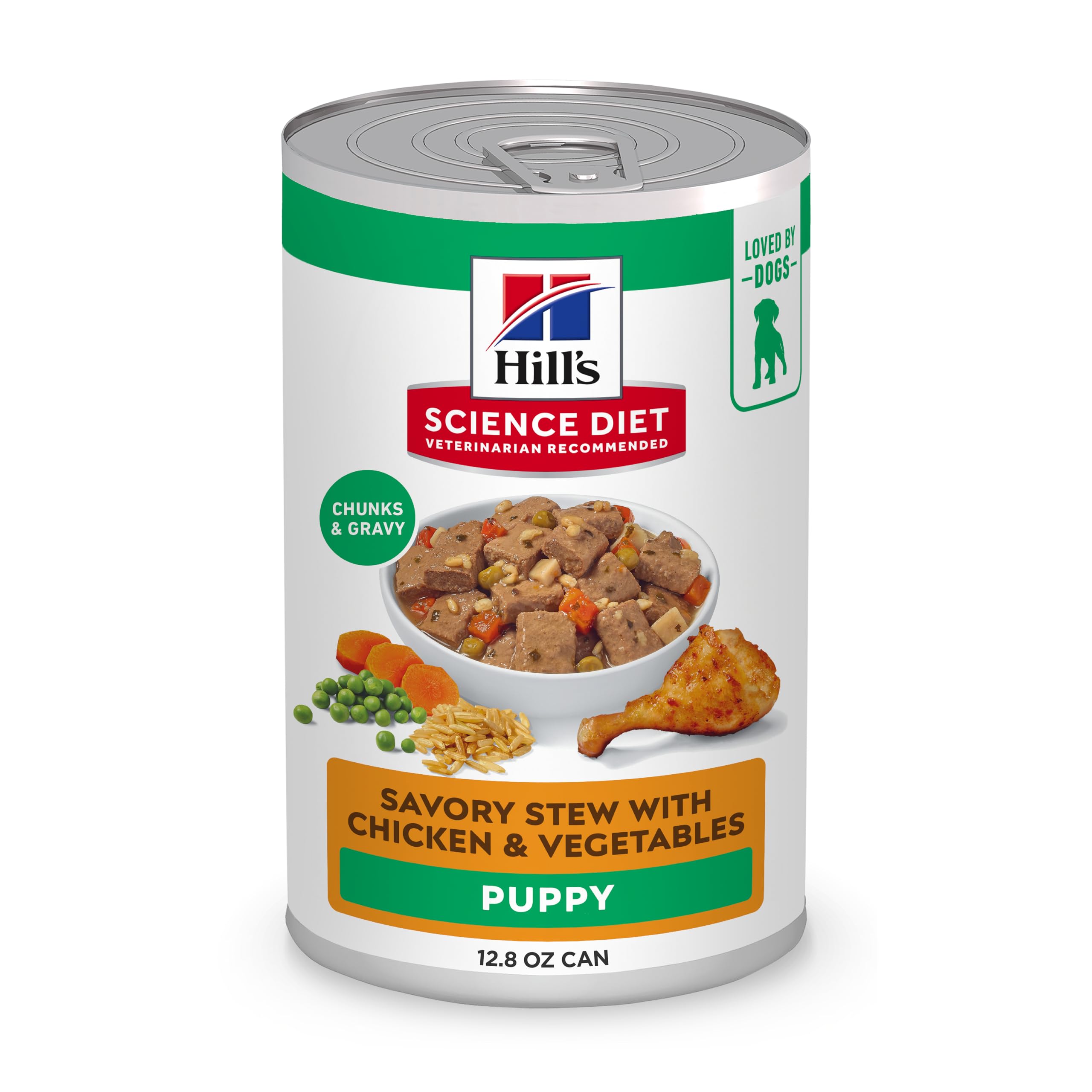
Hill's Science Diet Puppy Wet

Hill's Science Diet Puppy Wet

Texture variety

Our Score 9.0/10
Check Price

Worth Noting

  • One of the pricier cases in this roundup
Case
12 cans, 153.6 oz
Texture
Stew with meat and vegetables
Life Stage
Puppy, all breed sizes
Key Nutrient
DHA from fish oil
Read the full review

Texture is the reason to look at this one. Instead of a smooth pate you get a stew with visible chunks of meat and vegetable in a thick gravy, and the cans have pull-tops — trivial until you are opening one before work with a puppy underfoot.

Underneath it is a straightforward growth formula: DHA from fish oil for brain and eye development, a balanced mineral set for bones and teeth, and easily digestible ingredients. It is made for all breed sizes, so a household with two very different puppies is not juggling two foods.

The chunky texture divides puppies. Some go straight for the chunks, others nose them to the side of the bowl and wait for something smoother, and a puppy raised on pate can take a few meals to commit.

We buy it for the texture, not the label. Nutrition is solid right across this list, and a food a puppy finishes beats a better-formulated one he walks away from, which is the only reason to keep a chunky stew in the rotation.

Bottom line: The texture play: a chunky stew with visible meat and vegetables, pull-top cans, and solid growth nutrition for a puppy who has gone off pate.

How We Tested the Best Canned Puppy Food

We started with a long list of cans sold in pet specialty shops, big-box stores, and online, then cut anything whose label did not carry an AAFCO statement confirming it is complete for growth or for all life stages, since that is the bare minimum for a puppy. From there we filtered by protein source, texture, and price per hundred calories rather than price per can, so the final 10 were not all premium options.

Each formula got a minimum of 10 days, with a five-day slow transition to avoid blaming a new food for an old one's aftermath. Bowls went down at 7 a.m. and 6 p.m., and we logged how quickly each puppy started eating, how much was left after 10 minutes, and whether they walked away mid-bowl or licked it clean. We also scooped every stool for four days, grading firmness, volume, and smell, and noted gas and any loose stools, which ended a formula's run early.

The rest was slower and less scientific. We weighed puppies at vet visits and tracked energy and coat condition across the four months. We opened every can cold and rated how it smelled to a human nose, how easily it slid out and mixed with kibble, and how much stayed stuck to the spoon. To judge value honestly, we calculated cost per day based on the calories each puppy actually needed to reach a healthy adult weight, not the price of the can.

How to Choose the Right Canned Puppy Food

Read the Growth Statement First

The front of the can says puppy; the fine print is what tells you whether it is a complete diet or something to spoon over kibble. Look for a statement that the food is complete and balanced for growth or for puppies, then check the age window — most of these run to 12 months, and the Pro Plan extends to two years for larger breeds.

If your puppy is heading past 70 pounds as an adult, that statement matters twice over. Pedigree's formula is complete and balanced for puppies except large breeds, so it is not the can for that dog. A large-breed puppy needs a diet formulated for the longer, faster growth, which is a separate label claim rather than a marketing nicety.

Match the Can to the Puppy, Not the Case

Format is where most of the daily friction lives. A 13-ounce can is the standard here and the least expensive way to buy food, but a toy-breed puppy will not finish one before it has sat in the fridge too long. Single-serve formats — Royal Canin's 3-ounce cans, Hill's 3.5-ounce trays — cost more per serving and waste less.

Our rule of thumb: if a puppy eats less than half a standard can at a meal, buy the small format and stop scraping leftovers into containers. If you are feeding two puppies or a fast-growing one, the full-size can wins on both cost and convenience.

Choose a Texture Your Puppy Can Work With

Pate, ground, stew, and slices in gravy are all complete diets; the difference is whether a puppy will eat them. Smooth pates and loaves are easiest for a puppy moving off milk and for small mouths, and they are what to thin with water for a first solid meal.

Chunky stews and slices give a puppy something to chew and can restart one who has gone off smooth food. Texture is the most common reason a good food gets refused, so change the texture before you change brands.

What the Premium Actually Buys

Every can in this roundup is a complete growth diet, so extra money buys positioning rather than basic nutrition: antioxidant complexes, prebiotic fiber, named proteins, and smaller packaging. The midrange cans carry DHA, high-quality protein, and a complete-and-balanced claim too — Purina ONE does it for less than the premium picks.

Spend up when a puppy has a sensitive gut or a rough start, or when a specific breed size needs a specific formula. Otherwise, put the difference toward a second case.

Frequently Asked Questions

Final Verdict

Purina ONE Plus Classic Ground is the can we keep on the shelf: complete growth nutrition, a named protein, and the steadiest digestion in this group, at a price that does not make a case feel like a splurge. For most puppies, that combination is the whole decision.

If you want chicken first and a formula that stretches to two years for a big dog, Purina Pro Plan is the one. For a small-breed puppy and no half-cans in the fridge, Hill's Science Diet Small & Mini is the practical answer, and Royal Canin's X-Small cans solve the same problem for a toy breed.