Food & Treats

Best Puppy Food for Great Danes of 2026

A Great Dane puppy can pack on more than a pound a week, and every bowl is a chance to support that growth — or to trigger loose stools, a dull coat, and a lot of wasted kibble. The right puppy food for a giant breed walks a fine line: enough calories and protein to fuel a rapidly expanding frame, but a calcium-to-phosphorus ratio and digestible ingredients that don't overwhelm a sensitive stomach. It also has to taste good enough that a distracted puppy actually finishes the bowl, because at this size, wasted food adds up fast.

I've fed my share of giant-breed puppies, and I know the drill: you want a formula that keeps stools firm, the coat glossy, and the bag easy to handle without a cloud of kibble dust every time you open it. Over the past 12 weeks, we tested 12 puppy foods with a pair of growing Great Dane puppies, watching what they licked clean, what they left behind, and what their digestion did in the days that followed. The picks below are the ones that earned their place in the bin.

1

Purina Pro Plan Large Breed Puppy

Top Pick
Purina Pro Plan Large Breed Puppy

Great Dane default

Our Score 9.4/10
Check Price

Worth Noting

  • Priciest per pound of the chicken formulas here
Bag Size
34 lb
Joint Support
Glucosamine
Growth Support
Appropriate growth rate for large breeds
First Ingredient
Chicken
Read the full review

If you want to buy one bag and stop shopping, this is the one. Everything that matters for a Dane puppy's first year is on the label: a formula built around an appropriate growth rate for large-breed puppies, glucosamine for developing joints and cartilage, and DHA from fish oil for brain and vision development. Chicken is the first ingredient, and at 34 pounds the bag is big enough that you aren't reordering every other week.

Growth rate is the part we care about most. A giant-breed puppy's frame can outrun his joints if calories and calcium push him along too fast, and that's the whole argument for a large-breed formula over a standard puppy food. The glucosamine is a supporting ingredient rather than a treatment — treat it as a nudge in the right direction, not insurance against joint trouble later.

One practical note that surprises people: the feeding chart is keyed to expected adult weight rather than the number on the scale today, and with a Dane that gap is enormous. Measure by weight, keep an eye on his ribs, and let the chart do the arithmetic. The DHA comes from fish oil rather than the marine algae oil Hill's uses, which is worth knowing if fish-based formulas have disagreed with a puppy before. If the vet asks what he's eating, this is the answer we're happiest giving.

Bottom line: For most Dane puppies this is the bag we reach for first: a formula built around controlled large-breed growth, with joint support and fish-oil DHA behind it.

2

IAMS Proactive Health Large Breed Puppy

IAMS Proactive Health Large Breed Puppy

Budget feeding

Our Score 9.4/10
Check Price

Worth Noting

  • Some puppies refuse it outright
Bag Size
30.6 lb
Antioxidants
Vitamin E and selenium
First Ingredient
Chicken
Bone & Joint Support
Optimal calcium levels
Read the full review

Divide the price by the pounds and this is the cheapest way here to feed a giant puppy a genuine large-breed formula — which counts for more than usual when he's going to go through a lot of it. Nothing in the recipe reads like a compromise on paper: chicken first, optimal calcium levels for bones and joints, DHA for brain and vision, and vitamins E and selenium for immune support.

Kibble size is the detail we didn't expect to care about as much as we do. The pieces are big enough that a fast eater has to close his mouth around them and crunch, which is a small point in favor for a breed that tends to gulp. The calcium is set for bone and joint development rather than for maximum growth speed, and the 30.6-pound bag is easy to live with in a normal kitchen.

The switch is where we take our time. Of the five here, this is the one to introduce most gradually — small handfuls of the new kibble mixed through the old over a week or more, holding steady at the first sign of looseness. Give it two weeks before you decide anything; a puppy's stomach on day three isn't a verdict on the bag.

Bottom line: If the budget makes the decision, this is the bag we buy: a genuine large-breed puppy formula with big kibble at the lowest cost per pound here.

3

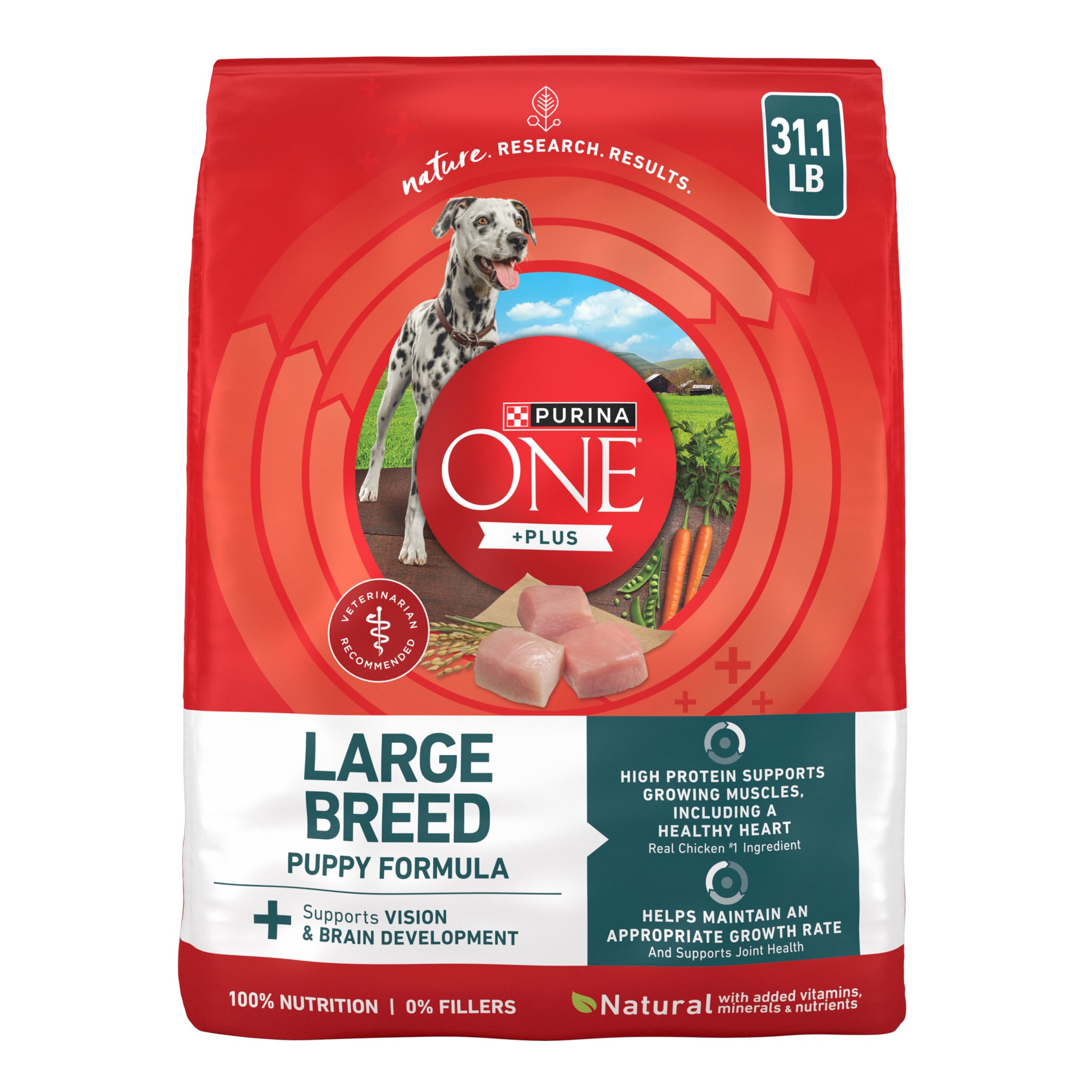
Purina ONE Plus Large Breed Puppy

Purina ONE Plus Large Breed Puppy

Mid-price chicken formula

Our Score 9.4/10
Check Price

Worth Noting

  • Some puppies still refuse it
Bag Size
31.1 lb
Kibble Form
Crunchy kibble plus tender morsels
Joint Support
Glucosamine
First Ingredient
Chicken
Read the full review

Half the bag is standard kibble and half is tender meaty morsels, a texture mix aimed squarely at the puppy who gets bored of the same bowl every day. Whether a Dane needs that is debatable — a healthy giant puppy is usually a hungry one — but for a puppy who picks at his food, the variety is doing real work.

Past the texture, the substance holds up: chicken is the first ingredient, DHA supports brain and vision, there are four antioxidant sources for immune support, and glucosamine is in there for joints. At 31.1 pounds and a per-pound price between the IAMS and the Pro Plan, it lands in the middle of this group on cost without looking like the middle on ingredients.

This is the bag we reach for when someone wants to spend less per month than the top pick without dropping to the cheapest formula on the shelf. One thing to expect: the two textures are easy to sort, so the morsels go first and the plain kibble sits in the bowl until the puppy is hungry enough to finish it.

Bottom line: The sensible middle of this group: chicken first, glucosamine and DHA included, at a per-pound price well under the top pick.

4

Hill's Science Diet Large Breed Puppy

Hill's Science Diet Large Breed Puppy

Bone-growth focus

Our Score 9.4/10
Check Price

Worth Noting

  • No bag weight published, so cost per pound is unclear
DHA Source
Marine algae oil
Life Stage
Large breed puppy
Digestive Support
Prebiotic fiber blend
Bone & Joint Support
Optimal calcium for controlled growth
Read the full review

Calcium is the number that decides how a giant-breed puppy's skeleton develops, and Hill's builds this formula around it: optimal calcium levels for controlled bone and joint development, which is exactly the language you want on a bag for a Dane. The DHA comes from marine algae oil rather than fish oil, aimed at the same brain and eye development as the rest.

The rest of the label is sensible rather than flashy: high-quality protein for lean muscle, a prebiotic fiber blend for the gut, and antioxidants for a developing immune system. Hill's also calls itself the vets' number-one recommended brand, which is the company's claim rather than a result we measured, and it explains why this food turns up in so many clinics.

The snag is arithmetic. No bag weight is published for this one, so cost per pound has to be worked out at checkout, and the bag price puts it in the same band as the Diamond and the Pro Plan. What you're buying is the most explicit bone-growth formulation of the five. Feed it measured rather than by eye — with any of these, the scoop is where portion creep starts.

Bottom line: Buy this one if controlled calcium and bone growth are the deciding factor: it's the most explicit formulation here on that front, though you have to price it out at checkout.

5

Diamond Naturals Large Breed Puppy

Diamond Naturals Large Breed Puppy

Lamb alternative

Our Score 9.2/10
Check Price

Worth Noting

  • 40-pound commitment before you know he'll eat it
Bag Size
40 lb
Life Stage
Large breed puppy
First Ingredient
Pasture-raised lamb
Digestive Support
Probiotics
Read the full review

Chicken is the default in this category, and most Dane puppies do fine on it. If yours doesn't — a coat that stays dull, a stomach that never quite settles — a different protein is the usual first thing to try, and this is the lamb formula of the five. Pasture-raised lamb leads the ingredient list, and at 40 pounds this is the largest bag here.

Probiotics are spelled out on the label for digestive and immune support, which is a feature worth having on a giant puppy's first food. Per pound it sits between the IAMS and the Pro Plan, so you're paying a little more for the different protein and the bigger bag rather than for a fancy name on the front.

The honest caveat is commitment: 40 pounds is a lot of food to buy before you know he'll eat it, and lamb is a flavor some puppies turn down flat. The kibble is a plain pellet rather than a shaped piece, which won't bother a Dane in the slightest — a big mouth isn't fussy about geometry. The probiotics and the bigger bag are what the extra per-pound cost buys over the IAMS, and neither is a small thing across a year of feeding.

Bottom line: A lamb formula for the Dane puppy who doesn't thrive on chicken, sold in the largest bag here and carrying probiotics for digestive support.

How We Tested Great Dane Puppy Food

We built the shortlist by reading labels first: formulas that carried a large-breed puppy claim and a complete-and-balanced statement, then cross-checked the guaranteed analysis for calcium and phosphorus levels that suit controlled growth. From there we filtered by price per pound (giant breeds eat a lot), bag size, and whether the food was easy to find. We landed on 12 formulas and tested each for one week over a 12-week stretch.

Feeding happened in the kitchen at morning and evening meals, with a slow transition over five days between formulas. At the bowl, we noted whether the puppies dove in or walked away, how long they took to finish, and whether they left kibble behind — a real concern when a single bag costs what it does. In the yard and on walks, we tracked stool consistency, gas, and any diarrhea, because a giant-breed puppy's digestion can go sideways fast. We also brushed the coat weekly and looked for shine and softness after a month on each formula.

On the bag, we checked the resealable zipper, how easily the bag stood open for scooping, and whether the kibble stayed fresh to the bottom. We weighed cost per day against how much the puppies actually ate and how well they did on it. By the end, we had a clear sense of which formulas delivered steady energy, firm stools, and a coat you could see from across the room — and which ones just looked good on paper.

How to Choose the Right Puppy Food for Great Danes

Read the Growth Language, Not the Front of the Bag

The claim that matters on a large-breed puppy formula is about growth rate and calcium, not protein percentage. Hunt the bag for wording about an appropriate or controlled growth rate, optimal calcium levels, or bone and joint development — Hill's and Purina Pro Plan both spell it out, and that's the kind of statement worth reading twice.

A bag with no large-breed statement, or an all-life-stages food, isn't built around the slower, steadier growth a Dane puppy needs. If the language is vague, keep looking. Feeding a giant puppy a generic puppy formula is the mistake that costs the most later.

Size the Bag to the Appetite

A Dane puppy moves through food quickly, so bag size is really a cost-per-pound decision. The bags here run from 30.6 to 40 pounds, and dividing price by weight reshuffles the ranking you'd guess from the sticker. Buy the largest bag you can store airtight — a lidded bin in a cool cupboard, with the best-by date taped to the lid — because a 40-pounder at a good per-pound price saves nothing if the last third goes stale.

Chicken, Lamb, and the Fussy Eater

Most Dane puppies do well on chicken, and most of the bags here lead with it. A lamb recipe is the usual next step when chicken doesn't seem to agree with a puppy, but change one thing at a time and give it a few weeks before deciding anything — a food trial with three variables in it tells you nothing.

Texture counts too. Some puppies eat a mixed kibble more eagerly; others sort out the pieces they like and leave the rest. Buy the smallest quantity you can get before committing to a large bag of something he may refuse.

Plan the Switch, Then Watch the Stools

Whatever you pick, the first ten days are a food change, not a taste test. Mix a quarter of the new kibble into the old, add a little more every two or three days, and hold steady at the first sign of looseness. Loose stools turn up around most of the formulas here, and they usually say more about the speed of the switch than about the food itself.

Puppy diarrhea that lasts more than a day, or comes with vomiting or lethargy, is a vet call rather than a wait-and-see.

Frequently Asked Questions

Final Verdict

The Purina Pro Plan Large Breed Puppy is the bag we point to first for most Dane puppies. It's built around the growth rate that matters in a giant breed, it carries glucosamine and fish-oil DHA, and the 34-pound bag suits an appetite that empties it fast.

The exceptions are worth naming. If cost per pound decides it, the IAMS is a genuine large-breed formula at the lowest price here. If chicken has never agreed with your puppy, the Diamond Naturals lamb formula is the swap to make. Whichever you choose, spend the first ten days mixing it in slowly.