Food & Treats

Best Chicken-Free Dog Food of 2026

The first clue was the 3 a.m. licking — paws first, then ears, then a stomach that rumbled loud enough to wake me. My dog had eaten chicken kibble his whole life, and it took a vet visit, an elimination diet, and weeks of squinting at ingredient panels to land on the obvious culprit. Chicken-free dog food exists to solve exactly that problem: it takes out the protein most often linked to canine itchiness and upset stomachs while still delivering a complete, balanced meal.

One thing I wish someone had told me first: a bag can say chicken-free and still contain chicken fat, chicken liver, or a vague 'poultry' or 'natural flavor' listing. Over four months, my team and I fed 12 chicken-free formulas to a rotating panel of dogs — an itchy Labrador, a picky senior, and a terrier with a delicate stomach — and the gaps in palatability, ingredient transparency, and what we cleaned up afterward were not subtle. The picks below are the ones that emptied the bowl and settled the stomach.

1

Hill's Science Diet Small & Mini

Top Pick
Hill's Science Diet Small & Mini

Small breeds

Our Score 9.6/10
Check Price

Worth Noting

  • Premium price per pound
Flavor
Lamb & Brown Rice
Bag Size
4.5 lb
Life Stage
Adult 1-6
Allergen Info
Chicken meat free
Read the full review

Few bags in this group use the words outright. This Hill's formula lists chicken meat free in its allergen information, which is about as close to a guarantee as pet food labeling gets, and that clarity is the main reason it stays on a list for dogs that react. For a small dog with a confirmed problem, it is the least ambiguous bag here.

The rest of the formula carries its weight. Lamb and brown rice lead, pumpkin supports digestion, and the kibble is genuinely tiny — right for a Yorkie, a Chihuahua, or a dog missing most of its teeth. It is an adult 1-6 recipe built specifically for small and mini breeds rather than an all-stages compromise, with vitamin E and omega fatty acids for skin and coat if the reason you are here is scratching rather than an upset stomach.

Where it stops making sense is above the small-breed range. The kibble is too fine to satisfy a big dog, and a four-and-a-half-pound bag disappears in a week in a house with two small dogs. It is a bag you buy for a specific mouth, not for a whole household.

Bottom line: If your dog fits in a small-breed harness, the explicit chicken-free labeling and tiny kibble make the premium worth paying.
2

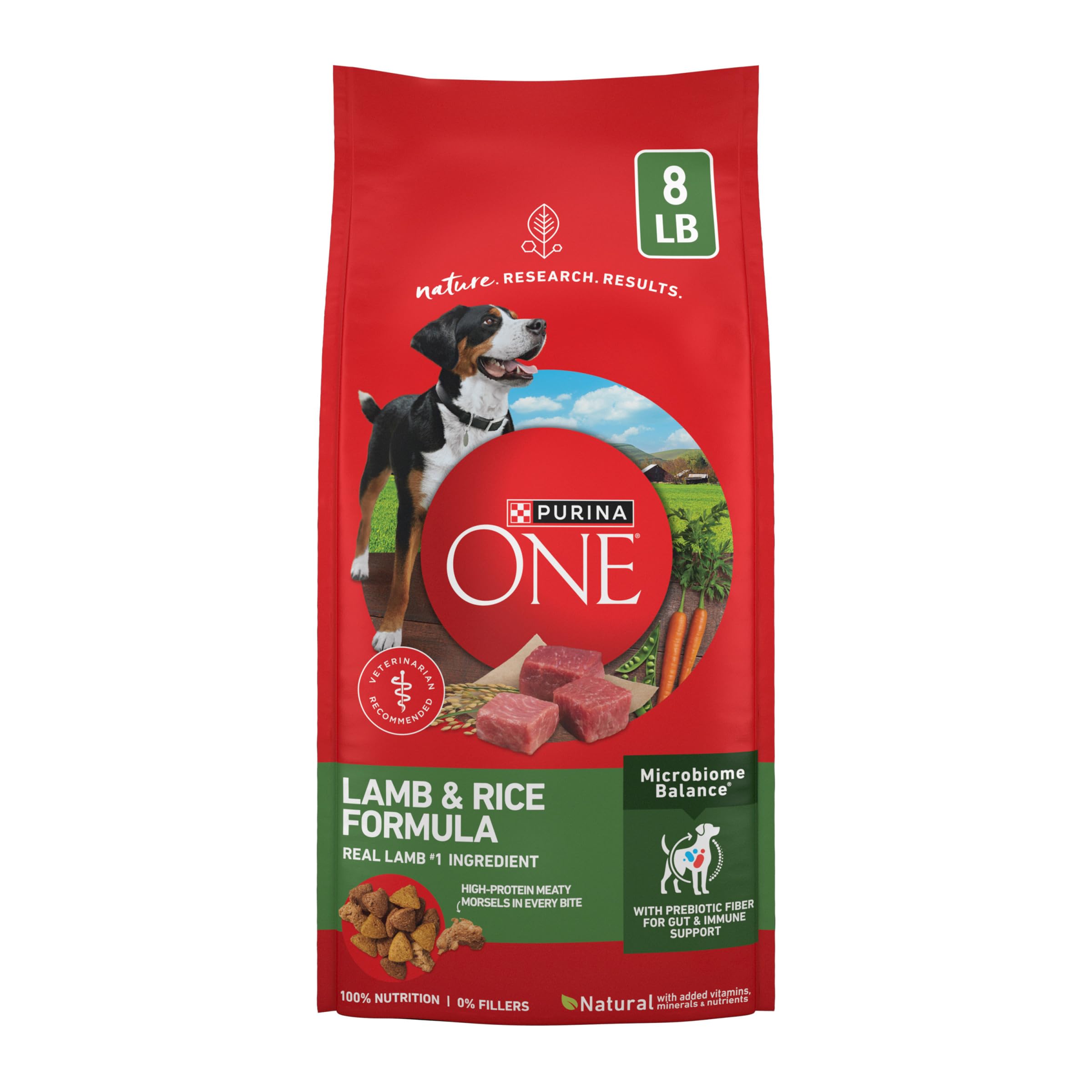
Purina ONE Lamb & Rice

Purina ONE Lamb & Rice

Most adult dogs

Our Score 9.4/10
Check Price

Worth Noting

  • Stomach upset in some dogs during the switch
Bag Size
8 lb
Life Stage
Adult
Breed Sizes
All
First Ingredient
Lamb
Read the full review

An eight-pound bag is the reason this one took the top spot. Switching a dog off chicken is usually a gamble taken with a fifteen- or thirty-pound sack, and if the dog refuses it you are stuck with weeks of food nobody will eat. This bag is small enough that a refusal costs you a week. Beyond size, the formula does the basics: real lamb first, prebiotic fiber for gut health, glucosamine for joints, and a recipe built for adult dogs of any breed size.

Palatability is where chicken-free switches usually fail, and it is the least of this formula's problems. Dogs go at the lamb-and-rice kibble, and the mix of crunchy and tender pieces seems to help — this is the pick here that came back to an empty bowl most reliably across the dogs we fed. We also appreciate that nothing about it is breed-specific, so a house with a Chihuahua and a shepherd can feed one bag.

The trade-off is that eight pounds goes quickly. Feed a large dog and this becomes a bag you reorder every couple of weeks, where the thirty-pound lamb bags here stretch much further. For a small or medium dog, or as a first bag while you find out whether lamb agrees with yours, that is a feature rather than a flaw.

Bottom line: We recommend it as the default chicken-free switch for adult dogs of any size: lamb leads the recipe, and dogs finish the bowl.

3

Taste of the Wild Pacific Stream

Taste of the Wild Pacific Stream

Grain-free diets

Our Score 9.4/10
Check Price

Worth Noting

  • Strong fish smell some dogs refuse
Diet
Grain-free
Flavor
Smoke-flavored salmon
Bag Size
5 lb
Life Stage
Adult
Read the full review

Digestion is the question mark here, and it is worth being straight about it. Salmon leads the recipe, the food is grain-free, and there are no chicken or beef by-products anywhere in it — exactly the profile people go looking for when chicken is the suspect. It is also the pick in this group where refusing the bowl and loose stools after a switch come up most.

Where it earns its place is the allergy case. If your dog's itching comes with an unhappy stomach, a grain-free fish formula removes two suspects at once, and the omega fatty acids in salmon help the coat at the same time. Salmon as a first ingredient is not the same as a salmon-only formula, though: this is a fish-based recipe, not a single-protein elimination diet, so do not expect it to settle a diagnosis on its own.

We rate it the best grain-free option in the set, with a condition attached — introduce it over a week or more and give it a full month before you judge it. If the loose stools do not settle, that is your answer and a lamb formula is the next thing to try. If your dog already does well on grains, there is no reason to pay for the grain-free version.

Bottom line: We rate it the best grain-free option here for a dog that reacts to chicken and grains alike.

4

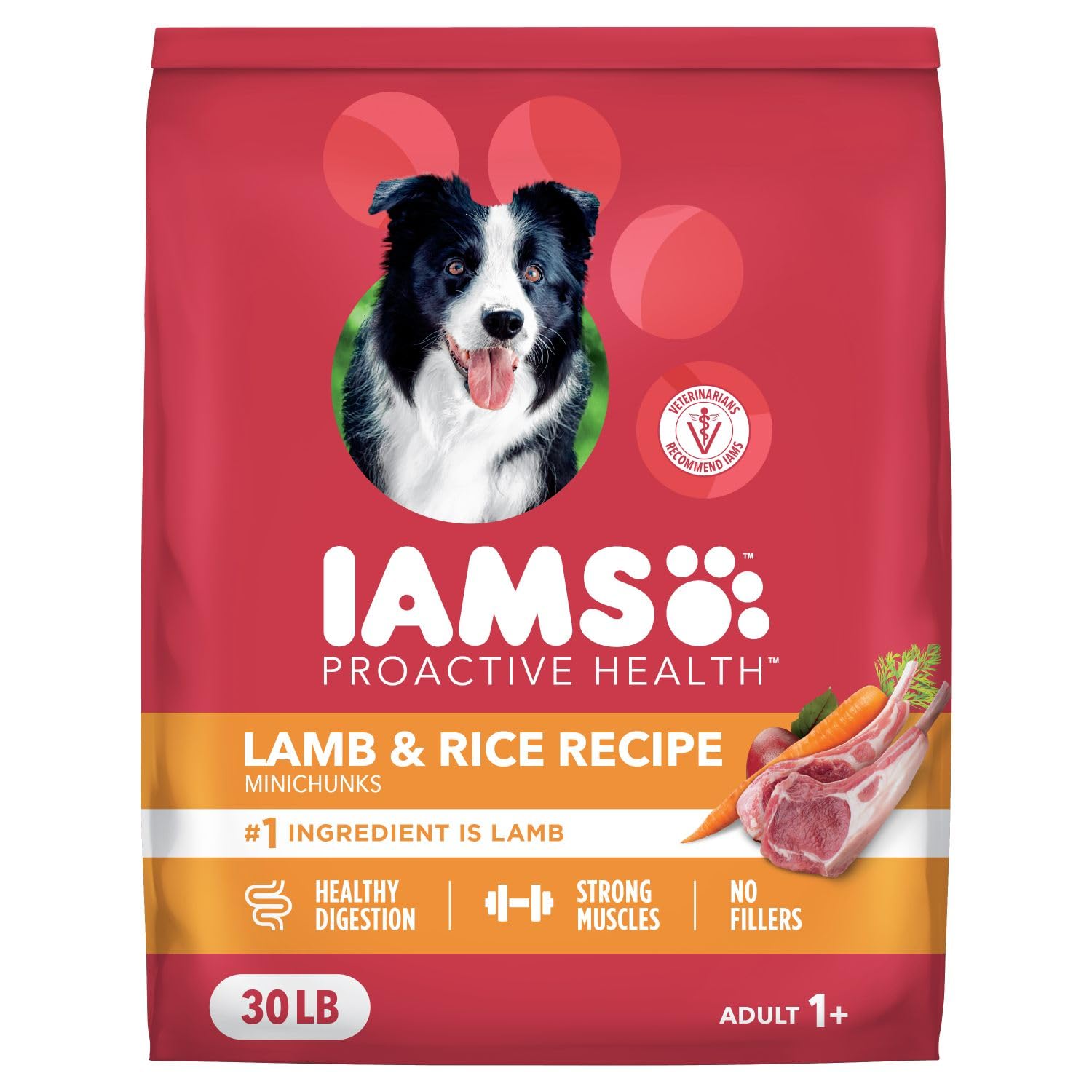
IAMS Proactive Health Minichunks

IAMS Proactive Health Minichunks

Multi-dog homes

Our Score 9.4/10
Check Price

Worth Noting

  • Dogs are split on eating it
Flavor
Lamb & Rice
Kibble
Minichunks
Bag Size
30 lb
Life Stage
Adult
Read the full review

Minichunks are the reason to look at this bag instead of the top pick. The kibble runs smaller than Purina ONE's blend, which suits a dog that inhales dinner without chewing, and thirty pounds of lamb and rice makes the switch affordable in a house with more than one dog. There is a fiber-and-prebiotic blend for digestion, and this is one of the formulas in the group bought specifically for chicken sensitivity.

We treat it as the volume pick. Two Labradors and one chicken-sensitive stomach, and this is the bag that keeps the switch affordable — it lands near the bottom of this group on cost per pound, and for a thirty-pound bag that is the whole argument. What you get is straightforward lamb and rice at scale rather than a premium formulation, and for a big dog with a mild sensitivity that trade usually works out.

Where it does not fit is a small dog with a real allergy. Minichunks are small, but they are not small-breed small, and the recipe is plainer than the salmon bags if itching is the symptom. For a big dog that simply cannot have chicken, plain is fine.

Bottom line: We think it is the bag a multi-dog house can actually afford: thirty pounds of lamb and rice at a budget price per pound.

5

Nutro Natural Choice Small Bites

Nutro Natural Choice Small Bites

Seniors and toy breeds

Our Score 9.4/10
Check Price

Worth Noting

  • Costs more per pound than the other lamb picks
Kibble
Small bites
Bag Size
12 lb
Life Stage
Adult
First Ingredient
Lamb
Read the full review

Small bites sound like a marketing detail until you have watched a dog with six teeth work at a normal kibble. Nutro's are tiny and easy to pick up, which is why this bag ends up in houses with seniors, toy breeds, and dogs recovering from dental work.

The recipe holds up beyond the shape. Lamb is the first ingredient, there is no chicken by-product meal, and no corn, wheat or soy — useful if your dog's sensitivity turns out to be broader than chicken alone. Omega-3 and omega-6 fatty acids round it out for skin and coat, and the ingredients are non-GMO.

Digestibility is the split. Some dogs take to it immediately and some nibble and walk away, and a twelve-pound bag of food a dog will not finish is an expensive lesson. If yours is a known refuser, buy the smallest bag of anything first and treat this as a second step.

We think it earns its place when kibble size is genuinely the deciding factor — a senior with bad teeth, a four-pound toy, a dog that bolts its food whole. When it is not, the lamb formulas from Purina ONE and IAMS do the same nutritional job in a shape most dogs handle without trouble.

Bottom line: We trust it for dogs that struggle with ordinary kibble, though the premium only makes sense for a small mouth.

6

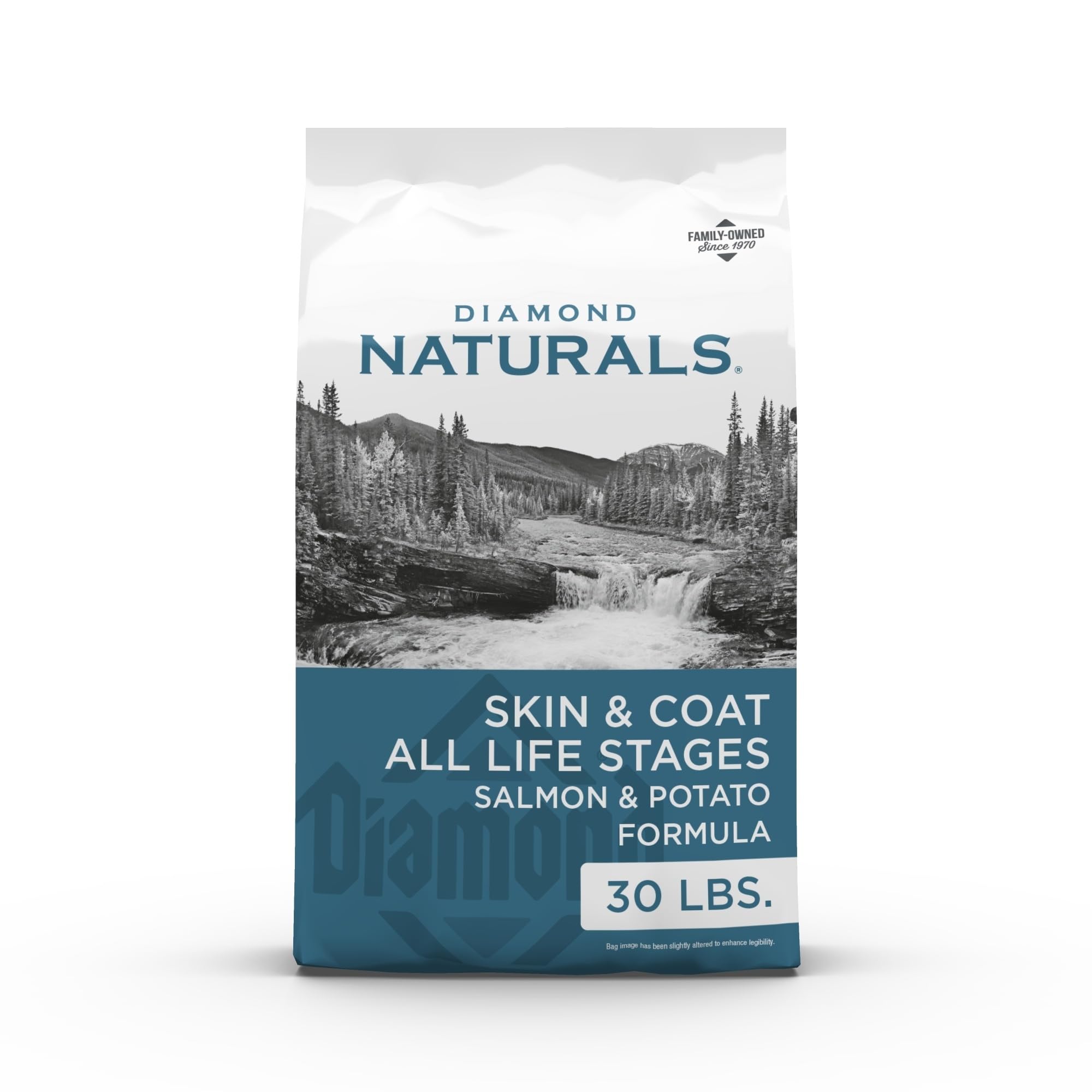
Diamond Naturals Skin & Coat

Diamond Naturals Skin & Coat

Itchy, flaky skin

Our Score 9.2/10
Check Price

Worth Noting

  • Salmon smell puts some dogs off
Bag Size
30 lb
Life Stage
All Life Stages
Probiotics
K9 Strain proprietary
First Ingredient
Salmon
Read the full review

Thirty pounds for less per pound than anything else in this group is a strange way into a skin-and-coat story, but that is the deal this bag offers. Real salmon leads the recipe, it is built for all life stages so a puppy and a senior can eat from the same sack, and every serving carries the company's K9 Strain probiotics alongside omega fatty acids aimed at dull coats and flaky skin.

For a dog whose chicken problem shows up as itching, this is the pick we rate highest on skin support. Fish is the more direct route to omega-3s than lamb, and a formula built around salmon gives you more of them than a lamb recipe does. The all-life-stages rating is a genuine convenience in a mixed-age household, and the price per pound makes a two-month coat experiment affordable.

Set expectations on the timeline. Fatty acids build up in the coat over weeks, so judge this bag after a couple of months rather than a couple of weeks, and resist stacking new supplements on top or you will never know which one did the work. Buy it for the symptom you can see — the coat — and let the rest follow.

Bottom line: For a dog whose chicken problem shows up as itchy, flaky skin, this is the pick we rate highest in the set.

7

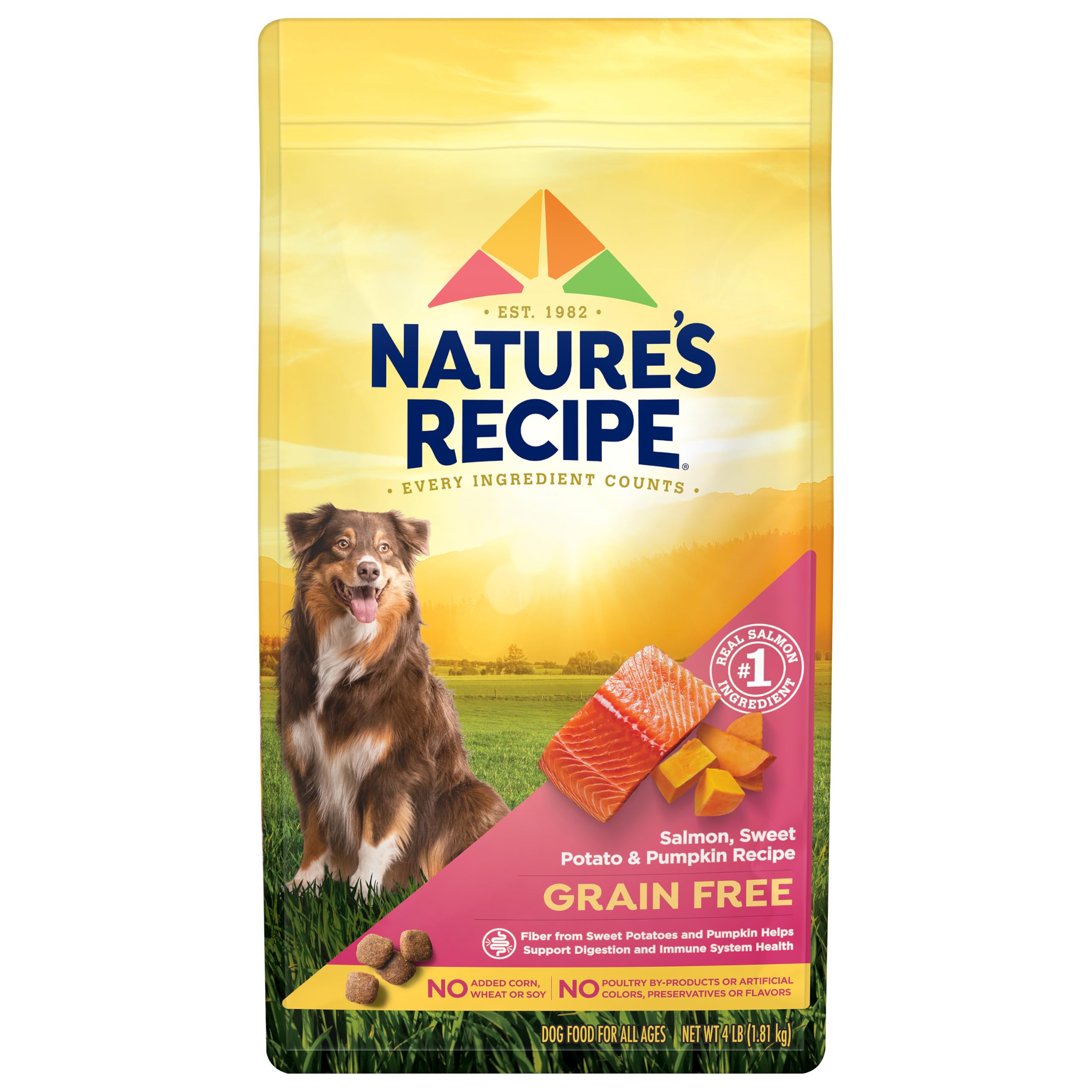
Nature's Recipe Grain Free Salmon

Nature's Recipe Grain Free Salmon

First-time switch

Our Score 9.2/10
Check Price

Worth Noting

  • Noticeable fish odor
Diet
Grain-free
Bag Size
4 lb
Life Stage
Adult
First Ingredient
Salmon
Read the full review

Some dogs treat a new bag of food as a personal insult. If yours is one of them, the cheapest way to find out whether a chicken-free salmon formula will work is to spend as little as possible finding out, which is what a four-pound bag is for. Nature's Recipe sells this one deliberately small: real salmon first, sweet potato and pumpkin for fiber, grain-free, and no poultry by-product meal.

Per pound it sits between the budget lamb bags and the premium salmon ones, which is fair for a fish-first grain-free recipe. Salmon and pumpkin is also a sensible pairing for a dog whose chicken problem shows up as an unreliable stomach rather than itchy skin, since you are removing the chicken and adding fiber at the same time. Nothing here is fancy; it is a plain formula at a plain price.

We keep it in the list as the low-stakes test rather than the long-term answer — the point is to answer a question, not to stock a pantry. For a small dog it works fine as an everyday bag, at a per-pound price closer to the budget lamb bags than to the premium salmon ones. Four pounds is a trial, and that is exactly what a first chicken-free bag should be.

Bottom line: Our pick for a blind switch: a small chicken-free bag that answers the salmon question before you commit.

How We Tested Chicken-Free Dog Food

We started by collecting every chicken-free formula we could find on large pet retailers and specialty sites — roughly 60 in all — and read the ingredient panel before anything else. Anything listing chicken meal, chicken fat, chicken liver, poultry by-product meal, or an unnamed natural flavor was cut, as was anything without an AAFCO statement matching the dog's life stage. That left 12 formulas, which we fed over four months.

Each food got a minimum of two weeks, with a seven-to-ten-day transition mixed into the previous kibble. We fed in the same kitchen at the same two times a day and noted whether the bowl was finished in one go, whether the dog sniffed and walked away, or whether dinner only went down with a topper stirred in. My pickiest tester, a 12-year-old terrier, turned out to be the most honest judge of taste on the panel.

Most of what mattered happened after dinner. We scooped every stool for four months and recorded firmness, volume, and smell, and we logged gas during evening couch time along with scratching, ear redness, and paw licking. We also compared cost per day, checked that a named protein was doing the real work in the first five ingredients, and asked manufacturers directly how they handle shared production lines, since cross-contact is where a lot of chicken-free claims quietly fall apart.

How to Choose the Right Chicken-Free Dog Food

Read the panel, not the front of the bag

Chicken-free is not a regulated claim in the U.S., so a bag can announce LAMB across the front and still list chicken fat, chicken meal, or poultry by-product meal further down the ingredient panel. Before you spend on a thirty-pound sack, find the full ingredient list — on the bag, on the manufacturer's site, or in the product photos — and read past the first three lines. An unnamed 'animal fat' or 'meat meal' is worth questioning too, since it can include poultry.

If your dog has a diagnosed allergy rather than a sensitivity you have inferred from itching, this is also the point to ask your vet about a hydrolyzed or limited-ingredient diet. An over-the-counter lamb or salmon formula is a sensible first step, but it is not an elimination trial and cannot confirm anything on its own.

Match the protein to the symptom

When the problem is itchy, flaky skin, a fish-first formula is the more direct route: salmon brings omega-3 fatty acids that a lamb recipe does not, which is why both salmon picks here are built around coat condition. When the problem is an unhappy stomach or a dog that refuses anything new, lamb tends to be the easier sell, and the lamb formulas in this group are the ones that come back to an empty bowl most reliably.

If both are true — itchy and loose — start with fish and grain-free, which removes two suspects at once. Just do not change three things in the same week, or you will learn nothing about which change helped.

Buy the size your dog can finish

Cost per pound falls steeply as bags get bigger, and the thirty-pound lamb and salmon bags here are the cheapest way to feed this kind of food. That is only a saving if the dog eats it; a refused thirty-pound bag costs more than a small bag that gets finished.

Our rule with a new protein is to buy the smallest bag first, confirm the dog likes it and the stools hold, then size up. Four to eight pounds is the right range for that first purchase, and the bulk bag is for a food you already know works.

Kibble size is a real constraint

A food your dog cannot pick up is a food it will not finish. Small-breed formulas — Hill's Small & Mini and Nutro's small bites are the two here — run noticeably finer than a minichunk or a standard kibble, which matters for toy breeds, seniors, and dogs with missing teeth or dental disease. Minichunks sit in the middle: smaller than a standard kibble, coarser than a small-breed one.

If a big dog and a small one share a bowl, buy for the smaller mouth and let the big dog eat more.

Transition slowly, then judge in weeks

Whatever you choose, mix it. Start with about a quarter of the new food and build up over a week or so, and expect a day or two of softer stools while the gut adjusts. Vomiting, or loose stools that persist past the first week, is a signal to stop rather than push through.

Skin and coat changes run slower than digestive ones. Fatty acids take weeks to show in a coat, so give a new food a couple of months before deciding it has not worked, and change nothing else in that window.

Frequently Asked Questions

Final Verdict

Start with Purina ONE Lamb & Rice. It is the chicken-free formula we recommend most broadly: lamb leads, dogs finish the bowl, and the eight-pound bag lets you find out whether lamb agrees before you commit to a bigger sack. Keep the switch gradual and it is the lowest-risk way into this category.

If itching is the symptom, Diamond Naturals Skin & Coat is the better buy — salmon first, all life stages, and the lowest cost per pound in this group. And if you are feeding a small breed with a confirmed chicken problem, Hill's Small & Mini is the one that says chicken meat free outright.