Collars & Leashes

Best Doberman Collars of 2026

A Doberman's neck is wider than the top of his head, which is why a collar that looks snug in the kitchen can slide straight over the ears the second a squirrel crosses the fence line. The right one fixes that: sized for the neck, wide enough to spread pressure instead of digging into the throat, and closed with a buckle that stays shut when a 90-pound dog hits the end of the leash. It should also fasten one-handed on a wiggling dog and look good enough to leave on for the photo.

Most people size a collar by eyeballing the neck and end up with something either loose enough to slip or tight enough to rub the coat behind the ears; real adjustability and a well-placed buckle solve more of that than any measuring chart. Over the past four months, my team and I have kept 14 collars on Dobermans of different ages and builds — hook-and-loop closures, straightforward metal buckles, a range of colors — and the standouts all got the construction details right. The picks below are the ones we'd leave on our own dogs.

1

Carhartt Nylon Collar

Top Pick
Carhartt Nylon Collar

Low-light daily walks

Our Score 9.6/10
Check Price

Worth Noting

  • Plastic buckle is the weak link
Neck Fit
18–26 in
Leash Ring
Slotted metal D-ring
Reflective
Triple-needle stitching
Collar Width
1 in
Read the full review

Carhartt's workwear nylon is the familiar everyday option here, and the reflective triple-needle stitching is the detail we like most. The large size covers an 18–26-inch neck, the band is 1 inch wide, and the hardware includes a slotted metal D-ring plus a plastic strap keeper and adjuster. It looks like a plain brown collar until headlights hit the stitching.

The large range is the roomiest everyday fit in this group, which gives a thick-necked Doberman some margin and a younger dog room to grow. At 1 inch wide, it is narrower than the ADITYNA, so it feels more like a standard collar than a control strap. The metal D-ring is a proper tag-and-leash ring, not a plastic loop, and the nylon is easy to wipe down after a muddy walk. We appreciate that the reflective treatment is part of the stitching, so it does not add a separate strip that can peel.

The one-year warranty is a sensible backstop. This is a standard everyday collar rather than a control collar; if you need a handle or a prong for training, look at those picks instead. For a Doberman that walks politely, it is the low-fuss collar we leave on for everyday wear.

Bottom line: We recommend this as the everyday nylon collar for a Doberman when you want low-light visibility, a metal D-ring, and a simple, familiar fit.

2

ADITYNA Heavy Duty Collar

ADITYNA Heavy Duty Collar

Strong everyday walker

Our Score 9.2/10
Check Price

Worth Noting

  • Two-prong buckle takes care to seat
Neck Fit
18–23 in
Warranty
2 years
Collar Width
1.5 in
Control Handle
Yes
Read the full review

A 1.5-inch-wide band with a traffic handle is the shape we look for on a Doberman, and this ADITYNA collar puts both in one piece. The large size is listed for 18–23-inch necks, with nine adjustment holes, a metal D-ring, reflective stitching, and a padded lining. The handle sits along the back of the collar, so you can grab it when you need the dog close at a curb or in a crowd.

We recommend it first because the width and handle solve the two problems we notice most on a strong, deep-chested dog: pressure and close control. The broad band spreads contact across the neck instead of concentrating it on a narrow strip, and the handle gives you a second point of contact without reaching for the leash. On evening walks, the reflective stitching is a useful extra rather than the main event. The two-year warranty is also a sign the maker expects the hardware to hold up. The padding is a welcome detail on a broad neck, especially if the collar stays on for long walks.

This is an everyday control collar, not a prong replacement. If your Doberman is already a polite walker, a simpler collar will do, but for a dog that can pull, the handle changes the walk more than any extra feature on the list.

Bottom line: For a Doberman that walks with a strong pull, we recommend this wide, handled collar first: it gives you a secure grip and spreads pressure across a broad neck.

3

Herm Sprenger Prong Collar

Herm Sprenger Prong Collar

Supervised training

Our Score 9.2/10
Check Price

Worth Noting

  • No quick-release buckle
Origin
Germany
Neck Size
19 in
Chain Length
23 in
Prong Thickness
3.2 mm
Read the full review

A prong collar is a training tool, not the collar we leave on a Doberman all day, and the Herm Sprenger is the one we trust for that narrow job. The 3.2 mm chrome-plated steel links have blunt tips, removable links, and a center plate that positions the prongs for even pressure.

The center plate is the detail that matters. It holds the links in line so the correction arrives as a broad squeeze rather than a sharp point, and the removable links let you size the collar to a 19-inch neck without guessing at a fixed size. The 23-inch chain length leaves enough room to slip it over the head. The blunt tips are the reason this one is on our list rather than a generic pinch collar.

We recommend it only for supervised training with a dog that already pulls hard, and we fit it snug and high on the neck, just below the ears. Take it off after the session; this is not a collar for the dog to wear around the house. If you are not working with a trainer or you are not confident about timing and fit, a wide everyday collar is the better place to start.

Bottom line: We recommend this prong collar for supervised training with a strong Doberman, not as all-day wear.

4

Joytale Reflective Collar

Joytale Reflective Collar

Calm budget walker

Our Score 9.2/10
Check Price

Worth Noting

  • Plastic snap buckle is a weak point
Padding
Neoprene
Leash Ring
Metal D-ring
Collar Width
1 in
Collar Length
24 in
Read the full review

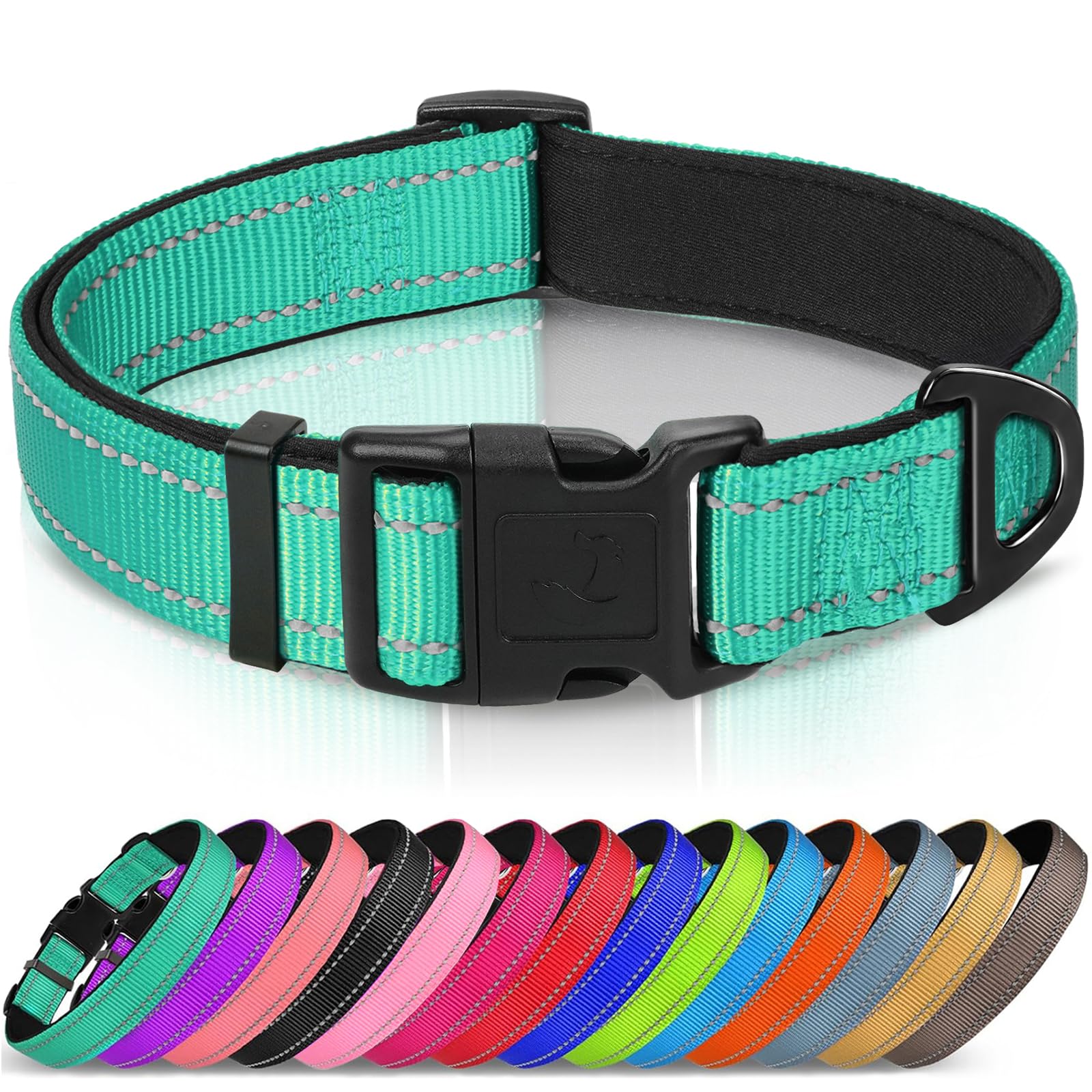
Reflective threads are the reason to notice this Joytale collar, and the budget price is what makes it an easy second collar. The large is 1 inch wide and 24 inches long, with a metal D-ring, a neoprene lining, and a plastic snap buckle.

We like the padding against the neck; the reflective thread runs along the collar and picks up headlights without turning it into a safety vest. The metal D-ring is a useful step up from a plastic leash loop, and the color range is wide enough to find something visible on a dark-coated Doberman. The nylon is light, so it does not feel like a heavy strap on a dog that already wears a collar all day.

For a calm companion or a backup collar, that is enough. It is easy to wipe clean, the padding dries quickly, and the reflective thread does real work without adding bulk. It is not the collar we choose for a dog that lunges, but it is a sensible everyday option for a steady walker. The teal is easy to spot in a dim hallway, too.

Bottom line: For a calm Doberman on a budget, this reflective padded collar is an easy everyday choice; we do not trust its plastic buckle with a hard puller.

5

GoTags Personalized Collar

GoTags Personalized Collar

Visible ID

Our Score 9.2/10
Check Price

Worth Noting

  • Snap closure is not strength hardware
Closure
Snap
Collar Width
1 in
Collar Length
26 in
Personalization
Name and number
Read the full review

A personalized collar is a different purchase from a heavy-duty walking collar: you are buying a visible name and phone number, not a handle or a training tool. The GoTags puts both on embroidered nylon, with a 1-inch width and a 26-inch length in the listing.

The lettering is the point, and it is the part that holds up. The embroidery is stitched into the collar, and the lettering is easy to read from a distance, so a neighbor or a vet can find your number without hunting for a dangling tag. We like the wide color combinations for a dark-coated Doberman, and the nylon is machine washable, which matters on a collar that gets muddy.

The listing's size information is the wrinkle: the product details show a 26-inch length and 1-inch width, while the breed-size note points in a different direction. Measure the neck and compare it with the stated range before ordering. We treat this as an ID collar first and a walking collar second.

We recommend it for the Doberman that needs a name and number visible at a glance, especially if tags tend to disappear or jingle. It is not the collar we choose for a hard puller, and it is not a substitute for a proper fit check, but it solves a different problem well. A dog can be identified from across the yard without a dangling tag.

Bottom line: This is the collar we suggest when a visible name and phone number matter more than heavy-duty hardware.

6

DAIHAQIKO Leather Collar

DAIHAQIKO Leather Collar

Leather everyday wear

Our Score 9.0/10
Check Price

Worth Noting

  • Buckle can loosen over time
Hardware
Metal buckle and welded D-ring
Material
Genuine leather
Neck Fit
16.2–22 in
Collar Width
1.2 in
Read the full review

Leather is the material we reach for when we want a collar to look less utilitarian and soften with wear, and this DAIHAQIKO is the leather pick here. The large is listed at 1.2 inches wide for 16.2–22-inch necks, with a metal buckle, a welded D-ring, and a soft cowhide finish.

The width is a good middle ground for a Doberman: wide enough to feel substantial, narrow enough that it does not read as a tactical strap. The leather has a broken-in feel rather than a stiff, shiny finish, and the separate tag ring keeps the leash clip away from the ID. We also like that it arrives in a gift box, which makes it an easy choice if the collar is a present.

We recommend it for the Doberman that wears a collar all day and only occasionally needs hard control. The leather is comfortable and the metal hardware feels appropriate for a strong dog. Measure the neck and compare it with the 16.2–22-inch range, because the fit can run smaller than the size letter suggests. The leather will soften with wear, and that is the point of choosing it.

Bottom line: We recommend this if you want the look and feel of thick leather with metal hardware; it is the dressier everyday option in this group.

7

DAGANXI Tactical Collar

DAGANXI Tactical Collar

Tactical everyday use

Our Score 8.8/10
Check Price

Worth Noting

  • Hook-and-loop panel can shift under load
Closure
Metal quick-release buckle
Included
AirTag case and two patches
Material
1000D nylon
Control Handle
Yes
Read the full review

The DAGANXI is the tactical collar we hand to someone who wants a handle and an AirTag spot without spending much. It is built from 1000D nylon with a padded lining, a metal quick-release buckle, a hook-and-loop panel, a control handle, and it comes with an AirTag case and two patches.

We like the handle for close control and the separate AirTag holder for keeping track of a dog that slips out of the yard. The 1000D nylon feels substantial, and the patches are a bit of fun rather than a reason to buy. The metal quick-release buckle is the main closure, with the hook-and-loop panel adding a second layer of hold.

The AirTag cradle is the detail that makes it more than a tactical look, and the handle earns its place on a hike or in the yard. It is a lot of collar for the money, but it is not the one we choose for a hard puller on a busy street; the ADITYNA's simpler buckle is easier to trust.

Bottom line: We recommend this budget tactical collar for a Doberman that needs a grab handle and an AirTag spot, provided you check the closure every time.

How We Chose and Tested the Best Doberman Collars

We started with neck measurements from Dobermans we know, then worked through a long list of collars and filtered by width, closure type, materials, and price. Anything with a plastic side-release buckle on a dog this strong, stitching we could pull apart with two fingers, or a width that concentrated pressure in one spot came off the list. That left 14 collars, which we rotated across several Dobermans of different ages and builds over four months.

Every collar went on real walks rather than photo shoots: morning loops around the block, evening training in the yard, a rainy stretch that turned the park into soup, and plenty of lunging at the sight of another dog. After twenty minutes of pulling we checked how each one sat, whether the edge dug in behind the ears or rolled flat, and whether the slack tail stayed in its keeper. We also put each collar on a wiggling dog one-handed, because that's how it happens at 6 a.m.

For secure fit, we let a strong dog hit the end of a six-foot leash, then inspected the buckle for bending, creep, and accidental release. Hook-and-loop closures were opened and closed dozens of times, and we watched for fuzzed hooks, lost grip, and fur snagged in the loops. We ran each collar from its shortest to its longest setting to see how much adjustment it actually offered, hosed them down, let them dry in the sun, and looked for frayed stitching, cracked edge coating, and rust at the rivets. Because a collar is worn as much as it's used, we also checked color — whether dye came off on a white towel, and how the finish held up after a month of mud.

How to Choose Doberman Collars

Start With the Neck, Then the Width

A Doberman's neck is deep and muscular, so the size letter on the package is only a starting point. Measure the base of the neck, then compare that number with the collar's stated range; the ADITYNA covers 18–23 inches, the Carhartt 18–26, and the DAIHAQIKO 16.2–22. Width matters next: a 1.5-inch band spreads pressure better on a strong dog, while a 1-inch nylon collar feels lighter for everyday wear. We prioritize a snug fit that does not slide over the head.

Hardware Is the Safety Story

Look at the D-ring and the closure before anything decorative. A welded or solid metal D-ring gives the leash a dependable attachment point; a plastic buckle is the part most likely to feel less certain on a hard puller. We check that the clasp seats with a positive click and that no strap keeper is loose. On a tactical collar, the hook-and-loop panel has to sit snug under the buckle, because two closures only help if both are engaged.

Choose a Handle or a Training Collar for a Reason

A traffic handle is for close control, not for lifting a dog off the ground. It helps at a curb, in a crowd, or when you need a second hand on a strong Doberman. A prong collar is a separate training tool: fit it high and snug, use it for short supervised sessions, and take it off afterward. We do not use a prong as an everyday collar. If your dog walks politely, a plain collar is enough.

Match the Material to the Weather and the Walk

Nylon is the easy choice for rain, mud, and a dog that swims; leather is the collar that softens with wear and looks better on a dog that stays mostly dry. Neoprene padding adds comfort on a broad neck, but it also holds water, so a padded collar needs to dry fully between wet walks. We choose nylon for a working dog and leather for a dog that mostly walks the neighborhood.

Visibility and Identification Are Separate Jobs

Reflective stitching helps a driver pick out a dark dog at dusk, but it is usually a thread or a stitched line, not a glowing band. Pair it with a light for true night walks. For identification, an embroidered name and phone number is visible without tags, while a metal tag ring keeps backup ID secure. We like a reflective collar with a clear ID panel for a Doberman that spends time in a fenced yard near the street.

Frequently Asked Questions

Final Verdict

We start most Doberman households with the ADITYNA. Its 1.5-inch band and traffic handle give you the width and close control a strong dog needs, and the 18–23-inch range is a realistic fit for a mature Doberman. If you want a plain everyday nylon collar with reflective stitching, the Carhartt is the easier choice; if pulling is the specific problem, use the Herm Sprenger as a supervised training tool rather than an all-day collar. The right collar is the one that fits the job, not the one with the longest feature list.