Food & Treats

Best Dog Bones for Large Dogs of 2026

A "long-lasting" chew has a way of humbling itself around a big dog. My neighbor's 95-pound shepherd mix once turned a bone sold for giant breeds into a stub in under ten minutes. The size printed on the package tells you what a manufacturer thinks, not what your dog's jaw can actually do, and the gap between those two is where splinters and swallowed chunks live. The right bone keeps a heavy chewer busy for an hour, holds its shape while it does, and doesn't leave a smell hanging in the room or an upset stomach the next morning.

Over the past three months, we've handed 14 bones — natural, nylon, collagen, and pressed — to dogs between 70 and 110 pounds. What separated them had less to do with price than with how each one held up in the second half of its life, when the ends soften and the pieces start coming off. A determined gulper needs something different from a leisurely gnawer, so the picks below run the range.

1

Milk-Bone Original Large Biscuits

Top Pick
Milk-Bone Original Large Biscuits

Daily treating

Our Score 9.6/10
Check Price

Worth Noting

  • Hard texture can be tough on older dogs
Texture
Crunchy biscuit
Treat Size
For dogs over 60 lb
Pack Weight
10 lb
Read the full review

Ten pounds of biscuits is a serious carton, roughly the footprint of a case of soda, and one big dog will not get through it quickly. That is exactly the job we use it for: the everyday biscuit, handed out after a walk or snapped in half across a training session, rather than the thing that keeps a dog busy while you are on a call.

The large biscuit is genuinely large, sized for dogs over sixty pounds, and it breaks cleanly in two, which makes it useful for a smaller dog in the same house or a shorter training rep. Fifteen percent protein and a dozen vitamins will not replace a balanced diet, but they make this a more sensible daily habit than much of what passes for a treat, and the crunch does a little work on tartar on the way down.

What it is not is a solution to boredom. A biscuit is gone in three crunches, which is why it does not replace a roll or a femur when you need an hour of peace. Dogs love them, they store easily, and they are the cheapest way here to reward a big dog several times a day.

Bottom line: This is the everyday biscuit rather than the marathon chew: a big, cheap, crunchy treat for dogs over sixty pounds, and the box lasts.
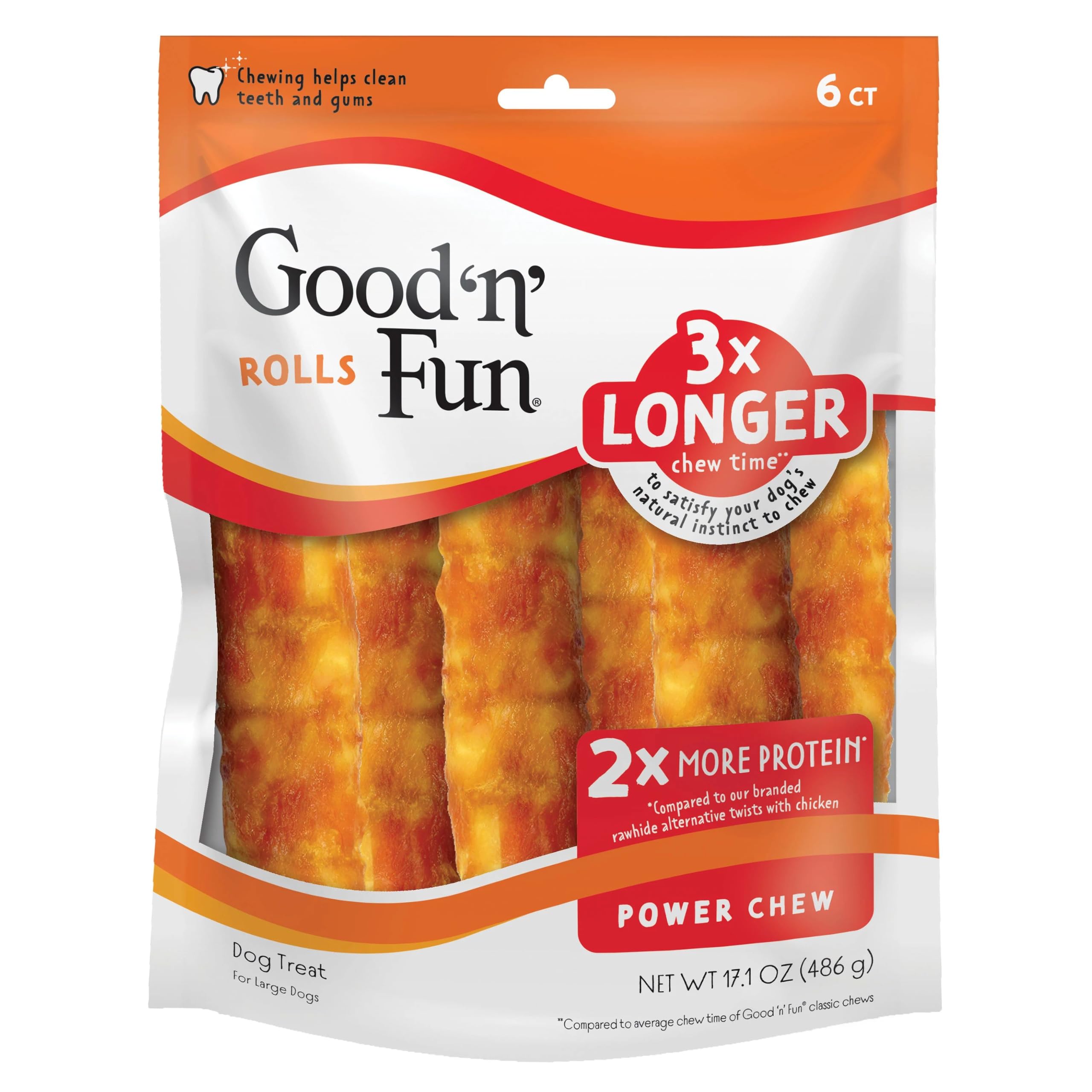
2

Good 'n' Fun Triple Flavor Rolls

Good 'n' Fun Triple Flavor Rolls

Budget-minded homes

Our Score 9.2/10
Check Price

Worth Noting

  • Seven-inch roll is short for giant breeds
Length
7 inches
Material
Beef hide, chicken
Pack Count
6 rolls
Read the full review

Six rolls for less per chew than any other pick here buys a lot of quiet. Each one is a seven-inch roll of beef hide wrapped in chicken, and the chicken is what gets a dog's nose down and its paws planted; the hide underneath is what keeps it there once the good part is gone.

We like these for the middle of the range. A dog in the fifty-to-seventy-pound bracket gets a proper session out of one, and the wrapped construction gets fussy dogs started when a plain hide roll is ignored. They are the ones we hand out most freely, because at this cost per chew you do not have to save them for special occasions.

The hide-and-chicken combination does not suit every stomach. A few dogs get loose stools after their first one, so give it on a quiet day and see before you commit to the bag. Beyond that, these are about as simple as a long chew gets: no stuffing to dig out, no residue, and very little left behind on the floor.

Bottom line: The value pick: six chicken-wrapped rolls that keep a mid-to-large dog busy without a premium price per chew.

3

Cowdog Retriever Rolls

Cowdog Retriever Rolls

Hard-chewing large dogs

Our Score 9.0/10
Check Price

Worth Noting

  • Roll thickness varies from box to box
Material
Beef rawhide
Pack Count
20 rolls
Chew Length
9-10 inches
Item Weight
4 lb
Read the full review

Nine or ten inches is the number that matters here. That is long enough for a Lab or a Shepherd to pin a roll under a paw and work the end of it, and far too long to swallow in one go, which is more than you can say for the five-inch chews sold as large-dog treats.

It is the format we reach for first when a big dog needs to be occupied rather than merely rewarded. Rawhide softens into sheets as it is chewed instead of shattering, so the roll gives way gradually, and a twenty-roll box means you can hand one over on a wet Sunday without doing arithmetic first.

Toughness is where these earn their keep. They hold up to heavy chewing better than the pressed rolls and biscuits in this guide, they do not crumble across the carpet, and the dogs we gave them to stayed with them well past the point where a formed chew is finished. Value is the other half of the case: twenty to a carton works out as the cheapest long chew here, which matters if your dog gets one most days.

The inconsistency is what keeps this from being perfect. Rolls run from thick and stubborn to noticeably thinner, and a thin one is a single-sitting chew for a determined dog. Squeeze the end before you hand it over; a roll that flexes easily is a twenty-minute snack, not an evening. Take it away once it is short enough to fit entirely inside the dog's mouth.

Bottom line: We hand a hard-chewing dog one of these first: a ten-inch roll it can hold, work on for an evening, and at a cost per chew that makes a twenty-pack easy to justify.

4

Mighty Paw Bully Sticks 12-Inch

Mighty Paw Bully Sticks 12-Inch

Big soft-chew fans

Our Score 9.0/10
Check Price

Worth Noting

  • Sticks vary in thickness from bag to bag
Length
12 inches
Material
100% beef
Pack Count
5 sticks
Read the full review

Let us deal with the smell first, because it decides whether you will actually use these. The sticks are milder than most bully sticks and the bag will not announce itself from another room, but a bully stick is still cured beef, and your dog will want to work on it on a hard floor rather than the sofa. Given that, the twelve-inch stick is the best soft chew here for a big dog.

Twelve inches is the whole point. A big dog can brace the stick between its paws and work one end without the rest vanishing down its throat, and there is no hide, no binding agents and no chicken in the bag, just beef. If your dog has a sensitive stomach or reacts to poultry, that short ingredient list is worth a lot.

How long it lasts depends entirely on the dog. A steady chewer gets a good half hour out of one; a dog that really commits is through it faster, and this is one of the pricier ways here to buy half an hour. If your dog is a crusher rather than a gnawer, a rawhide roll is the better spend and the twelve-inch stick is wasted.

Bottom line: We keep the twelve-inch size for big dogs: long enough to hold, single-ingredient beef, and milder in the house than most bully sticks we have opened.

5

Mighty Paw Yak Chews

Mighty Paw Yak Chews

Power chewers

Our Score 8.8/10
Check Price

Worth Noting

  • Costs the most per chew of the picks
Material
Yak milk cheese
Pack Count
4 sticks
Ingredients
Milk, salt, lime juice
Read the full review

A hard cheese chew answers a very specific problem: the dog that treats every other chew as a ten-second appetizer. Mighty Paw's version is four pressed sticks of yak milk, salt and lime juice, nothing else, and for a strong chewer they are the closest thing here to a chew that is still going tomorrow.

We appreciated the short ingredient list more than we expected to. Three lines, no rawhide, no binders, which matters if your dog reacts badly to chicken or grains, and it means the stick does not leave grease where it has been worked on. The bag also carries a genuinely good tip: when a stick wears down to a nub, microwave it and it puffs into a crunchy piece the dog can finish safely, turning the last inch from rubbish into a treat.

So long as you are willing to supervise the endgame, this is the strongest hard chew in this guide. These are dense sticks, and dense things chip: a yak chew can break into pieces as it wears, and some bags arrive more brittle than others. Watch for chunks, take the stick away once it gets small, and do not leave a power chewer alone with one.

Bottom line: The hardest-working chew here for a dog that finishes everything else in minutes, as long as you will watch the last inch and do not mind paying per stick.

6

Pawstruck Filled Femur Bones

Pawstruck Filled Femur Bones

Dogs that lick

Our Score 8.8/10
Check Price

Worth Noting

  • Femur cracks under determined chewing
Flavors
Peanut butter, cheese & bacon, beef
Pack Count
3 bones
Bone Length
5-6 inches
Bone Material
Beef femur
Read the full review

The filling is the whole idea. A hollowed femur packed with peanut butter, cheese and bacon, or beef buys you a dog lying down and working at something instead of pacing the hallway, and when the middle is clean the bone is still a bone.

Three femurs come in the pack, one of each flavor, and at five to six inches they are a proper handful for a large dog. The filling sits deep in the marrow cavity, though, and a broad tongue cannot always reach the last of it. Pack it with your own peanut butter or a smear of wet food and put it in the freezer for an hour, and each bone gets a second life.

This is the one for the patient dog. One that settles down to lick and gnaw will get hours out of a single femur, which makes it the best occupying value in this guide even though the pack is small. A dog that bears down on things is a different story, and you will know within a session which one you have.

Bottom line: For the dog that licks rather than crushes, we have not found a longer stretch of quiet than a filled femur you can top up yourself.

7

EcoKind Yak Cheese Chews

EcoKind Yak Cheese Chews

Long-haul chewers

Our Score 8.6/10
Check Price

Worth Noting

  • Brittle batches chip from the first session
  • Short chews in the bag are wasted on a big dog
Material
Yak milk cheese
Pack Count
4-5 chews
Pack Weight
16 oz
Read the full review

A yak chew wears down rather than breaking apart, which is why a strong chewer can be at one of these for days instead of minutes. It is the same three-ingredient recipe as every other Himalayan cheese chew, milk, salt and lime, and it is the long sticks in this bag that make it worth buying.

Those sticks are dense, slow work. Unlike a hide roll, a cheese chew does not go soft and stringy as it is chewed; it grinds down gradually, which is exactly what you want for a dog that destroys everything softer in an afternoon. There is no rawhide involved and the ingredient list is short enough to read at a glance.

The smell divides people. Some sticks are effectively scentless, others carry a strong smoked-cheese whiff that follows the dog around the room. A few dogs also get loose stools from the rich cheese, so give one on a quiet day before it becomes part of the routine.

We still think it earns a place. It costs a little less per chew than the other cheese chews in this guide, and for a dog that has seen off everything softer in the cupboard, a bag of long sticks is money well spent.

Bottom line: One of the longest-lasting cheese chews here at a lower cost per chew, provided you accept a mixed bag and some batch variation.

How We Tested Dog Bones for Large Dogs

We started by pulling every bone sold in a size meant for dogs over 70 pounds, then cut anything with a vague sizing chart, unlisted ingredients, or a steady pattern of complaints about splintering. That left 14, spanning natural bone, nylon, collagen, and pressed chews, from brands we'd hand to a friend and a couple we were quietly skeptical of.

Each one went home with a large dog — living room, backyard, crate — and we ran two kinds of sessions: supervised ones where we timed how long the dog stayed interested before walking away, and solo ones we watched on camera to see what happened when nobody was hovering. We weighed every bone at the start and again each week, because how much mass disappears tells you more about durability than any product claim. Anything that shed a third of its weight in seven days didn't make the cut.

Preference came down to a two-bone test: we set a new bone beside a known favorite and noted which got picked, then re-offered the loser a day later to rule out plain novelty. Odor got its own check — an hour sealed in a plastic tub, then opened in a small room, plus a sniff of the dog's breath and bedding the following morning. We tracked stool for 48 hours after every session, and divided each bone's price by the weeks it actually lasted, since one that keeps a dog busy but upsets his stomach isn't a bargain at any price.

How to Choose Dog Bones for Large Dogs

Size it to the mouth, not the breed

Large on a box can mean for dogs over forty pounds, for dogs over sixty, or simply a bigger biscuit in an unchanged recipe, so read the stated weight range and the actual length. A chew shorter than your dog's muzzle can disappear in one swallow; that is why the rawhide rolls here run nine to ten inches and the bully sticks twelve.

If your dog is closer to a hundred pounds, size up again. A five-to-six-inch femur is an evening's project for a Shepherd and a two-minute snack for a Mastiff. Hold the first chew against your dog's muzzle before it goes down.

Decide how long you need it to last

Every chew sits somewhere between a treat and an activity. Hard cheese chews and thick rawhide rolls are at the long end; chicken-wrapped hide rolls and bully sticks sit in the middle; biscuits are at the bottom, gone in a few crunches.

Match that to the moment. A dog left alone for a workday needs the long end, a dog being rewarded for coming when called needs the bottom, and buying a hard chew for a dog that only wants a snack wastes money in the same way that buying biscuits to cure boredom does.

Know what each material does as it wears

Rawhide softens into sheets as it is chewed, pressed hide rolls go stringy, hard cheese chews chip and can break into pieces, and femur bones crack. None of that makes a chew unsafe on its own, but it tells you what to watch for: sheets and strings get swallowed, chips get dropped, cracked bone gets retired.

Whatever you choose, supervise the first session and take the chew away once it is small enough to fit entirely inside the mouth. Some dogs also get loose stools from rich chews, so introduce one on a quiet day rather than the morning of a long car trip.

Count the cost per chew, not the price of the bag

The biggest carton here is one of the cheapest per chew, and a small bag of four sticks can cost more than twenty rolls. Divide before you decide. A chew that lasts an evening and costs a little more beats three that are gone before the dog has settled.

Bulk buys make sense for one big dog because they keep, but check the count against how often you hand one over. Twenty rolls on a shelf is a habit; twenty rolls your dog will not touch is a wasted carton.

Think about where the dog will chew it

Bully sticks and cheese chews carry a smell, mild on some bags and stronger on others, while rawhide and biscuits are the quiet ones. Filled bones leave a residue wherever they are worked on.

If your dog chews in the living room, smell and mess matter more than the difference in cost per chew. If it chews in the yard or a crate, buy for durability instead and take the trade happily.

Frequently Asked Questions

Final Verdict

Most big dogs should start with the Cowdog rolls. They are the length a large dog needs, they hold up to serious chewing, and a twenty-pack makes them the cheapest good habit in this guide.

If your dog destroys everything in ten minutes, move up to the yak chews and supervise the last inch. If your dog licks rather than crushes, a filled femur will keep it happier for far longer than any roll.