Grooming

Best Dog Brush for Labradoodles of 2026

A Labradoodle coat is a coin flip between a wavy fleece that mats if you look at it wrong and a looser curl that leaves soft gray drifts across the rug. Either way, the wrong brush makes the job worse: pins that are too short skate over the topcoat, pins that are too stiff scrape the skin, and a head that's too big can't get behind the ears where the knots actually start. The right one does two jobs at once — lifts loose hair out of the coat and works through small tangles long before they turn into felt.

I've brushed my own Labradoodle through two coat changes and one very muddy spring, and I've learned that the dog gets a vote. A brush they lean into gets used every day; a brush that grabs gets avoided, and then the mats win. Over the past four months, my team and I put 16 brushes through that routine — slickers, rakes, and a few hybrids — and the differences showed up fast in how much hair came out, how the dogs behaved, and whether the pins were still straight by week six.

1

Paw Brothers Extra Long Slicker

Top Pick
Paw Brothers Extra Long Slicker

Everyday doodle brushing

Our Score 9.4/10
Check Price

Worth Noting

  • No self-cleaning pad; hair comes out by hand
  • Long pins need a light hand on thin coats
Weight
4.32 oz
Head Size
4.5 x 3 inches
Pin Length
1 inch
Handle Length
4.75 inches
Read the full review

An inch of stainless pin is the whole reason this brush works on a Labradoodle. The fleece on these dogs is dense and springs back, and a slicker with short pins skates along the top of it, leaving a coat that looks smooth and mats quietly at the skin. With this one we could feel the pins land on skin along the spine and behind the shoulders, which is where the trouble starts. That single fact is why it is the brush we reach for first.

The head is 4.5 by 3 inches on a 4.75-inch handle, and the flat shape lies against a flank instead of rocking on it. At a little over four ounces it doesn't wear out your wrist, and the pins are firm enough to part the coat without scraping. We brush in sections — one hand holding the coat back, the other working from the skin out — and this is the tool that suits that rhythm.

Set against the pro-style brush below, it gives up some fluffing: the pins are straight and spaced wider, so a curly coat comes out tidy rather than sculpted. What it doesn't give up is the part that keeps a doodle out of the clipper, which is steady, sectioned brushing that gets under the coat instead of over it. For a household grooming three or four times a week, that trade is the right one.

Bottom line: Our pick for most Labradoodles: one-inch pins get under the fleece to the skin, and you pay ordinary money for it.

2

Chris Christensen Big G Slicker

Chris Christensen Big G Slicker

Groomer-style finishing

Our Score 9.4/10
Check Price

Worth Noting

  • Handle and pin pad can break in use
  • The most expensive brush in this set
Size
Large
Pin Type
Angled stainless steel
Coat Type
Thick, curly
Handle Material
Wood
Read the full review

This is the most expensive brush on the page by a wide margin, and the money buys specific things: a dense bed of angled pins on a cushioned pad, with a wooden handle. On a curly fleece the angle is what counts. The pins slide under a knot instead of bouncing off it, and the density lifts the coat away from the skin so you can see where you've been.

We noticed it most on legs and topknot, the places where a doodle's coat is thickest and a straight-pin slicker tends to skid. A few strokes and the hair stands up separate rather than lying in clumps. It's gentle in the hand too: the flex in the pad means you don't have to press, which matters over a long session and on an older dog.

Where it sits in the set: the Paw Brothers does the daily work for less, so this one earns its price as the finishing pass on a dog in full coat, or as the only brush you buy if grooming is a hobby rather than a chore. The pins are closely packed and load up quickly, so keep a comb nearby and clear them every few strokes.

Bottom line: We reach for this when a curly coat needs a groomer's finish rather than a quick once-over.

3

Augwind 3-Piece Grooming Kit

Augwind 3-Piece Grooming Kit

First grooming kit

Our Score 9.4/10
Check Price

Worth Noting

  • Slicker pins are too short for a dense doodle coat
Pieces
3
Weight
12.7 oz
Warranty
2 years
Rake Teeth
9 and 17
Read the full review

Three tools, one box and a two-year warranty: a push-button slicker, a double-sided rake with nine teeth on one side and seventeen on the other, and a fine-toothed flea comb. If you have just brought home a doodle and own nothing but a kitchen towel, this covers the first month while you work out what your dog's coat actually needs.

The rake is the piece we use most. It's the same layout as the standalone rake above — wide teeth for splitting knots, finer teeth for loosened undercoat — and it's the part of the kit that does real work on a doodle. The slicker is the comfortable one: press the back, the pins retract, and the hair drops in a pad you can lift away, which is the sort of small convenience that makes a chore feel shorter.

The third piece is a flea comb. On a doodle it's a face-and-debris tool that will lift grit from a muzzle and check behind the ears; against a fleece coat it stands no chance at all.

What you're really buying is the rake with two extras thrown in, and as a first kit it's hard to argue with: light in the hand, comfortable when wet, and backed by a warranty that matters for a tool left out in the yard. Just don't expect it to be the last brush you buy.

Bottom line: We point new doodle households here first, then send them back for a long-pin slicker.

4

Wet Brush Pet Detangler

Wet Brush Pet Detangler

Face and ears

Our Score 9.4/10
Check Price

Worth Noting

  • Bristles have snapped off with use
  • Skates over a tightly curled adult coat
Size
Large breed
Model
BPET830DOGP
Weight
3.21 oz
Bristles
IntelliFlex
Read the full review

Flexible bristles on a compact oval head, closer to a human detangling brush than to the slickers here. That isn't a criticism. On the ears, the muzzle, the paws and the thin coat inside a back leg, a stiff pin brush is the wrong tool, and this one glides through without the dog pulling away.

The bristles bend instead of digging. Through a loose, wavy fleece that's exactly right: it leaves the coat smooth and the dog unbothered, with no technique to learn. At just over three ounces it's light enough to hold in one hand while the other steadies a collar, which is how most quick sessions actually go.

Where it earns its place is temperament. A doodle that objects to the slicker usually stands for this one, and ten minutes with it beats a skipped session — you can follow with a long-pin brush once the dog has settled. For a puppy's first brush, or a nervous dog learning that grooming is fine, that matters more than the specification suggests.

Bottom line: Our pick for the sensitive spots — ears, muzzle, paws — and for doodles that won't stand still for a slicker.

5

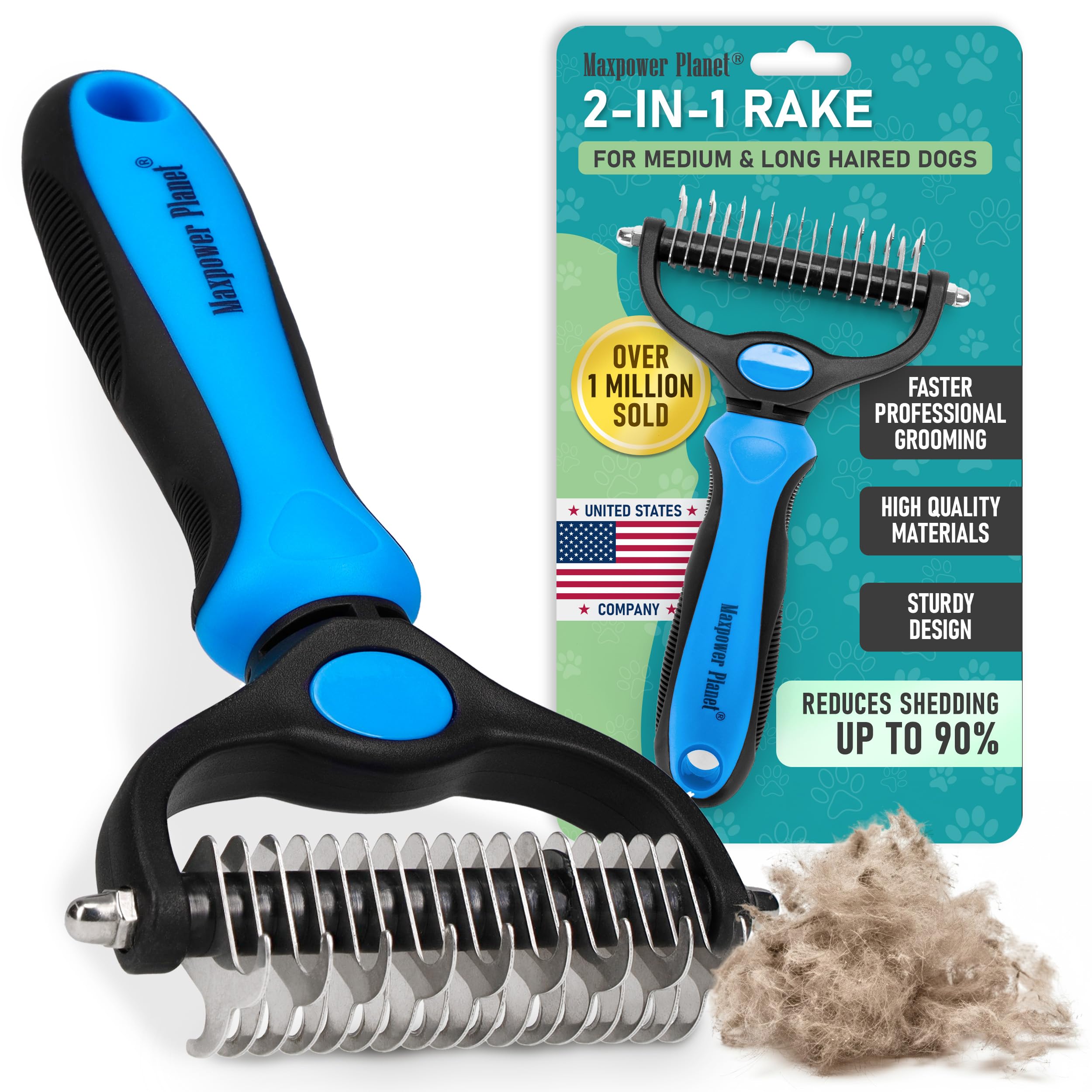
Maxpower Planet Dual-Sided Rake

Maxpower Planet Dual-Sided Rake

Mats and undercoat

Our Score 9.2/10
Check Price

Worth Noting

  • Teeth are coarse for fine or wavy coats
  • Too big for faces, ears and tail tips
Model
PGT-002
Teeth
9 and 17
Weight
4 oz
Dimensions
6.6 x 3.9 x 2 inches
Read the full review

The first pass with the nine-tooth side tells you what you've been missing. Drawn through a knot behind a shoulder or under a collar, the wide teeth split the mat into strands a brush can then lift out, and that is the job — the reason a plain-looking rake has a permanent spot in our kit.

The second side does the quieter work. Seventeen finer teeth comb the loosened undercoat out of the coat after a bath or a long walk, and because they are rounded rather than bladed, a dog that objects to a dematting comb will usually stand for this. Four ounces and a non-slip grip mean a long session doesn't wear out your wrist.

Think of it as the second tool rather than the first. The slicker does the daily work; this comes out when you find something the slicker can't shift, and on a coat that mats in the same two or three places it saves a lot of tugging. On a coat with no mats at all, you may never reach for it.

Bottom line: The rake we keep for the spots that mat first, where its two tooth counts do what a slicker cannot.

6

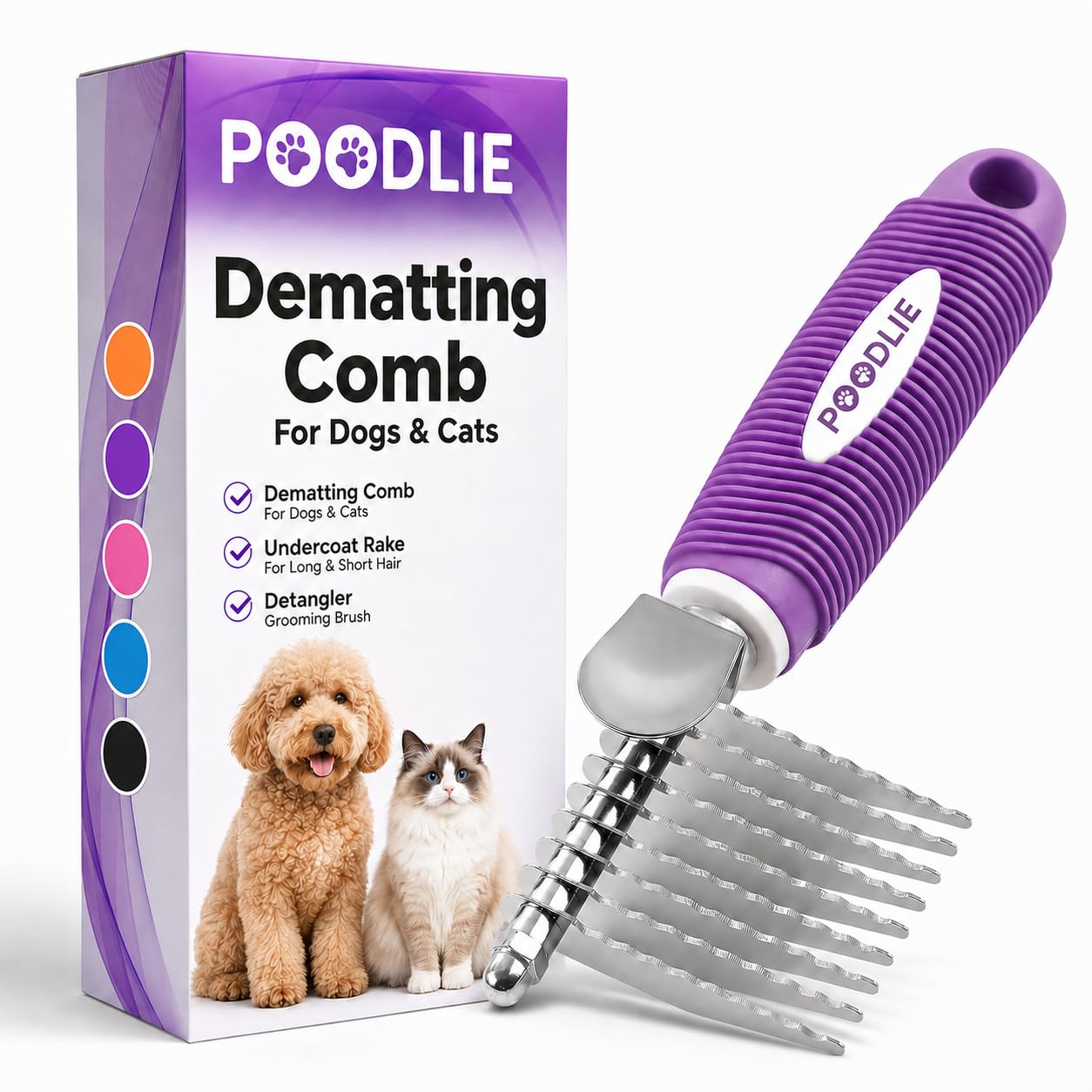
Poodlie Dematting Comb

Poodlie Dematting Comb

Cutting out knots

Our Score 9.2/10
Check Price

Worth Noting

  • Handle can snap under a stubborn knot
  • Blades lose their edge with use
Model
PPEC 6037
Weight
4.2 oz
Material
Stainless steel, rubber
Blade Length
2.5 inches
Read the full review

These are blades, not pins, and the difference is the whole review. The 2.5-inch stainless teeth sit in a rubber handle and are built to score through a mat rather than comb around it, which is why it handles a coat that has already gone wrong. It's also why the edge stays turned away from the skin and the strokes stay short — this is a tool you use deliberately.

On a doodle the useful targets are the small, tight knots behind the ears, under the collar and where a harness rubs. A minute of gentle work in one spot usually breaks a knot down into something a slicker can finish. What it doesn't fix is a mat that has tightened against the skin; forcing that is how dogs get nicked, and a groomer is the right call.

What it isn't is a daily brush. The blades are for rescue work on knots that have already formed, and a coat taken over with this every day ends up thinner and rougher than you want. We treat it as the tool that lives in the drawer for a bad week — worth owning, never a substitute for regular brushing.

Bottom line: A knot-breaker rather than a brush: we use it slowly, on the mats a slicker won't shift.

7

SleekEZ Deshedding Brush

SleekEZ Deshedding Brush

Loose hair cleanup

Our Score 9.2/10
Check Price

Worth Noting

  • Won't detangle or break up a mat
Weight
3.53 oz
Made In
USA
Dimensions
5.5 x 3 x 1.5 inches
Blade Width
5 inches
Read the full review

A five-inch loop of serrated steel is a strange-looking dog brush, and it works in a stranger way: rather than combing, it strips loose hair off the surface of the coat. Short, flat strokes in the direction the hair grows pull out shed fur and the grit from a muddy walk, and the hair gathers in a roll you can lift off with one hand. The same blade does a passable job on a couch, a car seat and a stair carpet.

That's the job we keep it for. On a Labradoodle it deals with hair that has already left the skin — the stuff that ends up on your trousers — faster than any pin brush, and without tugging. The blade sits flat against the body, so it's also the tool we hand to someone nervous about pressing too hard.

The edge is exposed, which is why it lives in a drawer rather than on the floor, and why we keep it away from faces and paws. At three and a half ounces it's easy to leave in the car with a towel. It's the least essential tool in this guide and the one we notice missing on a shedding week.

Bottom line: Our cleanup tool rather than our main brush: it strips loose hair off the dog, the couch and the car.

How We Tested the Best Dog Brushes for Labradoodles

We started with a list of more than 40 brushes sold for doodle coats and narrowedit down using the specs that actually matter here: pin length and spacing, whether the tips were rounded or blunt, how much the pad flexed, head size, and price. That left 16 brushes — slickers, undercoat rakes, and a few combination tools — which we used for four months.

Most of the testing happened on the living room rug during Sunday-night TV, with a second round on the tailgate after muddy walks and in the back seat on the drive home, where I could see how much hair ended up on the seat cover instead of the dog. For each brush, we timed how many strokes it took to clear a thumb-sized tangle behind the ear without the dog pulling away, and we noted whether loose hair collected in the pins or drifted onto the floor.

Sharpness we checked by drawing the pins lightly across the back of a hand and watching for scratching or digging. Ease of use meant brushing one-handed while holding a treat, then pressing the hair-release button to see whether the fur slid off in one pad or had to be picked out. Size got judged on legs, muzzles, and tails, where a wide head is a liability. Durability came down to week eight — pads that stayed flat, pins that didn't bend or retract, handles that didn't creak.

Pet preference we logged honestly: whether the dog stayed, leaned in, or walked off after a minute. Value we judged at the end rather than the start, since the cheapest brush in the group outlasted two pricier ones and one handle cracked long before its pins dulled.

How to Choose the Right Dog Brush for Labradoodles

Pin length decides whether the brush works

Labradoodle coats run from loose waves to tight curls, but they share one property: the hair springs back. A brush with short, fine pins glides over that and leaves you with a tidy-looking dog and knots forming at the skin. Long pins — around an inch, like our top pick — part the coat and reach the base. The check is a metal comb: draw it through an inch-wide section from the skin out. If it stops, the brush hasn't finished, however good the topcoat looks.

Match the tool to the problem

The slicker is the everyday brush and the one to buy first. A rake handles dense undercoat and loosened knots in the places that mat repeatedly. A bladed dematting comb is for knots that have already set, and a shedding blade like the SleekEZ deals with hair that has left the skin and landed on the furniture. Most doodle households end up with a slicker plus one of the others. The common mistake is buying a dematting blade as the only brush: it cuts knots but does nothing to stop them forming.

Coat type, age, and what the dog will tolerate

A wavy, single-layer fleece is forgiving, and a soft flexible brush does more of the work; a tight adult curl needs long, firm pins and a sectioned routine. Puppy coats change, so buy for the coat in front of you rather than the one you expect. Temperament counts as much as texture. If your dog walks away from the slicker, start with the softest tool you own and build up, keep sessions to a few minutes, and finish while the dog is still enjoying it. A brush the dog accepts beats a better brush it refuses.

What to spend, and what wears out

You don't need the priciest brush here to keep a doodle comfortable; our top pick is far from the most expensive tool in this set and does the daily job. The parts that fail first are the ones nobody advertises: wooden handles, pin pads and push-button mechanisms, on premium brushes as much as budget ones. A long-pin slicker with a plain handle and no button has less to break. Put the money into pins that reach the skin and a head that fits your hand.

Frequently Asked Questions

Final Verdict

Start with the Paw Brothers Extra Long Slicker and a metal comb, and you have the routine that keeps a Labradoodle out of the clipper: pins that reach the skin, no mechanism to break, and money left over. If your dog is in full curly coat and you want the groomer's finish, the Chris Christensen Big G is the better brush and the one with a durability question hanging over it. If mats are the recurring problem, add the Maxpower rake rather than a second slicker.