Grooming

Best Dog Brushes for Long Hair of 2026

Long-haired dogs shed in a way that feels personal. You brush for twenty minutes, the pile looks respectable, then you run a hand down their flank and come away with a second dog's worth of undercoat stuck to your palm. The right brush pulls that loose coat out instead of pushing it around the surface, and that one difference means fewer mats behind the ears, fewer hair tumbleweeds along the baseboards, and a lot less vacuuming.

Over the past four months, my team and I have put 14 brushes through two long-haired dogs, and the pattern was obvious within a week: tooth length and spacing decide everything. A brush with pins too short for the coat just glides along the top layer, no matter how nice the handle feels. Pay attention to whether the pins are tipped, too, because a sharp tip on a squirmy dog ends grooming sessions fast. The picks below earned their place on hair removal first and everything else second.

1

Paw Brothers Extra Long Slicker Brush

Top Pick
Paw Brothers Extra Long Slicker Brush

Everyday long-coat brushing

Our Score 9.4/10
Check Price

Worth Noting

  • No self-cleaning button; hair comes off by hand
Head Size
4.5 x 3 inches
Pin Length
1 inch
Handle Length
4.75 inches
Bristle Material
Stainless steel
Read the full review

An inch of pin is the whole argument. On a dog whose coat is longer than the brush pad is deep, a standard slicker bottoms out and slides along the topcoat all afternoon without ever touching the hair that is actually shedding. These stainless pins keep going, so the tips reach the undercoat where the loose fur and the small knots sit. That is why it is the best all-round brush in this guide for a long coat, and it costs less than the pro-style slickers we compared it against.

The head measures 4.5 by 3 inches on a 4.75-inch handle, which turns out to be the useful middle: small enough to work the inside of a back leg or behind an ear, big enough that line brushing a Great Pyrenees does not take all evening. We worked in sections, lifting the coat with one hand and brushing with the other, and the grip stayed comfortable through a long session.

Because the pins are long, technique matters more than pressure. Keep the pad almost flat to the skin and let the pins find the hair; dig in with the heel of your hand and the dog will tell you. The flat pad does not scratch the way a stiff, short-pinned brush can, and the dogs we brushed settled into it rather than ducking away.

If your dog is in full seasonal shed, treat this as the finishing brush and start with a rake — a slicker alone will not keep up with a coat that is coming out in handfuls. For the other ten months of the year, this is the one we leave by the door.

Bottom line: The best all-round brush here for a long coat: inch-long pins reach the undercoat, the head fits around legs and ears, and it rewards a light hand over muscle.
2

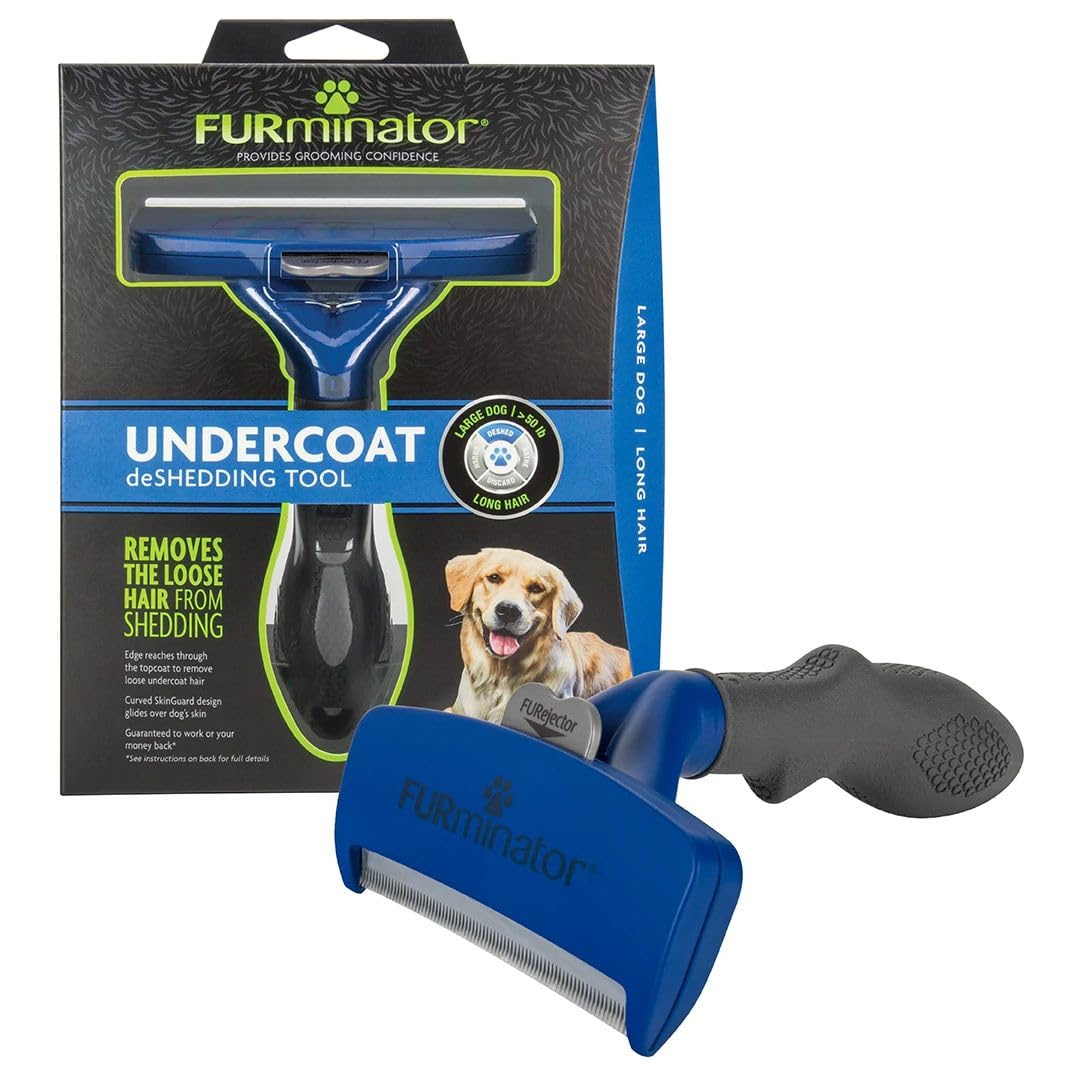
FURminator Long Hair deShedding Tool

FURminator Long Hair deShedding Tool

Heavy shedders

Our Score 9.4/10
Check Price

Worth Noting

  • Premium price for a single-job tool
Dog Size
Over 50 pounds
Coat Type
Long hair
Hair Release
FUREJECTOR button
Bristle Material
Stainless steel
Read the full review

Start with the size. This tool is built for dogs over fifty pounds, and the broad blade head and full-size handle make that obvious the moment you pick it up. On a shepherd, a malamute, or a big golden it feels right; on a twenty-pound spaniel it feels like a shovel. If your long-haired dog is small, one of the slickers here is the better buy.

On a big dog in season, nothing here strips loose undercoat faster. The blade runs beneath the topcoat, the FUREJECTOR button pushes the collected strip off in one motion, and a single pass over a hindquarter can fill the head. We used it about once a week rather than daily, which is the pace it is built for, and it made the difference between a house with dog hair in it and a house with dog hair on everything.

The fine print matters. The blade is designed to reach undercoat without cutting the topcoat when it is used as directed: light pressure, short strokes in the direction of the coat, and no repeated digging at one spot. It is also not a detangler — on a matted coat there is nothing for the blade to catch, so the mats come out first with a rake or a comb.

The metal body feels substantial and the handle sits well for the long, even strokes this tool rewards, which is more than we can say for the plastic-bodied brushes in this guide. It is a specialist, and the coat it is built for is the one that fills your vacuum cleaner.

Bottom line: For a long-haired dog over fifty pounds in a heavy shed, this is the fastest undercoat stripper we have used — nothing else here clears a coat that quickly.

3

Chris Christensen Big G Slicker Brush

Chris Christensen Big G Slicker Brush

Doodles and poodles

Our Score 9.4/10
Check Price

Worth Noting

  • Handle and pin pad can fail over time
  • Large head is awkward around muzzles and paws
Size
Large
Pin Type
Extra-long, angled
Coat Type
Thick, curly
Handle Material
Wood
Read the full review

What separates this slicker from everything else here is the pin field. The pad carries roughly a third more pins than a standard slicker, each one angled and set into a flexible cushion, and the effect on a dense coat is immediate: fewer strokes, less bouncing over the surface, and a brush that keeps working when it meets a knot instead of skidding off it.

That density is why doodle and poodle people swear by it. On a curly or cottony coat, fine knots sit close to the skin where a sparse brush never reaches; the long angled pins flex into the coat, open the knot, and leave the hair standing up instead of flattened. We also liked it on finer long coats, where it lifts loose hair without pulling.

It is the most expensive brush in this guide, and after a few weeks with it the premium makes sense: a doodle coat brushed with this several times a week stays ahead of matting, and the denser pin field is a large part of why. Whether that is worth it depends entirely on the coat — on a doodle with a history of shave-downs, yes; on anything short, this is not the conversation.

Where it does not help is a coat already matted to the skin. A slicker opens knots; it does not break a solid mat, and starting with one on a tight mat is how a dog learns to hate being brushed. Work those out with a comb first, then finish with this.

Bottom line: The brush we reach for on doodle and poodle coats: dense, angled pins open fine knots that sparser slickers skate over, and the coat finishes fluffy.

4

Augwind 3-Piece Grooming Kit

Augwind 3-Piece Grooming Kit

First long-haired dog

Our Score 9.4/10
Check Price

Worth Noting

  • Flea comb adds little to a normal routine
Warranty
2 years
Rake Sides
9-tooth and 17-tooth
Tools Included
Rake, slicker, flea comb
Read the full review

Three tools arrive in one box: a double-sided rake, a self-cleaning slicker, and a flea comb. If you have just brought home a long-haired puppy and do not yet know what its adult coat will demand, this is the least expensive way to have the right tool on hand when you find out.

The rake does most of the work. The nine-tooth side is built to open knots, the seventeen-tooth side to pull the loosened undercoat, and between them they handle what our standalone rake picks handle. The slicker is the finishing step — push the back, the bristles retract, the hair lifts off — and it leaves the coat smooth enough to live with.

The tools themselves are light, the retraction mechanism works cleanly, and the two-year warranty is a real vote of confidence at this price. Nothing in the box feels like it will fall apart in a season.

As a set for someone starting out, it is the best value here — three tools that cover a full routine for less than one of our single-purpose picks. You will not mistake any of them for the pro-grade brushes in this guide, but you also will not be shopping for a second brush next month.

Bottom line: A complete, inexpensive starting kit for a first long-haired dog: the rake does the heavy work, and the slicker finishes the coat.

5

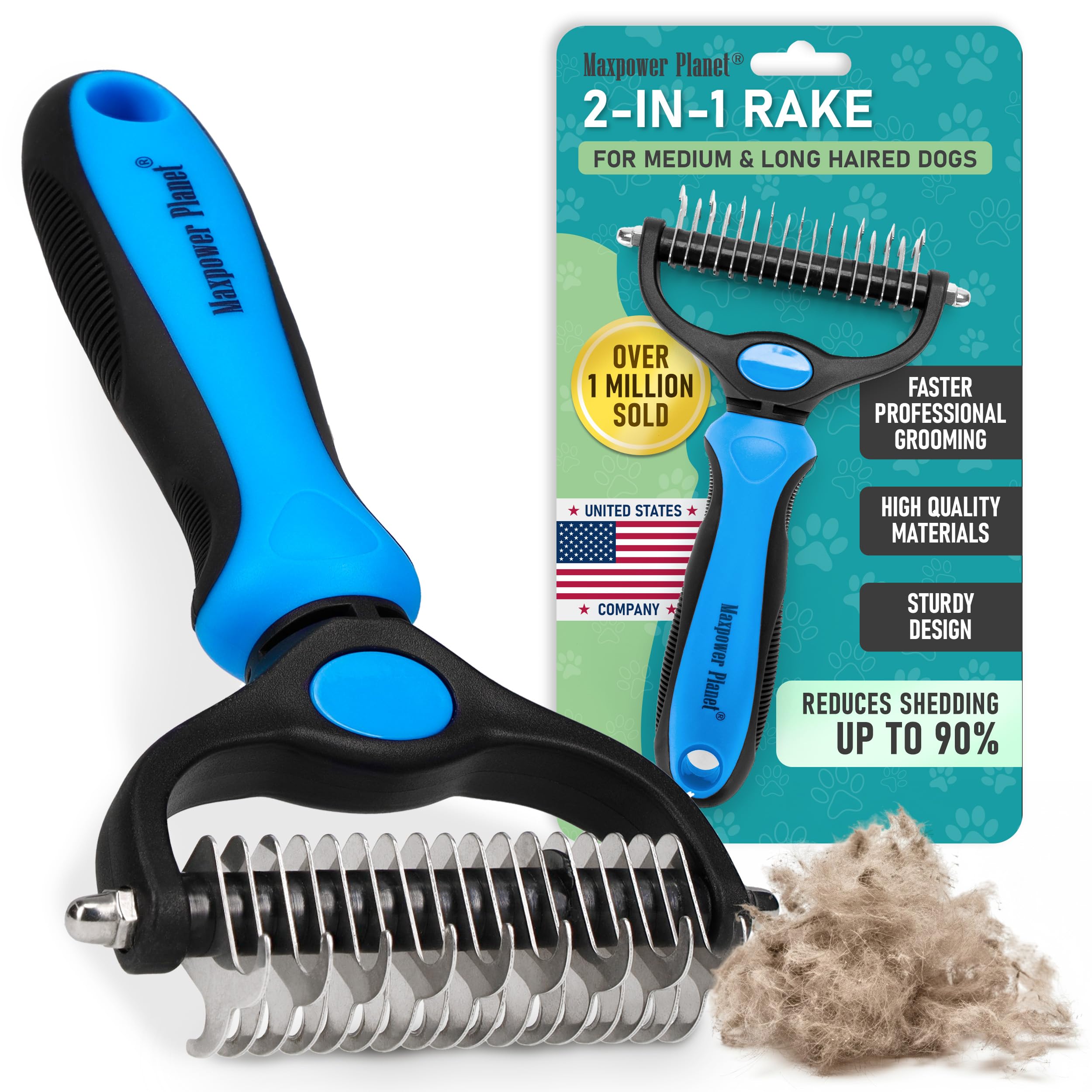
Maxpower Planet Grooming Rake

Maxpower Planet Grooming Rake

Mats and undercoat

Our Score 9.2/10
Check Price

Worth Noting

  • Fur has to be pulled off the teeth by hand
Head
Dual-sided rake
Teeth
9-tooth side for mats
Weight
4 oz
Dimensions
6.6 x 3.9 x 2 inches
Read the full review

There are two sides to this rake, and we reach for the nine-tooth one first. Wide-spaced teeth get under a knot behind an ear or a mat forming at the base of the tail and lift it without dragging half the coat along with it. The second side then combs through what is left and pulls the loosened undercoat out in tufts.

For the money, nothing here pulls more undercoat per stroke. The teeth are sharpened but rounded at the tips, so the rake gets down to the skin without scratching it, and the dogs we tried it on leaned into it the way they lean into a good scratch. On a lab or a shepherd in season, ten minutes fills the head more than once.

The places to slow down are the thin-skinned ones — armpits, the inside of a back leg, the skin over the ribs. Short strokes that follow the coat work better there than any amount of pressure, and a mat comes apart more easily from its edge than from the middle. The rubberized handle and the four-ounce weight mean a long session does not wear out your hand.

It is the tool we hand someone who has just realized how much undercoat a long-haired dog carries and does not want to spend much finding out. The coat will not look finished afterward — that is a slicker's job — but the hair that would have been on your floor is in the bin.

Bottom line: The least expensive way into serious undercoat removal: two sides take on mats and loose fur, and it is gentle enough that dogs lean into it.

6

SleekEZ Deshedding Dog Brush

SleekEZ Deshedding Dog Brush

Brush-averse dogs

Our Score 9.2/10
Check Price

Worth Noting

  • Sharp edge
Weight
3.53 oz
Coat Types
Short, medium, long
Blade Width
5 inches
Read the full review

This is not a brush in the usual sense. It is a curved blade with fine teeth that catches the tips of loose hair and pulls it free, and because there is no pin pad, nothing clogs and nothing scrapes. That is what makes it the tool we hand a dog that has learned to walk away from brushing: the pressure it needs is lighter than it looks, and it does not tug at a knot the way a slicker can.

Technique is simple — short strokes in the direction of the coat, blade almost flat, no pressing. On a thick coat it takes several passes over the same patch before you see the payoff, and then the hair comes off in a felt-like strip you can peel away in one piece. We also ran it over the car seat afterward, which is half of why it stays within reach.

Where it runs out of road is tangles. A blade grabs loose hair; it does not open a knot, and on a matted coat it skates over the top. So treat it as a shedding tool rather than a detangler, and let a slicker go through first on a coat that has had a few days of burrs and weather in it.

Bottom line: The pick for a dog that hates being brushed: a blade that lifts loose hair without tugging, and no pin pad to clog or scrape.

7

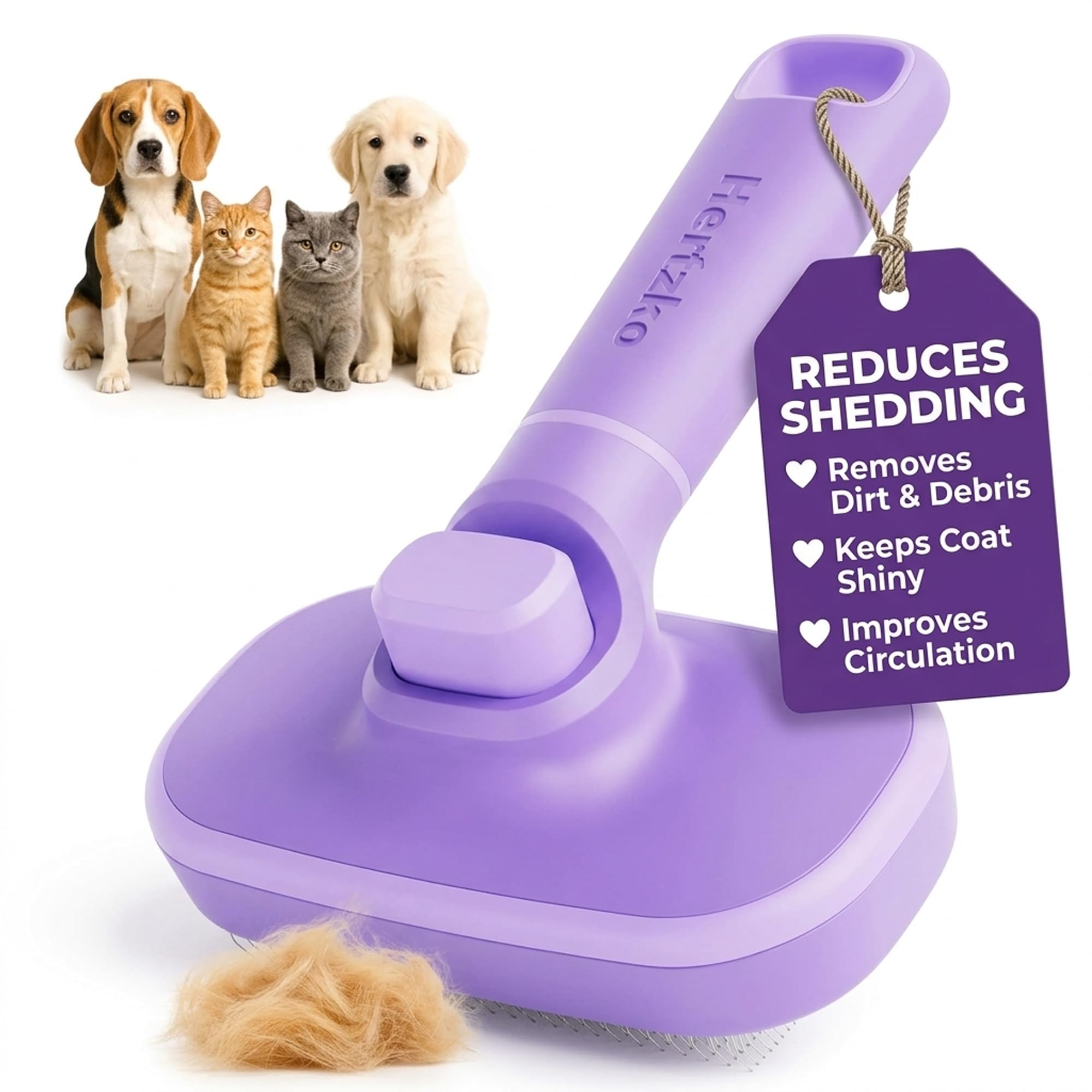
Hertzko Self Cleaning Slicker Brush

Hertzko Self Cleaning Slicker Brush

Quick daily cleanup

Our Score 9.0/10
Check Price

Worth Noting

  • Button can stick or need a firm push over time
  • Bristle tips can scratch if you press hard
Weight
3.2 oz
Dimensions
5.8 x 3 x 10 inches
Bristle Type
Fine, angled
Hair Release
Push-button retraction
Read the full review

The button is the feature. Push it, the bristles retract into the head, and the fur that was wound through them sits on a flat surface and lifts away in one piece. Cleanup takes a couple of seconds, and that is the reason this brush is here instead of a plainer slicker that grooms just as well.

In the coat, the fine angled bristles do a good job on a medium-length coat — an Aussie, a border collie, a golden mix — lifting loose hair and leaving the topcoat smooth. The head is light and the grip comfortable enough to keep going through a whole dog. It is not a tool for the bottom of a dense double coat, though; the bristles are shorter than the pins on our top pick, so on a malamute in season it works the surface rather than the undercoat.

For upkeep between proper grooming sessions, it is the easiest brush here to live with, and it is priced like a simple tool rather than a pro-grade one. If your long-haired dog tolerates brushing but you do not do it as often as you should, the two-second cleanup is what will make you do it.

Bottom line: The brush we reach for on a normal weeknight: cleanup takes seconds, the fine bristles leave a medium-length coat smooth, and it costs very little.

8

Docrok Grooming Rake and Comb

Docrok Grooming Rake and Comb

Matted long coats

Our Score 9.0/10
Check Price

Worth Noting

  • Teeth are cleared by hand
Material
Stainless steel
Comb Sides
Wide and dense
Rake Sides
Wide and dense
Tools Included
Rake and comb
Read the full review

Most brushes finish when the coat looks smooth. This set keeps going: a double-sided rake for the undercoat, and a metal comb to run through afterward and find the mats you missed.

The rake has a wide side for opening knots and a dense side for pulling loose hair, with teeth long enough to get under a long coat rather than skate across it. The comb is the more interesting half — wide teeth for smoothing, close teeth for lifting what is left — and running it through after the rake is the fastest way to learn where a coat is actually tangled.

In use it is gentle enough for a dog that does not love being brushed. The teeth are finished with a protective edge, the TPR handle stays comfortable through a long session, and both tools rinse clean under the faucet.

Where the set earns its place in a long-haired household is on mats: a mat in a doodle or a spaniel is usually loose undercoat tangled into topcoat, and the rake opens it while the comb confirms it is gone. That back-and-forth without putting one tool down and picking up another is the difference between a grooming session you finish and one you abandon.

Bottom line: The pick when a long coat has mats in it: a wide-toothed rake to open them and a metal comb to confirm they are gone.

How We Tested the Best Dog Brushes for Long-Haired Dogs

We started by reading through specifications for slickers, undercoat rakes, deshedding blades, and combs, then narrowed the field by pin length, pin spacing, whether the tips were coated, handle shape, and price. Fourteen brushes made the cut, and we used them for four months across two long-haired dogs, one a heavy seasonal shedder and the other prone to mats behind the ears and under the collar.

Each brush got a timed five-minute session on the porch after the evening walk, with the hair collected in a paper bowl so we could see how much actually came out per pass. We also noted whether the dog leaned into the brush or tried to walk away, and whether our wrists got tired working along the back and hindquarters. On muddier days we brushed after the coat dried to see whether the pins dragged or glided.

Ease of cleaning got its own check: we looked at whether fur peeled off the pins in one sheet or had to be picked out with a fingernail, and whether the self-cleaning button fully retracted the pins when the brush was packed with undercoat rather than empty. Button responsiveness came up repeatedly here, since a button that sticks halfway leaves you pulling hair out by hand anyway. We also gave every brush a rinse and let it air dry to see whether the cushion or handle fittings held up.

Finally, we checked durability after months of regular use, looking for bent pins, cracked ferrules, handles that flexed under a firm grip, and cushions that came unglued. The brushes that survived without shedding pins or wobbling at the neck are the ones that made the list.

How to Choose Dog Brushes for Long Hair

Start With the Tool, Not the Breed

A slicker with long pins is the everyday tool: it separates hair, opens small knots, and leaves the coat smooth. An undercoat rake is for volume — thick double coats, mats, and seasonal shed — while a blade-style deshedder handles the loose undercoat a rake leaves behind on a big dog in a heavy shed. A metal comb is the referee: run it through after brushing and it tells you where the coat is still tangled.

Most long-haired dogs do best with two of these. We keep a slicker and a rake within reach, and we reach for the rake first in spring and the slicker the rest of the year.

Pin Length Beats Everything Else on the Label

For long hair on the box does not guarantee pins that reach long hair. If the pins are shorter than the coat, the pad bottoms out and you spend the session polishing the topcoat while the undercoat stays put — which is how a dog gets brushed twice a day and still mats. A one-inch pin is what our top pick uses, and it is a fair benchmark for anything longer than a spaniel's coat.

Look at the pad as well. Pins set into a flexible cushion give a little when they meet a knot; a hard, tightly packed pad has to be forced through, and the dog feels the difference.

Blades, Rakes, and the Pressure Question

Blade-style deshedders and rakes work on loose undercoat, not knots. Pressing harder does not get more hair out; it puts metal against skin, which is how a grooming session ends early. Short strokes in the direction of the coat, light pressure, and stopping when the dog flinches is the whole technique.

Mats come out before any blade touches the coat. Start at the edge of a mat with a rake or a comb and work outward — a blade dragged through a solid mat does nothing useful and plenty of harm.

Cleanup, Grip, and Head Size

Retractable-bristle brushes make cleanup a two-second job, and if you brush daily that convenience beats any other feature on the box — provided the button keeps working, which is the usual weak point on cheaper self-cleaning brushes. A plain pad is fine too, since hair peels off in a sheet.

Then think about your dog. A small head is easier around faces and paws, a big one covers a hindquarter in fewer strokes, and a handle that fits your hand matters more than the spec sheet suggests.

Frequently Asked Questions

Final Verdict

The brush we recommend first for a long-haired dog is the Paw Brothers extra-long slicker. It reaches the undercoat, it is gentle enough to use every day, and it costs less than the pro-style brushes it competes with.

Add a rake if your dog carries a thick double coat, and move to the FURminator if your dog is over fifty pounds and shedding hard, because nothing here clears that much coat as quickly. For a curly doodle coat, the Chris Christensen is the one that justifies its price.