Grooming

Best Dog Brushes for Matted Hair of 2026

Nothing ends a good ear scratch faster than a hard, pea-sized knot behind it, and nothing makes a dog duck away quicker than a brush dragging straight down through that knot. A mat is just shed undercoat that has felted against the skin, and the wrong tool doesn't loosen it so much as pull on it. The right brush works under the knot instead of yanking through it, lifts the dead hair around it, and gets the job done without scraping skin or turning grooming into a wrestling match.

I keep a mat splitter and a slicker within reach of the couch, and over the past four months my team and I have run 16 brushes through real coats — burrs, spring blowout, and one grape-sized mat behind an ear. Here's what nobody tells you: no brush dissolves a fully felted mat on its own, and the ones that promise to usually just rip. What a good one does is break the mat apart, clear the undercoat around it, and leave a coat that still looks like your dog. The picks below did that without bending, scratching, or costing more than they should.

1

Andis Dematting Comb

Top Pick
Andis Dematting Comb

Finishing and checking

Our Score 9.6/10
Check Price

Worth Noting

  • Separates knots rather than cutting them
Teeth
Rounded stainless steel
Length
10 in
Tool Type
Dematting comb
Coat Focus
All coat types
Read the full review

Ten inches of stainless steel sounds like overkill until you are checking a standard poodle from skin to tip. The Andis 68545 gives you that reach without a fat handle, and the rounded teeth slide through a coat that has already been brushed out. We keep it as the finishing comb in this group: it finds the small knots a slicker skips and tells you where the coat is still tight.

The long teeth are the point. They get down through a dense leg, tail, or topknot and let you feel the coat rather than just skim the surface. Stainless steel keeps the teeth stiff enough to separate a knot, and the rounded ends are gentler than a sharp-toothed comb when you are working near skin. It is also light enough to use for a full grooming session without your hand cramping.

What it is not is a mat cutter. The teeth separate knots; they do not saw through a felted lump the way a serrated blade does. Start with a slicker or rake on the bulk of the mat, then use this comb to check the perimeter and the spots you missed. For the money, it is the most useful comb here for poodles and doodles in a long coat.

Bottom line: We keep this long stainless comb for checking a coat to the skin after brushing; it is the best finishing tool here for poodles and dense legs.

2

Chris Christensen Big G

Chris Christensen Big G

Curly doodle coats

Our Score 9.4/10
Check Price

Worth Noting

  • Higher price than other picks
  • Handle and pins are durability weak points
Tool Type
Slicker brush
Coat Focus
Curly, cottony coats
Pin Design
Extra-long angled pins
Bristle Material
Stainless steel
Read the full review

The Big G is the brush we reach for when a doodle coat has turned into a thick, cottony cloud. Its long angled pins sit in a flexible cushioned pad, and the pin field is dense enough to separate fine knots and the small mats that hide around ears, legs, and collars. That combination is why it feels less like a generic slicker and more like a finishing tool for curly coats.

We recommend it first because it handles the everyday mat before it becomes a felted lump. The angled pins glide through a cottony coat without the scratchy drag you get from stiff, straight pins, and the cushioned pad gives the pins enough give to follow the body instead of digging in. For a goldendoodle, labradoodle, or poodle in full coat, that is the difference between a quick line-brush and a wrestling match.

The higher price is real, and so is the durability question. The handle and pin field are the parts to watch: a broken handle or a patch of lost pins ends the brush's usefulness, and that is a hard pill when you have paid for the top tier. We still think the brushing experience justifies it for a curly coat that mats regularly, but it is not the tool for a dog that never tangles.

Use it in small sections, working from the skin out, and follow with a metal comb to check your work. The Big G is the brush we want on the table before the mat gets tight; once it has, the serrated comb below is the better first move.

Bottom line: We recommend the Big G first for most curly, cottony coats: its long angled pins separate fine mats with less tugging, and the higher price is the main hurdle.

3

Paw Brothers Slicker

Paw Brothers Slicker

Long, dense coats

Our Score 9.4/10
Check Price

Worth Noting

  • Pins can reach too deep on short coats
Head Size
4.5 x 3 in
Tool Type
Slicker brush
Coat Focus
All coat types
Pin Length
1 in
Read the full review

If your dog's coat is long enough to disappear a standard slicker, the Paw Brothers' one-inch pins are the fix. The head is 4.5 by 3 inches, the pins are long, and the flat shape is easy to line-brush through a thick coat without fighting the tool.

The long pins get through dense double coats and doodle hair that would stop a shorter slicker at the surface. We like the wide head for covering a big dog quickly, and the handle is comfortable enough for a long session. It is not a delicate finishing tool; it is the brush you use when there is real coat to move.

The same length that makes it useful on a thick coat can reach too deep on a short coat or a sensitive dog. Use a lighter hand, keep the pins moving, and do not press down to the skin. If your dog has thin skin or a close-cropped coat, a shorter pin is the kinder choice.

We recommend this as the value long-pin slicker here. It does much of the work of the premium pick for a dense coat, and it leaves you room to add a comb for checking. The Big G still has the edge on fine, cottony mat separation; the Paw Brothers is the one we reach for when the coat is heavy and the budget is tighter.

Bottom line: We recommend this slicker when you need long pins without the premium price; it handles dense coats well, provided you keep the tips off short hair.

4

Saccison Slicker & Comb

Saccison Slicker & Comb

Budget curly-coat kit

Our Score 9.4/10
Check Price

Worth Noting

  • Softer pins may flex on dense mats
Tool Type
Slicker brush and comb set
Coat Focus
Medium-length and curly coats
Pin Length
≈ 1 in
Set Contents
Slicker brush and comb
Read the full review

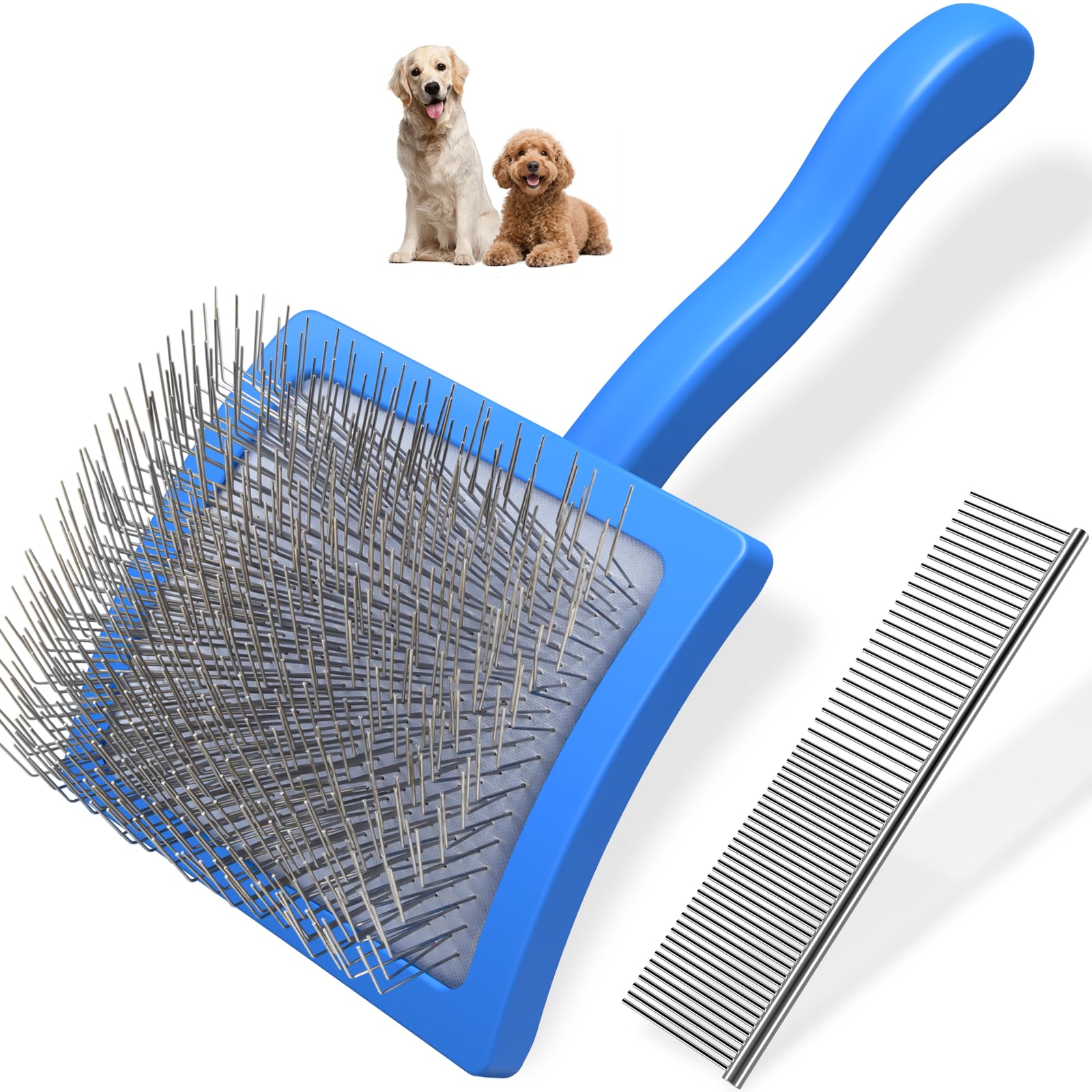
The Saccison set gives you a long-pin slicker and a metal comb in one budget package. The slicker has extra-long angled pins, about an inch long and set at roughly 45 degrees, which is the shape you want for medium-length and curly coats that tangle easily.

The angled pins are the useful part. They reach through a doodle coat without the straight-down scrape of a cheap slicker, and the comb gives you a second pass to find the knots you missed. We like the two-piece approach because a slicker alone can fluff the surface and leave a tight knot underneath.

This is the budget pick for a reason: the pins feel softer than the premium brush, and on a dense, felted mat they may flex instead of separating. Start with the comb on the tight spots, then finish with the slicker. For a doodle household that wants a complete first kit without paying boutique prices, it is the set we hand over.

Bottom line: We hand this set to doodle households shopping on a budget: the angled slicker does the daily work, and the comb helps you find missed knots.

5

Coastal Safari De-Matting Comb

Coastal Safari De-Matting Comb

Tight, stubborn mats

Our Score 9.2/10
Check Price

Worth Noting

  • Sharpness varies out of the box
  • Blades demand careful handling near skin
Size
One size
Blades
Serrated stainless steel
Tool Type
Serrated de-matting comb
Coat Focus
Medium to long coats
Read the full review

Tight, felted mats are not a brushing problem; they are a cutting problem. A slicker can fluff the coat around a mat, but it will not slice through the dense center, and pulling harder only makes the dog resent the session. The Coastal Safari takes the other approach: serrated stainless-steel blades score the mat so you can work it apart in sections.

The blades are short, close together, and set in a plastic handle with a comfortable grip. That shape gives you control in small areas, which is what you want around ears, armpits, and the back of the legs. The plastic cover is worth keeping because the teeth are sharp enough to demand respect even when the tool is sitting in a drawer.

We rank it as the best tool here for stubborn mats because it does the job a brush cannot. Sharpness is the variable: a blade that arrives less sharp will pull rather than cut, so test it on a small mat before you commit to a long session. Hold the blade away from the skin and work in short strokes; if the mat is tight against the skin, stop and let a groomer take it. For a coat that has already felted, this is the pick we reach for.

Bottom line: We reach for the Safari when a mat has already felted: its serrated blades score the knot so you can work it apart instead of dragging it.

6

Poodlie Dematting Rake

Poodlie Dematting Rake

Thick double coats

Our Score 9.2/10
Check Price

Worth Noting

  • Handle can snap under heavy matting
  • Blades can dull with use
Material
Stainless steel and rubber
Tool Type
Dematting rake
Coat Focus
Long, thick coats
Blade Length
2.5 in
Read the full review

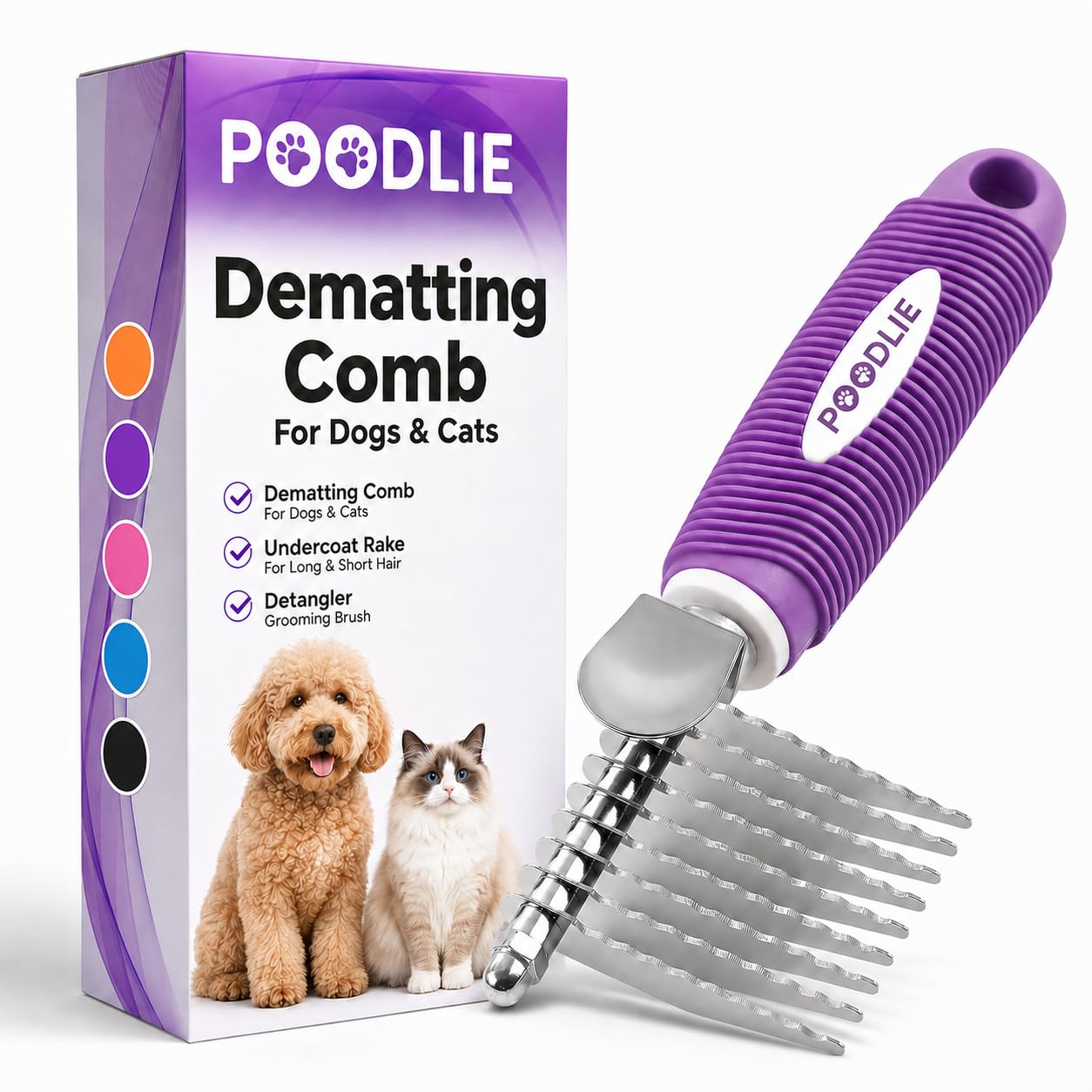
The Poodlie rake goes after the mat that other tools skate over. Its 2.5-inch stainless-steel blades are longer than the pins on most slickers, so they can reach into a dense double coat and break up the knot from underneath instead of just pulling at the surface.

We choose it for thick undercoat because the long blades do the deep work. The rubber handle is textured and easy to grip, and the shape lets you use short, controlled strokes rather than hauling the tool through the coat. For a husky, shepherd, or doodle with a dense underlayer, that reach matters more than a pretty handle.

The trade-off is durability and edge life. The handle can snap under a heavy mat, and the blades can dull with use, so this is not the tool to force. Keep it for the mats you can see and feel, not for daily once-over brushing. It is a budget workhorse, not a buy-it-once heirloom.

Bottom line: For thick double coats with deep mats, we choose this rake: the long blades reach under the knot, though the handle and edge life are the trade-off.

7

Freshly Bailey Dematting Comb

Freshly Bailey Dematting Comb

Sensitive dogs

Our Score 9.0/10
Check Price

Worth Noting

  • Less bite on tight felted mats
Size
7.60 x 3.75 in
Teeth
Curved stainless steel
Tool Type
Double-sided dematting comb
Coat Focus
Medium to long coats
Read the full review

Curved teeth are the quiet advantage of the Freshly Bailey comb. The double-sided head has wide teeth for larger mats and narrow teeth for loose fur, and the curve lets the teeth get under a tangle without a sharp scrape against the skin. We like it for sensitive dogs and medium to long coats that need a gentler hand.

The stainless-steel teeth are set in a wood-and-metal body that feels more substantial than a plastic comb. Use the wide side first on a mat, then switch to the narrow side to clear the loosened hair. The curved shape is also easier to follow around the flank and behind the ear than a flat comb.

It is an also-consider rather than a top pick because it is less aggressive on a tight, felted mat. If the knot is already dense and close to the skin, a serrated comb will do more; if your dog is sensitive or the mats are loose, this is the tool that keeps the session calm. We keep it for the dog that flinches at a sharper rake.

Bottom line: We like this double-sided comb for sensitive dogs and medium coats: curved teeth get under tangles with less scraping, but tight felted mats need more bite.

8

Docrok Grooming Combo

Docrok Grooming Combo

Double-coat maintenance

Our Score 9.0/10
Check Price

Worth Noting

  • Generalist rather than curly-coat specialist
Tool Type
Rake and comb combo
Coat Focus
Medium and long double coats
Comb Sides
Wide and dense
Rake Sides
Wide and dense
Read the full review

A rake on one side and a comb on the other sounds like a tidy answer to a double coat. The Docrok combo gives you a two-in-one rake with a wide side for dematting and a dense side for deshedding, plus a two-in-one comb for knots and loose hair.

We like it for medium and long double coats because the two tools cover the two jobs: the rake gets into the undercoat, and the comb checks the topcoat and the edges. The stainless-steel teeth and TPR handle feel solid in the hand, and the compact shape is easy to store.

It is a generalist, not a curly-coat specialist. On a tight doodle mat, the wide rake can skate over the surface, and the comb is more useful after a slicker has done the main work. On a dog that blows coat and picks up tangles in the underlayer, the combination makes more sense than buying two separate tools.

We keep this in the also-consider tier for the double-coated dog that needs undercoat removal and knot control in one kit. The rake does the heavy lifting; the comb is the part we use most afterward. If your main problem is a felted doodle coat, start with the Big G or the Safari instead.

Bottom line: We keep this combo for double-coated dogs that need both undercoat removal and knot control, not as the first tool for a tight doodle mat.

How We Tested 16 Dog Brushes on Coats That Actually Mat

We started with the brushes groomers actually reach for on matted coats — slickers, undercoat rakes, mat splitters, dematting combs — and ruled out anything with pins glued into the pad or a handle that flexed when I squeezed it. That left 16 brushes, from cheaper than a bag of treats to priced like a grooming appointment, so value was part of the comparison from the first day.

For four months they lived in a basket by the couch and worked on three dogs: a double-coated shepherd mix in full spring blowout, a curly doodle whose hair ropes behind the ears, and a short-coated terrier who mats in his armpits anyway. Brushing happened after walks, after baths, and during the pre-dinner couch session when the dogs are too sleepy to argue, and every brush got the same two test mats — one behind an ear, one on the tail feathering.

Each session I noted how many strokes it took to break a mat apart and whether the dog leaned in or pulled away, and I weighed the hair on a kitchen scale after every ten-minute session, then ran a fine metal comb over the same patch to see what the brush left behind. For sharpness, I drew every pin and blade across the back of my hand and over an inflated balloon; mat splitters need an edge, but anything that scored the balloon wasn't going near a dog.

Ease of use came down to small things: whether hair released from the pad in one sheet or had to be picked out, whether I could work the retract button one-handed with a leash in the other, and how the grip held with damp hands. Durability got checked monthly — bent pins, cracked handles, buttons that stopped springing back — and the ones still in the basket at the end are the ones that passed all of it.

How to Choose Dog Brushes for Matted Hair

Match the tool to the mat

A slicker brush is the everyday tool for loose tangles, fine knots, and curly coats that have not yet felted. Its angled pins separate hair rather than cut it, and a cushioned pad lets the pins follow the body. A serrated de-matting comb or a rake with long blades is the next step when the knot is dense and close to the skin. If you can see the mat as a solid lump, start with the serrated tool; if the coat is just tight and crowded, a slicker like the Big G is enough.

Length and spacing decide how deep you go

Pin length is not a macho spec. A one-inch slicker pin is useful on a dense doodle or double coat; a 2.5-inch rake blade reaches deeper into an undercoat; a 10-inch comb gives you reach and control for finishing. Short coats and sensitive skin need shorter pins or a lighter hand, because long pins can poke if you press. Match the tool to the coat in front of you, not the biggest number on the listing.

Comfort is part of the job

A grooming session can last longer than you expect, especially on a dog that has already decided it dislikes the brush. Look for rounded tips, a flexible pad, and a handle that fills your hand without forcing a death grip. A tool that makes the dog flinch is not saving you time. If your dog pulls away or the skin looks red, stop and switch to a gentler comb; the best mat tool is the one your dog will tolerate long enough to finish the job.

Plan for hair and upkeep

Matted coats leave a lot of hair in the tool, and a clogged pin field or blade gullet stops working. Clear the tool after each section, not just at the end, and wash off any product or oils before you put it away. Durability is the other recurring weak point: handles can crack, pins can bend, and serrated blades can dull. A cheaper tool that stays sharp is a better buy than a premium one you force through a mat.

Know when to stop

A mat that is tight against the skin is not a DIY challenge. Work in small sections, keep bladed edges angled away from the skin, and never cut a mat out with scissors; it is too easy to catch skin in the fold. If the mat does not loosen after a few passes, or the dog will not settle, book a groomer. Clearing the coat around it with a slicker or comb is useful; digging at a solid felted lump is how nicks happen.

Frequently Asked Questions

Final Verdict

The Chris Christensen Big G is the brush we recommend first for most matted coats, especially curly doodle hair, because its long angled pins separate fine knots before they turn into felt. If the mat is already tight and close to the skin, start with the Coastal Safari serrated comb and work in small sections; the Big G is for the coat around it.

For a thick double coat, the Poodlie rake reaches deeper, and the Paw Brothers slicker is the value alternative for dense hair.