Toys & Chews

Best Dog Chew Toys of 2026

A chew toy has one job, and it's harder than it sounds: keep a dog busy without turning into a choking hazard or a shredded mess on the rug. I've watched dogs ignore a basket of expensive toys to gnaw the same disgusting rope for a year, and I've watched them gut a so-called tough rubber bone in eleven minutes. What you're really shopping for is a match — the right density and size for your dog's mouth, not the toughest thing on the shelf.

My team and I spent the past three months with 15 chew toys and a testing pool that ran from a six-pound terrier to a ninety-pound lab mix. The surprise was how often size beat material: anything a dog can fit fully behind its front teeth went straight into the no pile, whatever the label claimed. Get that match right and you buy yourself a quiet hour and a happier dog. The picks below are grouped by the kind of chewer you live with.

1

KONG Classic

Top Pick
KONG Classic

Everyday chewing

Our Score 9.2/10
Check Price

Worth Noting

  • Large runs smaller than the name suggests
Size
Large, 8.23 x 5.43 x 2.76 in
Material
Natural rubber
Stuffable
Yes, hollow center
Chew Level
Average chewers
Read the full review

Peanut butter in the hollow, ten minutes in the freezer, and a dog has something to do for the length of a phone call. That trick is why the KONG Classic stays at the top of this guide. It is a rubber chew first and a puzzle second, which between them cover the two reasons a dog chews: to work its jaws and to burn off energy.

The natural rubber is the part that matters most. It gives under a dog's back teeth instead of fighting them, so it suits a puppy cutting its first set and an older dog whose enamel is thinning in a way the hard nylon chews here do not. That softness is also the limit: KONG rates the Classic for average chewers, and a dog that has already taken chunks out of rubber will do the same to this. For that dog, move to the Wishbone.

We're convinced the shape is what earns the spot. The rounded top and narrow waist give a dog something to hold with both front paws while it works at the opening, and the erratic bounce keeps a game of chase going after the treats are gone. It is a toy a dog can use in a crate without you running interference, which is more than most chews manage.

Then there is the filling. Unscented rubber takes kibble, wet food or a smear of peanut butter, and freezing it turns a quick snack into a long job. Cleaning is a rinse and a run through the dishwasher. Nothing else here doubles as a slow feeder, and that is the reason it is the first chew we suggest to anyone starting a collection.

Bottom line: Our pick for most dogs: rubber soft enough for puppy teeth, a hollow that takes a whole meal, and a shape a dog can hold with both paws.

2

Benebone 4-Pack

Benebone 4-Pack

Multi-dog homes

Our Score 9.2/10
Check Price

Worth Noting

  • Bigger upfront spend than buying one bone
Flavors
Bacon, fish, maple
Contents
Four chew toys
Material
Nylon
Chew Level
Medium, under 60 lb
Read the full review

Four shapes, one box, and a simple idea: dogs get tired of the same bone. Rotating a chew out of sight for a few days and bringing it back resets interest better than replacing it, and this pack gives you enough variety to do that. For a household with two or three chewers, we think it is the most sensible buy in this guide.

What convinced us is the shape variety. These are the same nylon bones as the singles, flavored with real bacon, fish and maple rather than coated, and each one sits differently in the mouth. A dog that loses interest in a wishbone often takes to the fish, and that swap costs you nothing once the box is home. Weight and wear are the same as the singles, so the weekly ends check still applies.

Medium means medium. Dogs at the smaller end of the range can struggle to hold one, and a twenty-pound dog is better off with the KONG Ring or a small Nylabone. If you have a single moderate dog, one bone is the smarter purchase; the pack earns its place when there is more than one mouth in the house.

Bottom line: For a house with more than one strong chewer, this box is the sensible buy: four shapes, real flavor, and something to rotate in when interest fades.

3

Benebone Wishbone

Benebone Wishbone

Aggressive chewers

Our Score 9.0/10
Check Price

Worth Noting

  • Too hard for puppies and senior dogs
Size
Medium, 7 x 1.5 x 4.75 in
Flavor
Real bacon
Material
Nylon
Chew Level
Power chewers
Read the full review

Hard is the point. Benebone's nylon resists a dog that has already destroyed every rubber toy in the house, and the Wishbone is the shape here that a strong chewer can actually get its paws around: one end braced on the floor, the other in the mouth, no thumbs required. We think that curve is why this one gets picked up again after the novelty wears off.

The bacon is real, and it matters more than it sounds. A plain nylon bone gets sniffed once and abandoned; this one keeps drawing a dog back. Nylon does wear, though, and a determined dog working the same spot can loosen small pieces. Check the ends once a week, take it away when they get rough or thin, and it does its job for a long stretch.

Sizing is where this one asks you to pay attention. It is built for medium dogs, and the curve suits a dog that likes to hold a chew between its paws rather than gnaw one flat on the floor. Against the longer Nylabone Knuckle, it is easier to pick up and carry, but it gives a big dog noticeably less to work with.

Bottom line: We keep this one for dogs that have already chewed through the soft stuff: real bacon scent, a grippable curve, and nylon that fights back.

4

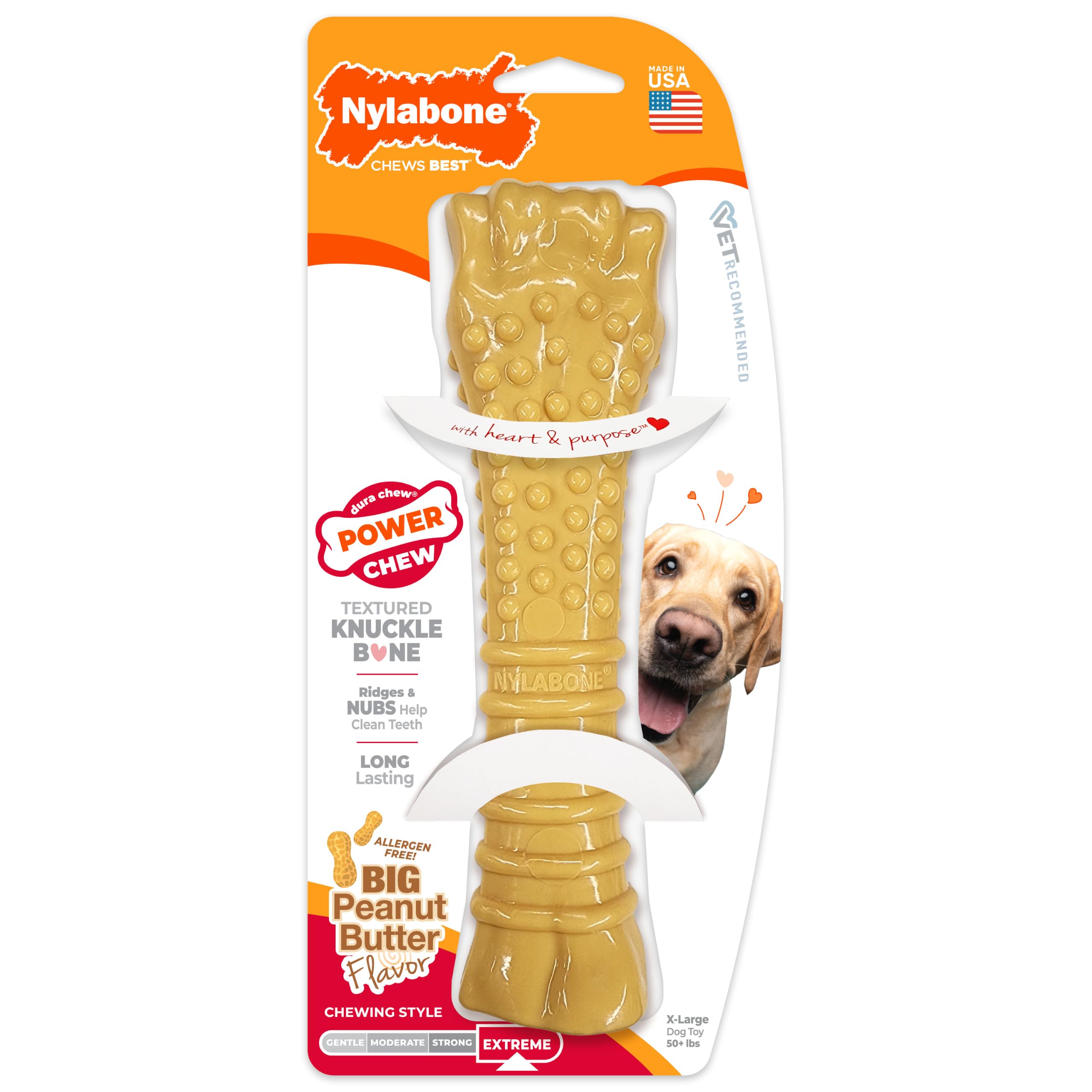
Nylabone Knuckle XL

Nylabone Knuckle XL

Giant breeds

Our Score 9.0/10
Check Price

Worth Noting

  • Hard nylon is tough on worn or damaged teeth
Size
X-Large, 10 in long, 50+ lb
Flavor
Peanut butter
Material
Nylon
Chew Level
Power chewers
Read the full review

Ten inches long and rated for dogs over fifty pounds, the Knuckle Bone is the biggest chew in this guide. The wide lobe at the base is what makes it useful for a giant breed: a mastiff or a Newfoundland can trap it under a paw and work the textured end instead of pushing the whole bone around the floor.

It is nylon, and hard with it. The surface is raised knuckles and ridges rather than smooth, which gives a dog's back teeth something to catch and keeps the chew interesting after the first session. Peanut butter flavoring gets things started, but we have stopped trusting flavor claims: a dog that ignores scented nylon will ignore this one too. Shape and resistance are what keep it in play, and that is why the big-dog slot on this list goes to it.

The appeal is how little it asks of you. Nothing to stuff, nothing to freeze, no smell to manage, and it sits by the sofa for months at a stretch. The length is the thing to watch: it is long enough to wedge across a big dog's mouth, so keep it with dogs over the fifty-pound line and leave a shorter nylon bone for smaller mouths.

Bottom line: The chew we hand to a giant breed: a ten-inch nylon bone that stays put under a paw, provided your dog's teeth are in good shape.

5

KONG Ring

KONG Ring

Puppies

Our Score 9.0/10
Check Price

Worth Noting

  • Won't hold up to a determined adult chewer
Size
Small/Medium, 5 in across
Flavor
Unflavored
Material
Natural rubber
Chew Level
Average chewers
Read the full review

Puppies need something to gnaw that will not win the fight. The KONG Ring is unfilled, unscented rubber with a little give, sized for small and medium dogs, and it is the toy in this guide we hand over first when a puppy is working through its second set of teeth.

The simplicity is the appeal. There is no hollow to stuff and no flavor to wear off, so a puppy can just carry it, chew the rim and fall asleep next to it. It is quiet on a hard floor, which is more than we can say for the nylon bones here, and there is nothing to clean beyond a rinse.

The size is what decides it. Five inches across and light, it suits a Cavalier or a labradoodle puppy and gets lost in a Rottweiler's mouth. Think of it as the first chew in a longer plan: once teething is over and your dog is working hard at a bone, the Classic or a nylon chew is the next step.

Bottom line: For a puppy or a small dog, we start here: soft-enough rubber, no stuffing, and a rim that is easy to hold on to.

6

SPOT Bam-Bones T-Bone

SPOT Bam-Bones T-Bone

Medium chewers

Our Score 9.0/10
Check Price

Worth Noting

  • Sized only for dogs between 30 and 60 pounds
Size
6 in, 30-60 lb dogs
Flavor
Beef
Material
Bamboo fiber and nylon
Chew Level
Moderate to heavy
Read the full review

The T shape does something the straight bones do not: the wide base sits flat while a dog works the upright, so the chew stays put instead of skittering across the kitchen floor. For a dog that likes to lie down and gnaw, we think that is the difference between a toy it uses and a toy it chases.

The material is a bamboo-fiber and nylon composite, and it lands between the hard nylon bones and the softer rubber in how it feels in the mouth. Raised nubs run along the edges, so there is texture for the back teeth, and the beef flavoring buys the first ten minutes while the shape does the rest.

At six inches and just under five ounces, it is sized for the 30-to-60-pound range the listing names, and it floats, which matters if your dog chews at the lake or in a kiddie pool. What we like is that it fills a gap the others leave: real resistance in a shape a medium dog can hold. It does wear down, so retire it once the T gets small enough to swallow.

Bottom line: We like this one for a medium dog that lies down to chew: the flat base keeps it still while the textured end does the work.

7

Pupstages Dogwood

Pupstages Dogwood

Wood chewers

Our Score 9.0/10
Check Price

Worth Noting

  • Not for puppies, seniors, or power chewers
  • Some dogs refuse it outright
Size
Medium, 7.5 in, 26-35 lb
Cleaning
Top-rack dishwasher safe
Material
Real-wood blend
Chew Level
Moderate chewers
Read the full review

Some dogs do not want a toy; they want a stick. If yours strips bark off every branch in the yard and moves on to the furniture between walks, this wood-blend chew is aimed at exactly that habit: it looks and smells like wood without the splintering of the real thing.

The material is the draw. It is a real-wood blend made without nylon, lead or phthalates, softer in the mouth than the hard nylon bones here, and light enough at 3.2 ounces that it does not thud when it is dropped. It is also top-rack dishwasher safe, which is unusual for a chew this substantial, and it holds a dog's attention because it feels like the thing the dog already wanted to chew.

The trade for that softness is maintenance. A dog that works the same end for weeks will loosen shards, and those are sharp, so check the ends weekly and replace the chew once it starts to flex or shed. Do not leave a dog alone with it; the Dogwood rewards steady, polite chewing rather than enthusiasm.

Inside those bounds it is the closest thing to a safe stick in this guide, and the one we point stick-chewers toward. It is a consumable rather than an heirloom, so buy it expecting to replace it eventually. Some dogs ignore it completely, and no flavor or shape will fix that.

Bottom line: If your dog chews sticks and furniture, this is the substitute we recommend: wood-like, soft enough not to splinter, and built for moderate chewers only.

How We Tested 15 Chew Toys (and Let the Dogs Vote)

We started with more than 60 chew toys — big-box standards, boutique rubber, and a few reader favorites — and cut the list by checking materials, how squeakers and treat pockets were secured, and whether any small piece could be worked loose in an afternoon. Size range and construction narrowed it to 15, which went out to a test pool of dogs from a six-pound terrier to a ninety-pound lab mix, including a puppy in the thick of teething. Testing ran three months, long enough for novelty to wear off and real wear to show.

Each toy went through the same rough week: solo crate time in the morning, a supervised chew session on the living room rug after dinner, a few rounds of fetch and tug, then a spot in the toy basket to see whether the dog went back to it unprompted. I photographed seams, ends, and edges on day one and checked them weekly for nicks, splits, and exposed filling, noting which toys lost a chunk and how fast. The softer picks went to the senior dog and the greyhound with delicate teeth, and I checked those for blood spots after every session.

Engagement was the hardest thing to score on paper, so the dogs voted: anything ignored for a week got pulled and re-offered later, and we counted how often each toy got picked out of the basket. Anything that came apart under supervision got flagged, and anything with a loose piece after one session came out of the running entirely. Finally, I broke down the cost of each toy by the weeks of actual chewing it delivered before it needed replacing, since a toy that dies in a day is the more expensive purchase no matter what it cost at checkout.

How to Choose Dog Chew Toys

Start with chew strength, not with claims

Ask what your dog does to a toy, not what the package promises. An average chewer works the edges and leaves a toy intact for months; a power chewer takes pieces off rubber in a single sitting. Those two dogs need different materials, and buying the toughest thing on the shelf for a moderate chewer wastes money just as surely as buying soft rubber for a strong one does.

The brands split along the same line. KONG rates the Classic for average chewers, while Benebone and Nylabone build their nylon bones for the dogs that finish everything else. Read that rating before anything else on the label; it is the single most useful piece of information on the package.

Size is a measurement, not a breed chart

Large on a chew toy label is a suggestion, and sizing tends to run smaller than the word implies. Measure the toy's actual length against something your dog already carries comfortably, then apply the swallow test: anything that fits entirely behind the molars is a choking risk, so size up rather than down.

Weight bands are the better starting point. The SPOT T-bone is built for 30 to 60 pounds, the Nylabone Knuckle for 50 and over, and the KONG Ring for small and medium dogs. A dog at the top of its band usually does better with the next size up.

Hardness buys durability and costs teeth

Every step up in hardness buys lifespan and takes something from the dog. Rubber gives under the back teeth and suits puppies, seniors and dogs with worn enamel. Nylon resists a serious chewer for months but is unforgiving on a damaged tooth. Wood-blend chews sit between the two and suit dogs that already chew sticks.

The practical rule is not to leave one hard bone down as the only thing in the room. A dog with nothing else to chew will work the same spot until it goes sharp, and a chew that has gone sharp is a chew to replace rather than smooth down by hand.

What keeps a chew interesting

A dog does not chew for the same reason twice. Some sessions are about food, which is where a hollow rubber toy packed with kibble and frozen earns its keep. Others are about texture and grip, which is where shape comes in: a curve or a T-base lets a dog hold a chew steady instead of chasing it across the floor.

Rotation does the rest. Keep three or four toys in a drawer, put two down at a time, and a bone that had lost its appeal gets picked up again a week later. That is the honest case for a multipack over one expensive bone: not more chewing, but more renewals.

Frequently Asked Questions

Final Verdict

If you want one chew toy and no research project, we send most people to the KONG Classic. Fill it, freeze it, and it covers boredom, teething and everyday chewing in a rubber that will not chip a tooth. The exception is the dog that has already destroyed rubber: for that one, the Benebone Wishbone or the ten-inch Nylabone Knuckle is the right step up.

Size whichever you choose to your dog's mouth rather than its breed, and look every chew over once a week. That habit prevents more trouble than any single purchase on this list.