Toys & Chews

Best Rubber Dog Toys of 2026

There's a particular sound that tells you a dog toy is finished — a wet, ripping tear, followed by the clatter of a squeaker hitting the floor. A good rubber toy is supposed to head that off. It's the one toy you can hand over without hovering, the one that survives a determined chewer and still gets picked up again the next morning. What you're actually buying, beyond the toy itself, is a dog that's genuinely worn out and a floor with nothing dangerous on it.

What I've learned from years of fishing rubber toys out of the yard: hardness matters more than shape. Too firm and the dog ignores it by Tuesday; too soft and it's gone by Tuesday afternoon. My team and I have spent the past three months cycling 16 rubber toys through daily life with dogs of very different sizes and chewing styles, and the ones that held up all had a certain give you can feel in your hand. The picks below cover that whole range, from gentle mouthing to serious destruction.

1

Chuckit! Ultra Ball

Top Pick
Chuckit! Ultra Ball

Fetch and water play

Our Score 9.6/10
Check Price

Worth Noting

  • 2.5-inch medium suits 20-60 lb dogs only
Floats
Yes
Diameter
2.5 in
Pack Size
2 balls
Launcher Fit
Medium Chuckit! launchers
Read the full review

Two things decide whether a fetch ball earns a place in the bag: it has to stay on the water when the throw is bad, and it has to survive the walk back. The Chuckit! Ultra Ball does both, and it is the one we reach for first. It is solid rubber with a thick core and a matte, textured skin, it bounces properly off pavement and grass, and it floats.

The 2.5-inch medium is built for dogs in the 20-to-60-pound range, and that is where it feels right: small enough to carry comfortably, big enough that a determined chomp does not end badly. It also fits medium Chuckit! launchers, which matters more than it sounds once you have thrown a ball forty times. A launcher saves your shoulder and keeps your hand out of the slobber.

Chewing is where we paid closest attention. The skin takes tooth marks instead of tears, and the ball keeps its shape rather than going soft in the middle the way cheap rubber does. That is tolerance, not immunity — this is a fetch ball that handles the gnawing between throws, not a toy to leave with a dog that settles in and works at something for an hour.

Buy it in the two-pack. Balls go over fences and into reeds, and a spare in the car turns a lost ball into a small annoyance rather than the end of the afternoon. One caution on sizing: this pack is the medium, so a dog much past 60 pounds is working with a ball that is on the small side.

Bottom line: Our default pick for almost any dog: the Ultra Ball floats, bounces high, and takes the chewing that happens between throws. It is the toy we recommend before anything else in this guide.

2

Chew King Fetch Balls

Chew King Fetch Balls

Bulk fetch balls

Our Score 9.4/10
Check Price

Worth Noting

  • Rated for average chewers, not power chewers
Diameter
2.5 in
Includes
Mesh bag
Pack Size
8 balls
Launcher Fit
Medium Chew King launcher
Read the full review

Balls disappear. Over the fence, into a storm drain, into the long grass at the edge of the park — in a house with a dog they go missing faster than anyone expects. The Chew King box of eight is built around that fact: eight 2.5-inch natural rubber balls and a mesh bag to keep them in.

The surprise is that they are not just quantity. The rubber is dense and springs back rather than going flabby, they bounce as well as anything here, and an air vent through each ball makes a whistle in flight — a detail that gives a dog something to track when the sun is in their eyes. At 2.5 inches they match the Chuckit! medium, so the launcher you already own will take them.

The limit is chewing. Chew King rates these for average chewers and sells a separate line for heavy ones, and that lines up with what we found: they shrug off mouthing and casual gnawing without breaking down, and a dog that methodically works a hole open will eventually get there. If your dog has already destroyed a rubber ball this year, shop in the firm end instead.

The vent has a second effect worth knowing: a ball that whistles in the air will also take on water in a pond, so treat these as land balls. Keep the Ultra Ball for swimming and let this box handle the park.

Bottom line: Eight launcher-ready rubber balls for the household where balls vanish over fences. They bounce, they whistle in flight, and losing one costs you a shrug rather than a replacement run.

3

KONG Extreme

KONG Extreme

Power chewers

Our Score 9.2/10
Check Price

Worth Noting

  • Large runs smaller than the label suggests
Size
Large
Weight
7.76 oz
Dimensions
8.62 x 5.39 x 2.64 in
Treat Fillable
Hollow interior
Read the full review

If your dog has turned the word indestructible into a personal challenge, start here. The KONG Extreme is the firmest natural rubber in KONG's lineup — the black one — built for power chewers rather than average ones, and shaped so the hollow center turns a chew into a job.

What we appreciate most is how little the surface changes. The rubber takes tooth marks rather than tears, and it holds its shape through the sort of gnawing that flattens softer toys in a week. It is not immortal. A dog that really commits can eventually open one up, and KONG's own packaging is clear that no toy is truly indestructible, which is the honest way to sell a chew toy.

The hollow does the second job. Pack it with kibble, smear peanut butter around the inside, freeze it, and a bored dog has something to do at six in the morning that is not your sofa. The erratic bounce makes it a serviceable indoor fetch toy too, though we keep it away from anything breakable.

At 8.62 inches long it is a two-paw toy for a big dog and more than a small one can manage, and the opening is narrower than it looks — chunky treats need chopping before they fit, and a spoon will not reach the bottom. A squeeze bottle or a thin smear of peanut butter does the job better than anything solid.

Bottom line: The toy we hand to people whose dogs have destroyed everything else. The black rubber holds its shape under real pressure, and the hollow center earns its keep once you stuff and freeze it.

4

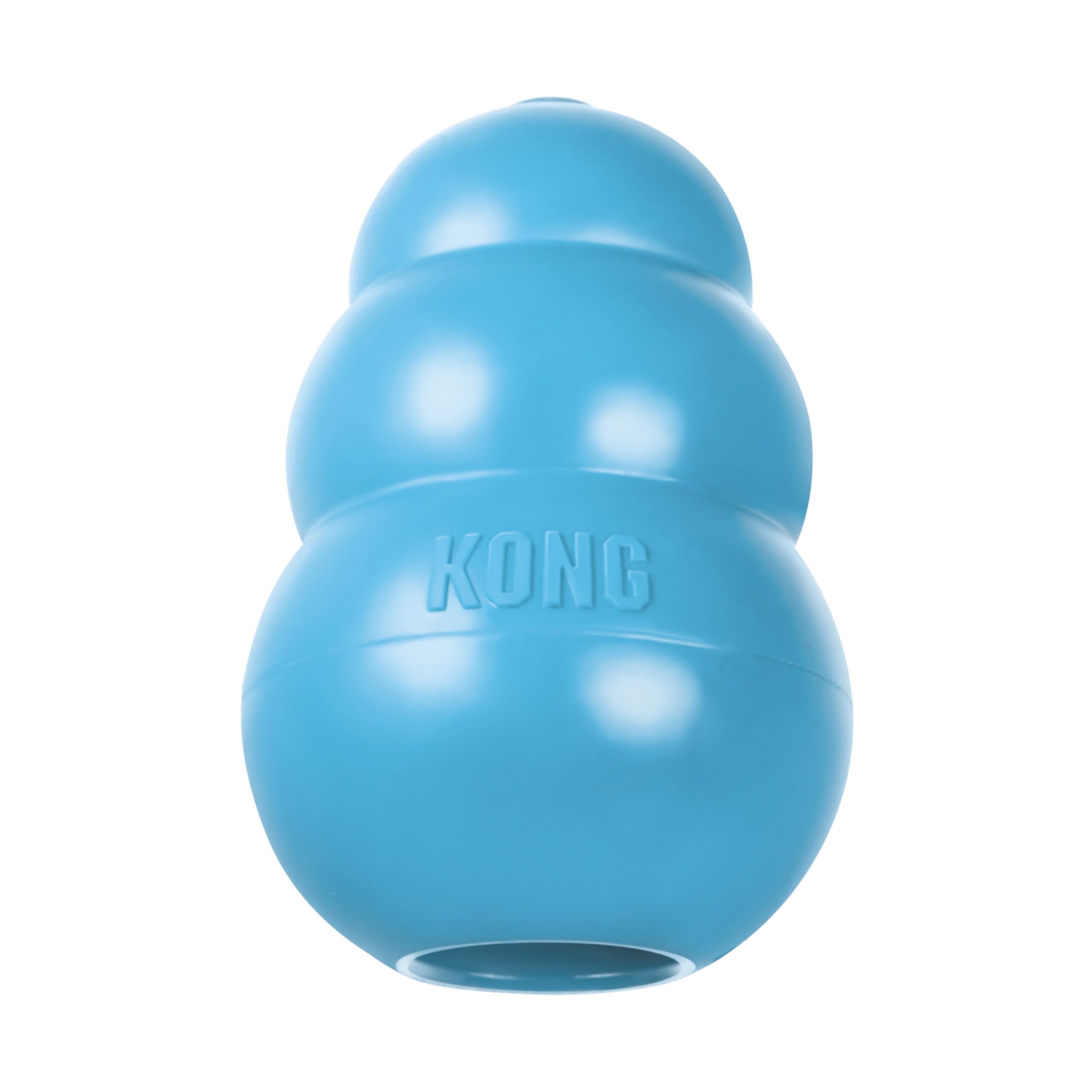
KONG Puppy

KONG Puppy

Teething puppies

Our Score 9.2/10
Check Price

Worth Noting

  • Small size is outgrown quickly by big-breed pups
Size
Small
Rubber
Puppy-soft natural rubber
Weight
1.76 oz
Dimensions
6.3 x 3.9 x 2.91 in
Read the full review

Adult chew toys are too hard for a mouth that is still forming, which is the problem the KONG Puppy solves. Same shape as the classic, in a softer natural rubber built around puppy teeth and the gums underneath them — the toy we put in a crate before anything else.

It is genuinely small: 6.3 inches long, 50 grams, sized for a puppy to hold between both front paws and get a grip on. It bounces well enough to double as a fetch toy during the thirty seconds a puppy stops chewing, and packed with kibble and frozen it becomes the closest thing to an off switch we have found for a teething puppy in a crate.

The softer rubber has a limit. It is gentle because it gives, and a determined chewer can crack it at the wide end once the adult jaw arrives — this is a teething toy, not a match for a full-grown mouth. Move up to a firmer formula when the baby teeth are gone.

The hollow gets unpleasant, as every stuffable toy does. A bottle brush reaches the narrow end and nothing else does, so rinse it the same day it is emptied and it stays in rotation.

Bottom line: The right first chew toy for a puppy: soft enough for baby teeth, hollow enough to stuff, small enough to hold. Move to a firmer formula once the adult teeth come through.

5

Chuckit! Fetch Stick

Chuckit! Fetch Stick

Long-distance fetch

Our Score 9.2/10
Check Price

Worth Noting

  • Not built for dogs that chew with intent
Length
12 in
Weight
4.48 oz
Material
Natural rubber
Launcher Fit
RingChaser
Read the full review

Twelve inches of natural rubber sounds like an odd thing to get worked up about until you throw one. The length gives you a real grip, the 4.48 ounces behind it carries further than a ball, and when your dog brings it back you can pick it up by the dry end.

Size is the first thing to sort out. At 12 inches long it suits medium and large dogs; a terrier can carry it, but the back half drags along the ground, which gets old for both of you. Two dogs can take an end each, and the rubber gives enough that neither gets a hard jolt when the other pulls.

Where it does not shine is water. The stick is solid rubber, so it sinks rather than bobs, and a throw into a lake is a throw you may not get back — the one thing that keeps it from being the toy we take everywhere. Keep it for fields and shorelines and take the Ultra Ball to open water.

It pairs with the RingChaser launcher, which picks the stick up off the ground without you bending, and the bright color is more useful than it sounds — ten minutes of hunting for a muddy green ball in November grass will make you appreciate a toy you can actually see.

Bottom line: A 12-inch rubber stick that throws further than a ball and keeps your hand off the wet end. It is a fetch toy, not a chewer's toy, and that is the line to buy it along.

6

Hartz DuraPlay Ball

Hartz DuraPlay Ball

Small gentle dogs

Our Score 9.2/10
Check Price

Worth Noting

  • Squeaker often quits before the ball does
Size
Small
Scent
Bacon
Diameter
3 in
Construction
Latex shell over foam core
Read the full review

Most rubber toys are one piece of rubber. The DuraPlay is a firm latex shell over a foam core, and that construction is the whole reason to look at it — the ball squashes in your hand, which makes it easy for a small mouth to grab and gentle for an older dog whose teeth are not what they were.

The foam core is the clever part: it keeps the ball light and bouncy without making it hollow, so it floats, and we found it gives just enough that a dog can get a grip without a hard edge pressing into the roof of the mouth. The squeaker and the bacon scent do the rest of the work. The scent is the divider — strong when new, faded after a few washes, and ignored entirely by some dogs.

The honest limit is the shell. Soft means soft, and a dog that chews with intent will open one up in an afternoon. That is a trade rather than a flaw: you get a ball that is kind to teeth and easy to carry, and you give up the ability to leave it with a destroyer.

Indoors is where it makes most sense. It is light enough to throw down a hallway without taking out a lamp, it does not clatter on hardwood the way a hard ball does, and when your dog carries it from room to room — which it will — nobody has to worry about the furniture.

Bottom line: A soft, bouncy, bacon-scented ball that is kind to older teeth and easy for small mouths to grab. Buy it for a gentle dog under twenty pounds, not for anything with a hard chew.

How We Tested Rubber Dog Toys (and What Broke First)

We started by gathering every rubber toy we could find that was marketed for chewing rather than just fetching, then trimmed the list down by rubber hardness, the sizes each one came in, and whether the design had a squeaker or treat pocket that could be torn out. That left 16 toys, which we ran through three months of testing in homes with dogs ranging from a 20-pound terrier mix to a 70-pound retriever. Every toy went through the same rotation: morning fetch in the yard, an evening chew session on the living room floor, and a supervised stretch in a crate.

Chewing was the main event. We handled each toy before the dog did and noted how much give the rubber had — whether a thumbnail left a mark — then watched 15-minute chew sessions and checked afterward for punctures, nicks along the seams, and bits of rubber coming away. We also swapped sizes between dogs, offering large-breed toys to the small dog and vice versa, and noted when a dog lost interest because a toy was too big to get its mouth around or too small to hold safely.

For the rest, we tossed each toy into a bathtub and then a pond to see whether it floated and whether it stayed upright or tipped and took on water. We smelled them straight out of the package and again after a week of drool and dirt, and we judged engagement by which toys a dog chose on its own after a week — not just the ones it accepted when we threw them. Rubber that came through all of that without chunks missing is what earned a spot on this list.

How to Choose Rubber Dog Toys

Match the rubber to the chewing, not the breed

Rubber toys are formulated on a softness scale, and the name usually tells you which end you are on. KONG's blue is puppy-soft, its red is for average chewers, and its black Extreme is the firmest. Chew King splits its line the same way, with the standard balls rated for average chewers and a separate supreme line for heavy ones.

If your dog has punctured a toy in a single sitting, shop in the firm end. If your dog carries a toy around and mouths it, a softer rubber is kinder to teeth and just as satisfying.

Size is two questions, not one

A toy has to be small enough for your dog to carry and large enough that it cannot be swallowed, and most listings only answer the first half. The Chuckit! medium ball is 2.5 inches and aimed at dogs from 20 to 60 pounds, which is a useful starting point for a medium dog.

The trap is puppies. A large-breed pup at ten weeks fits a small toy and will not fit it at five months, so buy the small now and expect to replace it rather than stocking up. Large on a listing is not a universal size either — check the actual measurement against your dog's mouth.

Fetch toys and chew toys are different jobs

The best fetch toys are built to fly and to be caught, not to be worked on. A 12-inch rubber stick is a great throw and a poor all-day chew. The hollow stuffable shapes are the reverse: heavy, unforgiving in flight, and made to be sat with.

Buying one toy to do both means compromising whichever job your dog cares about more. Two toys — one for the field, one for the crate — is usually cheaper than replacing a fetch toy every fortnight.

Water, air vents, and cleaning

Hollow toys collect gunk. A stuffable chew with a narrow opening needs a bottle brush and a same-day rinse, or it turns into a science project on the shelf. Solid rubber rinses clean and floats: the Ultra Ball and the DuraPlay both stay on the surface, while the solid Fetch Stick sinks.

If your dog swims, look for the word floats on the listing rather than assuming it. Ventilated balls that whistle in flight can also take on water through the hole, so keep them for dry land.

Frequently Asked Questions

Final Verdict

The Chuckit! Ultra Ball is the one we buy first. It floats, it bounces, it takes the chewing that happens between throws, and the two-pack means a lost ball does not end the afternoon. Almost any dog between 20 and 60 pounds can use it tomorrow.

If your dog destroys toys rather than plays with them, the answer changes: go to the KONG Extreme in black and accept that you are paying for rubber density. If balls vanish faster than you can replace them, the Chew King eight-pack keeps the game going. And for a puppy, start with the KONG Puppy and move up when the adult teeth arrive.