Training & Behavior

Best Dog Clickers of 2026

A dog clicker is a tiny noisemaker with one job: mark the exact second your dog gets it right, then get out of the way while the treat arrives. I’ve fumbled enough flimsy ones mid-session to know that a stiff button or a mushy click can cost you the moment. Over the past three months, my team and I have clicked our way through 16 clickers in living rooms, backyards, on daily walks, and at weekly obedience class. The good ones disappear in your hand and leave the training to the dog.

What separates them isn’t fancy features—it’s a crisp, consistent click and a button you can press one-handed without your thumb cramping. Some are so loud they startle a shy puppy; others are so soft they vanish in a windy park. We also checked whether the plastic survived a drop on the driveway, whether the spring held up after a few hundred reps, and whether the price felt fair for something you’ll clip to a treat pouch. The picks below earned their place by doing the simple thing well.

1

Educator Finger Clicker

Top Pick
Educator Finger Clicker

Hands-full handling

Our Score 9.0/10
Check Price

Worth Noting

  • Highest price in this group
Weight
0.32 oz
Attachment
5-inch hook-and-loop finger strap
Clickers Per Pack
1
Read the full review

Every clicker runs into the same design problem: you need three hands. One for the leash, one for the treats, one for the marker. Educator answers it with a five-inch hook-and-loop strap that wraps around a finger and puts the button under your thumb, so the hand already holding the leash is the hand doing the clicking.

It's a small, solid piece of plastic at about a third of an ounce, with a mechanism that has no electronics and no batteries to replace. The strap rotates, so the clicker can sit on the inside or the outside of your hand depending on how your thumb falls, and the button returns quickly enough to mark twice in succession when you're shaping something new.

We ended up preferring it for anything on a leash: loose-leash walking, door manners, settling on a mat. Having the clicker attached rather than in a pocket means the mark lands on the behavior instead of a beat after it, which is the mistake most beginners make. If you'll be clicking hundreds of times a week, that difference is worth paying for.

What you get is exactly one clicker. That suits a walk-and-train routine, but if you want one in every room, plan on buying two or choosing a multi-pack instead.

Bottom line: For leash walks and treat-heavy sessions, the finger strap keeps the clicker where your thumb already is, in the sturdiest unit of the group.

2

Ruconla 4-Pack Clicker

Ruconla 4-Pack Clicker

Multi-dog homes

Our Score 9.0/10
Check Price

Worth Noting

  • Loud enough to startle a nervous dog up close
Colors
Black, red, white, blue
Weight
3.17 oz
Attachment
Elastic wrist strap
Clickers Per Pack
4
Read the full review

A house where more than one person trains the dog needs more than one clicker, and this four-pack in four colors is the simplest way we've found to sort that out. One on your wrist, one on your partner's, one in the car and one in the treat bin, and nobody stalls a session hunting through coat pockets.

Each clicker is small in the palm, about 2.4 by 1.8 inches, with an oversized button you can find without looking down. The click is definite and carries across a room, the elastic wrist straps are comfortable enough to leave on between reps, and the four colors — black, red, white and blue — mean each handler grabs their own without asking. The set weighs just over three ounces.

There's very little to go wrong: a plastic body, an elastic band, a button that comes back up cleanly every time. For a tool that lives in a pocket and gets dropped on driveways, that simplicity is the appeal, and it's why we're comfortable recommending it to a household rather than to a single trainer.

Bottom line: A house where more than one person trains the dog needs more than one clicker, and this four-pack in four colors is the simplest way to sort that out.

3

Diyife 2-Pack Clicker

Diyife 2-Pack Clicker

All-round training

Our Score 8.8/10
Check Price

Worth Noting

  • No training guide in the box
Weight
1.44 oz
Material
ABS plastic and stainless steel
Warranty
1 year
Clickers Per Pack
2
Read the full review

The sound is the whole job, so that's where we started. Diyife puts a stainless steel clicker element inside a plastic shell, and what comes out is a short, mechanical tick with a hard edge to it — a sound that separates itself from a jingling collar or a television in the next room. Across a yard it was easy to hear, and at arm's length it wasn't harsh enough to make our dogs flinch.

Where this one pulled ahead for us is in the hand. The shell has a matte, slightly textured finish instead of the glossy plastic most of these use, and the button is wide with a light, short travel. That detail earns its keep when you're holding a leash in one hand and a treat in the other and the click has to land on the instant the dog's rear touches the floor. We marked behaviors one-handed with it without breaking stride, which isn't true of the rounder, slicker clickers here.

The coiled wrist strap slides over a hand and stays put, and a small clasp lets it hang from a belt loop or a leash handle instead. Two come in the pack, blue and white, and the second one is the point: one on the leash, one in the kitchen drawer, and no hunting for it halfway through a session. At an ounce and a half, you won't notice wearing it.

What's missing is guidance. There's no training booklet in the box, and clicker training lives or dies on timing, so plan on reading up before your first session. The one-year warranty is generous for a tool this inexpensive, though we doubt many people will ever need it.

Bottom line: Our pick for most people: the metal click stays sharp and repeatable, the matte body doesn't slip in a sweaty hand, and two clickers cover the leash and the kitchen drawer.

4

OYEFLY 2-Pack Clicker

OYEFLY 2-Pack Clicker

Tight budgets

Our Score 8.8/10
Check Price

Worth Noting

  • Not loud enough for long-distance work
Colors
Black and water lake blue
Weight
1.34 oz
Attachment
Elastic wrist strap
Clickers Per Pack
2
Read the full review

If you want to find out whether clicker training suits your dog without spending much, this is the pair we point people to. Two clickers, an elastic wrist band on each, and a click that's crisp enough to cut through the ordinary noise of a house — for sits, downs and name recognition, that covers the job.

The band is the part we keep coming back to. It's a soft elastic loop that slides over the wrist and stays there while you hand out treats, thin enough that you forget it's on, and it will also clip to a leash or a belt loop. The clickers weigh almost nothing, come in black and blue, and the press is short and easy on the thumb.

The click sits on the louder side of the middle, which is fine indoors and at close range on a walk. In a windy park, or with a dog working toward the far end of a field, it's less commanding than the loudest models here. Nothing about the shell feels fragile, and the pair format means a lost clicker doesn't cost you a week of training.

Bottom line: The least expensive way to find out whether clicker training suits your dog, with an elastic band that keeps the clicker on your wrist instead of in a pocket.

5

Coolrunner 7-Pack

Coolrunner 7-Pack

Whole-house coverage

Our Score 8.8/10
Check Price

Worth Noting

  • Click and button feel vary between units
Colors
Seven assorted colors
Attachment
Elastic wrist strap
Dimensions
2.5 x 1.2 inches
Clickers Per Pack
7
Read the full review

Most clickers in this group disappear inside a closed fist, which is fine until you have large hands and a thumb that keeps missing the button. The Coolrunner is sized up on purpose: about 2.5 inches long and 1.2 wide, with a button that springs back up crisply instead of sitting half-pressed.

Seven clickers, seven colors, an elastic wrist band on each. The logic is coverage — one in the kitchen, one by the back door, one in the car, one in the training bag, and three to replace the ones that vanish. It's a practical way to make sure a training moment doesn't get missed because the clicker is in another room.

The wrist bands are the plainest here, thin elastic on a small clip, and they're the part that gives out first, so expect the clickers to outlive their straps.

None of that is a reason to walk away. For a household that trains in short bursts all day, this is a sensible buy: inexpensive enough per unit that losing one doesn't matter, big enough to spot in a drawer, bright enough that a child can find it. It just isn't the clicker to choose if your dog needs the same sound on every single press.

Bottom line: Seven clickers in a spread of colors, sized for a bigger hand — buy the pack to scatter around the house, not to carry in a pocket.

6

Starmark Pro-Training

Starmark Pro-Training

First-time trainers

Our Score 8.8/10
Check Price

Worth Noting

  • Button can pop off after a hard drop
Extras
Step-by-step training guide
Dimensions
2.3 x 1.5 x 0.8 inches
Clicker Element
Stainless steel
Clickers Per Pack
1
Read the full review

Clicker training usually fails for a boring reason: timing. Most people click a beat late for the first week, and a clicker that arrives with written instructions has a real advantage for anyone starting from scratch. Starmark includes a step-by-step training guide in the box, which is more than any other pick here does.

The clicker itself is a rounded, palm-sized shape, roughly 2.3 by 1.5 inches, with a stainless steel clicker element that won't rust and a weight of about eleven grams. It sits comfortably in the hand, the press is firm and positive rather than mushy, and the loop makes it easy to keep on a keychain — which is where ours ended up between sessions.

The click is sharp enough that a small or sensitive dog may startle the first time, so introduce it from across the room with treats ready and give the dog a session or two to connect the sound with food. Price is the other consideration: it sits in the middle of this group, while the multi-packs undercut it per clicker.

Bottom line: The one that comes with instructions: a palm-shaped clicker and a step-by-step guide for the person who has never used a marker before.

7

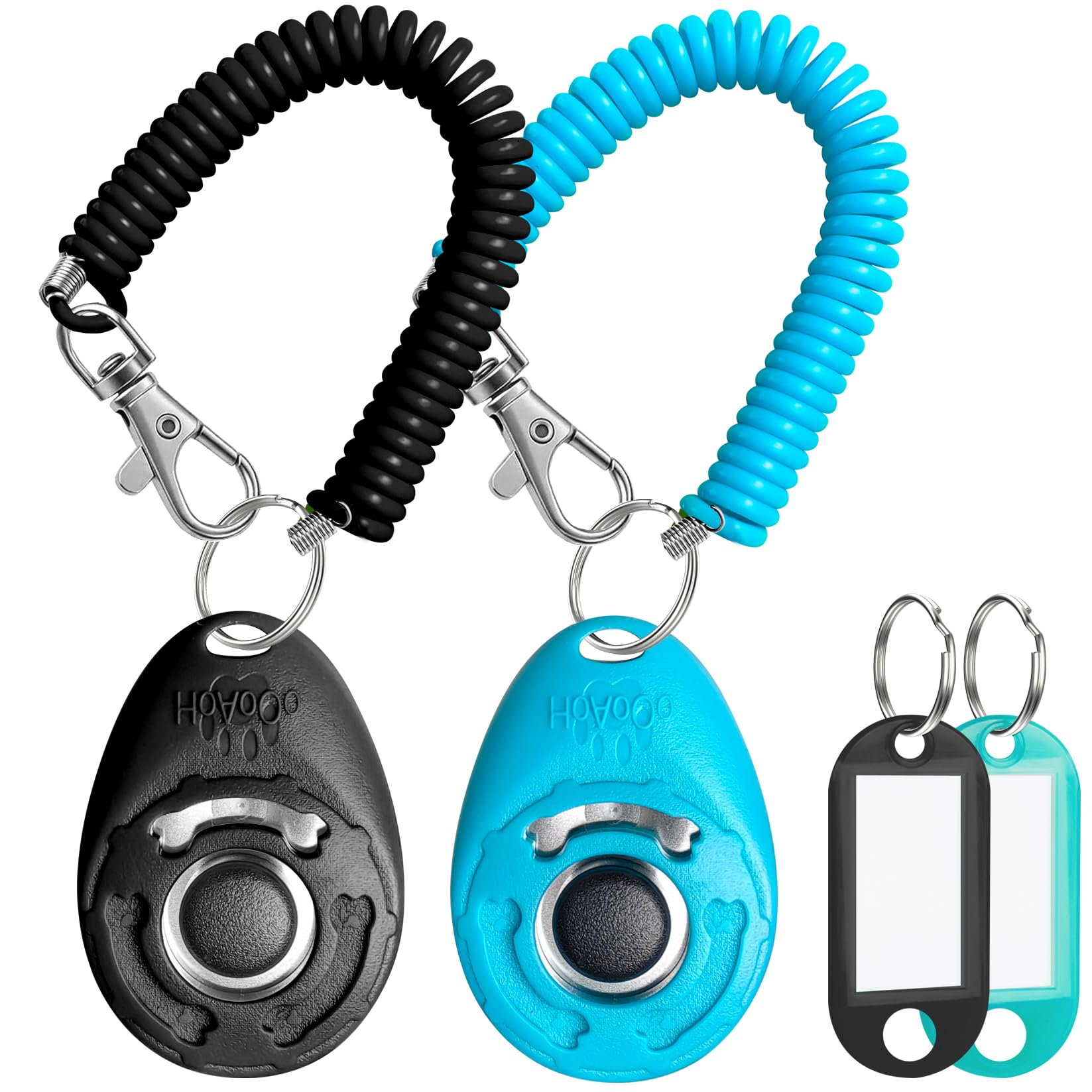
HoAoOo Clicker + Tags

HoAoOo Clicker + Tags

Outdoor distance work

Our Score 8.6/10
Check Price

Worth Noting

  • Spring strap can come apart with a tugging dog
Extras
2 name tags
Attachment
Spring wrist strap
Strap Length
6.3 to 9.84 inches
Clickers Per Pack
2
Read the full review

Twenty yards is where cheap clickers fall apart. A dog with its nose in a fence line doesn't need a polite tick; it needs a sound with some snap that arrives above wind, traffic and the neighbor's leaf blower. This one has that — a hard, bright click that lifted our dogs' heads from across a field, which is more than we can say for the quieter clickers in this group.

The spring-loaded wrist strap runs from about six inches to nearly ten, so it stretches over a coat sleeve instead of stopping at the cuff, and there's a keyring clip for a leash or treat bag. Two name tags come in the box as well, handy if your dog's collar tag has gone missing, and the whole set weighs under two ounces.

For outdoor work this sits near the top of the group on volume, and that's the reason to choose it over the cheaper pairs. The trade-off is the spring strap itself: with a dog that grabs and pulls at it, the coil can come apart, and then you're holding a clicker with no way to wear it. Indoors, where the sound has nowhere to go, a plain elastic band is the calmer choice.

Bottom line: For training that happens outdoors, this is the click we trust to carry: loud, sharp, and on a strap long enough to reach over a winter sleeve.

8

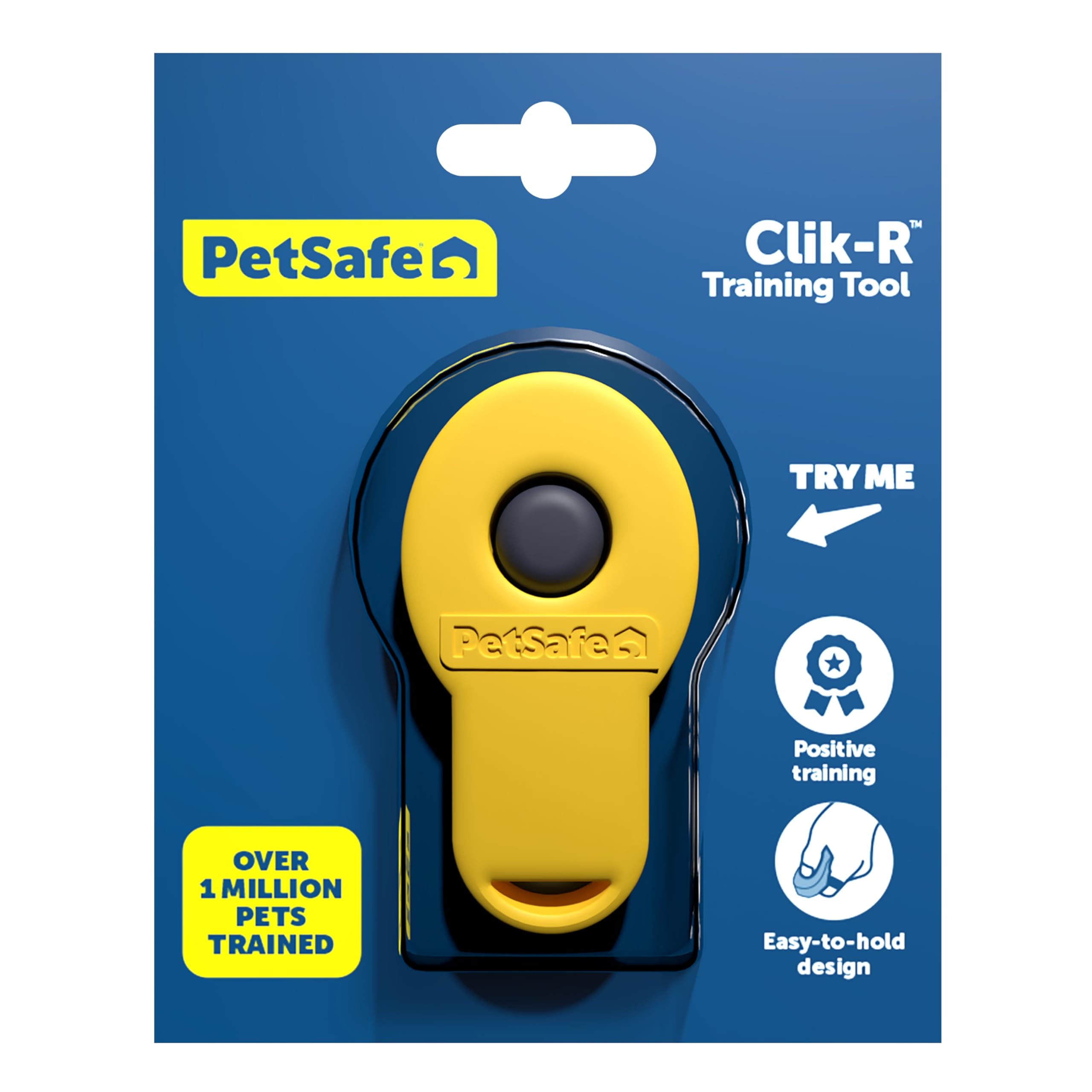
PetSafe Clik-R

PetSafe Clik-R

Finger-band fans

Our Score 8.4/10
Check Price

Worth Noting

  • Sold without a warranty
Weight
0.48 oz
Warranty
None
Attachment
Finger band
Clickers Per Pack
1
Read the full review

The Clik-R is a small yellow clicker on a snap band that slides over a finger, so it sits under your thumb without being gripped. The idea is good: with a leash in one hand and a treat pouch in the other, a clicker you don't have to hold is one less thing to drop.

The execution is where it gets shaky. The click is lighter and quieter than most here, and the mechanism is the part to worry about: the button can engage only along one edge, or the click can go quiet after a few days of use. Since the click is the entire product, that's not a small complaint, and it's the reason this one sits at the bottom of our list rather than in the middle.

When the unit is good, it's comfortable and unobtrusive — under half an ounce, with simple instructions and a band that stays on a finger without pinching. It's also sold without any warranty.

We kept it in the roundup because the format solves a real problem and plenty of people get on fine with it. Buy it where returns are easy, click it a few dozen times the day it arrives, and listen for a clean, repeatable sound before you build a training plan around it.

Bottom line: A comfortable finger-band clicker that solves the full-hands problem, provided you end up with a unit that clicks strongly and consistently.

How We Tested the Best Dog Clickers

We started by pulling together a shortlist of clickers that kept showing up in training forums, obedience-class recommendations, and our own past test bins—then filtered out anything with a reputation for sticking buttons or brittle plastic. That left us with 16 clickers, which we rotated through three months of real training: weekly obedience class, daily walks around the neighborhood, backyard recalls, and living-room sessions with puppies and adult dogs. Every clicker went into a pocket or treat pouch and came out for sit, down, come, and loose-leash work.

To judge clickability, I pressed each one 100 times in a row with my thumb and noted whether the click stayed crisp or turned mushy, whether the button traveled too far, and whether my hand cramped. I also clicked while holding a leash in the other hand, because that’s the real test of one-handed ease. For volume and noise level, we clicked from across a room, in gusty weather, and around a noise-sensitive dog to see which ones cut through and which startled or got lost. A training aid only works if the dog can hear it without flinching.

Durability got its own round of abuse: we dropped each clicker on a concrete driveway, jangled it in a pocket with keys, and kept clicking to see how the spring held up after a few hundred reps. We compared price against how it survived that treatment—some cheap ones felt like a bargain, others like a false economy. The keepers were the ones with a consistent click, a comfortable press, and enough volume for the setting without being harsh. We’ll keep using them in class and on walks, and we’ll update if a button starts to fail.

How to Choose Dog Clickers

The Sound Comes First

A clicker only works if the sound is identical every time and different from everything else in the room. A mushy press or a rattle in the housing blurs the marker, and a click that is too quiet disappears the moment the wind picks up. Volume is the harder call: you want a click your dog hears at the distance you actually train, without one that makes a sensitive dog duck.

Test it where it will be used. Click once in the kitchen, once from the far end of the yard, and watch the dog rather than the clicker. If the dog flinches, hold it behind your back to take the edge off or pick a quieter model; if the dog doesn't react at ten paces outdoors, you need more volume, not more treats.

Wrist Strap, Finger Band, or Keyring

The attachment decides how the clicker lives between clicks. An elastic wrist strap is the most forgiving, because you can let the clicker dangle while you deliver a treat. A finger band leaves the hand free for leash and pouch, which is why people who train on walks tend to prefer it. A keyring clip keeps it on the leash handle, findable but slower to reach.

Watch the trap attached to each. A short coil won't stretch over a winter sleeve, and a spring strap under tension can pull apart with a dog tugging at it. If you train in gloves or a coat half the year, check the strap length before you fall for the click.

One Clicker or a Pack

Count the handlers and the places you train before choosing a pack size. Two people training one dog need two clickers, and a spare that lives by the back door saves a lot of walking. Colors are for humans — your dog can't tell a red clicker from a blue one — so use them to assign clickers to people, not to dogs.

A four or seven-pack only makes sense if you will genuinely spread them around the house and car. Otherwise a two-pack is the sweet spot: one on the wrist, one on the leash, nothing left to hunt for mid-session.

The Parts That Fail

A clicker has two wearing parts, the button and the strap. Press a new one repeatedly before you trust it: the button should return fully and sound the same on every press. In a multi-pack, compare units against each other, because a stiff or muted one does turn up and it will cost you marks.

A stainless steel clicker element resists rust better than a plain plastic one, but housings and buttons are what break first, usually after a drop. Keep one spare in the car or the treat bin and a dead clicker stops being an emergency.

Frequently Asked Questions

Final Verdict

For most people, the Diyife two-pack is the clicker to buy: a clean metal click, a light button and a body that doesn't slip, with a spare to leave on the leash. If your training happens outdoors and at a distance, the HoAoOo's louder snap is the better tool; if your hands are always full, the Educator's finger strap is worth paying for.

Whichever you choose, press it a few times before your first session and pay every click with a treat.