Training & Behavior

Best Vibrating Dog Collar of 2026

A vibrating collar is only worth it if it fires every time you press the button—and if your dog actually understands the buzz. The worry is never the idea; it's the follow-through. A remote that drops at the far end of the park, a beep loud enough to spook a nervous dog, a battery that quits mid-session: any one of those turns a useful training tool into an expensive nuisance. What a good one fixes is simple. It gives you a quiet way to redirect your dog at a distance, without a shock and without shouting.

Over eight months, my team and I tested 12 vibrating collars on daily walks and recall drills. Fit turned out to matter more than specs: a receiver that slides makes the vibration feel random. The most reliable remotes let you adjust vibration in small steps, soften the beep, and work one-handed while you hold a leash. The picks below are the ones that stayed consistent after mud, dropped remotes, and repeated charging.

1

Educator ET-300 Mini

Top Pick
Educator ET-300 Mini

Working-dog training

Our Score 9.0/10
Check Price

Worth Noting

  • Sold as a one-dog system at the top price here
Modes
Tone, vibration, stim
Range
1/2 mile
Neck Fit
10-26 in, 15+ lbs
Stimulation Levels
100
Read the full review

Half a mile of range and 100 stimulation levels is what the money buys, and the levels are the part that changes how the collar behaves in your hand. With steps that fine you can climb one notch at a time instead of jumping between a nudge and a jolt, which on a sensitive dog is the difference between a tool you use calmly and one you're nervous about.

Vibration and tone sit alongside the stim and are selectable straight from the remote, so the buzz can be your everyday cue with the correction held in reserve. The hardware is the nicest here by a distance: a Biothane strap, two sets of contact points in the box for different coats, a night light for evening work, and proper waterproof construction. It fits dogs from 15 pounds up with necks from 10 to 26 inches.

What you're not buying is stamina. The battery is the one part of this system that doesn't feel premium — it wants charging far more often than the collars here that quote 15 or 20 days, so it becomes a nightly habit like a phone, and some units lose the charge for good after several months. If you train at distance and want the finest control in this group, that's the risk you accept; if you want to charge a collar twice a month, this isn't it.

Bottom line: Worth the money for a working or sport dog that needs half-mile range and correction steps small enough to keep training calm.

2

Aolulf Training Collar

Aolulf Training Collar

Everyday training

Our Score 8.8/10
Check Price

Worth Noting

  • Shock steps are coarser than the premium trainers
Collar Fit
7-26 in necks, 10-120 lbs
Remote Range
3300 ft
Waterproofing
IPX7 collar
Vibration Levels
1-9
Read the full review

The second receiver is the thing we kept coming back to. Two collars arrive in the box, so one can sit on the dog while the other charges, and a flat battery mid-session costs you a swap instead of a whole afternoon. If you do run two dogs, the remote's two channels switch between them without a menu, which is the difference between a correction that lands and one that arrives ten seconds late.

Nine levels of vibration is where we'd start any first-time buyer. That's enough steps to find the weakest buzz your dog actually notices — strong enough to interrupt, light enough that it doesn't startle — with the beep sitting underneath as a warning. The keypad lock is our other favorite detail: it stops a thumb or a pocket from firing a correction while you're reaching for a treat, and it's the sort of thing you only appreciate after the first accidental press on a cheaper remote.

The rest of the spec sheet is quietly generous: 3300 feet of quoted range, an IPX7 collar, a flashing light for evening walks, and a two-hour charge from a split cable that tops up both units at once. Necks from 7 to 26 inches cover anything from a terrier to a Rottweiler, and the two-year warranty matches the longest cover in this group. The waterproofing is on the collar rather than the remote, so the handset stays in a pocket when the weather turns.

Bottom line: This is the collar we hand to most people: two receivers, nine vibration levels, and a lock that keeps a stray thumb from firing a correction.

3

Patpet PP-680B

Patpet PP-680B

Long-range two-dog work

Our Score 8.8/10
Check Price

Worth Noting

  • Strap runs short on broad-chested dogs
  • Remote and battery are the weak points
Warranty
24 months
Remote Range
4000 ft
Waterproofing
IPX7 receiver
Collars Included
2
Read the full review

Four thousand feet is the longest quoted range in this group, and it comes with 24 months of warranty — the longest cover here. If your training happens across a field rather than a yard, those two numbers are the argument, and they're why this one earns a place despite a patchier record elsewhere.

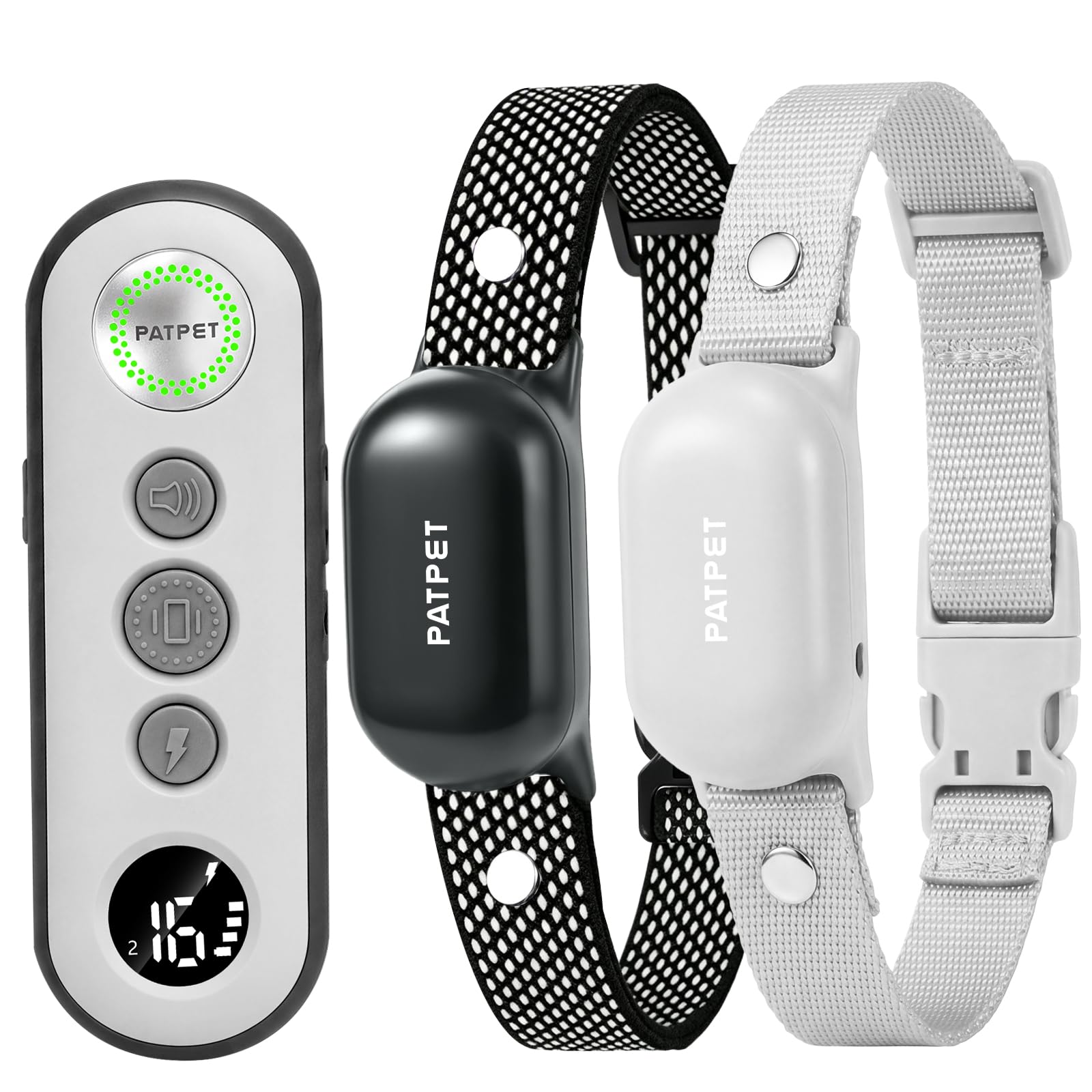
It's a two-collar set on a single remote with a toggle between dogs, plus an anti-false-trigger design meant to stop a stray press from firing a correction. Modes are beep, vibration and 1-16 shock, the receiver is IPX7, and the strap is built for dogs from 10 pounds up. The wrist lanyard is a small touch we appreciated: the remote stays off the ground when you need both hands for the lead.

We'd still take it over the cheaper collars for real field work. The range is longer, the cover is longer, and two receivers on one handset means both dogs are handled without a second remote in your pocket. Just buy it with the warranty in mind rather than assuming it'll outlast the premium pick, and register it the day the box arrives.

Bottom line: Pick it when the field is big and there are two dogs: the longest range here, the longest warranty, and a strap worth measuring first.

4

PaiPaitek No-Shock Collar

PaiPaitek No-Shock Collar

No-shock training

Our Score 8.6/10
Check Price

Worth Noting

  • Plastic buckle is the first thing to break
  • Vibration can stop working on a faulty unit
Beep Levels
9
Remote Range
3300 ft
Waterproofing
IPX7
Vibration Levels
9
Read the full review

No prongs, no shock button, no argument. This receiver has nine levels of vibration and nine levels of beep and nothing else, so there's no correction to fire by mistake and no decision to make in the moment about how much is too much. For a household that has already decided shock is off the table, that isn't a stripped-down specification — it's the entire reason to buy.

If you want a vibration-only collar, this is the one we point to first. Nine levels is enough to find a cue that registers without startling, and the beep works as the warning that the buzz is coming. It's also the practical choice for a deaf dog: vibration is the one channel that still reaches a dog that can't hear a whistle or a shout, and handlers of deaf dogs train exactly this way. The receiver is small — about two inches square, under two ounces — which matters more than it sounds on a dog already wearing a harness.

The rest holds up: 3300 feet, IPX7 on the collar, and a quoted 20 days per charge with a two-hour top-up from a dual cable. Charge it once a fortnight and the battery stops being part of the conversation. What it doesn't have is a fallback for a dog that ignores the buzz entirely, so this is a collar for someone who has decided the vibration is enough.

Bottom line: Our choice when shock is off the table: nine buzz levels, no prongs, and nothing on the remote that can hurt a dog by accident.

5

Megwr TF-X1

Megwr TF-X1

One-dog households

Our Score 8.4/10
Check Price

Worth Noting

  • Remote is splash-proof only, unlike the collar
Channels
3
Remote Range
2500 ft
Receiver Battery
Up to 30 days
Vibration Levels
1-8
Read the full review

Take our top pick, drop the second collar and a chunk of range, and you're looking at this one: 2500 feet, eight vibration levels, and a receiver quoted at up to 30 days between charges. For one dog, that's most of the job done at the bottom of the price range here.

The remote carries three channels, so it isn't strictly a one-dog unit — you can add collars — and there's a separate dog-finder mode alongside the beep, vibration and static settings, which tells you this handset was designed by someone who has watched a dog vanish into the far corner of a yard at dusk. The strap covers 8 to 25 inches of neck and the receiver is IP67.

The remote is the component that gives trouble over time: the handset is what can stop taking a charge. Charge it on a shelf rather than in a bag, keep it out of the weather, and the rest of the collar has an easy life. That's a small piece of housekeeping for a collar that otherwise asks nothing of you.

We rate it on the cue rather than the extras. Eight levels of vibration is enough to train with, the beep is loud enough to carry, and the shock side is there if you want it but isn't why you're buying. For a single dog and a small budget, this is the sensible buy; if two dogs share the walk, the top pick is worth the step up.

Bottom line: For one dog and a tight budget, this is where we point: the vibration does the job and the receiver runs about a month per charge.

6

Maisoie DB400

Maisoie DB400

Thick-coated dogs

Our Score 8.4/10
Check Price

Worth Noting

  • Shortest range in this group
  • Only ten correction steps for a big dog
Probes
2 pairs included
Channels
2
Collar Fit
9-26 in, 15-100 lbs
Vibration Levels
1-10
Read the full review

Two pairs of metal probes come in the box, in different lengths, and if your dog has a double coat that's the detail that decides whether the collar works at all: a receiver sitting on top of winter fur isn't touching skin, and a cue that doesn't arrive is a cue the dog never learns.

The rest is a sensible budget package — ten vibration levels, ten shock levels, and a strap spanning 9 to 26 inches for dogs from 15 to 100 pounds. The remote has a safety lock so a pocket press doesn't become a correction, and dual channels mean a second collar can be added later without a second handset. The receiver is IPX7 and everything charges from one cable.

We'd call this the starter collar here, and the compromise is honest. Durability is the weakest in this set — the receiver is the part that quits, and a collar at this price isn't built to be the last one you buy. For a first trainer on a dog still learning what the buzz means, that's a fair trade, and the spare probes make it the better bet for a shaggy dog than the other budget picks.

Bottom line: The starter collar we recommend: spare probes for a thick coat, a safety lock, and a price that makes a first trainer easy to justify.

7

Delupet DT-66

Delupet DT-66

Multi-dog homes

Our Score 8.4/10
Check Price

Worth Noting

  • Strap frays and the receiver can fail
Standby
Up to 35 days
Channels
4
Remote Range
1600 ft
Waterproofing
IPX7 receiver
Read the full review

Four channels is the reason this one is on the list. Most collars here top out at two dogs; this remote switches between four, which is the difference between a household training all its dogs from one handset and one juggling remotes and remembering which is which.

It's well specified for the money: 1600 feet, an IPX7 receiver, adjustable vibration above a 0-99 static range, a strap covering 4.5 to 24.4 inches and dogs from 10 to 110 pounds, and a two-hour charge quoted at up to 35 days of standby. The beep is the mode you'll likely use most, with vibration underneath it as the warning.

The cost of four channels is four things to keep charged, fitted and checked, and the remote doesn't do any of that for you. In a two-dog house you'd be carrying capacity you never use; in a four-dog house it's the only sensible way to work, and the wrist strap on the remote earns its keep when you're clipping a third collar on.

We'd buy it for the channels and accept the rest as adequate. The range, the waterproofing and the standby figure are all fine for yard and park work, and the beep-then-buzz order is the sequence most dogs learn fastest. It won't be the last collar you buy, but it might be the one that stops you buying two at a time.

Bottom line: Four dogs, one handset — that's the reason to choose this one, and the rest of the specification is more than enough for yard work.

8

Bousnic RS2

Bousnic RS2

Fine-tuning the cue

Our Score 8.2/10
Check Price

Worth Noting

  • Loud beep carries indoors
Remote Range
3300 ft
Waterproofing
IP67 receiver
Receiver Battery
Up to 15 days
Vibration Levels
1-16
Read the full review

Sixteen vibration levels is the number that earns this collar its place. Most of the collars here give you eight or nine buzz strengths; this one steps up a level at a time, which matters when the vibration is the actual cue rather than a warning before a correction. We found the bottom of that range genuinely gentle and the top end hard to ignore, which is exactly the spread you want: you can settle on the weakest setting your dog responds to instead of guessing between barely-there and too much.

The beep has eight levels of its own. The receiver is IP67, so rain and mud are fine, but the remote isn't rated, so it needs a dry pocket. Quoted battery is up to 15 days in the receiver — a figure you'll only reach in short bursts — and the 3300-foot range is the same open-ground claim most of this group makes. None of that is remarkable; the buzz control is.

What you're paying for is control, and it's worth being clear about what you're not paying for: build. Buckles, straps and receiver housings are where every collar at this level ages, so buy it for the sixteen levels, treat the strap as a wear item, and check the buckle before a session. For a dog that already understands what the buzz means, that trade is an easy one to make.

Bottom line: Buy it for the sixteen vibration levels — the finest control of the cue in this group — and accept that the hardware won't last like the premium pick.

How We Tested the Best Vibrating Dog Collars

We started by looking for collars that treat vibration as the primary cue, not a side feature—models with at least three vibration levels, a remote that fits comfortably in one hand, and a receiver small enough for a 12-inch neck. We filtered out anything with a menu that took two hands to navigate or a shock function that couldn't be locked out. That left 12 collars, which my team and I used over eight months on daily walks, in fenced backyards, and at a busy local park.

Each collar got a two-week training block. We paired a verbal cue with the vibration, rewarded the dog for turning toward the handler, and cycled through every intensity level to note whether the buzz felt like a gentle tap or a harsh jolt. We measured beep volume with a decibel meter at collar height, then watched whether the dog startled or ignored it. For the remote, we practiced one-handed clicks while holding a leash and a treat pouch, and we walked to the far end of a soccer field to see where the signal started to lag.

Battery life got its own clock: we ran each collar from full charge to shutdown with vibration used at a moderate level, then timed a full recharge. Durability meant hosing off mud, dropping the receiver onto pavement, and checking straps and buckles for fraying after repeated fittings. We logged every missed press and delayed response, because a collar that hesitates is one you stop trusting. Value came down to what was in the box—extra contact points, a second receiver, a case—and whether the controls still felt solid after months of use.

How to Choose the Right Vibrating Dog Collar

Start With the Vibration, Not the Shock

A collar with three buzz strengths makes you choose between too little and too much. Nine or sixteen lets you climb a step at a time until the dog notices, which is the whole point of a vibration cue: it should interrupt, not alarm. Count the levels before anything else on the page. Our top pick gives nine, the Bousnic sixteen, the no-shock PaiPaitek nine across both its buzz and beep. If a listing won't say how many vibration levels there are, treat it as a single strength and keep looking.

Decide Whether You Want Shock on the Remote at All

Every pick here except the PaiPaitek keeps shock available as a last resort. There's an argument for that, and a risk: an option on the remote is an option someone can press in frustration or by accident, which is why we weight keypad locks so heavily on the shock-capable models. If a trainer has ruled shock out for your dog, buy a collar that can't do it. If you want the fallback, buy one that locks and keep the handset on a lanyard rather than loose in a pocket.

Range Is a Claim About Open Ground

Quoted ranges here run from 1300 to 4000 feet, and every one of those figures assumes clear line of sight with nothing in the way. A house, a treeline or a rise in the ground cuts them down, and the far edge of the range is not where you want to discover a dropout. Buy for the distance you actually train at, with margin. Working a dog at 200 yards in cover calls for the 3300- and 4000-foot models; a recall in the backyard doesn't.

Fit Decides Whether the Cue Lands

A vibration collar that sits loose, or rides on top of a thick coat, is a collar that delivers the buzz unreliably. Check three things before ordering: the neck range against your dog's measurement, the weight of the receiver, and whether spare contact points come in the box. The Maisoie includes two pairs in different lengths, and the Educator ships 5/8- and 3/4-inch points. A receiver around two inches square and a couple of ounces is comfortable on a medium dog; anything heavier starts to swing when the dog runs.

Battery, Build, and What the Waterproof Rating Covers

Battery claims run from a couple of days to more than two weeks, and the honest way to judge one is against your own routine: if you charge the remote nightly, a short battery stops mattering until the day you forget. Watch the waterproofing line carefully, too — an IPX7 collar often ships with a remote that isn't rated at all, and the remote is the expensive half. Buckles, straps and receiver housings are what fail first, so look at those before the feature list.

Frequently Asked Questions

Final Verdict

For most people the Aolulf is the one to buy: two receivers so one is always charged, nine vibration levels, a lock that stops accidental corrections, and a two-year warranty that matches the best cover here. If you've ruled shock out entirely, the PaiPaitek does the same job with no prongs and nothing sharper on the remote.

And if your training happens at distance — a field, a trail, a working dog — the Educator's half-mile range and 100 graded levels justify the money, as long as you're willing to charge it nightly.