Crates & Gates

Best Dog Doors for Cold Weather of 2026

A dog door is a hole you cut in your house on purpose, and in January that can feel like a bad trade. The good ones pay for themselves by 7 a.m., when the dog lets himself out and you stay under the blanket. The bad ones rattle in the wind, leak a draft you can feel from the hallway, and quietly turn the mudroom into a porch. What you're really buying is a flap that seals behind a wet, excited dog and stays sealed until the next trip outside.

Getting that right comes down to less than you'd think. The frame has to match the thickness of your actual door, and the flap has to be stiff enough to close on its own every single time. I've lived with ten of these over seven months, including a cold snap that froze the latch on my gate, and the differences showed up fast. Sizing trips up more first-time buyers than anything else: measure your dog across the shoulders, not just his height, then add an inch. The picks below are the ones worth cutting a hole for.

1

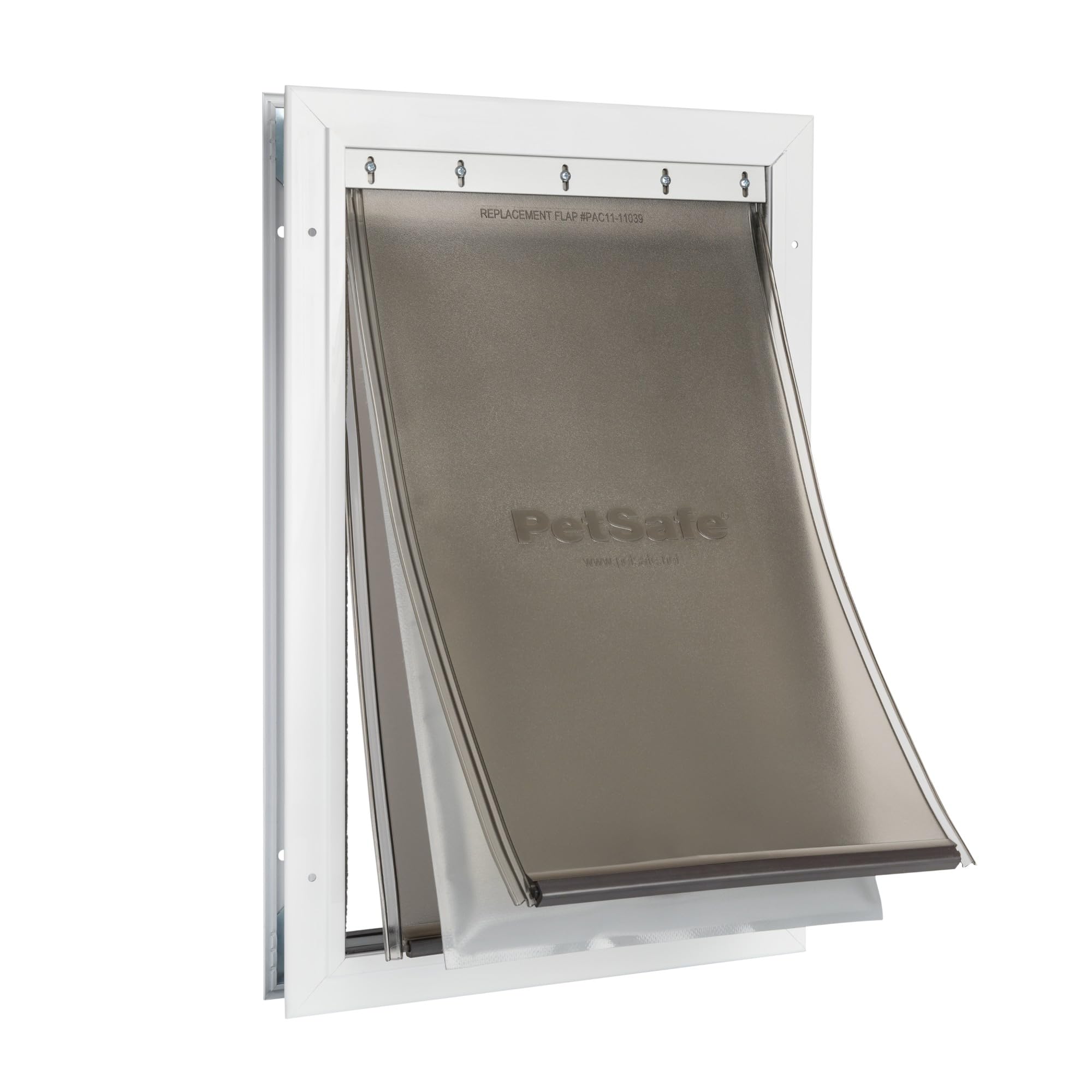
Perfect Pet All-Weather XL

Top Pick
Perfect Pet All-Weather XL

Standard exterior doors

Our Score 9.4/10
Check Price

Worth Noting

  • Wall installs need a separate wall kit
  • One flap can stop seating flush
Insulation
Double vinyl flap with air pocket
Pet Weight
Up to 90 lb
Flap Opening
9 3/4 x 17 in
Door Thickness
3/4 to 1 3/4 in
Read the full review

Two vinyl flaps with a pocket of still air trapped between them is the whole idea, and it works the way double glazing works: the outer flap takes the weather, the inner one keeps the room's air where it belongs. A single sheet of vinyl, which is what the cheapest doors use, has nothing to fall back on when a gust gets under it. Here the second flap is the fallback.

On a windy afternoon this is the door we kept coming back to. The slap-and-settle you hear from a single-flap door every time the dog goes out mostly disappears with the second layer, and the draft at the frame was the least noticeable of the door-mounted doors we fitted. We also liked that the flaps stay light enough for a dog to push through without a run-up, which is not true of every three-flap model here.

Installation is the usual story of a template, a jigsaw and a frame that clamps through the panel. It fits doors from three-quarters of an inch to an inch and three-quarters, which takes in essentially every standard exterior door, and the adjustable frame means you are not hunting for a model in your exact thickness. Going through a wall instead? The wall kit is sold separately.

The flap is a big one at 9 3/4 by 17 inches, sized for the 90-pound end of the range, so there is more vinyl for a small dog to push and more surface for wind to find. On a sheltered porch that hardly matters. On an exposed wall, use the closing slide on the nights the wind gets up and the flap stays where you put it.

Bottom line: We recommend this one to most people cutting a door into an exterior door: the twin vinyl flaps hold a pocket of still air, and the frame spans nearly any door you already have.

2

Baboni Wall 3-Flap

Baboni Wall 3-Flap

Going through a wall

Our Score 9.4/10
Check Price

Worth Noting

  • Needs a wall cutout and a depth check
  • Flaps can hang open after a fast exit
Flaps
Three, with center layer
Frame
Steel and aluminum
Pet Weight
Up to 100 lb
Wall Thickness
4 3/4 to 7 1/4 in
Read the full review

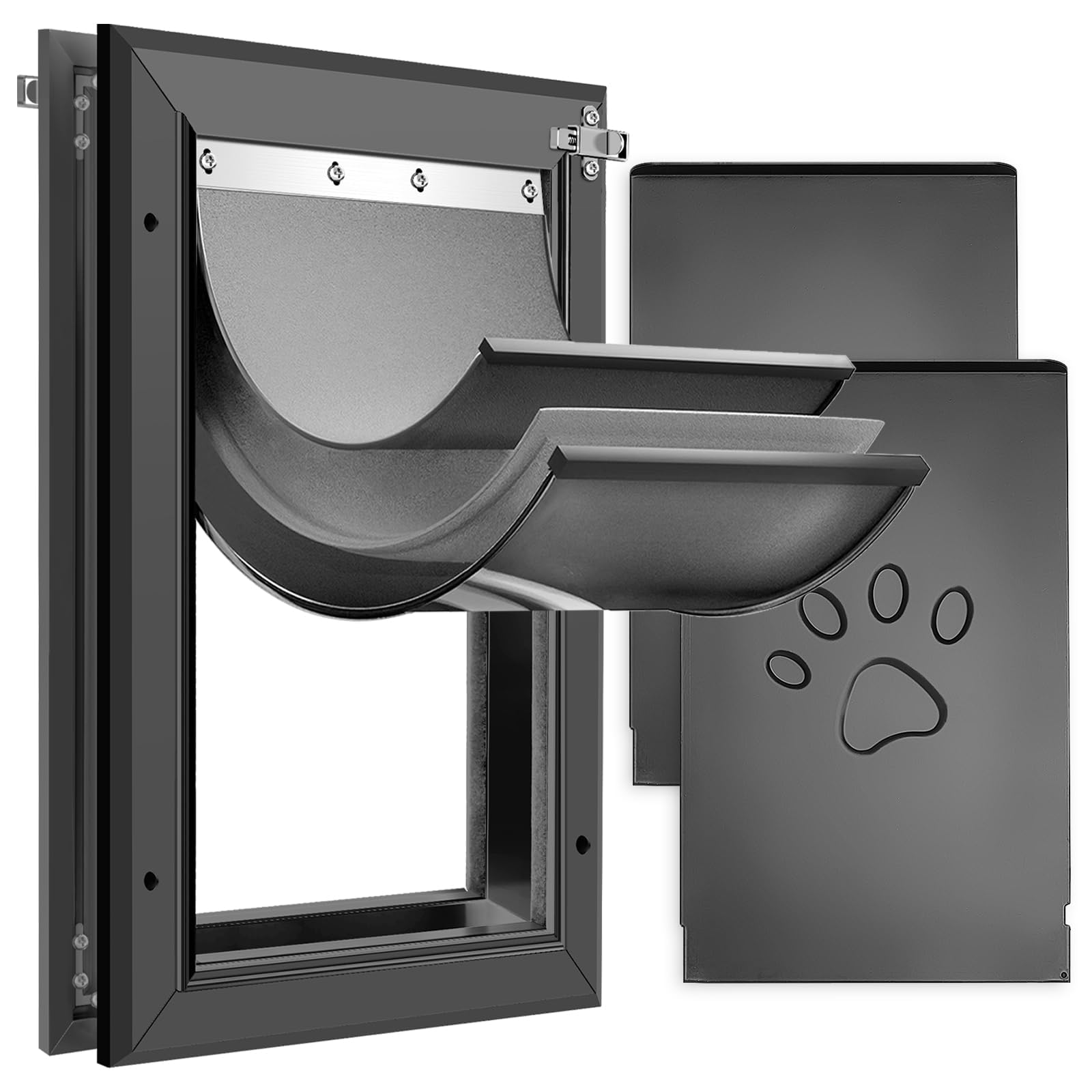
What if there is no door you are willing to cut into, or the door in question is the one thing in the house you will not drill? That is the question the Baboni answers, and it answers it with a steel and aluminum frame rather than the plastic shells most wall units use. Three flaps, a middle insulating layer and a metal lock: it is the wall door we trust most.

The telescoping tunnel spans walls from 4 3/4 to 7 1/4 inches, which covers a framed 2x4 wall with sheathing and siding and most 2x6 walls as well. Two vinyl flaps sit on the faces with the insulating flap between them, so the assembly is three layers deep, and the aluminum lock slides in on the inside when you want the dog to stay put. The frame is the reason to choose it over the cheaper wall door here: it does not flex when a big dog hits it.

Cold is the part to think about. Vinyl stiffens well below freezing and the outer flap is the layer that takes the brunt, so in a place that sees hard minus temperatures a spare flap on the shelf is cheap insurance. The magnets that pull the flap flat do their job in still air; after a fast push-through, check that it has settled rather than hanging.

Bottom line: For a hole through the wall rather than the door, this is the one we trust: a steel frame, three flaps, and a tunnel that spans the wall thicknesses most houses actually have.

3

Petoasis 3-Flap Aluminum

Petoasis 3-Flap Aluminum

Multi-dog homes

Our Score 9.2/10
Check Price

Worth Noting

  • Heavier flaps slow small or older dogs
Flaps
Three, insulated
Frame
Aluminum alloy
Locks
Both sides
Door Thickness
Up to 2.4 in
Read the full review

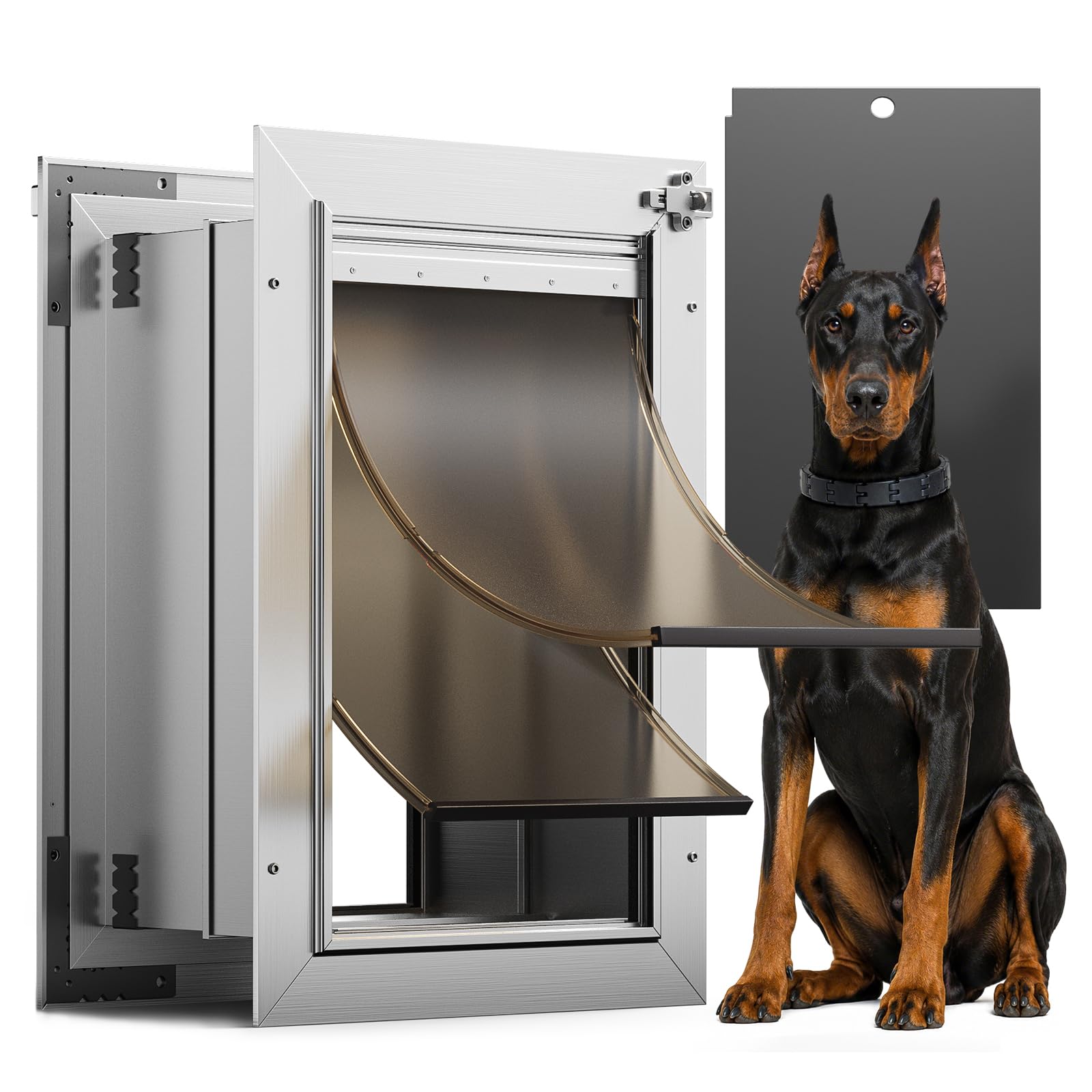
Three dogs, a swinging flap and a door that gets hit a dozen times before lunch is a different problem from one polite Labrador. Petoasis builds for that: a thickened aluminum alloy frame, three flaps with a middle insulating layer, and slide-in panels on both faces so the opening can be locked from inside or out.

The frame is what we liked most. Compared with the PetSafe aluminum door, the Petoasis is beefier at the edges and its tunnel spans up to 2.4 inches, so it sits over a thick door without straining. It earns its keep on noise too: three weighted flaps do not chatter in a breeze the way a single sheet does. The trade is weight. These flaps are heavier than the vinyl on our top pick, and a small or elderly dog may stand at the door a while before committing.

Sealing is the strong suit. The flaps sit close, the middle layer stops wind and rain finding the gaps, and the magnetic lock holds them flat between trips. Flaps are the wear item on any door of this kind, and Petoasis backs this one with three years of after-sales support, including a replacement if your dog damages a flap, which is the promise that actually matters here. Fitting is straightforward for anyone comfortable with a jigsaw.

Bottom line: The one we reach for in a house with several big dogs: a thick aluminum frame, three flaps and a lock on both sides, built to survive being hit all day.

4

PetSafe Extreme Weather Aluminum

PetSafe Extreme Weather Aluminum

Hard winters

Our Score 9.0/10
Check Price

Worth Noting

  • Flaps can blow open on an exposed wall
  • Plastic flap retainer is the wear point
Flaps
Three, insulated center
Frame
Aluminum, reinforced corners
Closing Panel
Slide-in included
Door Thickness
1 1/2 to 2 in
Read the full review

This costs about what our top pick costs and solves the same problem from the other direction. Where the Perfect Pet uses two vinyl flaps with air between them, PetSafe adds a third layer, an insulated center flap, and hangs all three in an aluminum frame with reinforced corners.

The frame is the part that lasts. Aluminum does not rust and does not go brittle the way plastic shells do, and the reinforced corners are there for households where two or three dogs hit the flap in sequence. The tunnel fits doors from 1 1/2 to 2 inches thick, which takes a standard exterior door with room to spare, and the flaps are held shut by magnets.

In still air this is the tightest of the three-flap door units we fitted. That middle insulated layer does real work, and it shows on the inside face of the door. Wind is the qualifier: once a gust gets under the outer flap, the magnet alone will not pull it back flat, and a door on an exposed wall will flutter. On a sheltered wall it stays put.

Two things worth knowing before you order. The plastic strip that retains the outside flaps is the part that ages, a small piece doing a structural job and where these doors eventually fail. And the closing panel that slides in behind the flap is what gets you through a cold snap, which is why we care that it comes in the box rather than as an extra.

Bottom line: Three flaps, an insulated center panel and an aluminum frame: this is the door-mounted build we point to when winter is genuinely hard and the door is thick enough to take it.

5

Ideal Air Seal

Ideal Air Seal

Tightest seal

Our Score 9.0/10
Check Price

Worth Noting

  • Rubber hinges are the wear point
  • Rigid panel suits dogs 35 lb and up
Panels
Dual-pane LEXAN with air gap
Pet Weight
35 to 90 lb
Flap Opening
10 1/2 x 15 3/4 in
Door Thickness
1 1/4 to 1 3/4 in
Read the full review

Most pet doors are a sheet of vinyl in a frame. The Air Seal is a window: two rigid LEXAN panels with an air gap between them, hung on rubber hinges, and it seals better than any flap in this guide. There is no vinyl to curl and nothing to flutter, and a dog going out does not leave a sheet of material swinging behind it.

The panel measures 10 1/2 by 15 3/4 inches, which suits dogs roughly in the 35 to 90-pound band, and it fits doors from 1 1/4 to 1 3/4 inches thick. A spring-loaded slide locks the opening when you want the dog in. Because the panel is rigid, the dog has to push it open square rather than nosing under a soft edge; most figure it out in a day, but a hesitant dog takes longer than it would with vinyl.

What you give up is longevity at the hinge. The rubber hinges connecting the panels are the part that wears, and after a season or two of constant use the seal can start to go along the bottom edge. That is the trade for the best draft performance here, and this is the least expensive of the large door-mounted doors in the guide: a fair swap for a lot of houses, a poor one for a dog that goes in and out all day.

Bottom line: We rate this the tightest seal in the group: two rigid panels with air between them and nothing to flap in the wind.

6

Baboni 3-Flap Medium

Baboni 3-Flap Medium

Medium dogs

Our Score 9.0/10
Check Price

Worth Noting

  • Fits only 1 3/8-inch doors
Flaps
Three, magnetic
Pet Weight
Up to 40 lb
Flap Opening
8 1/4 x 12 1/4 in
Door Thickness
1 3/8 in
Read the full review

This is the cheapest way into a three-flap door, and the design is the same idea as the wall version above: two vinyl flaps with a middle layer between them, held shut by magnets, with a slide-in insert that closes the opening at night. Baboni builds it in plastic rather than steel to reach that price, and for a medium dog on the right door it is a lot of insulation for the money.

The frame is thicker than the usual budget shell and the flaps have some weight to them, so the door does not feel like a toy. The magnets are strong, strong enough that the flaps snap shut with a click, and strong enough that a tentative dog may need a couple of days to learn to push through them.

The part we did not expect was the insulation. Three layers with magnets doing the sealing keep the cold on the far side of the door, and the only weather that gets through is wind-driven, when a gust lifts the outer flap before the magnets catch it. The dogs learn it quickly; the humans learn not to prop it open.

The catch is the tunnel. It is listed at a single 1 3/8-inch door thickness, and most exterior doors are thicker than that, so measure the edge of your door before ordering. On a door that thin it is the value pick of the group; on a standard exterior slab the frame will not clamp, and no amount of insulation makes up for a door that does not fit.

Bottom line: The cheapest three-flap door here, and our budget pick for a medium dog on a thin door, but check your door's thickness because the tunnel fits one size only.

7

VOSOIR Wall Dog Door

VOSOIR Wall Dog Door

Thick walls

Our Score 8.8/10
Check Price

Worth Noting

  • Won't fit walls under about 4 in
Frame
Aluminum alloy
Pet Weight
Up to 110 lb
Flap Opening
18.7 x 9.92 in
Wall Thickness
3.95 to 7.5 in
Read the full review

Wall thickness is where wall doors live or die, and the VOSOIR covers the widest span here: 3.95 to 7.5 inches. For brick veneer, deep sheathing or a 2x6 frame, the telescoping tunnel reaches through without a separate extension kit. Frame and locks are all aluminum, which is unusual at this end of the price range.

The flap opening is 18.7 by 9.92 inches, tall rather than wide, and the panel is a translucent brown-black that cuts UV along with blocking air. Locks and a removable closing panel sit on both faces, so the opening can be secured from indoors or out, and spare flaps come in the box, a detail we appreciate more than most because the flap is what wears first.

Where it falls short is the other end of the range. The tunnel starts at just under four inches, which puts a bare 2x4 wall with thin siding below its fit, so measure the full depth rather than the stud. It is rated to 110 pounds, and the tall opening suits a leggy dog better than a wide, low one. Through a standard wall the Baboni's steel frame is the sturdier buy; through something genuinely thick, this is the one that reaches.

Bottom line: Deep walls are where most wall doors run out of tunnel; the VOSOIR reaches 7.5 inches and is our pick for a thick wall.

How We Picked and Tested Cold-Weather Dog Doors

We started with roughly 30 doors from brands that specialize in pet doors and narrowed the list by the things that decide whether a door survives winter: whether the frame adjusts to a two-inch insulated exterior door or a deeper wall tunnel, whether the size range covers a 20-pound terrier and a 90-pound shepherd, whether the flap is magnetic, and what the hardware is made of. Price counted, but only against what came in the box. Ten made the cut, and each one stayed installed for seven months.

Installation was timed, solo, with a jigsaw and the manufacturer's template. I noted whether the frame needed shimming, whether the tunnel extension actually covered my door thickness or left a gap, and how much of the assembly was plastic versus metal. After dark I ran a flashlight along the inside of the frame and looked for light at the edges, then checked again a week later once the dog was using it daily. Fit is what sinks a cold-weather door; the flap takes the blame for a draft that's really a frame sitting proud of the door.

Then the weather did the rest. On windy mornings I held a tissue at each corner of the flap and watched whether it fluttered. I stood inside while the dog pushed through at a run, noting whether the flap swung shut on its own or hung open — the magnetic ones mostly snapped back, the single-sheet ones often didn't. Over five months I watched for hinge cracking, flap curl, and magnets that had lost their pull, and I worked every lock and slide-in panel one-handed with gloves on, the way you actually do it holding a leash.

How to Choose Dog Doors for Cold Weather

Door mount or wall mount

Start with where the hole goes. A door-mounted unit clamps through the door panel and covers a thickness range; three-quarters of an inch to an inch and three-quarters takes in nearly every exterior door, while some models want a thicker slab. A wall-mounted door uses a telescoping tunnel that spans the wall depth and needs a bigger, messier cut.

Measure your door at its edge with the door closed, and measure a wall from the interior surface to the outside siding rather than just the stud. A door unit does not become a wall unit on its own: the wall kit is usually a separate purchase, and a purpose-built wall door is the better route.

What actually blocks the cold

Still air is the insulator. A single vinyl flap has nothing behind it, so when it lifts, the room is open. Two flaps trap a pocket of air between them, and three flaps with an insulated middle layer add another barrier, the same principle as double glazing. Rigid dual-pane panels take it furthest: no vinyl to curl, no flap to slap.

The cost lands on the dog's side of the door. Every extra layer is another thing to push, and a heavy three-flap door will stall a small or older dog until it learns the technique. Match the number of layers to the dog as well as the climate.

Sizing the opening to the dog

Flap dimensions matter more than the weight rating, which is only a rough guide. Measure your dog across the shoulders and from the floor to the top of the shoulder blades while it stands, then add an inch each way.

A door rated for a hundred pounds has a flap a terrier will struggle to push and that catches far more wind; a door built for a forty-pound dog will scrape a shepherd's hips. Between two sizes, go up: a dog that has to squeeze will stop using the door.

Cold, plastic and the parts that wear

Freezing weather is hard on materials. Vinyl stiffens, and the plastic retainer strips that hold a flap in place turn brittle and crack. A metal frame outlasts a plastic shell, but the flap and its retainer are the wear items on every door here, whatever the frame is made of.

Before you buy, confirm that replacement flaps are sold for that model, and keep one on the shelf. A torn flap in January is an open hole, and waiting on a part is the worst possible time to have one.

Wind exposure decides more than the spec sheet

A magnetic seal holds a flap shut in still air and loses the argument with a gust. Two doors with identical specifications behave differently on a sheltered porch and on a wall facing the prevailing wind, so judge your own site before the listing.

If the door is exposed, plan on the slide-in closing panel for the coldest weeks, or on a screen or fence that breaks the wind. It is also worth checking how the flap sits after a hard push-through: some settle back flat, some hang.

Frequently Asked Questions

Final Verdict

For most homes the Perfect Pet All-Weather is the one to buy: two vinyl flaps trap a pocket of air, the frame fits nearly every exterior door, and it takes a large dog without complaint.

If there is no door you are willing to cut, take the Baboni wall door instead. If your winters are brutal and your door is at least an inch and a half thick, the PetSafe aluminum three-flap is the tougher build. Anyone chasing the tightest possible seal should look at the Ideal Air Seal, and go in knowing the hinges are the part that ages.