Crates & Gates

Best Dog Door of 2026

A dog door is a hole in your house that you make on purpose, so the good ones feel like small feats of engineering and the bad ones feel like a mistake you stare at every day. Done right, one buys your dog the run of the yard and buys you back your mornings; done badly, it whistles in a cold wind and you spend the winter wedging a towel against the flap. What you're really paying for isn't the hole — it's everything around it.

I have two dogs and a back door that takes the weather, so I had a personal stake. Over eight months my team and I installed and lived with 11 dog doors — through a hot summer, a wet fall, and the first cold snaps — tracking how each fit the opening, how the flap swung and settled, whether it sealed, and what it took to install solo. One thing I'd tell a first-timer: size by shoulder height and chest width, not weight. The picks below are the ones that earned their screws.

1

Baboni Wall 3-Flap

Top Pick
Baboni Wall 3-Flap

Wall installation

Our Score 9.4/10
Check Price

Worth Noting

  • Flaps can tear or hang open over time
Flap Design
3-flap
Flap Opening
8 1/4 x 12 1/4 in
Wall Thickness
4 3/4 - 7 1/4 in
Pet Weight Limit
40 lb
Read the full review

The Baboni’s telescoping tunnel is the reason it works in a wall between 4 3/4 and 7 1/4 inches thick, and it is the wall-entry door we reach for when a standard door is not an option. Its tunnel bridges that gap without a stack of separate extenders, and the three-flap stack gives you an outside flap, an inside flap, and an insulating layer in between. That is a lot of door for a medium pet, and the aluminum frame and lock make it feel more like a permanent fixture than a plastic insert.

The three-flap arrangement is the weather story, and the telescoping tunnel is the installation story. The frame and lock are the parts that sold us. The flap opening is 8 1/4 by 12 1/4 inches, and the frame is 12 1/4 by 17 1/8 inches, so measure the wall opening before you cut.

For a garage, mudroom, or exterior wall where you want a solid lock and a real weather barrier, this is the premium wall pick. It is not a renter’s project, and a dog over 40 pounds needs a different model; the medium opening is not generous.

Bottom line: If the door has to go through a wall, the Baboni’s telescoping metal tunnel and triple flap are the strongest wall-entry package here for pets up to 40 pounds.
2

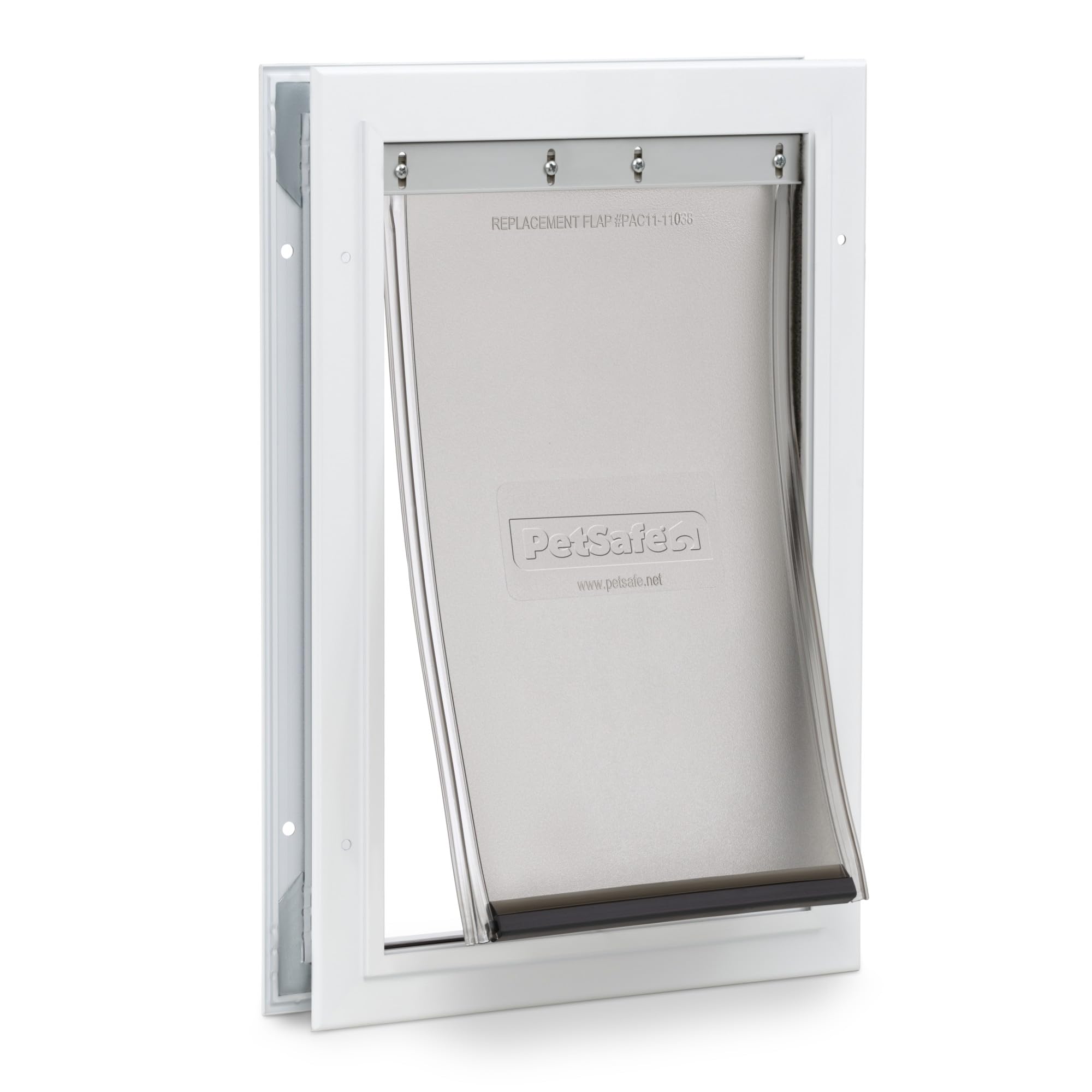
PetSafe Freedom Aluminum

PetSafe Freedom Aluminum

Standard doors

Our Score 9.2/10
Check Price

Worth Noting

  • Flap can hang open in strong wind
Frame
Aluminum
Flap Closure
Magnetic
Door Thickness
0.38–2 in
Pet Weight Limit
40 lb
Read the full review

Most dog doors end up in a human door, and that is where the Freedom Aluminum makes the most sense. It fits doors from 0.38 to 2 inches thick, uses a medium magnetic flap for pets up to 40 pounds, and surrounds the opening with an aluminum frame rather than plastic. That frame is the reason we start here: it holds its shape around a dog that leans and pushes, and it gives the flap a solid edge to seal against. The included closing panel is a useful extra when you want the dog contained.

We also appreciate the cutting template, which turns a permanent cut into a manageable weekend project. The mismatch to watch is the hardware: the frame is aluminum, but the supplied screws are plastic, so they are the first thing to strip if you overtighten them. Treat the installation as a measuring job, not a race. Done carefully, the result is a clean, low-profile door that does not look bolted on.

The medium size is the real boundary. It is rated for pets up to 40 pounds, and a larger dog needs one of the XL models here. For the standard wood, PVC, or metal door in a typical home, though, this is the least complicated route to a finished dog door.

Bottom line: We recommend the Freedom Aluminum as the default for standard doors and dogs up to 40 pounds; its metal frame and closing panel make it the most sensible starting point.

3

Ideal Designer XL

Ideal Designer XL

Large dogs

Our Score 9.2/10
Check Price

Worth Noting

  • Flap and bottom corners can wear over time
Frame
Plastic
Flap Opening
10.5 x 15 in
Door Thickness
1.25–2 in
Pet Weight Range
36–90 lb
Read the full review

The first number to notice on the Designer Series XL is not the 10.5 by 15 inch flap; it is the 11.75 by 17.5 inch cutout. A door for a 36-to-90-pound dog needs that bigger hole, and the extra frame is what makes the opening feel roomy rather than marginal. This is the pick for a large dog that still uses a human door, not a wall.

The frame is impact-resistant plastic, not aluminum, so it relies on a snug fit and careful screw tension rather than metal stiffness. We like the lock-out slide and the flexible vinyl flap, and the 20-minute install estimate is realistic for a handy homeowner with a jigsaw. The cutout is the part to measure twice; a flap that looks big enough on paper can still leave a tall dog ducking.

The size is the reason to buy: a tall dog clears it without ducking, and the lock-out slide gives you control. It is not the door for a 40-pound dog, and it is not the door for a wall; those buyers have better options here.

Bottom line: For a big dog that needs a real door-mounted opening, the Ideal Designer XL is the large-flap pick, provided your door is 1 1/4 to 2 inches thick.

4

Ideal Air Seal

Ideal Air Seal

Draft-prone doors

Our Score 9.0/10
Check Price

Worth Noting

  • Plastic frame and hinge points can wear
Flap
Dual-pane LEXAN
Flap Opening
10.25 x 15.75 in
Door Thickness
1.25–1.75 in
Pet Weight Range
35–90 lb
Read the full review

The Air Seal’s dual-pane flap is the reason to look at this door if drafts are your main complaint. It uses LEXAN panels with an air gap between them, and that is the design detail that matters in a cold hallway or a heated garage. The large flap is 10.25 by 15.75 inches, and the door fits 1 1/4 to 1 3/4 inch thick doors.

We like the spring-loaded locking slide and the fact that the rigid panels do not flutter the way a thin single flap can. The frame is plastic, though, and the weather seal depends on the flap sitting flat; if the door is out of square, that seal is harder to get. Installation is straightforward for a door-mounted unit, but the thickness range is narrower than some here.

For a large dog and an exterior door where heat loss is the main worry, this is the more comfortable choice than a basic single-flap door. It is not the cheapest way into a dog door, and it will not suit a thin hollow-core door; the 1 1/4-inch minimum is a real limit.

Bottom line: If drafts are the reason you are shopping, the Air Seal’s dual-pane flap is the insulated door-mounted pick here for dogs from 35 to 90 pounds.

5

NAMSAN Screen Door

NAMSAN Screen Door

Screen doors

Our Score 9.0/10
Check Price

Worth Noting

  • Passage can be tight for broad-chested dogs
Frame
ABS
Passage
12 x 14 in
Pet Weight Limit
80 lb
Screen Thickness
0.5 in
Read the full review

The NAMSAN’s screw-through frame is made for a screen door, where there is no thickness to cut, just a membrane to support. It uses a 12 by 14 inch passage in a 14 by 16 inch frame, and it screws through the screen with nuts on the back. That hardware is the part that decides whether the door feels solid or starts to sag.

We like the magnetic self-closing flap and the ABS frame; for a porch door, that is a sensible balance of weight and stiffness. The installation is quick, but the screen itself needs to be taut and the screws need to be snug, not cranked down. On a loose or brittle screen, the frame can pop out of place when a big dog hits it.

This is a porch and screen-door solution, not a security door. If the door is your main house entry, a solid-door or wall model is the better answer. For a screened porch where the dog comes and goes all day, it is a low-effort way to stop the screen from being scratched apart.

Bottom line: For a screen door or a screened porch, this is the practical add-on we recommend for pets up to 80 pounds, as long as you reinforce the screen around it.

6

PetSafe Sliding Glass

PetSafe Sliding Glass

Sliding glass doors

Our Score 8.8/10
Check Price

Worth Noting

  • Flap can blow open in wind
Fits Height
75 7/8 to 80 11/16 in
Panel Width
11 1/2 in
Flap Opening
8 1/4 x 13 3/16 in
Pet Weight Limit
40 lb
Read the full review

The PetSafe Sliding Glass door solves the rental problem without cutting, but it takes an 11 1/2-inch bite out of the walk-through opening. The assembled panel drops into your existing track and adjusts from 75 7/8 to 80 11/16 inches tall. That width is the detail we put first, because it changes how the door feels every day.

For renters and anyone who does not want to cut a wall, the trade is worth it. The medium flap is 8 1/4 by 13 3/16 inches and suits dogs up to 40 pounds; the aluminum frame and latch kit let you lock the slider once the panel is in place. We also like that it comes assembled, so the project is mostly lifting and adjusting rather than sawing. The closing panel slides over the flap when you want to keep the dog in.

In a sheltered spot, the convenience still wins: no cutting, no repair to the door, and the panel comes out when you move. An exposed slider is the setting where we point people to a wall door instead.

Bottom line: For a sliding glass door and a renter-friendly install, this panel is the one we recommend, as long as you can give up 11 1/2 inches of walk-through width.

How We Tested the Best Dog Doors

We started with about 40 doors from brands that have been making them for years, plus the cheaper options that keep surfacing in reviews. We filtered for size range — most models come in three to five flap sizes, and one that only fits a Lab is useless to a lot of households — along with material, price, and whether the maker sells replacement flaps. That left 11.

I installed all 11 myself, timing each one with a drill, a jigsaw, and a tape measure. One went into a steel back door, one into a wooden garage side door, and the rest into interior doors. I noted whether the cutout template matched the frame, whether I needed shims to get it sitting flat, and whether I could manage the job solo. Then I pushed on the upper corners of each frame to feel how much it flexed.

Then came eight months with two dogs of very different sizes. I watched whether the flap swung freely for the smaller one or took a firm push, whether it settled flush or hung ajar, and whether it slapped loudly enough to hear from the next room. On breezy days I ran a hand around the flap edges and looked for daylight. I also slid each lock panel to see whether it moved easily for me and held against a dog's nose, and checked monthly for cracks, warping, and hinge wear.

At the end we set the price against what came in the box — replacement flap, warranty, hardware — and ranked accordingly. The doors that held their shape and sealed tightest are the ones recommended below.

How to Choose the Right Dog Door

Match the Door to the Opening

A standard human door is the simplest place to start. A door-mounted unit cuts through one slab and usually takes an afternoon; the PetSafe Freedom Aluminum covers doors from 0.38 to 2 inches thick. A wall gives you more placement freedom but needs a telescoping tunnel and a larger cutout; the Baboni fits walls from 4 3/4 to 7 1/4 inches. Sliding glass doors use an assembled panel in the track, and screen doors use a screw-through insert. Measure the actual opening and thickness before you shop.

The trap is assuming every model fits every opening. A standard-door unit is not a wall unit, and a screen insert has nothing to clamp to on a solid slab.

Measure the Dog at the Flap

Weight ratings are a rough guide, not a fit guarantee. Shoulder height and chest width decide whether a dog clears the opening, and two dogs at the same weight can need different flap sizes. Check the flap opening, not the outer frame; the Ideal Designer XL uses a 10.5 by 15 inch flap inside an 11.75 by 17.5 inch cutout. For a broad-chested dog, passage width matters more than the pound rating.

If your dog is between sizes, size up only when the door or wall has room for the larger frame. A flap that is too small gets scratched at the edges and can make the dog reluctant to use it.

Decide How Much Weather You Need to Keep Out

A single flap is fine for a sheltered interior door or a mild climate. A triple-flap or dual-pane design is for an exterior door that faces wind, and the difference is most obvious on a cold or windy day. Magnetic closures help the flap settle, but a light flap can still blow open in a gust. If your door is exposed, look for a rigid panel or a deep frame, and plan a wind block.

The PetSafe Sliding Glass panel is convenient, but its single flap is best on a sheltered slider. The Ideal Air Seal uses dual-pane LEXAN panels with an air gap, which is the more serious cold-weather choice for a standard door.

Plan the Cut, the Lock, and the Cleanup

Every door-mounted or wall-mounted unit needs a cutout, and the template is a guide rather than a substitute for checking the actual door thickness. Before you cut a wall, check for wiring, plumbing, and framing. A closing panel or lock-out slide is what controls access when you want the dog in or out, and a screen-door insert is not a substitute for a secure main entry. A helper and a sharp jigsaw make the job safer.

If the door is hollow-core, thin, or out of square, fix that first or choose a different installation. The door has to carry the frame and the dog’s traffic; a loose fit will show up as a draft and a flap that does not seal.

Frequently Asked Questions

Final Verdict

Our default is the PetSafe Freedom Aluminum: it fits the standard door most people already have, and the aluminum frame is the right material for a dog that leans and pushes. The medium flap suits dogs up to 40 pounds. If your dog is larger, go to the Ideal Designer XL; if the door has to go through a wall, the Baboni is the better project.