Grooming

Best Dog Dryers of 2026

Bath time ends, the towel comes out, and for about three seconds your dog looks like a drowned rat — then the shake hits and water lands on the walls, the mirror, and you. Towels only get so far, especially on a double coat, where the underlayer stays damp for hours and leaves that wet-dog smell in the couch cushions. A dryer is what actually finishes the job: it pushes air past the topcoat and down to the skin, turning a 45-minute towel-and-air-dry into something closer to ten.

Over the past six months, my team and I ran nine dryers through real baths, muddy walks, and one memorable post-beach rinse. Here's what nobody tells a first-time buyer: heat and drying power are not the same thing. A strong stream of room-temperature air gets a nervous dog dry faster than a warm, weak one he's trying to escape — and once you know that, the numbers on the box start making a lot more sense.

1

EGFKI 5.2HP Dog Dryer

Top Pick
EGFKI 5.2HP Dog Dryer

Most home groomers

Our Score 9.4/10
Check Price

Worth Noting

  • 135 °F ceiling is mild for very thick coats
Power
5.2 HP / 3800W
Nozzles
4
Max Air Speed
72 m/s
Temperature Range
95-135 °F
Read the full review

The EGFKI quotes 5.2 HP and 3800 watts, which is more motor than the Flying Pig we also recommend, for noticeably less money. It's a handle-topped box rather than a steel drum, and at 9.35 pounds you can carry it from the tub to the back step in one hand while the dog drips on your shoes.

That combination is why it's our top pick. Power is what pulls water out of a coat before your dog starts to shiver, and on the cheaper high-velocity machines that power usually arrives with a noise level that turns bath time into a wrestling match. This one doesn't: at the lower speeds the sound sits about where a loud vacuum does, which most dogs tolerate once they've had a sniff of the nozzle. We were also struck by how much of the drying happens on air alone, before the heat matters at all.

Four nozzles come in the box, and the practical benefit is that one can stay on the body while another handles legs and paws, rather than swapping a wet tip every few minutes. Speed and temperature adjust separately, so you can drop the airflow for a face without giving up the warmth. The hose clips on rather than locking, so seat it fully before you switch on.

The detail we keep coming back to is the control: being able to soften the airflow for a dog's head and then open it up again for the chest means you finish the whole dog in one sitting instead of doing the head separately with a towel. That, more than the wattage on the box, is what makes it feel like a grooming tool.

Bottom line: For most home groomers this is the one: enough blow force for a soaked coat, four nozzles, heat that stays safe, and it costs less than the pro-style machines.

2

Flying Pig Flying One

Flying Pig Flying One

Thick double coats

Our Score 9.4/10
Check Price

Worth Noting

  • 11.1 lb is heavy for long sessions
Weight
11.1 lb
Airflow
Up to 240 CFM
Hose Length
10 ft
Heat Settings
Three, 81-160 °F
Read the full review

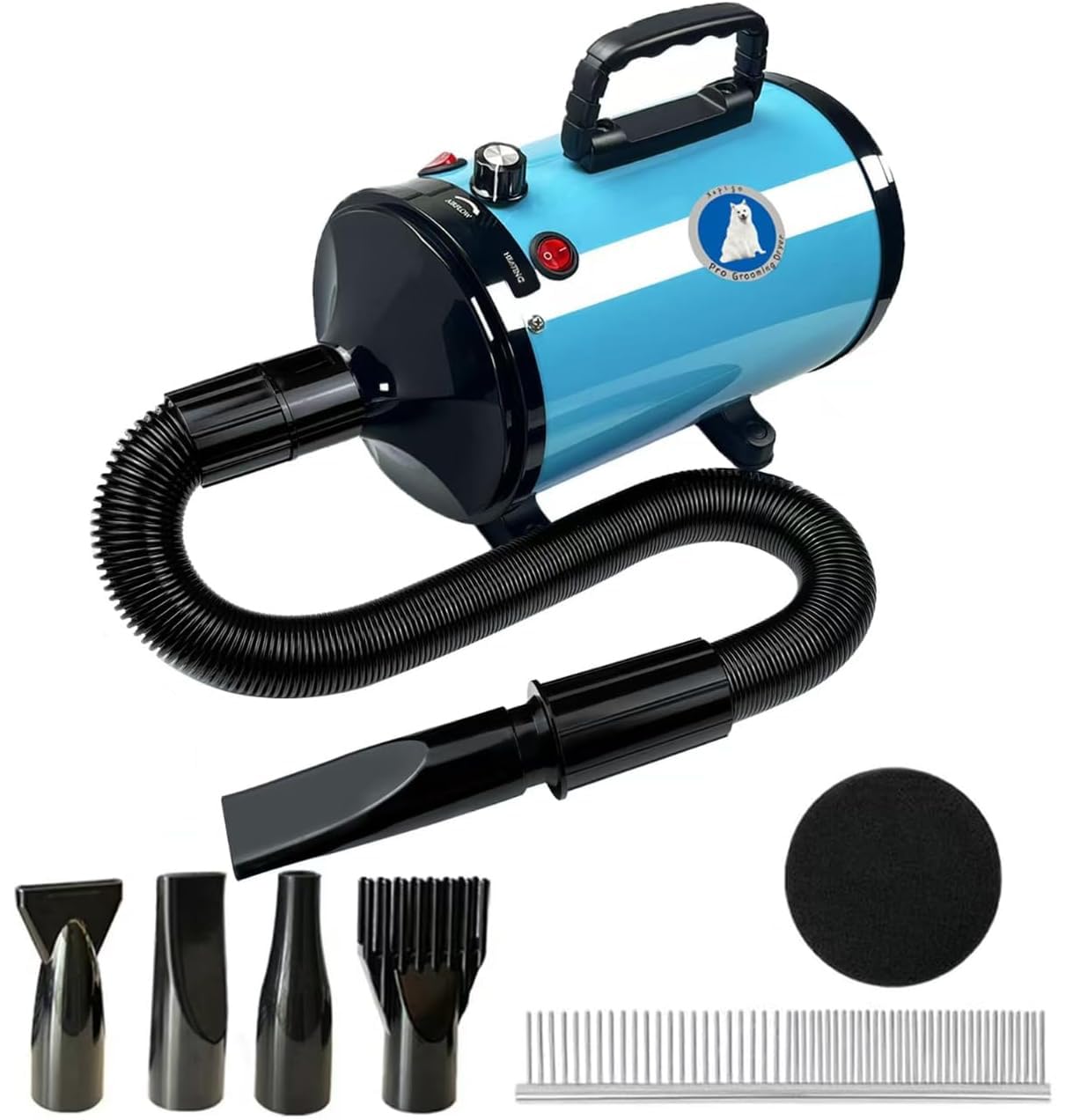
240 CFM is the biggest airflow figure on this page, and it's why this is the dryer we choose for a Newfoundland, a husky or a house full of doodles. That number isn't decoration: it's roughly three times the air volume the SHELANDY quotes, and over a soaked double coat the difference is minutes of work and a dog that isn't shivering by the end.

The surprise is the noise. A machine moving that much air should sound like a jet, and this one reads more like a big vacuum cleaner — at low speed you can talk over it. Heat runs from 81 °F to 160 °F across three settings, and 160 °F is the hottest here, so on the top setting keep the nozzle moving and never park it against skin.

Steel housing, 11.1 pounds, a 10-foot hose and two nozzles: it's built like shop equipment, and it's the only blower here that feels like it belongs on a grooming table. The hose is the part to look after — it clips into the housing and can work loose if you drag the unit along behind you, so coil it loosely and check the connection before each bath.

Bottom line: If you're drying a Newfoundland, a husky or a house full of doodles, the airflow is worth the money — this is the closest thing here to a grooming-shop blower.

3

Xapigo Dog Dryer

Xapigo Dog Dryer

Cheapest high velocity

Our Score 9.4/10
Check Price

Worth Noting

Weight
7.28 lb
Nozzles
4
Hose Length
Up to 90.5 in
Speed Control
Stepless
Read the full review

It costs less than any other high-velocity blower here, and it doesn't feel like a corner was cut to get there: 7.28 pounds, four nozzles, a hose that stretches to 90.5 inches, and a stepless speed dial rather than a handful of presets.

The heat-insulated sleeve at the hose joint is the detail we didn't expect at this price. It means you can grab the hose where it meets the housing with a wet hand without flinching, and it's the sort of thing budget machines usually skip. There's overheat protection as well, which counts for more on an inexpensive unit than an expensive one.

For a single short- or medium-coated dog, this is a lot of dryer for the money, and the stepless dial is genuinely nicer than fixed speeds when you're working around a nervous head. What it doesn't have is a familiar badge on the side, and that's part of why it costs what it does — a fair trade if airflow matters more to you than the name on the housing.

Bottom line: The cheapest real high-velocity blower here, with a stepless dial that lets you creep up on a nervous dog instead of jumping between speeds.

4

SHELANDY Groomer Partner

SHELANDY Groomer Partner

First-time buyers

Our Score 9.2/10
Check Price

Worth Noting

  • Gets sharp and loud at full speed
  • Hose joint is the weak point
Air Speed
65-135 MPH
Hose Length
Up to 7 ft
Airflow Volume
84.7 CFM
Max Temperature
131 °F
Read the full review

Seven speeds is more control than most blowers here offer, and it's the feature that matters most on this one: you can start a nervous spaniel on the lowest setting, let them settle, and work up without ever switching the machine off and restarting the whole introduction.

The rest of the package is unusually complete for the money. There's a heater with two settings and a ceiling of 131 °F, four nozzle tips, and a flexible hose that stretches to about seven feet — enough to reach a back leg without moving your feet. Airflow is quoted at 84.7 CFM with a nozzle speed of 65 to 135 mph, well short of the Flying Pig's volume but plenty for one medium-coated dog.

This is the blower we hand a first-time home groomer who wants to stop paying for baths. It dries, it heats, it comes with the tips you need, and it costs much less than the machines we rank above it. Compared with our top pick it feels like a tool from an earlier generation — simpler controls, a bulkier 10.3-pound body — but it does the same job on a single medium-coated dog, and it's one of the least expensive ways here to get a heater and four nozzles in one box.

Bottom line: A sensible first blower: seven speeds to work a nervous dog up through, a heater, four tips, and a price that undercuts the machines we rank above it.

5

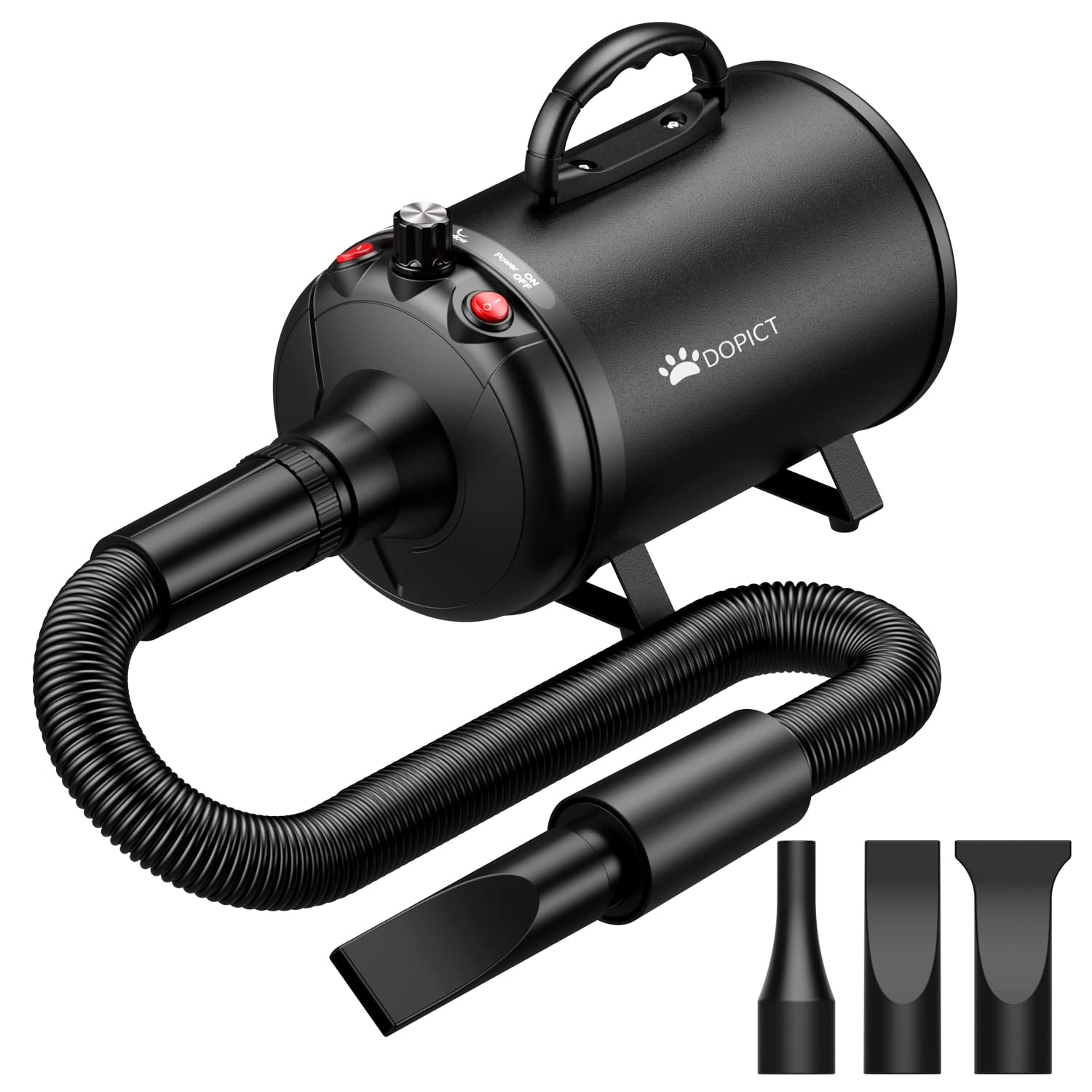
DOPICT 5.2HP Pet Dryer

DOPICT 5.2HP Pet Dryer

Top pick substitute

Our Score 9.2/10
Check Price

Worth Noting

  • Heat stays mild for winter drying
  • Three nozzles instead of four
Power
5.2 HP / 3800W
Weight
9.22 lb
Nozzles
3
Read the full review

If the EGFKI is out of stock, this is the substitute to grab: the same 5.2 HP and 3800-watt rating, near-identical dimensions, the same adjustable speed and heat. The difference you can count is nozzles — three here against four.

The practical case is simple. It's a strong, stable blower with an insulated housing, a raised base that keeps it from tipping when the hose pulls, and a 9.22-pound body that's a touch lighter than our top pick's. Over a wet coat it does what the numbers promise, and the hose has enough reach to work around a big dog without moving the machine.

The heat is the thing to think about. It warms the air rather than driving it hot — comfortable for a September bath, less convincing in an unheated garage in January, and the reason a thick-coated dog takes longer on this than on a hotter machine.

So: same power, same money, one fewer nozzle, and a gentler top temperature. Nothing here makes it the better buy over the EGFKI, and nothing makes it a bad one either. If it's the one that's in stock, you're getting the same class of machine.

Bottom line: If our top pick is out of stock, buy this: the same 5.2 HP and 3800 watts, three nozzles instead of four, and heat that stays on the mild side.

6

Jellyfish Handheld Dog Dryer

Jellyfish Handheld Dog Dryer

Travel and small dogs

Our Score 9.0/10
Check Price

Worth Noting

  • Louder than its size suggests on high
  • Costs more than several full-size blowers
Speeds
2
Weight
1.23 lb
Air Velocity
62 m/s
Temperature Settings
Four, 68-176 °F
Read the full review

At 1.23 pounds this is the only dryer here you can pick up with two fingers, and the difference in how you use it is bigger than that number suggests. There's no hose to drag and no box to set down: you hold it like a hair dryer and follow the dog around the room, which is exactly what you want for a Corgi who won't stand still on a table.

For small and medium dogs it's the pick of the handhelds and a serious dryer by any measure. The 40 mm brushless motor pushes 62 m/s, close to what the full-size EGFKI manages, and the four temperature settings — 68, 122, 149 and 176 °F — let you dry a face on cool and a back on warm without changing attachments.

It isn't a substitute for a big blower on a heavy coat; a Newfoundland's undercoat is still a job for the Flying Pig. The two speeds are coarse next to a stepless dial, and 176 °F is hot enough that you should test it on your own wrist and keep it moving. For a dog that fits on your lap, none of that matters much.

Bottom line: Small dogs, small bathrooms and drying on the road: 1.23 pounds, four temperatures and a real 62 m/s stream you can hold in one hand.

7

shernbao SMD-06P

shernbao SMD-06P

Tight spaces

Our Score 9.0/10
Check Price

Worth Noting

  • 118 °F ceiling is the coolest here
Wattage
2200 W
Mounting
Wall-mount kit included
Hose Length
4-8 ft
Temperature Range
55-118 °F
Read the full review

The wall-mount kit is what makes this the right blower for a small house: screw the bracket next to the tub, hang the unit on it, and the machine is off the floor and out of the way between baths. That one accessory turns a bulky appliance into something you don't have to find a cupboard for, and it's why we keep recommending it to people grooming in a bathroom the size of a closet.

The spec sheet is honest about what it is: 2200 watts, two speeds, three nozzles, a hose that stretches from 4 to 8 feet, and a heat range of 55 to 118 °F. The casing is insulated ABS with the motor circuit kept separate, which is the kind of detail that stops a bathroom appliance from getting hot to the touch after twenty minutes.

It's built for small and medium dogs, and that's the honest way to read it: a terrier or a cockapoo is dry in a few minutes, while a thick-coated shepherd will have you wishing for one of the 3800-watt machines. What you get in return is the tidiest installation here — bracket, hose, done — and a price below every other full-size blower in this group.

Bottom line: The apartment answer — 2200 watts in a compact body with a wall-mount kit, so it hangs out of the way instead of taking up a cupboard shelf.

8

KUUBIA 2-in-1 Dryer Brush

KUUBIA 2-in-1 Dryer Brush

Small dogs and cats

Our Score 8.6/10
Check Price

Worth Noting

  • Not enough power for medium or large coats
  • Heat builds if the brush sits still
Noise
75-85 dB
Power
300 W
Weight
13 oz
Heat Settings
104 °F and 140 °F
Read the full review

This isn't a blower, and reading it as one is the mistake to avoid. The KUUBIA is a 300-watt warm-air brush: the air comes out through a slicker head that dries and detangles at once, and it's built for a Shih Tzu, a Maltese or a cat rather than anything with a double coat.

For that job it's clever. At 13 ounces it's the lightest thing in this group, and you can work it one-handed around a small dog's legs and face without a hose fighting you. The two heat settings, 104 °F and 140 °F, are gentle enough for a dog that already hates the whole business.

The limits are real. On anything bigger than a small breed it turns drying into an afternoon, and 75 to 85 dB is about what a human hair dryer produces — some animals shrug it off, some don't. 140 °F is also hot enough to matter, so keep the brush moving and don't park it against skin.

Where we land: for a small dog or a cat, this does something the blowers can't — brush and dry in one pass — and it's the least expensive product here by a wide margin. For a Labrador, it's the wrong purchase, and patience won't fix that.

Bottom line: For a Shih Tzu, a Maltese or a cat, a 13-ounce warm-air brush that dries and detangles in one pass — and the wrong tool for anything bigger.

How We Tested Nine Dog Dryers

We started by pulling every dryer we could find that shipped with a hose and at least two nozzle shapes, then cut the list by motor type, heat settings, hose length, and what came in the box — spare filters, extra nozzles, a case. Price counted, but only as a question of what you got for it; a couple of the least expensive units outdried models that cost twice as much.

Nine dryers came home with us for six months. They lived in a basement bathroom, on a covered porch, and once in a hotel parking lot after a very muddy hike, drying everything from a 12-pound terrier to a 70-pound golden retriever. For each one, we soaked a towel-dried dog, started a stopwatch, and noted when the undercoat at the shoulders and rump stopped feeling cool to the touch — that's the real finish line, not a dry topcoat.

Noise got measured with a decibel app at three feet, but the reading we trusted more was whether the dog stayed in the room or walked out of it. We put a hand on the nozzle and housing after ten minutes of continuous running, and we paid attention to whether the low setting was genuinely gentle or just a slightly quieter version of high. Power we judged as air velocity at the nozzle rather than wattage on the label. Durability came down to the boring stuff: whether the hose kinked and stayed kinked, whether the filter clogged after three dogs, and whether a unit survived being knocked off a counter twice.

How to Choose Dog Dryers

Match the airflow to your dog's coat

High velocity is a category, not a measurement. What you're buying is air volume, and the spread in this group runs from a 240 CFM blower to a 300-watt brush dryer that's doing a different job entirely. A short-coated beagle is dry in minutes on almost anything; a husky, a doodle or a Newfoundland in full coat needs volume, and the bigger machines are the ones that deliver it.

The trap is the phrase suitable for tiny cats to large breeds, which appears on nearly every listing and tells you nothing. Look for a quoted airflow figure in CFM, or a nozzle speed in m/s or mph, and compare only like with like. If a listing gives no airflow figure at all, treat it as a small-dog tool until proven otherwise.

Judge noise at the speed you'll actually use

Every blower here is loud at full power; what separates them is the sound at the setting you'll work at. Published decibel figures are hard to compare — one unit here quotes 75 to 85 dB, another says nothing at all — and neither number tells you what the machine sounds like on half power in a tiled bathroom.

We weight the lowest speed more heavily than the highest. A dryer whose slowest setting is already shrill is one your dog will learn to dread, and dread is what turns a ten-minute job into a two-person job. Airflow itself makes noise, so a 3,800-watt unit moving 72 m/s of air can never be silent, whatever the box says.

Heat: warm helps, hot hurts

Warm air speeds drying and makes it more comfortable for an older or thin-coated dog. Maximum temperatures in this group run from 118 °F to 176 °F, and that range is the whole argument: at the top end the nozzle has to keep moving and you need to be paying attention, while at the bottom you add a few minutes and stop worrying.

Our rule is simple. Test the air on your inner wrist at the setting you plan to use, dry heads, ears and bellies on cool, and never hold a nozzle still against skin. If the heat feels weak on a January day, a towel and a few extra minutes are a better fix than crowding the nozzle closer.

Weight, hose and where it lives

You'll be holding this for twenty minutes or more, and the range here is from just over a pound to more than eleven. Handheld units with no hose are the easiest thing to use on a small dog and hopeless on a big coat; hose-and-box machines need floor space and somewhere to stand. In a small bathroom, a wall-mount kit solves the storage problem outright.

Hose length matters more than it sounds. Four feet means moving the dog to reach a back leg; ten feet means reaching it from where you're standing. Check how the hose attaches, too — a clip fitting that works loose mid-dry is the hardware failure to watch for, and the reason to coil the hose loosely rather than dragging the machine around by it.

Frequently Asked Questions

Final Verdict

The EGFKI is the dryer we point most people to. It has the blow force of the big machines without their racket, four nozzles, and heat that stays in a band you don't have to worry about — and it costs less than the pro-style blowers here.

Spend up if your dog carries a serious coat: the Flying Pig's 240 CFM is in a different league and will shorten the worst drying jobs. For a small dog, a small bathroom, or drying away from home, the Jellyfish and the shernbao are the two that make the most sense.