Collars & Leashes

Best Dog Harness of 2026

The right dog harness should make a walk feel simpler, not like a wrestling match in the hallway. A harness that shifts or rubs turns every outing into a fitting session, and one that’s hard to put on is the last thing you want with a dog who’s already spinning by the door. What you’re really buying is a secure, comfortable fit your dog can wear without thinking about it—and that you can buckle on in seconds.

Fit is the whole ballgame here, and it starts with measuring your dog’s girth rather than guessing by weight. Over the past six months, I’ve tested 14 harnesses on my own two dogs—one broad-chested, one narrow—and on friends’ dogs of very different sizes. Some looked great but rubbed after a mile; others felt flimsy until a dog actually pulled. The picks below are the ones that stayed put, cleaned up well, and didn’t make either of us dread the front door.

1

AUROTH Tactical Dog Harness

Top Pick
AUROTH Tactical Dog Harness

Head-shy strong dogs

Our Score 9.2/10
Check Price

Worth Noting

  • Plastic buckles take the load
  • A determined dog can still back out
Care
Machine wash
Entry
Side buckles, no head-through
Neck Range
18–29 in
Chest Range
24–37 in
Read the full review

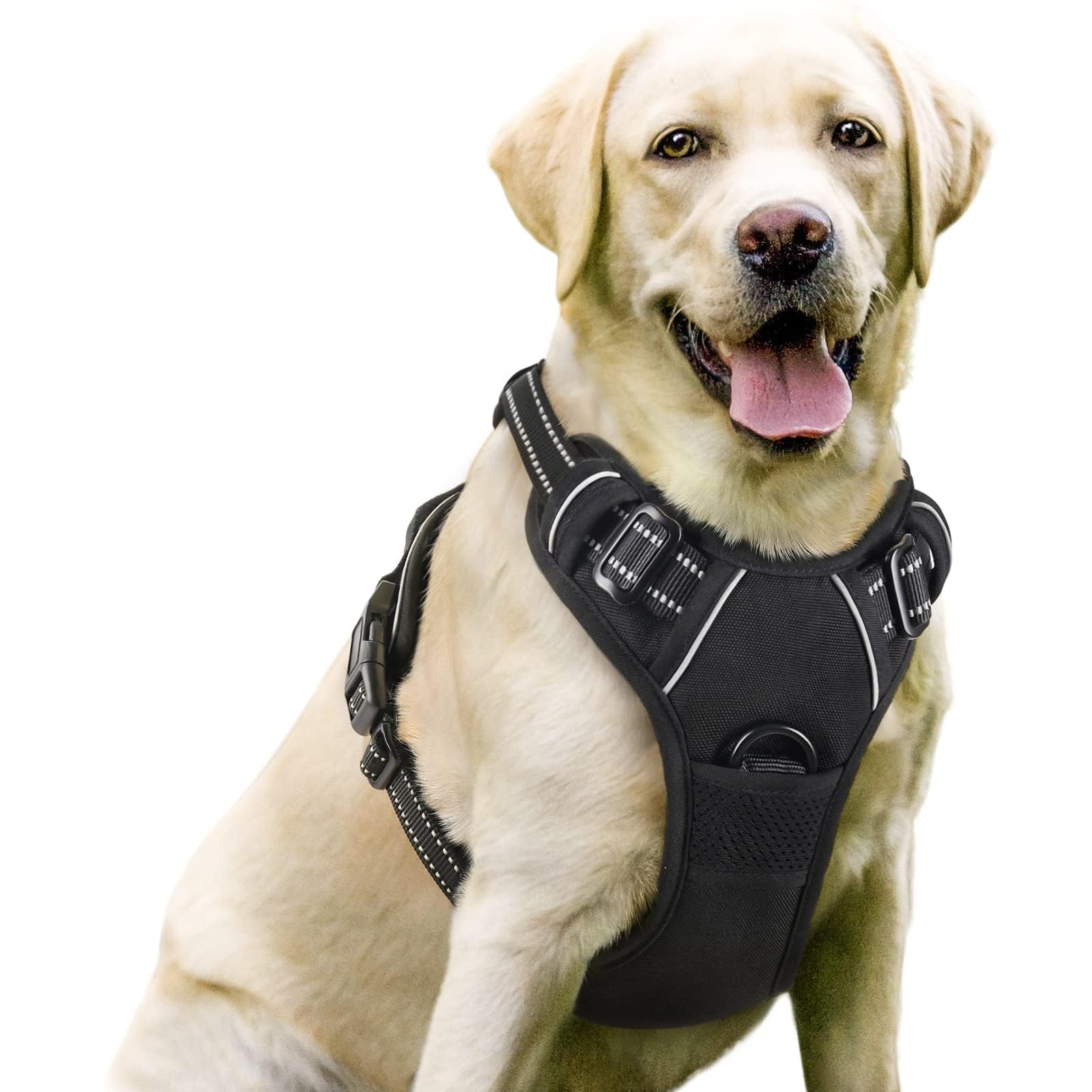
Two side-release buckles and no head opening is the whole pitch, and it is why we hand this one to anyone whose dog ducks and backs away at the sight of a harness. Clip the neck strap, clip the chest strap, and the dog is dressed before it has decided to object. Four adjusters then shape it, and the padded chest panel spreads the load instead of pinning it to one strap.

The build is heavier than the budget vests here: nylon with reinforced stitching, air mesh over a padded cushion, and a shell that goes in the washing machine, which is more than most of this group allows. MOLLE strips run down both sides for a pouch. We treat that as a bonus rather than a reason to buy, since a pouch on a dog's flank is only useful if you actually carry one. Two metal leash points, front and back, and a handle cover the same control jobs as the rabbitgoo.

Large is cut for a neck of 18 to 29 inches and a chest of 24 to 37 inches on a 45 to 80 pound dog, and the panels are stiff enough that a narrow-chested dog swims in it while a broad one fills it properly. The army-yellow tactical look is a taste call. The machine wash is not: it is the thing we came back to after a wet week, and it makes this the harness for a big, strong dog that gets filthy regularly and hates being dressed.

Bottom line: Buy it if your dog won't take a strap over its head: two side buckles, a machine-washable shell, and enough harness for a strong, dirty dog.
2

Ruffwear Front Range Harness

Ruffwear Front Range Harness

All-day comfort

Our Score 9.2/10
Check Price

Worth Noting

  • Adjustment runs out on huge dogs
  • Hand wash only and slow to dry
Care
Hand wash only
Leash Points
Aluminum V-ring plus chest loop
Chest Padding
Closed-cell foam panels
Adjustment Points
Four
Read the full review

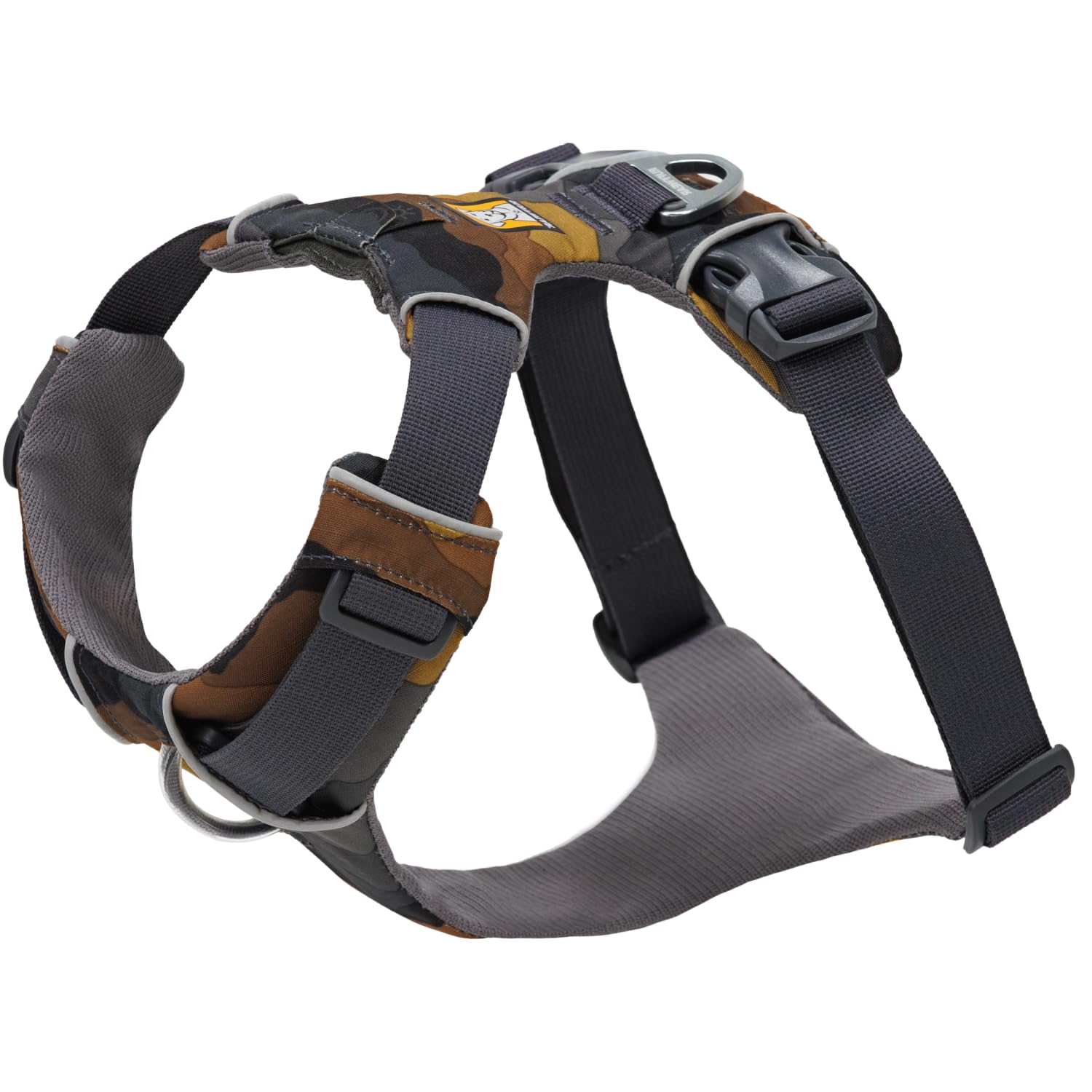
This is the most expensive harness here by a wide margin, and the one we take when the walk is going to be long. Ruffwear builds the Front Range around padding rather than straps: closed-cell foam in the chest and belly panels, four points of adjustment, an aluminum V-ring on the back, and reinforced webbing at the chest for a second, redirecting attachment.

The details are the sort you notice over a season rather than in a shop. There is an ID pocket, reflective trim, and a dedicated loop for a clip-on Beacon light. At 5.92 ounces it is light for the amount of structure it carries, and the panel shape leaves the shoulders free, so it does not ride forward when the dog drops its head to sniff.

What we noticed on dogs that wear a harness for hours is the absence of rubbing behind the front legs. That is the foam and the cut doing their job, and it is the reason this one is worth the money for hikers, trail runners, and anyone whose dog is dressed from breakfast to bedtime.

Be clear about what it is not. The chest attachment redirects a puller, but the Front Range is not a strong no-pull tool, and a determined dog will still lean into the leash. If pulling is the main problem, a front-clip vest like the rabbitgoo does more for a fraction of the cost. Buy this one for comfort and long wear, not correction. Entry is over the head.

Bottom line: The pick for long days and rough ground, where foam padding and four-point adjustment matter more than raw pull correction.

3

tobeDRI No Pull Harness

tobeDRI No Pull Harness

First-time kit

Our Score 9.2/10
Check Price

Worth Noting

  • Locking buckles can be stiff to release
  • Heavier than the lightest vests here
Care
Machine wash
Buckles
Locking quick-snap, both sides
Included
5 ft leash
Leash Points
Front and back metal rings
Read the full review

The leash in the box is the surprise: a five-foot rope-style lead with a padded handle, heavier than the flat webbing bundled with most harnesses and closer to a horse lead than a giveaway. It is not a throwaway extra.

The harness holds up its end too. Locking quick-snap buckles on both sides, four adjusters, a nylon oxford shell over a mesh lining, reflective stitching, and metal D-rings front and back. We rate the locking tabs: they add a second to every walk and remove the accidental release a plain snap allows. The front ring takes the pull out of a dog that surges, and the whole thing goes in the washing machine, which is the other part of keeping a harness in service.

Sizing is the part to get right, because the chart leans small and the harness is one of the heavier ones here. If your dog sits near the top of a size, take the next one up. Everything else about it is the sensible, unglamorous choice for a dog that walks in all weather: a bit bulky, thoroughly practical, and complete out of the box.

Bottom line: A complete first kit: a harness with locking buckles and metal rings, plus a rope lead that is better than most bundled ones.

4

Beebiepet Tactical Harness

Beebiepet Tactical Harness

Big dogs with gear

Our Score 9.2/10
Check Price

Worth Noting

  • Plastic clips undercut the heavy-duty billing
  • Fit runs large; measure first
Care
Hand wash only
Included
5 ft leash
Gear Mounts
MOLLE strips and ID window
Weight Range
30–100 lb
Read the full review

Large covers 30 to 100 pounds, and the cut is aimed at a deep chest, the kind of dog that makes a light vest look undersized. Four adjusters take up the slack on a narrower dog, and on wide-chested dogs the straps land mid-range instead of at the last hole, which is where a harness starts to distort.

The kit is generous: a five-foot leash with a foam handle, two leash clips, reflective trim, MOLLE strips down both sides, and a small ID window you write a phone number into. The ID window is the detail we did not expect to care about and now do, because a harness is the one thing a dog wears on every outing worth escaping from.

Comfort is where it is strongest. The padding is soft rather than stiff, the shell lacks the hard edges some tactical harnesses arrive with, and it sits quietly on a dog that wears it for a couple of hours. Reflective strips run down the sides for evening walks, and the four-point adjustment holds once it is set.

The plastic clips are the compromise: for all the heavy-duty styling, the fastenings are the same molded plastic as the budget vests, and that is what a hard puller will stress. Buy it for a big dog that carries its own gear and a name tag. For plain pavement walking, the rabbitgoo is lighter and the AUROTH is the same idea with less bulk.

Bottom line: The pick for a deep-chested dog near the top of the weight range that needs to carry a lead, a patch and a phone number.

5

rabbitgoo No Pull Dog Harness

rabbitgoo No Pull Dog Harness

Everyday no-pull walks

Our Score 9.0/10
Check Price

Worth Noting

  • Straps take patience to set
  • Buckles and stitching are the wear point
Care
Hand wash only
Entry
Over the head, 2 buckles
Chest Range
17–33.4 in
Leash Points
2, front and back
Read the full review

One Large covers a chest from 17 to 33.4 inches, a wider spread than most single sizes manage, and that is the reason this harness ends up on so many dogs. A leggy adolescent and a thick-chested adult can land in the same size. Four adjusters let you cut it to a narrow chest as easily as a broad one, and there is a handle on the back for the moments that need one.

Two leash points do different jobs. The back ring is for a relaxed walk on a loose line. The front ring on the chest is the no-pull part: when the dog surges ahead, the leash pulls sideways and turns it back toward you instead of letting it lean into the pressure. We used the handle more than anything else, at kerbs, in doorways, and when another dog comes round the corner. Reflective strips run along both sides for early and late walks.

For most people this is the harness to buy. It brings the combination that matters on an ordinary walk, front clip, handle, reflective trim and a fit range that covers awkward in-between dogs, and it sits at the budget end of this group. Next to the AUROTH and the PHOEPET, the difference is how it goes on: this one slips over the head and fastens with two buckles underneath. Dogs that tolerate that are fine. Dogs that duck need one of the others.

Two things to know. On a hard puller the front panel can creep up toward the throat, so check that it sits on the breastbone before you set off and reset the chest straps if it climbs. And it is hand wash only, which means a muddy walk leaves it drying overnight rather than going in the machine with the towels.

Bottom line: The one we send most people to: a front clip that redirects, a handle for close control, and a chest range wide enough to catch dogs that fall between sizes elsewhere.

6

Voyager Step-in Air Harness

Voyager Step-in Air Harness

Small dogs

Our Score 9.0/10
Check Price

Worth Noting

  • Size names don't track the chest chart
Care
Machine wash
Entry
Step-in, hook-and-loop plus buckle
Chest Range
14.5–16 in
Leash Points
Double D-rings at the back
Read the full review

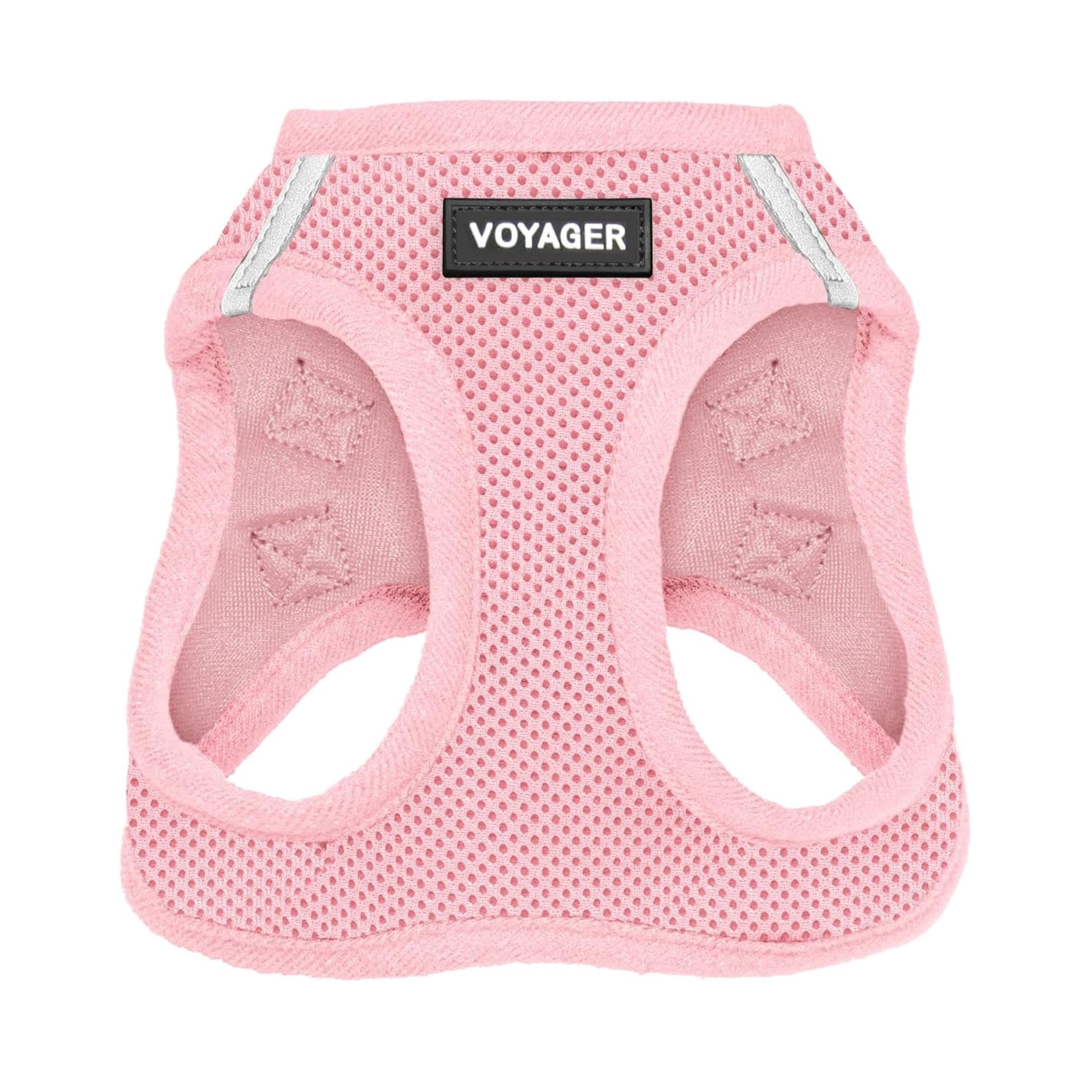
Small means a chest of 14.5 to 16 inches and a dog of roughly 10 to 14 pounds, so this is a small-dog harness and nothing else. The step-in design is the whole idea: front paws in, the hook-and-loop panel folds over the back, then a buckle and the double D-rings. Three separate fastenings, each doing a different job. It is also the easiest of these to put on a dog that has decided the pavement is terrifying, because the dog stays on the ground the whole time.

That triple closure is what we trust on a wriggler. There is no single thing to pop, and a 12-pound dog is not going to defeat all three. The air mesh is light and dries fast, the reflective bands are the two bright strips you want after dark, and it goes in the machine, which a step-in needs because the belly panel takes the dirt. What it does not have is a front leash point, so a small dog that pulls hard is down to training rather than leverage. At this size that is usually the right trade: less harness, fewer straps to get wrong.

Bottom line: For a 10-to-14-pound dog, a step-in with three fastenings is the calmest way to get dressed and the hardest to wriggle out of.

7

PHOEPET No Pull Harness

PHOEPET No Pull Harness

Budget easy on-off

Our Score 9.0/10
Check Price

Worth Noting

  • Straps are stiff to adjust
  • Buckles are the wear point
Care
Hand wash only
Entry
Three buckles, neck opens
Weight
7.68 oz
Leash Points
2 metal rings
Read the full review

The neck strap opens on a lockable buckle, so this harness goes on from the side instead of over the head. Three buckles in total: one at the neck, two across the chest. Two metal leash rings, front and back, a soft handle, reflective material along the panels, and 7.68 ounces of harness.

That neck release is the reason it stays on our list. It is the budget way to get a harness a head-shy dog will accept with a handle and a front clip, and on a dog that has learned to back away from a strap near its ears, that is worth more than any of the extras. The trade against the AUROTH is build: this one is lighter duty, with thinner webbing and less padding behind the chest.

Fit is where it asks for a decision, because the sizing runs roomy; a small breed at the bottom of the range should look elsewhere or take a size down, and it is hand wash only. What it does well is the thing that happens every morning: no wrestling, no dog backing down the hall, and a handle to grab when the postman arrives.

Bottom line: A budget way to get a neck buckle, a front clip and a handle, for a dog that ducks anything going over its ears.

8

PoyPet No Pull Harness

PoyPet No Pull Harness

Lunging pullers

Our Score 9.0/10
Check Price

Worth Noting

  • Elastic softens the fit
  • Neck buckle lock is a weak point
Care
Hand wash only
Entry
Lockable neck buckle
Belly Straps
Dual elastic
Leash Points
Front and back
Read the full review

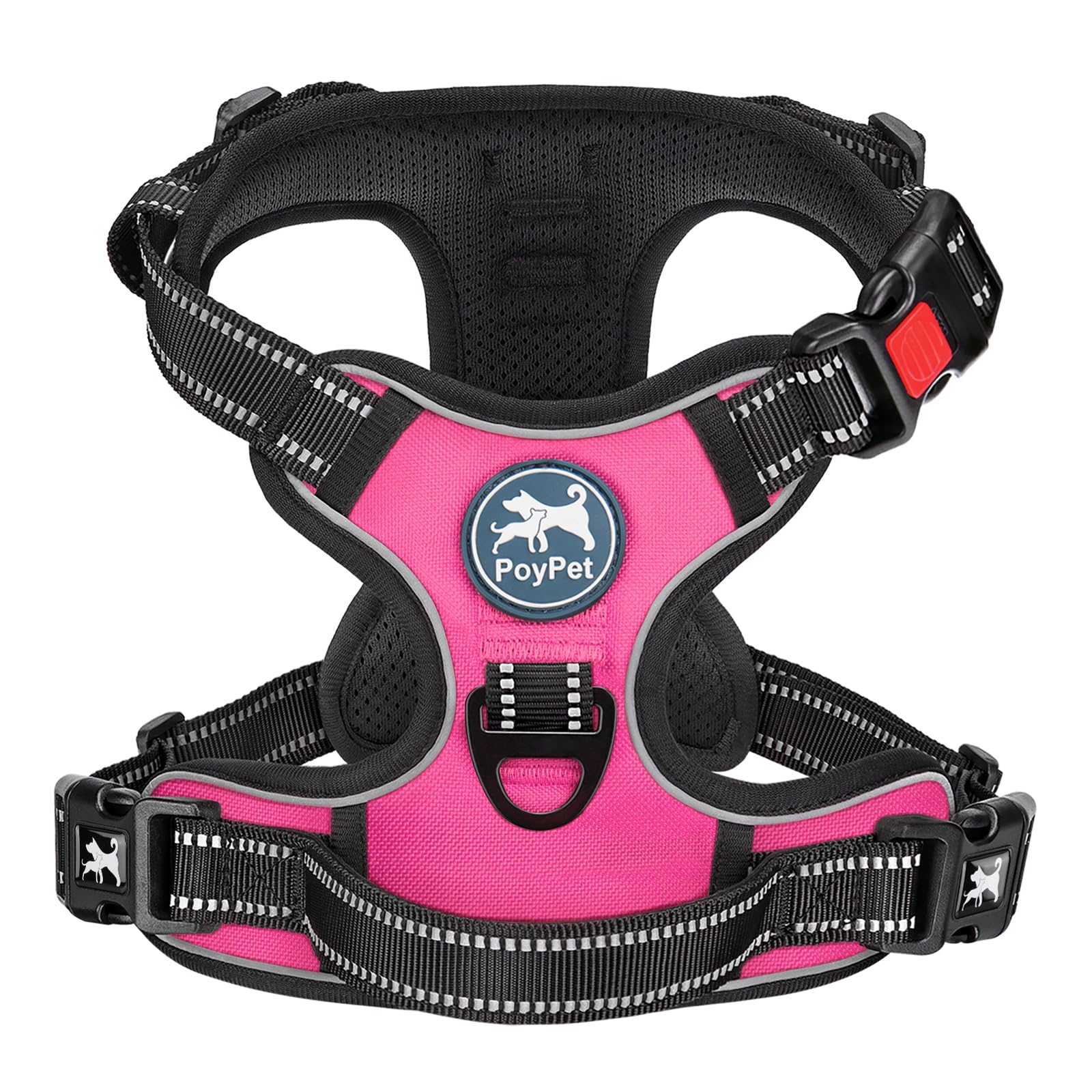
A dog hits the end of the leash at a run and the jolt travels through the lead, your shoulder and the harness. PoyPet puts elastic panels in the belly straps to take some of that: the webbing gives under load instead of passing the shock straight through. On a dog that lunges at squirrels, that give is the difference you feel, and it is why this one earns a place ahead of the plainer budget vests.

The rest of the design aims at the same dog. A lockable quick-snap buckle at the neck means no head-through, the padded handle is thick enough to hold while you steer past another dog, and there are metal leash points front and back. Air mesh sits under a wear-resistant oxford surface, reflective trim runs along the sides, and it weighs 7.68 ounces.

This is a harness for a dog that jolts rather than drags. A hard, sustained puller gets less from the elastic and more from a fixed-webbing vest with a snug front clip. Set it snug and it is a smart, cheap choice for a reactive dog that blows up at a gate and then settles. Once set, the straps stayed where we put them, which is not something every budget vest manages.

Bottom line: Elastic belly straps take the edge off a lunge, which makes this a smart choice for a reactive dog that jolts and then settles.

How We Tested 14 Dog Harnesses

We built the shortlist by comparing sizing charts, adjustment ranges, hardware, and stitching across dozens of harnesses, then ruled out anything with thin webbing, brittle-feeling buckles, or a size range that skipped common girth measurements. The goal was a spread of step-in, over-the-head, and front-clip styles, since ease of use and fit can vary wildly by design.

For six months, 14 harnesses rotated through daily neighborhood walks, muddy park runs, vet visits, and weekend hikes. I fitted each one to my two dogs—one broad-chested, one narrow—and to friends’ dogs of different sizes, then watched how the harness sat after a mile: whether the chest strap slipped, whether the leg openings rubbed, and whether I had to re-adjust anything mid-walk.

To check security, I tugged gently on the leash ring while each dog was stationary and watched for backing-out attempts at doorways. I ran a hand under every strap after walks and looked for redness or chafing, and I noted whether a wiggly dog could be buckled in without a second person. Durability got the muddy, practical test: repeated washes, snagged webbing, frayed stitching, and buckles that loosened. I also checked how each harness looked after a few weeks of real use, because a harness that fits well but sheds color or pills at the padding isn’t one I’d recommend.

How to Choose the Right Dog Harness

Measure the chest, not the breed

Wrap a tape around the widest part of the ribcage, just behind the front legs, snug enough to stay put with room for two fingers underneath. Weight ranges and breed lists are a starting point at best; the chest is the number that decides. Sizes do not travel between brands, either. A Small here is a 14.5-to-16-inch chest while a Large tactical vest runs 24 to 37 inches, so ignore the letter on the harness you already own and buy from the tape.

The trap is fitting for the dog you expect in six months. A harness that is loose at the chest rotates under a pull, rubs behind the front legs, and gives a determined dog room to work its way out. Fit the dog in front of you, and if the tape puts you between sizes, take the smaller one and check how much adjustment is left.

Front clip, back clip, or both

Every harness here has a back ring and most add a front one on the chest. The back ring is neutral: good for a dog that walks politely and the right choice for a long line on a quiet path. The front ring is the control tool. As the dog moves ahead, the leash pulls its chest to one side and turns it back toward you, so the pull never gets the leverage it wants.

What a front clip does not do is train the dog. It buys you a calmer walk while you work on the training, which is worth plenty on a reactive dog. Two practical notes: a front clip only works when the chest straps are snug, and the leash can brush the front legs until you both get used to it.

How it goes on decides how often you use it

Three designs cover this group. Over-the-head harnesses such as the rabbitgoo and the Ruffwear slip on and fasten with two buckles underneath, which is quick with a patient dog. Step-ins like the Voyager ask the dog to stand still while you fold a panel over its back. Three-buckle designs such as the AUROTH, the PHOEPET and the PoyPet open at the neck, so nothing passes the ears.

If your dog flinches at a strap near its head, that last type is worth choosing deliberately, because a harness you dread putting on is a harness that stays in the cupboard. Puppies and dogs new to harnesses do best if you practise the routine when you are not already late.

What wears out, and what to check

The buckle goes first, then the strap slider that holds your adjustment, then the stitching where the front ring attaches. Look at those three points before you buy and again before each walk, especially on a strong puller. Padding earns its money on longer outings: closed-cell foam panels like the Ruffwear's resist soaking and keep their shape, while thin mesh is fine for a lap of the block.

Washability matters more than it sounds. Machine-washable shells such as the AUROTH, the tobeDRI and the Voyager get cleaned and used; hand-wash-only harnesses tend to sit in the cupboard until the mud dries. Reflective trim is worth having, but be clear about how it works: it lights up when a headlight hits it, so it helps a driver see your dog, not you see the path.

Handles, gear and the extras

A handle on the back is genuinely useful. It steadies a dog at a kerb, gets it out of a doorway, and holds it while you clip the leash on. It is not a lifting strap for a dog that outweighs your arm.

MOLLE strips, ID windows and gear panels on the AUROTH and the Beebiepet only make sense if the dog actually carries something. Otherwise they add weight and stiffness for nothing, and a plain vest will sit more comfortably on a dog that just goes round the block.

Frequently Asked Questions

Final Verdict

For most dogs, the rabbitgoo is the harness we recommend. The front clip redirects a puller, the handle gives you a handhold at the kerb, and one size spans a chest range that catches a lot of dogs falling between sizes elsewhere.

If your dog will not take anything over its head, the AUROTH solves that and goes in the washing machine. If you walk miles and want padding that does not chafe, the Ruffwear earns its premium.