Food & Treats

Best Dog Jerky Treats of 2026

A dog will tell you in about three seconds whether a jerky treat was worth getting off the couch for. The trouble is that the bag gives you little to go on: “jerky” can mean a single-ingredient strip or a pressed chew with a long ingredient list, and origin claims are often buried in small print. What matters is whether your dog keeps coming back for it, whether the texture suits their chewing style, and whether the bag still smells fresh weeks after opening. A good one solves the daily reward problem—high-value enough for training, easy to hand over, and gentle enough to use more than once a day.

I spent four months testing 16 bags with my two dogs and nearby volunteers. Some were inhaled; others got a polite sniff and nothing more. I noted hardness and thickness when breaking them, watched for digestive changes the next day, and tracked which bags stayed fresh to the bottom. Ingredient clarity, origin, and value per bag separated the keepers—the picks below earned repeated interest, not just a first taste.

1

Just Food for Dogs Chicken Jerky

Top Pick
Just Food for Dogs Chicken Jerky

Elimination diets

Our Score 9.6/10
Check Price

Worth Noting

  • Priciest per ounce of these picks
  • Five-ounce bag goes quickly
Texture
Thin, semi-crisp slices
Bag Size
5 oz
Standard
Human-grade
Ingredients
Chicken breast only
Read the full review

One ingredient is the entire pitch, and for the right dog that is worth paying for. These are chicken breast — nothing else — sliced thin, dried, and human grade. If your dog is on an elimination diet or you are trialing proteins one at a time, a bag with a single line on the panel removes the guesswork, and that is why we keep it in the rotation.

The slices are thin and semi-crisp, which makes them easy to snap into stamp-sized pieces for training, and they are light enough to hand out several without blowing a diet. Expect a few shards at the bottom of the bag; crumble those over dinner as a topper rather than tossing them.

This is the one for the buyer who cares more about the ingredient list than the volume — a small bag you use up, in a house where a reaction costs more than a reorder. Buy it for the trial, not for the treat jar you refill every month.

Bottom line: For an elimination trial, this is the bag we want: one ingredient, human grade, and thin slices that snap into training pieces.
2

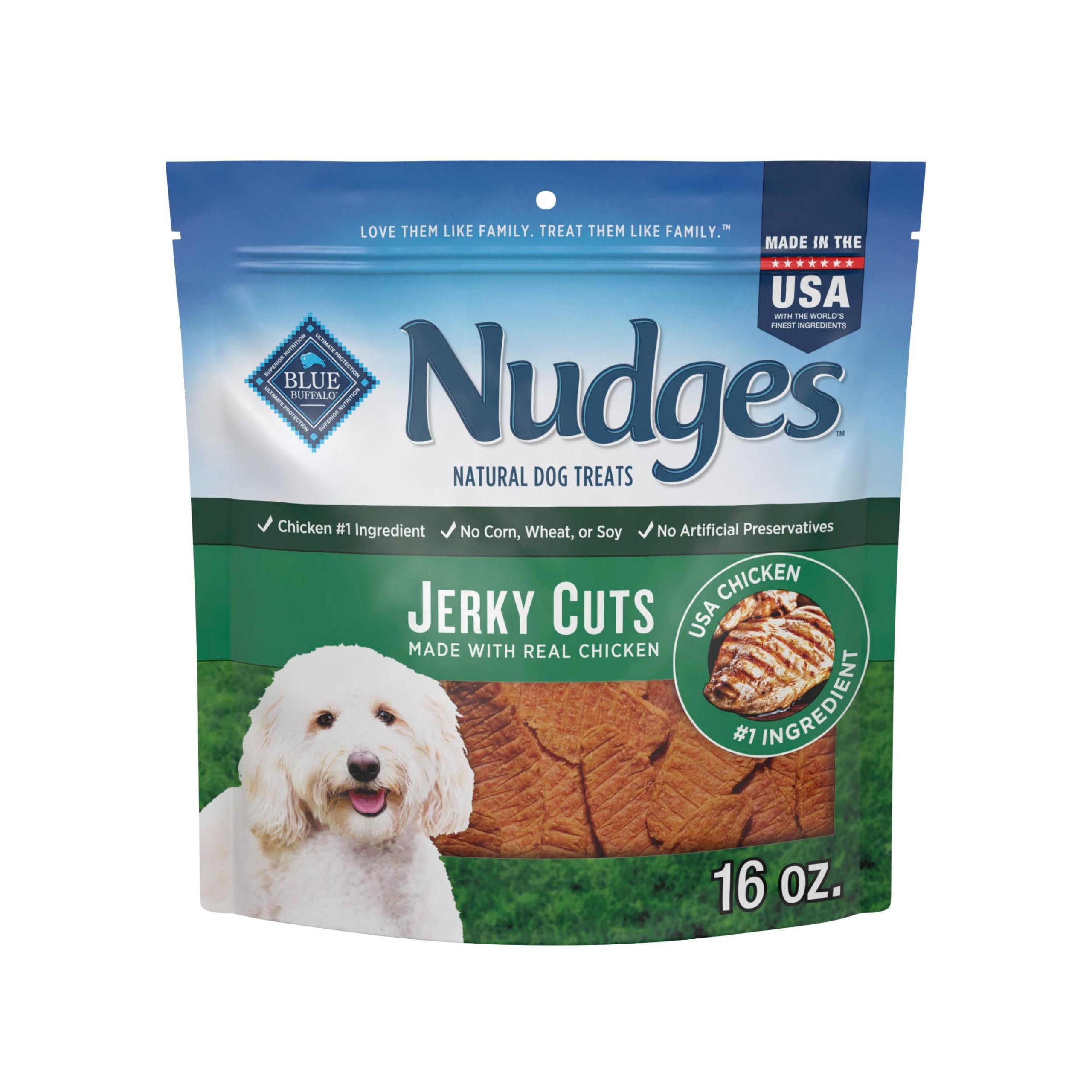
Nudges Jerky Cuts Chicken

Nudges Jerky Cuts Chicken

Everyday training rewards

Our Score 9.4/10
Check Price

Worth Noting

  • Freshness varies from bag to bag
Texture
Soft, easy to tear
Bag Size
16 oz
Life Stage
All life stages
First Ingredient
Chicken
Read the full review

The first thing we do with any jerky treat is try to break it in half, and these came apart between two fingers without shedding crumbs. That soft, tearable cut is why they hold the top spot here: one piece becomes three or four training rewards, and a puppy or a dog with a few missing teeth can chew them without a struggle. Chicken is the first ingredient, the recipe is corn-free, and nothing in the bag reads like filler.

Flavor is where this bag earns its keep. The dogs we offered them to went for these faster than for the firmer strips, and the pieces are small enough to hand out one at a time instead of breaking a chunk off something bigger. The smell is unmistakably roast chicken — strong in a pocket, which is exactly why it works as a high-value reward, and exactly why the bag lives in a sealed container at our house.

Sixteen ounces lasts a while in a one-dog household. Soft pieces also do not shatter at the bottom of a treat pouch, so you are not losing half of every handful to crumbs on the sidewalk.

For a dog that wants something to actually work at, we point you to the whole-muscle pick further down; these are for the reward, not the occupation. As the everyday treat you keep by the door, the one that suits a young puppy and an old dog equally, this is the bag we hand people first.

Bottom line: This is the bag we tell most people to start with: soft enough for puppies and seniors, easy to tear into training pieces, and made with chicken as the first ingredient.

3

Rocco & Roxie Beef Jerky

Rocco & Roxie Beef Jerky

Soft beef training

Our Score 9.4/10
Check Price

Worth Noting

  • Costs more per treat than the chicken picks here
  • One-pound bag is small for multi-dog homes
Origin
Made in the USA
Texture
Soft, tender sticks
Bag Size
16 oz
First Ingredient
Beef
Read the full review

These are the treats that ended up in a jacket pocket rather than the kitchen jar. They are slow-roasted beef sticks, grain-free and free of corn, soy, and gluten, made in the USA, and they bend before they snap — which is the whole reason we kept reaching for them mid-walk.

What sold us was how cleanly a stick breaks into pea-sized pieces. Training a puppy means a lot of small rewards in a row, and a treat that crumbles to dust or needs two hands to divide slows the session down. These do not. Beef also gives you a way out when chicken has stopped being exciting, and the smell is strong enough to pull a distracted dog back.

One detail we noticed: the cut ends of an open stick dry out first, so press the air out of the bag and clip it shut between sessions. Otherwise they hold together in a pocket without turning into jerky dust.

Bottom line: We reach for these when we are training a soft-mouthed dog or one that has tired of chicken: tender beef sticks that break into neat, small rewards.

4

Farmland Traditions Chicken Jerky

Farmland Traditions Chicken Jerky

Bulk limited-ingredient

Our Score 9.4/10
Check Price

Worth Noting

  • Biggest single outlay of the picks here
Origin
Made in the USA
Fillers
No grain, soy, or corn
Bag Size
3 lb
First Ingredient
Chicken
Read the full review

Three pounds of jerky is a different kind of purchase. This arrives as a stack of flat chicken strips you do not have to ration — full-size for the big dog, snapped into pieces for the little one, no counting out the last few on a Thursday. The recipe is short on purpose: chicken raised in the USA and vegetable glycerin, with no grain, soy, or corn.

Dehydrated strips have a grain to them, and it is worth using. Tear along it and you get a long strip for a large dog; tear across and you get a square that suits a small mouth. That is how we portioned out of this bag all week without reaching for a knife.

The simplicity here is real rather than a label story: one protein, no fillers, made in an FDA-registered plant in Southern California. That is why this is the pick for a dog with food sensitivities or a household that goes through treats fast. Pieces from the thick end can be dense, so bend one before you hand it to an older dog.

Bottom line: Our pick for a dog with sensitivities, or a houseful of them: one protein, no fillers, and a bag big enough that you stop rationing.

5

Full Moon Beef Savory Sticks

Full Moon Beef Savory Sticks

Human-grade rewarding

Our Score 9.4/10
Check Price

Worth Noting

  • Long sticks need breaking down for small dogs
Bag Size
22 oz
Glycerin
None
Standard
Human-grade
First Ingredient
Free-range beef
Read the full review

Human-grade is the claim across the front of this bag, and it is the reason to consider it: sticks made from free-range beef raised on U.S. farms, with no glycerin, grains, corn, wheat, or soy. If you have been reading panels and wincing, this one reads clean.

They also behave more like food than like a dog biscuit. The sticks are soft and lightly smoky, and one snaps into two pieces for a medium dog or six for a terrier, so a bag stretches further than the weight suggests. The aroma is the kind that gets a dog off the couch.

They are moist, which means the bag wants sealing properly between uses — leave it open on the counter and the ends toughen up within a day or two. We treat these as the one good reward of the afternoon rather than a scatter-on-the-floor snack.

Bottom line: We like these for the dog that gets one good reward a day: human-grade beef, no glycerin, and long sticks you can snap down to size.

6

Full Moon Pork Jerky

Full Moon Pork Jerky

Pork protein rotation

Our Score 9.4/10
Check Price

Worth Noting

  • Ten-ounce bag goes fast with more than one dog
Bag Size
10 oz
Glycerin
None
Standard
Human-grade
First Ingredient
Pork
Read the full review

Pork is the odd one out in this set, and that is the point. If chicken has lost its pull, pork jerky offers a genuinely different protein at the same human-grade standard: U.S.-raised pork, no glycerin, and no grain, corn, wheat, or soy.

The pieces are generous and tender enough that a small dog can manage one. They are also greasy — the bag leaves your fingers tacky, so keep a paper towel nearby and do not hand them out on the sofa. At least the grease is honest: nothing here has been dried to leather.

We were surprised by how quickly this became the bag we reached for when a dog went off its food; the smell does most of the work. Keep it as a rotation rather than the everyday bag — pork is rich and the pieces are big — and it earns its shelf space for the fussy eater alone.

Bottom line: Our pick when chicken has stopped working: a human-grade pork jerky that smells like the real thing, in a bag that goes fast.

7

Wag Whole Muscle Chicken Jerky

Wag Whole Muscle Chicken Jerky

Dogs that need a chew

Our Score 9.2/10
Check Price

Worth Noting

  • Large pieces need cutting down for small dogs
Fillers
No grain, corn, soy, or wheat
Texture
Chewy, oven-baked
Bag Size
16 oz
First Ingredient
Whole muscle chicken breast
Read the full review

Whole muscle means each piece is a slice of chicken breast rather than something ground and re-formed, and you can see the grain running through it. It is oven-baked, with no added grain, corn, soy, or wheat and no artificial colors, and it is made in the USA.

These are the chewiest treats in this set. Where the soft picks fall apart, a Wag piece holds together and takes a dog a minute or two to work through — exactly what we want for a dog that inhales a reward and immediately looks for the next one.

The flip side is that chewy can tip into tough. Flat-faced dogs, older dogs, and small mouths can struggle with a full-size piece; cut across the grain into short strips and most of that goes away. Keep water down after a session, since jerky is dry by design.

As an everyday training treat these are slower than we wanted — you do not want to be cutting strips mid-session — but as the thing that buys ten quiet minutes, they are the best of these picks for occupying a dog. The resealable bag matters here, because the pieces firm up once air gets to them.

Bottom line: If your dog needs something to work at, we hand them this: whole-muscle chicken that takes real chewing, made in the USA.

How We Picked and Tested Dog Jerky Treats

I started by pulling together a shortlist from ingredient panels, protein sources, origin statements, bag sizes, and price per ounce, then weeded out treats with vague labels or oversized bags that would go stale before a dog could finish them. We ended up with 16 bags and tested them over four months in the places jerky actually gets used: morning training sessions in the kitchen, afternoon walk rewards, after-dinner chew time, and weekend quiet moments in a crate or on a mat. Each bag was opened, smelled, and offered to my two dogs and a small group of neighbor dogs with their owners’ okay.

We watched whether dogs sniffed and walked away or came back for more, and noted whether interest held over several days rather than one excited first bite. To judge thickness and hardness, I snapped each piece by hand and timed how long the dogs chewed; thin, brittle strips disappeared fast, while thick ones were easier to break into training-size bits. We also checked texture—whether pieces were greasy, dry, or crumbly—and tracked freshness by resealing bags and revisiting them over the following weeks, noting when aroma faded or the surface turned tacky.

Ingredients and origin were checked against the packaging, not assumed from front-of-bag claims, and we compared bag size with how many training rewards each one actually delivered. Digestive effects got a simple check: normal stool and appetite the next day, with any change noted. Aroma mattered more than I expected—some bags smelled like roasted meat and drew dogs in immediately, while others had a dusty, stale scent. The treats that moved forward were the ones dogs asked for again, stayed fresh, and sat well.

How to Choose Dog Jerky Treats

Start With Texture, Not Flavor

Jerky runs from a soft cut you can pinch apart to a whole-muscle strip with a real grain, and that gap matters more than whether the bag says chicken or beef. Bend a piece: if it flexes, a puppy, a flat-faced dog, or a senior can manage it; if it snaps, treat it as a chew and cut it down.

The word jerky on the front of a bag tells you nothing about hardness. Our picks run from the tearable cut of Nudges to the whole-muscle chew of Wag for exactly this reason, and a soft bag can still throw a dense piece from the thick end.

Read the Ingredient Panel, Not the Front

The first ingredient should be a named meat, and the shorter the list after it, the easier it is to work out what disagreed with your dog. Limited-ingredient recipes like Farmland Traditions and single-ingredient ones like Just Food for Dogs are the ones to reach for during an elimination trial.

Glycerin is what keeps most jerky soft and pliable, and it brings nothing nutritionally, so it is worth knowing whether it is in the bag — the Full Moon sticks leave it out. Skip corn, soy, and wheat if your dog has a history of itching or loose stools.

Buy the Bag You Will Actually Finish

Jerky dries out once air reaches it, and a soft treat gone hard is a choking risk for a small dog rather than a bargain. A three-pound bag makes sense in a multi-dog house or with a dog earning several rewards a day; otherwise a one-pound bag you seal properly and finish within a couple of months stays fresher.

This is also where per-treat cost moves. The biggest bag here is the cheapest per ounce and the largest single outlay, while the five-ounce bag is the opposite trade — buy the size that matches your rate of treating, not the best unit price.

Weigh the Made-in-USA Claim

Several picks here are made in the U.S. with domestically raised chicken, beef, or pork, and for a lot of buyers that is the deciding line. The claim lives on the back panel rather than the front, and it shifts between products in the same brand's range.

If origin is non-negotiable, check the specific bag rather than the logo. Farmland Traditions, Full Moon, and Wag all make the claim on the product you are buying, and the chicken in the Nudges recipe is raised here even though the bag leads with ingredients instead.

Frequently Asked Questions

Final Verdict

Buy the soft chicken cut unless you have a reason not to. The Nudges Jerky Cuts are the bag we keep in a training pouch: chicken first, easy to tear into small pieces, soft enough that a puppy or a senior can eat one without a fight.

If your dog wants something to occupy it, the Wag whole-muscle strips last longer. If a single ingredient matters more than price, Just Food for Dogs is the answer, small bag and all.