Collars & Leashes

Best Dog Leash for Large Dogs of 2026

A leash is the cheapest piece of safety equipment you'll buy for a big dog, and the one most likely to be tested at the worst possible moment. A 90-pound dog can turn a squirrel into a sudden jolt, and a thin handle or a flimsy clip shows its weaknesses in that half-second. A good large-dog leash has to stay comfortable on a long walk, hold steady when your dog hits the end of it, and survive pavement, hallway traffic, and the occasional chew.

Over the past six months, I walked 14 leashes with a strong puller and a calmer senior dog, from quick morning loops to weekend training sessions. The differences showed up fast: handles that felt fine for a block but bit into my palm by mile two, clips that stayed secure but were clumsy with cold hands, and retractable models whose locking mechanisms and retraction either worked smoothly or gave me pause. We also checked construction, chew resistance, and value, and a few inexpensive leashes felt sturdier than fancy ones. The picks below are the ones I'd trust on a real walk.

1

Primal Pet Gear Double Handle

Top Pick
Primal Pet Gear Double Handle

Everyday big-dog walks

Our Score 9.6/10
Check Price

Worth Noting

  • Six feet is a handful in narrow aisles
Length
6 ft
Handles
Two padded loops
Reflective
Double-sided stitching
Webbing Width
1 in.
Read the full review

Two handles is the whole argument, and the lower loop is where it pays off. When a big dog swings toward a jogger, your hand is already a few feet closer to the collar than the end of the leash, so you fold him into your hip instead of hanging off a straight arm. That geometry is why this one lives by the door: it turns a two-handed reel-in into a single move. With a dog heavy enough to move you, the half second it saves is the difference between a walk and a wrestling match.

The build is better than the plain photos suggest. The webbing is an inch wide and closely stitched, both loops carry neoprene padding, and the reflective stitching runs down both faces rather than sitting on top as a painted stripe that wears away against curbs. The metal snap swivels, so a dog who circles doesn't twist the leash into a stiff rope. Six feet is the right default for park paths and quiet streets: enough room to sniff, little enough to gather quickly.

Six feet of one-inch webbing is still a lot of leash in a hardware aisle, and the traffic handle is a grab point rather than a brake — a dog already committed to a lunge will move you either way. For a dog who only occasionally needs collecting, though, that longer reach between the two loops gives you a looser, more relaxed hold than a closely spaced traffic handle does.

Where it separates from the rest of the double-handle group is the padding: both loops are cushioned, so switching hands mid-walk doesn't mean switching to a bare strap. The second loop is also cut wide enough to take a gloved hand in January, and it does the same job as the Max and Neo for less money. That combination is hard to argue with.

Bottom line: We recommend this one for everyday walks with a strong dog: two padded handles, 1-inch webbing and reflective stitching, with the second loop exactly where your hand needs it.

2

Max and Neo Double Handle

Max and Neo Double Handle

Crowds and traffic

Our Score 9.6/10
Check Price

Worth Noting

  • Pricier than the other double-handle picks
Length
6 ft
Handles
Two neoprene-padded
Webbing
1 in. wide, 2 mm thick
Traffic Handle
18 in. from clasp
Read the full review

Eighteen inches is the number that separates this from our top pick. The traffic handle sits much closer to the clasp than the Primal's, which means less leash to gather when you need your dog against your leg — a stroller, a crowded farmers market, a reactive dog across the street. On a busy sidewalk that shorter reach is the difference between a quick correction and a scramble.

The webbing underneath is an inch wide and about 2 mm thick, softer in the hand than the number suggests, with neoprene padding on both loops and reflective stitching down the length. The snap clip swivels and feels solid. The company also donates an identical leash to a rescue for every one sold, which is an unusual perk that doesn't change how the leash walks but is a decent reason to pick it over an identical-looking alternative.

The low handle is the one thing that gives us pause. Because it sits so close to the dog, using it means walking slightly bent, and on a long walk you feel that in your lower back after a while. In a crowd, though, you aren't walking far with a hand down there — you grab, you pass, you let go.

If most of your walking happens where people and dogs are close, the tighter spacing is worth the extra money over the Primal. For open-path walking where you rarely shorten the leash, it isn't, and the Primal's looser second loop is the more relaxed hold. That's the whole decision between the two.

Bottom line: We like this one for crowded sidewalks and obedience class: the close-set traffic handle collects a big dog fast, and both loops are padded for the grab.

3

Taglory Rope Leash 6 ft

Taglory Rope Leash 6 ft

Strong pullers

Our Score 9.4/10
Check Price

Worth Noting

  • Single handle, so no close-control loop
Length
6 ft
Hardware
360° swivel snap
Rated Weight
20–120 lbs.
Rope Diameter
1/2 in.
Read the full review

Half an inch of climbing rope is the reason to look at this one. A round rope fills the hand differently than flat webbing: it doesn't fold into an edge when a dog leans, and the foam-covered loop at the end spreads the load across your palm instead of across four fingers. The reflective threads are woven through the rope rather than printed on it, so the whole length catches a headlight instead of a single stripe. Six feet, with a swivel snap that spins a circling dog free.

There's a little spring in the rope, and we noticed it most on the first jolt of a lunge — it takes the sharp edge off before the pull reaches your shoulder. Of the leashes here, this is the one we hand over when the dog pulls hard and steady rather than in sudden bursts. The listing rates the 6-foot version for dogs from 20 to 120 pounds, which covers most of the large-dog range with room at the top.

What it doesn't have is a second handle, and that is the one thing we miss. If your walks involve a lot of collecting — passing dogs, cafe tables, a bike lane — a traffic loop does that job faster than gathering rope in your fist. For a dog who pulls in a straight line and doesn't lunge, the trade is worth making, and the padded loop stays comfortable for the whole walk.

Bottom line: This is the leash we hand over when a big dog pulls hard and steady: half-inch climbing rope, a padded loop and a swivel that keeps the rope from twisting.

4

JEWOSTER Double Handle 6 ft

JEWOSTER Double Handle 6 ft

Budget double handle

Our Score 9.4/10
Check Price

Worth Noting

  • Stiff webbing doesn't pack small
Length
6 ft
Handles
Dual padded
Webbing
1 in. wide, 3 mm thick
Hardware
360° swivel clasp
Read the full review

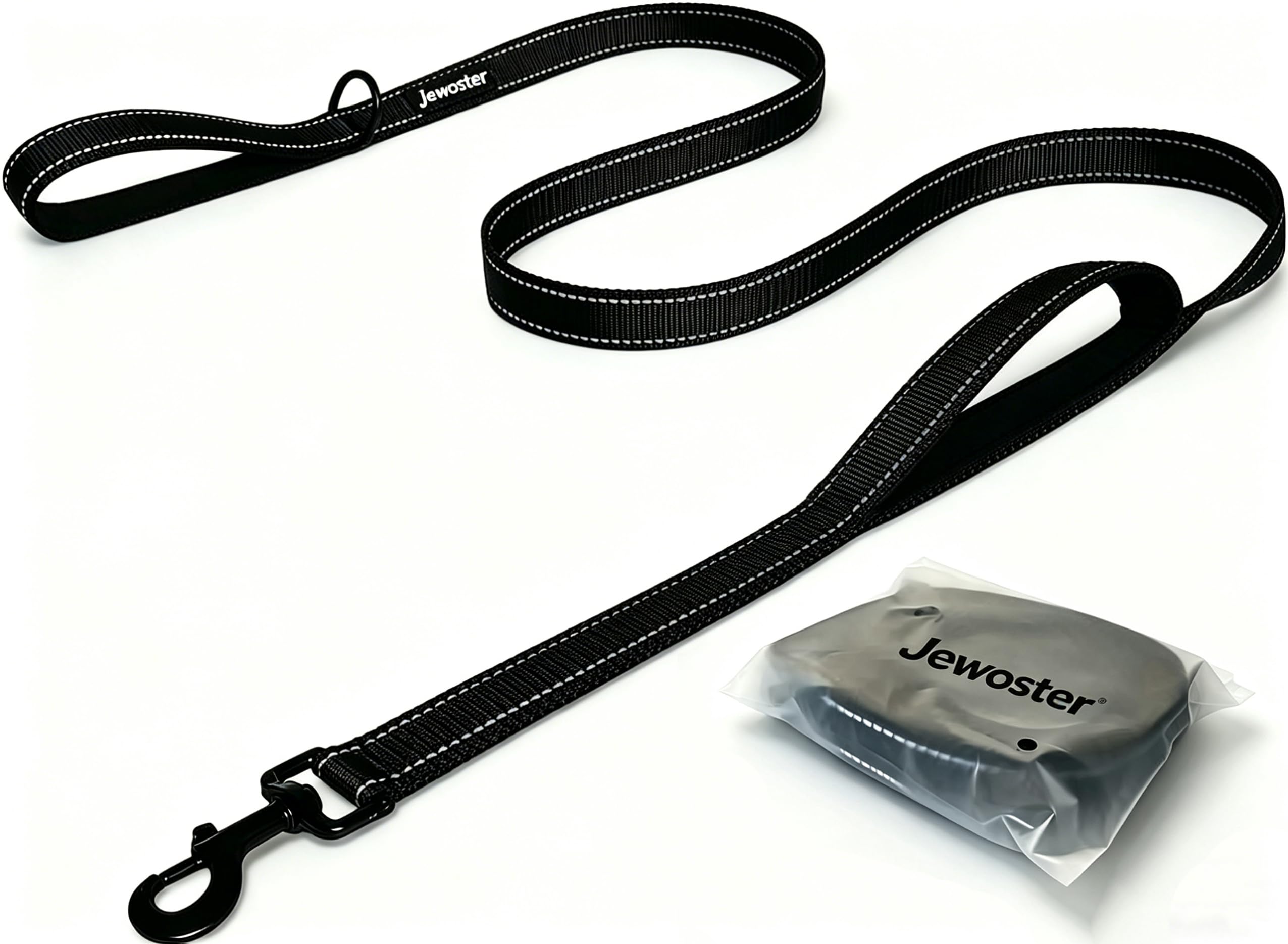
This is the least expensive way into a two-handle walking leash here, and nothing about it feels like the cheap one. The webbing is an inch wide and 3 mm thick — genuinely heavy in the hand — with neoprene padding on both loops, a swivel snap, reflective threading down the length and a two-inch clip at the end. It even ships with a zippered pouch.

The thickness is what we noticed first. Thick webbing doesn't roll into a narrow edge under a hard pull the way thin tape does, so the pressure spreads across your palm instead of concentrating in the crease of your fingers. The traffic handle is sewn directly onto the leash rather than looped through a ring, which is the part that gives way first on cheaper double-handle designs. For a dog who pulls with intent, this is a lot of leash for the money.

It is plain — black webbing, black padding, nothing decorative — and the stiff, thick material doesn't coil small, so it takes up a pocket or a door bin rather than disappearing into one. Neither matters much if the leash lives on a hook by the door, which is where most of them end up anyway.

Bottom line: The cheapest route to two handles here, and a solid one: 3 mm webbing that holds its shape under a pull, a swivel clasp and padding on both loops.

5

BAAPET Rope Leash 5 ft

BAAPET Rope Leash 5 ft

Tight city walks

Our Score 9.4/10
Check Price

Worth Noting

  • Foam handle is the first thing a mouthy dog destroys
Handle
Padded foam
Length
5 ft
Weight
4.97 oz
Rope Diameter
1/2 in.
Read the full review

Five feet is the shortest leash here, and that's the point. On a sidewalk with basement grates, a bus door and a deli counter, the extra foot a six-foot leash gives your dog is the foot you spend reeling in. This one keeps a big dog at your side without a running gather, and the half-inch rope gives you something solid to hold while you do it.

The padded handle is the comfortable part: soft foam over the loop, which protects your hand on a hard stop. The splice at the clasp end is covered by a hard plastic sleeve instead of the glued rubber cover older rope leashes used, so there's nothing to peel and no smell out of the bag. Reflective threads run the length for evening walks, and at 141 grams it disappears into a jacket pocket.

The foam is the part we keep an eye on. A dog who mouths the leash will get into that handle before anything else, and rope is chewable in a way tight webbing isn't. For a dog who walks politely at close range and leaves the leash alone, this is a genuinely good short leash for very little money; for a determined chewer, put the same budget into a flat webbing leash instead.

Bottom line: We recommend it for tight city walks with a dog who stays close: five feet of rope, a padded handle and very little leash to manage.

6

iYoShop Hands-Free Waist Leash

iYoShop Hands-Free Waist Leash

Running hands-free

Our Score 9.2/10
Check Price

Worth Noting

  • Bungee adds reach against a dog that leans
Wear Style
Adjustable waist belt
Leash Length
68 in.
Rated Weight
25–120 lbs.
Shock Absorption
Two bungee sections
Read the full review

This is the leash for the person with two things to carry and one large dog. The belt goes around your waist, the 68-inch leash runs from a clip at your hip, and your hands stay free for a coffee, a phone or a second bag. What we didn't expect to use as much is the traffic handle built into the leash itself — when another dog comes the other way, you grab it and your dog is suddenly at your side without a wrestling match.

Two bungee sections sit between the belt and the clip, and they do what bungee is supposed to do: absorb the front of a lunge so it arrives at your hips as a tug rather than a jerk. The removable zippered pouch takes a phone, keys and a roll of bags, and the two-inch clip is a serious piece of hardware. The listing rates it for dogs from 25 to 120 pounds.

The catch is the stretch. On a dog who leans into the leash for the whole walk, a bungee hands back the distance you thought you'd taken away — a hard charger can end up further out than a fixed-length leash would allow. That makes this a running and hiking leash for a big dog with decent manners, and a frustrating one for a dog who hasn't learned to stop pulling. We keep it for exactly the first job.

Bottom line: A good running leash for a big dog with manners: adjustable waist belt, two bungee sections and a traffic handle that pulls him back to your side.

7

TUG Retractable 16 ft

TUG Retractable 16 ft

Open-space sniffing

Our Score 9.0/10
Check Price

Worth Noting

  • Lock and retraction are the wear points
  • 1.1-pound housing is bulky on a long walk
Lock
Thumb lock and pause
Type
Retractable tape
Length
16 ft
Rated Weight
Up to 110 lbs.
Read the full review

Sixteen feet of tape sounds like freedom for a big dog, and on an open field it is. The TUG is rated to 110 pounds, locks and pauses with a thumb, and lets a dog range far enough to actually sniff instead of orbiting you at the end of six feet. We think it earns a place in a large-dog household — for one specific walk, not all of them.

Retractables live or die on the lock and the retraction, and those are the two things to check before you trust one with a big dog. This housing weighs just over a pound, so it's a noticeable lump on the wrist compared with a nylon leash, and the tape is thin enough that you never want to grab it with a bare hand while a dog is moving. TUG's warranty excludes chewing damage, so a mouthy dog is an expensive way to find out. Use it where there's room, keep a flat leash by the door for everything else.

Bottom line: Own it for open-field sniffing with a calm big dog: sixteen feet of tape, a thumb lock, and a housing that reminds you it's on your wrist.

How We Tested Leashes for Large Dogs

I started with a list of leashes sold for large and giant breeds, then filtered by hardware, materials, handle design, length, and whether the maker listed a weight rating. I ruled out anything with a thin stamped clip, a handle that felt like folded ribbon, or a retractable mechanism that looked undersized for a dog over 70 pounds. That left 14 leashes, which I used for six months on daily neighborhood walks, weekend park training sessions, and a few hikes.

Each leash was clipped to a harness and used on the same routes: a morning walk with a 90-pound puller, an evening training session with a calmer dog, and a weekend loop where both dogs pass reactive dogs and squirrels. I noted whether the handle stayed comfortable after a mile, whether the clip opened easily with one hand, and whether the leash stayed untangled when the dog crossed behind me. For sturdiness, I braced while the strong dog lunged after a squirrel and checked the clip, stitching, and handle attachment afterward.

For durability, I dragged each leash over asphalt, got it wet, and let it dry before checking for frayed edges and stretched stitching. For chew resistance, I offered the webbing to a supervised strong chewer and looked for tooth marks, fraying, and loose threads. On retractable models, I cycled the lock and brake repeatedly, noting whether the lock engaged without slipping and whether retraction stayed smooth after the line was fully extended. I also compared how each leash felt in hand and how the hardware held up against what it cost.

How to Choose the Right Dog Leash for Large Dogs

Length Is a Control Decision

When someone tells us a long leash gives their dog more freedom, we ask where they walk. Six feet is the standard for a reason: room to sniff a bush, little enough to gather in one motion. Five feet suits sidewalks and anywhere a big dog has to stay beside you, and the difference between five and six is smaller than it sounds until you are standing at a crossing.

Sixteen feet of retractable tape only makes sense in a field or on a quiet trail, and it comes with a trade: thin tape, a lock that has to work every time, and no way to shorten the leash instantly. Pick the length for the walk you take most days, not the one you take twice a year.

The Second Handle, and Where It Sits

A traffic handle is the loop partway down the leash that lets you hold a large dog close without wrapping the leash around your hand. Placement decides who it suits. Eighteen inches from the clasp is a tight hold — good for passing strollers and other dogs, but low enough that you bend to use it. A loop set further up gives a looser, more upright hold for a dog who only occasionally needs collecting.

If you walk busy streets daily, the tight spacing earns its keep. If your walks are open and quiet, a single padded loop is enough and you can spend the difference on better webbing.

Rope or Webbing, and the Clasp Nobody Checks

Rope and flat webbing behave differently in the hand. Half-inch climbing rope fills the palm and doesn't fold into an edge under a hard pull; inch-wide webbing spreads the load wider, but thin tape can roll and bite on a strong dog. Thickness matters as much as width — a 2 mm or 3 mm nylon keeps its shape where the papery tape on a discount leash does not.

Whatever the material, look at the clasp. A swivel snap that rotates freely keeps a circling dog from twisting the leash into a stiff rope, and it is the single point holding everything together.

Reflective Stitching, Not Reflective Paint

Woven reflective stitching survives scraping on curbs and against brick; a painted stripe does not. If your walks happen before sunrise or after dusk, look for stitching on both faces of the webbing or threads running through the whole rope, so the leash shows from either direction instead of only one.

It is the cheapest safety upgrade on a leash and one of the few features genuinely worth paying a little more for.

What a Leash Cannot Fix

A padded handle protects your hand. A bungee section takes the edge off a lunge. Neither teaches a dog not to pull, and a big dog who leans will still lean. If pulling is the main problem, put the money into a front-clip harness and a few sessions with a trainer before spending it on a fancier leash — then buy a decent leash for the walks that follow.

Frequently Asked Questions

Final Verdict

The Primal Pet Gear double handle is the leash we recommend to most people with a big dog: an inch of closely stitched webbing, padding on both loops, reflective stitching that won't wear off, and a second handle close enough to use before a situation develops.

If your walks are crowded and you shorten the leash constantly, the Max and Neo's tighter traffic handle is worth the extra money. If your dog pulls hard and steady rather than in bursts, the Taglory's rope does more for your hand.