Collars & Leashes

Best Harness for Blind Dogs of 2026

A blind dog doesn't need a tighter leash; it needs a clearer conversation. When a dog can't see the curb, the doorway, or the other dog coming, a harness becomes the main way you signal and steady each other. The best ones sit snug without pinching, adjust around the chest and neck as needed, and give you a padded handle for stairs, car rides, and sudden turns. The wrong ones slide, rub, or make a calm dog brace every time you reach for the leash.

I've walked enough blind and low-vision dogs to know that comfort and secure fit matter more than a pretty strap. Over six months, my team and I tested 12 harnesses on dogs from a 12-pound terrier to a 60-pound shepherd mix, paying attention to ease of putting on, sturdiness of buckles and stitching, and whether the color and reflective details helped at dusk. We also checked adjustability and grip on the handle during real walks. The picks below held up; the others slipped, chafed, or left us fumbling.

1

Beebiepet Tactical Dog Harness

Top Pick
Beebiepet Tactical Dog Harness

Strong pullers

Our Score 9.2/10
Check Price

Worth Noting

  • Plastic buckles under the tactical styling
Included
5 ft leash
Leash Clips
Two
Weight Range
30-100 lb
Adjustment Points
Four
Read the full review

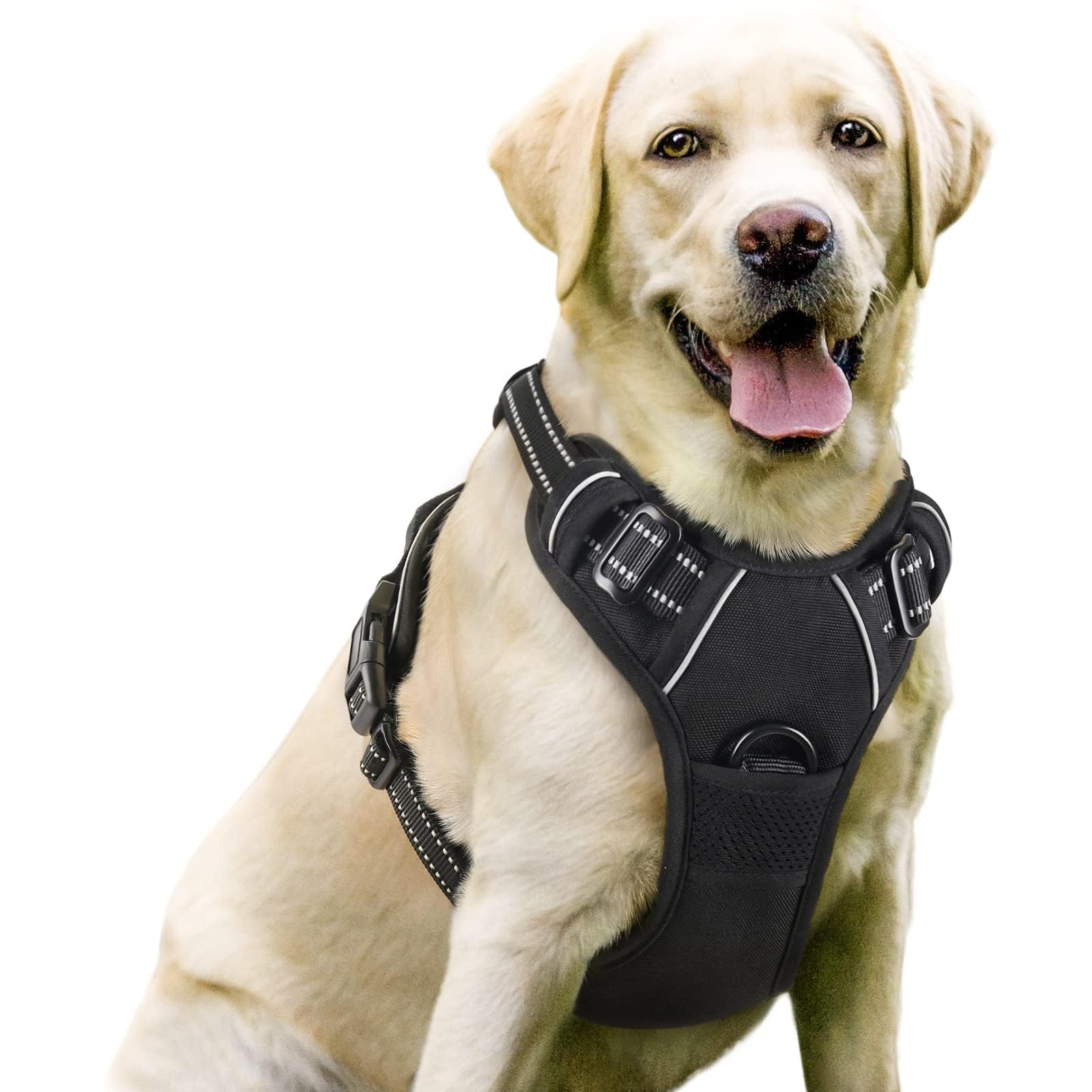
The first thing you notice lifting it out of the box is the weight — 0.74 kg of nylon, webbing, buckles and MOLLE strips. On a big dog who leans into the leash, that heft is reassurance rather than a burden, and it's the reason this one is on the list for the strong ones.

Four adjusters across the neck and chest mean the fit is dialed in rather than approximated, and two leash clips let you switch from a front redirect to a back clip without changing harnesses. The write-in ID panel is the part that matters most for a blind dog: if he gets loose, your phone number is on him and not only on a collar he may have left in the bushes.

A five-foot leash with a foam handle comes in the box, which makes it a kit rather than just a harness. The MOLLE webbing is bulk most dogs will never use; on a dog who needs a handle and a secure fit, it's the least interesting part of the design.

The range runs 30 to 100 pounds and sizes toward the generous side, so a lean dog will have the straps near the end of their travel. Measure rather than assuming a large fits a large dog.

Bottom line: For a strong, heavy blind dog, this is the one we reach for: four-point adjustment that stays put, a padded handle, and an ID panel with your number on it.

2

Doggie Stylz Blind Dog Harness

Doggie Stylz Blind Dog Harness

Blind dog guidance

Our Score 9.0/10
Check Price

Worth Noting

  • One size only, 19-25 in girth
  • Hand wash only
Handle
Padded grab handle
Closure
Buckle
Girth Range
19-25 in
Blind Dog Patches
Two included
Read the full review

A hand on the back handle is how you walk a blind dog, and that padded grip is why this harness takes the top spot. When your dog can't see the curb, the puddle, or the terrier coming, a light hold on that handle steadies him for the half second it takes to steer him around it — no leash jerk, no correction he has no way to understand. The two blind dog patches do similar work for the people you pass, who otherwise reach straight for a dog's head.

The rest is plain and well made: neoprene padding over nylon webbing, a buckle closure, reflective trim along the sides, and a girth range of 19 to 25 inches. That covers most medium and large dogs and none of the small ones, so run a tape around the chest before you order. We noticed the padding sits flat behind the front legs rather than bunching there, which is the spot a harness rubs first.

It goes on over the head, and that's the part to think about with a dog who can't see. A panicked back-out can slip it when the chest strap is loose, so set the straps snug and check them again after the first few walks. If your dog ducks when a hand comes near his face, hold a treat at nose height and let him walk into the harness rather than dropping it over his ears.

One detail we appreciated: the patches sit high on the shoulders, right where a stranger's eyes land on approach, so the warning arrives before the hand does. On a dog who can't see what's coming, that's worth as much as the handle is.

Bottom line: We point medium and large blind dogs here first: the grab handle, the reflective trim and the blind-dog patches all pull in the same direction.

3

rabbitgoo No Pull Dog Harness

rabbitgoo No Pull Dog Harness

Large dogs

Our Score 9.0/10
Check Price

Worth Noting

  • Hand wash only
Handle
Top grab handle
Chest Range
17-33.4 in
Leash Clips
Front and back
Adjustment Points
Four
Read the full review

Seventeen to thirty-three and a half inches of chest, four adjustment straps, two leash clips: the numbers describe a harness built to cover a lot of dog. What the numbers don't tell you is how the front clip behaves. On a blind dog who pulls toward a noise he can't place, that front ring tips his chest sideways and turns a lunge into a step.

This is the one we hand to someone with a big, strong, blind dog and a budget to respect. It's among the least expensive picks here, the build is stout enough for a dog that leans, and the padded top handle gives you a second grip when you need to hold him still at a curb.

The webbing is stiff when new, so the first adjustment takes two hands and some patience; once it's set, it stays where you put it. Watch the chest strap on a hard puller, though — the sliders can creep, and a harness that fits at the door and has slackened by the end of the street is how a dog backs out. A thumb over each slider every few walks keeps it honest.

There's nothing on it that tells a stranger your dog can't see, which is the one place it gives ground to the top pick. A patch on the back or a bright bandana covers most of that, and this stays the harness for muddy days and long walks.

Bottom line: The harness we hand to someone with a big, strong, blind dog and a budget: four straps, a front clip and a padded handle, with the size range to cover the chest.

4

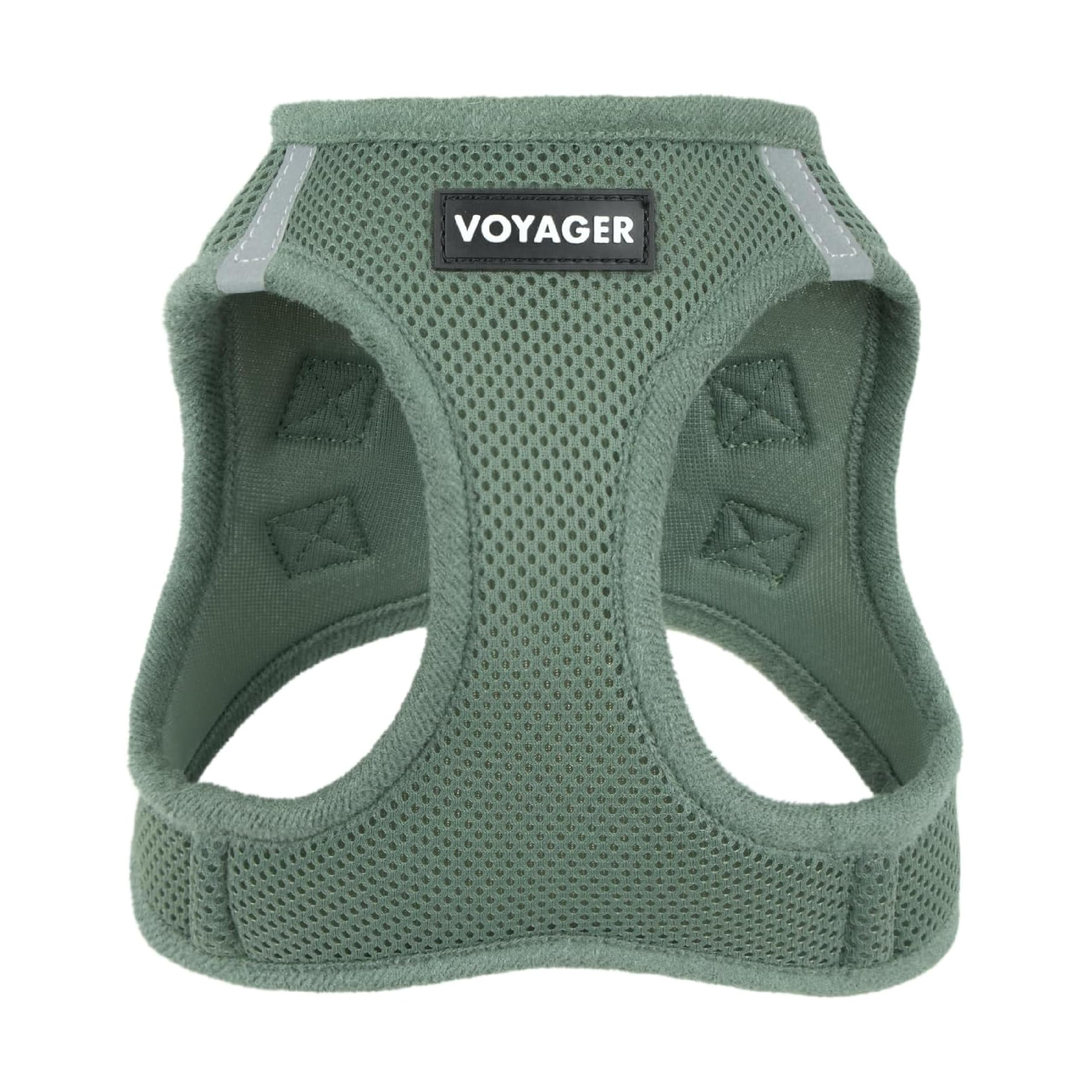
Voyager Step-in Air Harness

Voyager Step-in Air Harness

Small escape artists

Our Score 9.0/10
Check Price

Worth Noting

  • No grab handle for steering
  • No front clip for redirecting
Entry
Step-in
Closure
Hook-and-loop, buckle, double D-ring
Chest Range
14.5-16 in
Weight Range
10-14 lb
Read the full review

Step-in means what it says: the harness lies on the floor, the dog walks into it, and you close a hook-and-loop flap, a buckle and a pair of D-rings. Nothing goes over the ears. For a dog who can't see a loop coming at his head, that's a calmer start to a walk than any amount of coaxing.

It's light — air mesh, two reflective bands, machine washable — and small enough to roll up in a coat pocket. The chest tape is the only sizing that means anything: the small covers 14.5 to 16 inches, with a stated weight range of 10 to 14 pounds.

Three closures in series is why this one earns a place for small blind dogs who back out of harnesses. Most of the picks here rely on a single buckle and a snug strap; this puts hook-and-loop, a buckle and double D-rings between your dog and the street, and the chest panel stays put when he reverses — which is the moment that matters.

Sizing is the weak spot, so measure twice: these sizes don't line up with the S/M/L you're used to, and the chest number is the only guide worth following. When your dog lands on the line between two sizes, take the larger.

Bottom line: For a small blind dog who slips out of things, we start here: three closures and a snug chest make it the hardest of these to back out of.

5

PHOEPET No Pull Dog Harness

PHOEPET No Pull Dog Harness

Head-shy dogs

Our Score 9.0/10
Check Price

Worth Noting

  • Runs large; measure the chest
Size
Medium
Weight
7.68 oz
Buckles
Three, one lockable
Leash Rings
Two metal
Read the full review

The neck strap has its own lockable buckle, and that single detail is why this harness belongs on a shortlist for blind dogs. Instead of dropping a loop over his ears, you lay the harness across his back, close the neck buckle, snap the two chest buckles, and you're done. For a dog who shies when a hand comes at his face, that's ten seconds at the door instead of a wrestling match.

The rest is standard and well done: two metal rings, front for redirecting a pull and back for an ordinary walk, a soft handle on top, reflective material on the body, and oxford cloth over nylon webbing that shrugs off a wet morning. At 7.68 ounces in the medium, it's light enough that a cautious dog won't walk stiffly in it.

Adjusting takes patience — four points, stiff webbing, and some trial and error before the chest sits where you want it. The payoff is that once it's set, it stays set; the harness doesn't wander around the ribcage halfway through a walk.

We keep this one for the dogs who hate being dressed. If your blind dog has learned to back away when the harness comes out, closing it around him instead of pulling it over him interrupts that before it starts. Tape the chest first, though, because this cut runs big.

Bottom line: The one we hand to people whose blind dog fights a harness going over his head: a lockable neck buckle, two metal rings and a padded handle.

6

Annchwool No Pull Dog Harness

Annchwool No Pull Dog Harness

Everyday walks

Our Score 8.8/10
Check Price

Worth Noting

  • Front strap doesn't adjust
Size
L
Weight
5.6 oz
Patches
Two velcro patches
Leash Rings
Two, front and back
Read the full review

Two velcro patches come in the box — an American flag and a joke patch about being special — which tells you what this harness is: a patch panel with a harness attached. That's not a criticism. The panel takes any velcro patch, so one that reads blind dog slots straight on and does the job the printing doesn't.

Underneath the patches it's a capable everyday harness: a padded handle on the back, a front D-ring for redirecting a pull and a back ring for a normal walk, reflective stitching along the webbing, and five sizes from XS to XL, with the XS cut narrower at one inch.

We recommend it to someone who wants the handle and the front clip without paying top-pick money, and who is happy to supply the wording themselves. The catch is the front strap, which doesn't adjust: the chest fit is decided by the size you order, so getting that wrong means living with it or sending it back.

The padding is firm rather than plush, which we don't mind on a dog who mostly walks, and the handle is genuinely comfortable when you're lifting him into the car or over a stile.

Bottom line: We point people here when they want a padded handle and a front clip without top-pick money, and don't mind adding their own blind-dog patch.

7

Dexil Blind Dog Harness

Dexil Blind Dog Harness

Visible on sidewalks

Our Score 8.6/10
Check Price

Worth Noting

  • White webbing shows dirt fast
Weight
3.17 oz
Chest Range
15-24 in
Leash Rings
Front and back D-rings
Neck Opening
Up to 12 in
Read the full review

White is an odd choice for a dog harness until you watch people notice one. This harness is a signpost: the blind dog wording is embroidered into the white webbing in dark lettering, and strangers read it before they reach for your dog's head. That's the feature. The harness is what carries it.

It's the cheaper of the two harnesses here that carries the wording, and it's a real harness rather than a sleeve — nylon webbing, a buckle, a front D-ring for redirecting a pull and a back ring for an ordinary walk, at 0.09 kg. For a small dog on crowded pavement, that combination does something a plain black vest can't.

What it isn't is generous. The small covers a 15 to 24 inch chest with a neck opening up to 12 inches, and the fit runs exact rather than forgiving, so measure with a tape and don't guess between sizes. It's built for ordinary walks, not for a dog who throws himself at the end of the lead.

Where it earns its place is as the second harness — the one that goes on for the vet, the market, the school run. The white and the wording do the work, and the webbing underneath is plain but serviceable.

Bottom line: The cheaper of the two blind-dog-labeled harnesses here, and the one we hand to a small dog on busy sidewalks where strangers need to read the warning.

8

YOOGAO Heavy Duty Dog Harness

YOOGAO Heavy Duty Dog Harness

Giant breeds

Our Score 8.6/10
Check Price

Worth Noting

  • Front strap is the wear point
Handle
Elastic-buffered padded handle
Weight
12.8 oz
Closure
Double ring
Chest Range
28-38 in
Read the full review

A 28 to 38 inch chest range is giant territory — Great Dane, Saint Bernard, the dogs that make everything else on this page look like a cuff. This harness is here because that range is real, and most of the others stop well short of it.

The handle has elastic woven into it, which sounds like a gimmick until something startles a big dog and he hits the end of the leash: the give takes the edge off the jolt instead of passing all of it into your shoulder. We rate that above a rigid handle for a dog who can't see what set him off.

One thing we don't like: on a narrow-chested dog the harness slides sideways, so it wants re-centering after a walk. On a broad giant it stays where you put it, which is the dog this was cut for.

For a genuine giant, the size range is the argument and the elastic handle is a real advantage on stairs and tailgates. Under about ninety pounds, other harnesses here fit better and cost less, and there's no reason to carry the extra webbing.

Bottom line: If your dog measures past the top of every other size chart here, this is the harness that fits, and the elastic handle softens a lunge while you steady him.

How We Tested the Best Harnesses for Blind Dogs

We started by pulling together harnesses marketed for blind or low-vision dogs, plus standard walking harnesses with a lifting handle and a wide adjustment range. I read the sizing charts and measured strap ranges against the chest girths of dogs in our test group, then filtered out any whose smallest size still looked loose on a 12-pound dog or whose largest size stopped short of a 60-pound shepherd mix. Price mattered less than whether the buckles, stitching, and padding looked capable of daily use.

Over six months, we used the 12 finalists on daily walks around the block, through doorways, up and down stairs, into the car, and through the vet's waiting room. Each dog was fitted, then walked while we watched for straps that shifted, rubbed at the armpit, or loosened after a startled turn. We practiced putting each harness on and taking it off in a dim hallway, timing how long it took and noting whether the buckles could be done one-handed. We also lifted dogs by the handle over curbs and into the car to judge grip and how the weight distributed.

At the end of each week, we checked seams, webbing, and padding for fraying or flattening, and we washed the ones that allowed it to see how they held shape. Fit and adjustability were tracked as dogs gained or lost weight; secure fit meant a dog could not back out when startled. We noted appearance last—whether color and reflective trim made a dog easier to spot at dusk and whether the harness looked tidy after repeated walks. The picks below are the ones that stayed comfortable and predictable.

How to Choose the Right Harness for Blind Dogs

Start With the Handle, Not the Clip

On a sighted dog, the front clip does most of the work. On a blind one, the handle does. A padded grip on the back lets you stop a dog mid-stride before he walks into a bike rack, take some of his weight on a stair, or hold him steady while a stranger passes — things a leash correction can't teach, because he never saw the problem coming.

Every harness here except the Voyager and the Dexil has one, and on the Doggie Stylz it's the reason the harness exists. If you use nothing else, you'll still use the handle.

Entry Style Decides Your Morning

Three designs cover this group: over the head, step-in, and a wraparound that closes with a neck buckle. A blind dog can't see a loop coming, so head-shy dogs duck and reverse — which is exactly why the PHOEPET's lockable neck buckle and the Voyager's step-in entry are worth more than they look on paper.

Over-the-head harnesses still work, including our top pick. Introduce one with a treat at nose height and let the dog walk into it, rather than lowering it onto his ears from above.

Fit Is a Measurement, Not a Size Letter

Run a tape around the widest part of the chest, just behind the front legs, and buy from that number: S, M and L mean nothing consistent across these brands. The picks here run from 14.5 inches at the small end of the Voyager to 38 inches at the top of the YOOGAO, with the Doggie Stylz covering 19 to 25 inches.

Then check the sliders every few walks. A chest strap that has crept loose is how a blind dog backs out, and a dog who can't see has no way to find his way home.

What a Label Is Worth

Patches and embroidery aren't decoration on a blind dog. They stop strangers from reaching for his head, and they explain a long pause at a curb to someone who otherwise reads it as a rough handler.

The Doggie Stylz ships with two blind-dog patches, the Dexil has the wording embroidered in, and the Annchwool's velcro panel takes any patch you already own. Buy an unlabeled harness and you're relying on reflective trim, which tells a driver there's a dog but not that he can't see.

Frequently Asked Questions

Final Verdict

Start with the Doggie Stylz. The handle lets you steer and steady a dog who can't see what's coming, the patches keep strangers from surprising him, and the fit is easy to set for a 19 to 25 inch chest.

If your blind dog is small and known for backing out of things, the Voyager's three-closure step-in is the safer buy. If his chest tape reads past 30 inches, the YOOGAO is the one that fits.