Food & Treats

Best Dog Treats of 2026

The buyer of dog treats is never the one who eats them. I can stand in the aisle reading every ingredient panel on the shelf, but the final vote belongs to a sixty-pound mutt who will spit a biscuit onto the rug if he disapproves. That's the strange bargain of this category: you're shopping for quality and value, your dog is shopping for taste, and only one of you gets a say. The right treat buys you a reliable recall in the park, a dog who sits still for a nail trim, and a few quiet minutes on a rainy afternoon.

Over the past three months, my team and I worked through 18 different treats — soft training bites, freeze-dried morsels, and chews sturdy enough to survive a determined gnawer — with dogs ranging from a four-pound puppy to a twelve-year-old with a sensitive stomach. The lesson that stuck: price per bag means nothing. Divide by the number of treats inside, factor in how big each piece is, and you find out which bag is actually the expensive one. The picks below earned their keep.

1

Milk-Bone MaroSnacks

Top Pick
Milk-Bone MaroSnacks

Training and everyday

Our Score 9.6/10
Check Price

Worth Noting

  • Firm biscuits need breaking for toy and senior dogs
Texture
Crunchy outside, meaty inside
Dog Size
Small
Canister Size
40 oz
Calories Per Treat
10
Read the full review

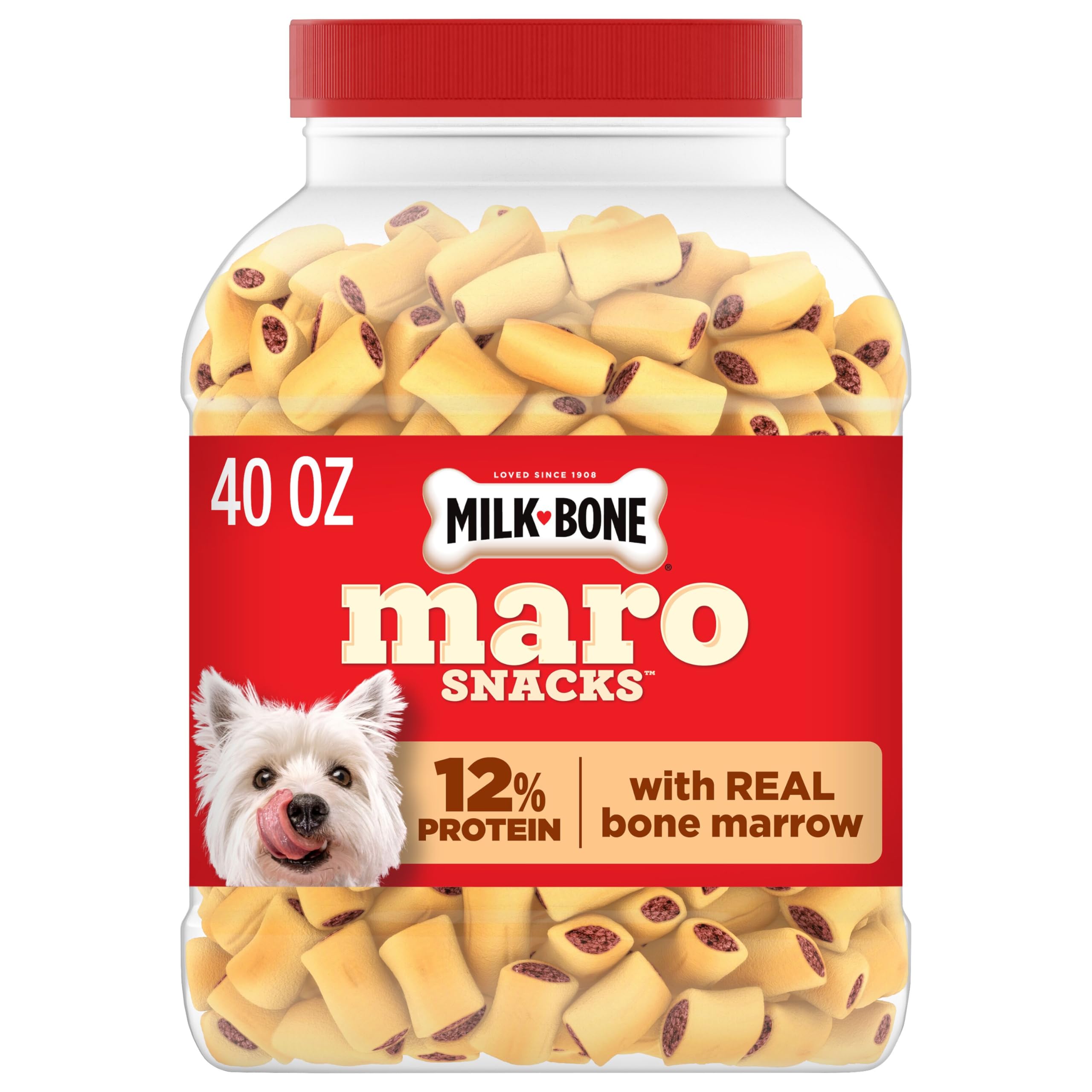
Ten calories is the number that decides this one for us. A reward that small means you can pay a dog for every good decision in a session — the sit, the wait, the loose-leash step — without turning a training habit into a weight problem, and without breaking a biscuit in half with your thumbnail while the dog loses focus.

The build is why we keep buying them: a firm biscuit shell around a marrow center, so there's a crunch and then something meaty behind it. Dogs notice the difference. It's a loud enough payoff to pull attention back in a noisy room, and small enough that a dog isn't still working on it when you want the next repetition. For crate training, where the reward has to arrive fast and disappear faster, that combination is close to ideal.

The 40-ounce canister is the other half of the case. Two dogs on a daily habit won't finish it quickly, the cost per biscuit is among the lowest here, and it lives on a shelf rather than in a drawer. Keep the lid tight: once these sit open they go dusty and crumbly at the bottom of the can, which is a storage problem a jar solves rather than a reason to avoid them.

The trade is hardness. These are firm little biscuits, and a toy breed, a puppy, or a dog with a few missing teeth may need them snapped in two first. If that's your household, the Soft & Chewy canister below does the same job without the crunch.

Bottom line: We recommend the MaroSnacks as the default training treat: ten calories a biscuit, sold by the big canister, and firm enough to ride in a pocket.

2

Greenies Regular Dental Chews

Greenies Regular Dental Chews

Daily dental care

Our Score 9.6/10
Check Price

Worth Noting

  • Premium price makes a daily habit costly
Count
27 chews
Texture
Chewy, cleans to the gumline
Dog Size
25–50 lbs
Primary Use
Dental care
Read the full review

Greenies are the most expensive thing in this roundup by a clear margin, and the case for paying it is specific. The brand attaches numbers to the texture — 47% less tartar accumulation when the chews are part of a daily routine — rather than simply calling them dental.

A regular-size chew is aimed at dogs from 25 to 50 pounds, and the design is the argument: a flexible, slightly giving bone with ridges that work at the gumline, rather than a hard biscuit that shatters against the tooth. Dogs treat them as a genuine reward, which matters more than any claim on the bag. A dental chew a dog refuses is worth nothing at all.

That's the real case for them, in our view. Dental care you have to wrestle a dog into stops happening by the second week; these disappear in a couple of minutes and the dog comes back for the next one. If you've been meaning to add something between brushings, this is the treat that actually gets used, and the resealable pouch keeps a 27-count bag in condition long enough to finish it.

The cost is the catch, and it's a genuine one for something you're meant to hand over every day — the arithmetic is different from a biscuit you give when you feel like it. Near the top of the weight band, size up rather than snapping a regular chew in half; the shape is what does the work.

Bottom line: The dental chew we trust most here: a flexible bone with a clinical claim behind it, and one dogs treat as a reward rather than a chore.

3

Blue Buffalo Bits Beef

Blue Buffalo Bits Beef

Soft training rewards

Our Score 9.6/10
Check Price

Worth Noting

  • Costs more than the biscuit picks here
Texture
Soft and bite-sized
Bag Size
19 oz
Added Nutrient
DHA
First Ingredient
Real beef
Read the full review

The smell arrives before anything else — a dense, beefy, jerky-like smell that carries across a room when the bag opens. For a training treat that isn't a side effect, it's the mechanism: the dog knows from three feet away that the good stuff is out, and you have attention before you've asked for anything.

Real beef is the first ingredient, the pieces are small soft hearts, and they're enhanced with DHA, which is aimed at puppies and is unusual in a bag of training treats. Omega 3 and 6 from flaxseed round out the label. What matters more to us is the softness: a dog that has to crunch through a biscuit loses two or three seconds per reward and drifts out of position, while these are gone almost immediately and the session keeps its rhythm.

They also break cleanly in half for a smaller payout, and the size is small enough to load into a puzzle toy as well as a pocket. That flexibility is why the bag lives in our training kit rather than the cupboard.

Where these fall down is pickiness. An assertive beef flavor is a hook for most dogs and a wall for a few, and there's no way to know which dog you have until the bag is open — so start with one before you commit to a shelf full. For a puppy or a distracted adolescent, though, that intensity is exactly what you're paying for.

Bottom line: The soft, smelly training treat we reach for with puppies and distracted dogs: quick to eat and hard to ignore.

4

Pedigree Dentastix Large

Pedigree Dentastix Large

Large dog dental

Our Score 9.6/10
Check Price

Worth Noting

  • Only sized for dogs 40 pounds and up
Count
36 sticks
Shape
X-shaped
Dog Size
40 lbs and up
Added Sugar
None
Read the full review

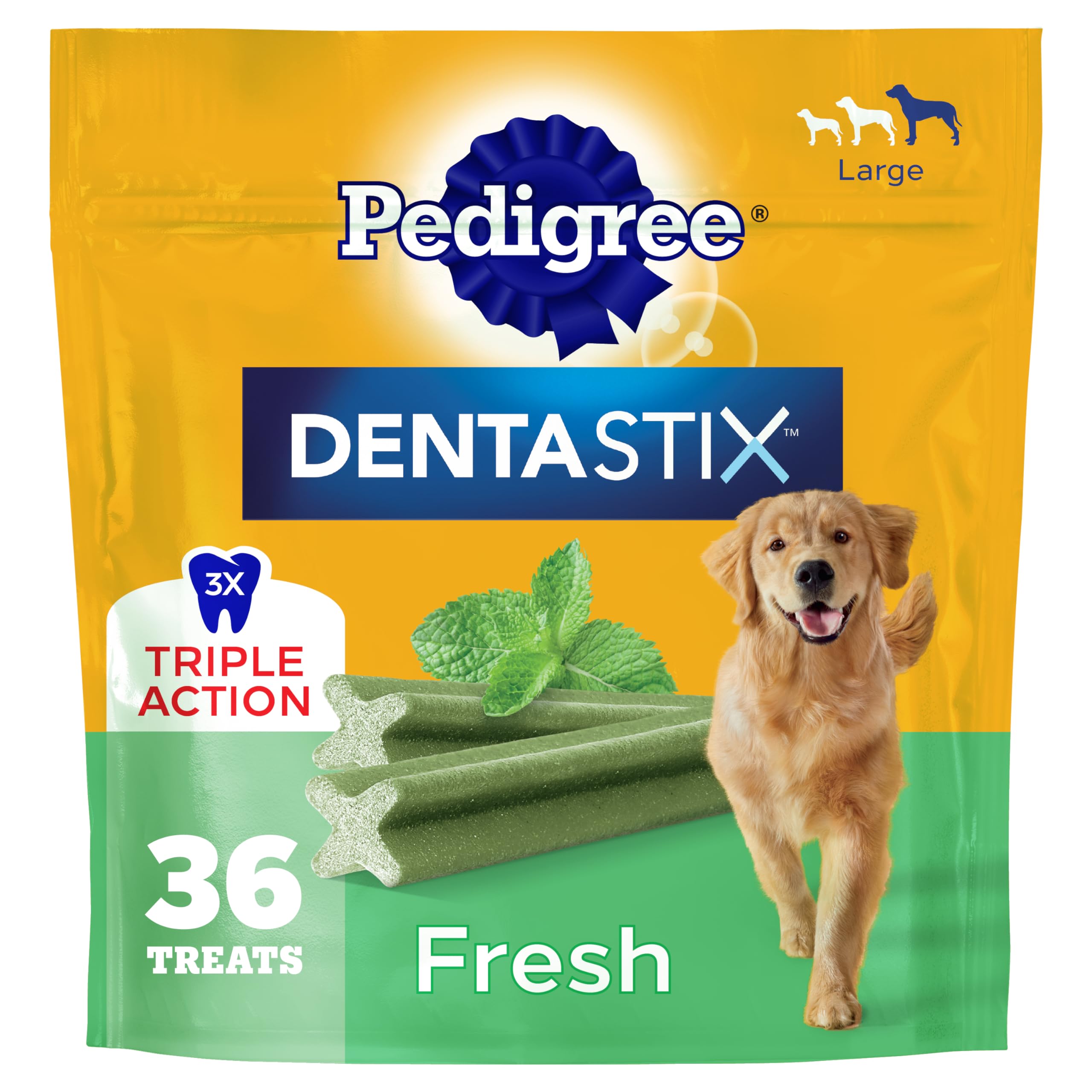
Forty pounds is the line, and it's the first thing to check. Below it, one of these sticks is a lot of chew in a single sitting; above it, the X-shape is sized to put grooves against the back teeth a toothbrush struggles to reach, which is a more specific job than most dental treats attempt.

One a day is the routine, and 36 in the bag covers a bit more than a month, so the habit is easy to keep. The texture is the part we like: chewy enough to bend before it snaps, which is gentler on a big dog's teeth than a hard biscuit, and the mint flavor leaves breath noticeably better afterwards. No added sugar is a small thing that matters when you're handing one over every evening.

The limitation is the size ladder. If your dog sits just under the line, this isn't the pack — an oversized dental chew gets swallowed too fast to do the work it was shaped for. Match the chew to the weight band on the bag and the rest takes care of itself.

Bottom line: Our pick for big dogs' teeth: one X-shaped stick a day, chewy enough to bend, sized for 40 pounds and up.

5

Purina Beggin' Fun Size

Purina Beggin' Fun Size

Walks and training

Our Score 9.6/10
Check Price

Worth Noting

  • Fun-size strips barely register for big dogs
Flavor
Bacon
Pouch Size
25 oz
First Ingredient
Real meat
Calories Per Strip
7
Read the full review

Bacon is close to a cheat code in a treat pouch, and the fun-size strip is the version we want on a walk: seven calories, soft enough to disappear in a second, and loud enough in the nose to beat a squirrel. Real meat is the first ingredient, there are no artificial flavors, and the strips stay soft while the pouch is fresh.

The resealable top is worth actually sealing. Left open, these stiffen within a few days and a dog that was obsessed on Monday will sniff and walk away. Beyond that, the 25-ounce pouch covers a long stretch of walks and training reps, which is why it stays in the rotation despite the plain construction.

Bottom line: Bacon that fits in a pocket: seven calories a strip, soft, and loud enough in the nose to win a dog's attention outdoors.

6

Milk-Bone Soft & Chewy

Milk-Bone Soft & Chewy

Seniors and puppies

Our Score 9.4/10
Check Price

Worth Noting

Protein
18%
Texture
Soft and chewy
Canister Size
25 oz
Vitamins And Minerals
12
Read the full review

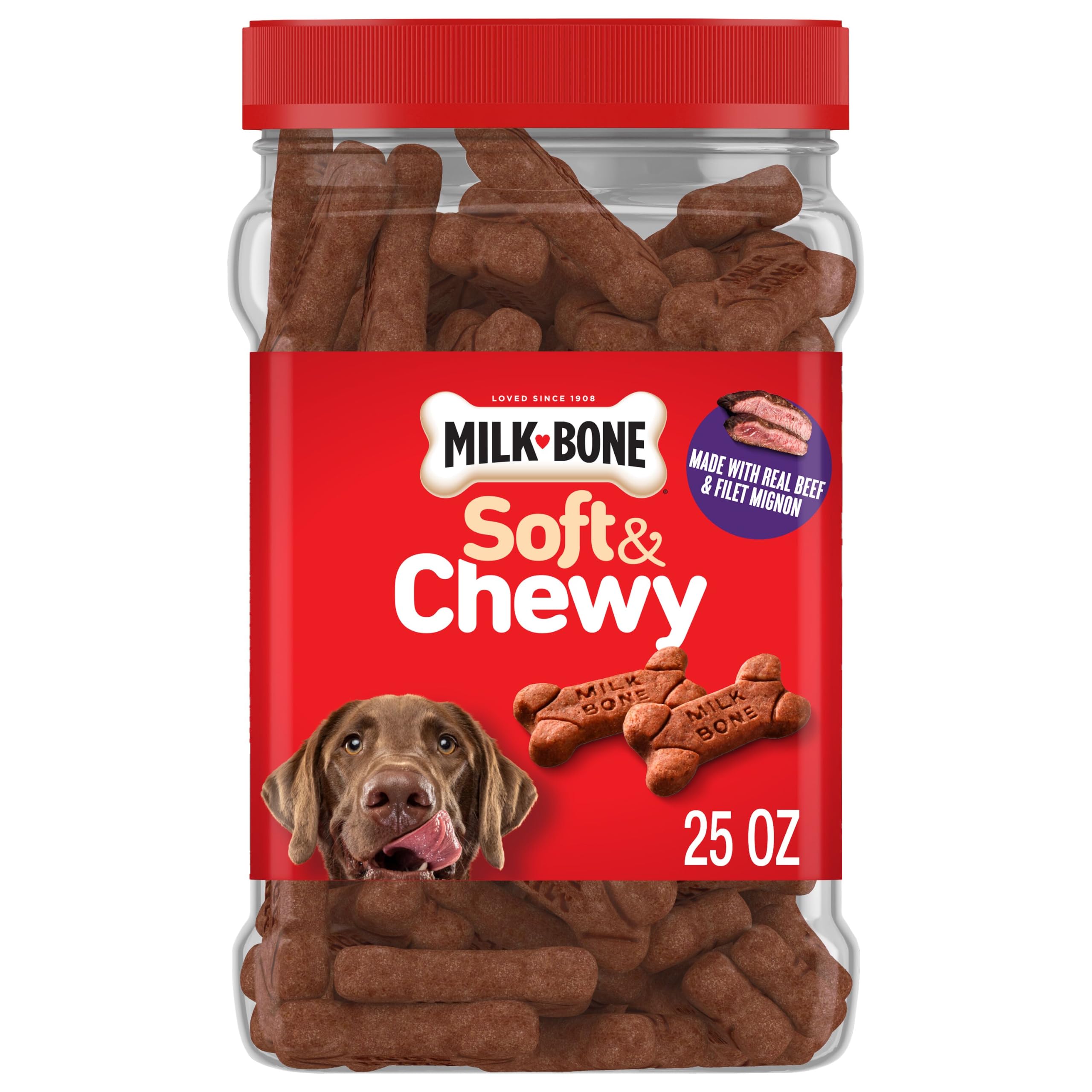
There's a point where a dog quietly stops managing a crunchy biscuit — a cracked tooth, a missing molar, an old dog who still wants the ritual but not the work. This is the canister we keep for that dog. The pieces are soft enough to fold between your fingers and still hold their shape in the container instead of smearing into the bottom.

What we appreciate most is that they don't feel like a concession. They tear into three or four training-size pieces without shattering, so a 25-ounce canister goes further than the count suggests, and 18% protein with twelve vitamins and minerals makes them more than a flavored sponge. The beef and filet mignon flavor is assertive enough that a fussy old dog takes an interest, which is the whole battle with a senior who has stopped caring about treats.

Soft treats are the ones that go stale fastest, so buy the size that matches your rate of use and keep the lid on between sessions. For a single small dog that's the only real caution here — the texture that makes these work is also why they don't keep like a biscuit.

Bottom line: The pick for older dogs and puppies: soft enough for worn teeth, and it tears into pieces instead of shattering.

7

Blue Buffalo Health Bars

Blue Buffalo Health Bars

Everyday biscuits

Our Score 9.4/10
Check Price

Worth Noting

  • Bars often arrive broken and crumbly
Texture
Oven-baked crunchy
Bag Size
16 oz
Free From
Corn, wheat, soy
Key Ingredients
Oatmeal, bacon, egg, cheese
Read the full review

Not every dog wants a soft treat. This is the crunchiest thing in the roundup — an oven-baked bar with a snap you can hear from the next room — and for a dog that likes to work at a biscuit, that noise is half the reward.

It's also the cheapest bag here by a wide margin. The recipe is a decent one for the money: oatmeal, bacon, egg and cheese, no corn, wheat or soy, and a firm bake that keeps in a pocket rather than smearing.

We keep these as the everyday biscuit rather than the training treat. They're too big and too slow to feed at speed, but for a dog that gets one after a walk or at bedtime, the bar lasts long enough to be an event, and the bacon-and-egg smell gets a dog waiting by the cupboard at the same time every evening. Ritual value is what a bag this size is for.

Size is the other thing to plan for: these are proper biscuits, not minis, and a small dog needs one broken in two. Medium and large dogs get the full bar, and the snap is the point.

Bottom line: The value pick: a big, crunchy, oven-baked biscuit for dogs that like to work at a treat, at the lowest price here.

8

Good 'n' Fun Kabobs

Good 'n' Fun Kabobs

Long chew sessions

Our Score 9.4/10
Check Price

Worth Noting

  • Rawhide needs supervision and doesn't suit every dog
  • Texture varies between bags, some arriving rock hard
Count
18 chews
Format
Rawhide kabob
Primary Use
Supervised chewing
Wrapped With
Chicken, duck, and liver
Read the full review

This is the only thing here that isn't really a treat. It's a chew, bought for a different job: a stretch of a dog being occupied rather than two seconds of a dog being rewarded.

The build is a beef-hide stick wrapped in chicken, pork hide, duck and chicken liver, sold 18 to a bag. Dogs strip the coating first and then settle into the hide, which is why one of these can hold a dog's attention through a bath, a delivery, or a phone call you want to finish.

Two things to know first. Rawhide is a supervised chew: give it on a floor you can wipe, and take it away once it's small enough to swallow. And some dogs don't tolerate it, with digestive upset the usual sign to stop. Bags vary too — a soft kabob and a rock-hard one can come out of the same order, and the hard ones are the chews some dogs abandon half-finished. None of that is a reason to avoid them; it's a reason to buy one bag before a case.

For dogs that take to them, the appeal is close to absolute: this is the treat that gets a dog parked by the cupboard, staring. Nothing else in this set buys quiet time the way a chew does, and that's the reason to keep a bag on the shelf — not as a reward, but as an occupation.

Bottom line: The chew rather than the treat: a rawhide kabob for dogs that like to work at something, bought for quiet time and given supervised.

How We Picked and Tested Dog Treats

We started with a list of more than 60 treats — bestseller lists, trainer recommendations, and brands our own dogs already ate — then read the guaranteed analysis on every bag and cut anything that led with unnamed meat meal, by-products, or artificial colors. That left 18 to test: soft training bites, freeze-dried single-ingredient pieces, dental chews, and a few long-lasting chews for the dogs who destroy everything.

Those 18 lived in my kitchen for three months and went everywhere the dogs went. We handed them out during leash walks, recall drills in the backyard, nail trims, and the evening settle on the couch, and we watched how the pickiest dog in the group reacted — took it immediately, chewed and dropped it, or sniffed and walked away. Anything a dog refused twice was marked.

We measured each piece against a thumbnail and checked whether it fit through a standard treat-pouch opening, then broke it in half to see how cleanly it split for small-dog portions. Chews got a stopwatch: we timed how long each one held a dog's attention and how much was left after 15 minutes, and we watched whether a dog gnawed steadily or tried to gulp a piece whole.

Every treat got at least three weeks of regular feeding so we could track stool consistency, gas, and any change in appetite; a bag that produced loose stool came out of rotation. We also counted treats per bag to find a real cost per treat, and noted whether the bag resealed and stayed fresh past the first week. The picks that survived are the ones worth both the money and the counter space.

How to Choose Dog Treats

Start with the job, not the flavor

Training treats need to be small and quick: a dog that's still chewing has stopped listening, and a reward that takes ten seconds costs you ten seconds of focus. Everyday biscuits can be bigger and slower, because the point is the ritual rather than the repetition rate. Chews are a third category entirely — bought for time, not for reward. Decide which of the three you're shopping for before you compare bags, because the best training treat here is a poor chew and the reverse is just as true.

Calories per piece decide how often you can reward

Look at the calories per piece before the bag size. The treats here run from five to ten calories each, and that spread is the difference between rewarding ten times in a session and rewarding twenty. Treats generally shouldn't make up more than about a tenth of a dog's daily calories, so small pieces you can repeat beat large ones you have to ration. Any soft treat can be torn in half to halve the payout.

Match the texture to the mouth

Crunchy biscuits are cheap, keep well, and satisfy a dog that likes to work at something — but they're firm, and a toy breed, a puppy, or a dog with missing teeth needs them broken or a softer option. Soft treats tear cleanly and suit training at speed; they also dry out faster once the bag is open, so buy a size you'll finish. A chew is neither: rawhide and pressed dental chews are for supervised time and for teeth, not for a quick reward mid-session.

Dental treats are a routine, not a substitute for brushing

Dental chews work by texture and time against the tooth surface, and the two formats here do it differently. Greenies use a flexible ridged chew with a clinical tartar claim and a 25 to 50 pound weight band; Dentastix uses an X-shaped stick built for dogs over 40 pounds. Both are daily habits, and the value sits in the days between brushings. Match the chew to your dog's weight band, because an undersized dental chew is swallowed before it can scrape anything.

Buy the size you'll actually finish

Bulk is where the value is, and freshness is what you pay for it. Crunchy biscuits go crumbly and soft treats stiffen once air gets to them, so a very large canister can outlast one small dog's enthusiasm. With a single dog, a resealable bag or a smaller canister is usually the smarter buy; with two dogs, or a dog in daily training, a 40-ounce canister earns its shelf space. Decant into an airtight jar and the arithmetic tips firmly your way.

Frequently Asked Questions

Final Verdict

Most dogs do most of their earning in a training session, and that's why the Milk-Bone MaroSnacks are the bag we point people to first: ten calories a biscuit, small enough to repeat, firm enough to live in a pocket, and sold in a canister that lasts.

If your dog has stopped managing crunchy food, the Soft & Chewy canister is the same idea for older teeth. If the goal is the teeth themselves, buy Greenies and use them daily — the price is simply what that routine costs.