Food & Treats

Best Chicken Dog Treats of 2026

The word chicken on the front of a dog treat bag tells you almost nothing. It can mean a single dried breast or a chicken meal buried under grains, and the packaging certainly won't tell you which one your dog will actually chew. What you're after is simpler than the marketing: a treat your dog will work for, that won't upset a sensitive stomach, and that does something for the teeth instead of vanishing in one gulp. That combination is rarer than the shelf would suggest.

My two dogs have very different mouths — a nine-year-old with a cracked molar and a puppy who inhales anything — so I've gotten fussy about texture. Over three months, we put 14 chicken treats in front of a rotating panel of dogs, from Yorkies to a very committed Labrador, and the differences came down to details nobody prints on the bag. Harder isn't automatically better for teeth, either: a treat has to match the jaw in front of it, or it gets swallowed whole or left on the rug. The picks below are the ones that held up on all of it.

1

Greenies Teenie Chicken

Top Pick
Greenies Teenie Chicken

Teeth and breath

Our Score 9.6/10
Check Price

Worth Noting

  • Contains wheat
Size
Teenie, 5-15 lb dogs
Count
43 treats
Format
Dental chew
Dental Claim
Vet-recommended, clinically proven
Read the full review

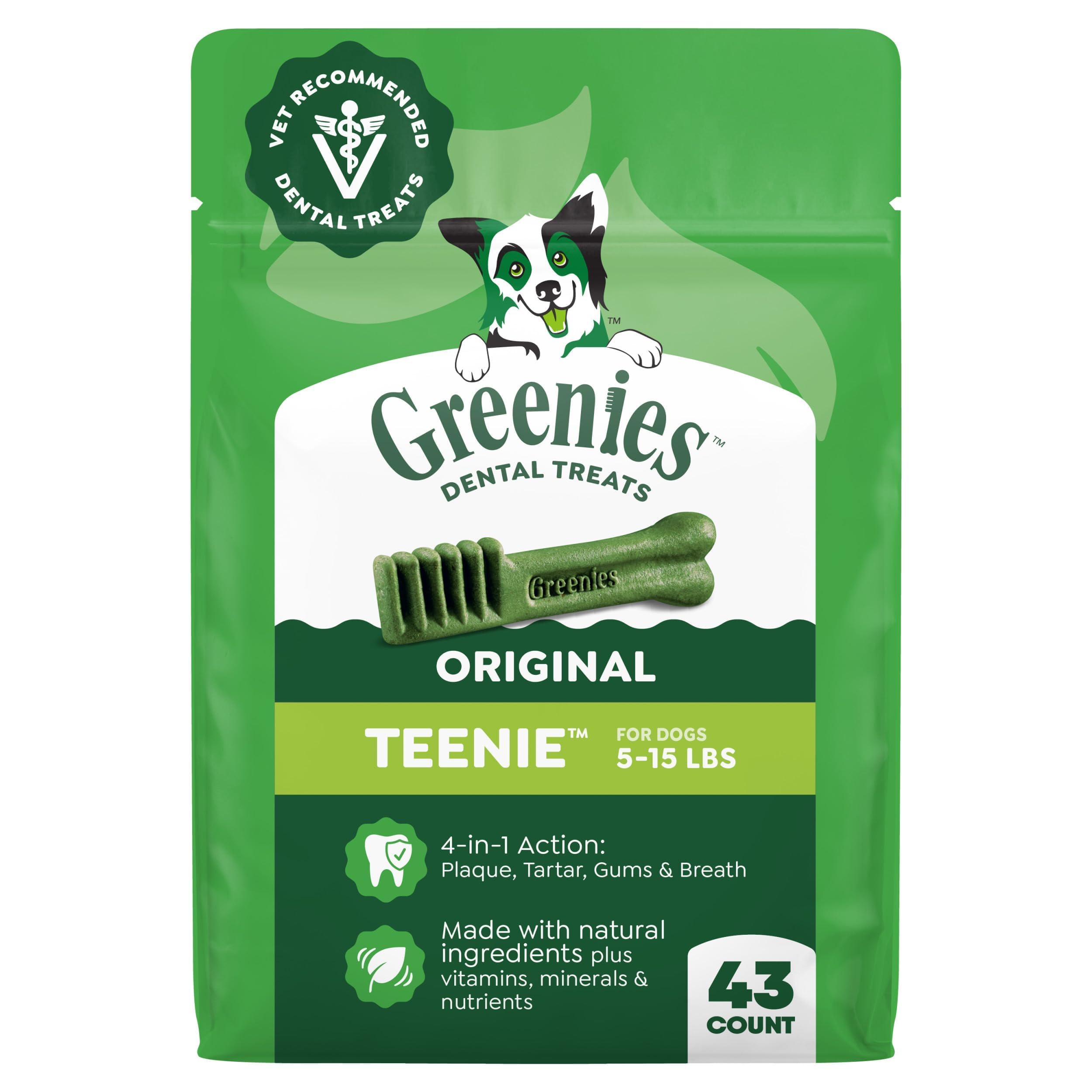
Greenies isn't really a reward. You can't tear it, and a dog doesn't take a bite so much as settle in and work at it, so judging it against the soft chicken treats on this list misses the point. It's a dental product that happens to be chicken flavored.

The dental case is the reason it's here. It's veterinarian-recommended, and the daily-use claims are clinical rather than decorative, with 47% less tartar accumulation as the headline figure. The mechanism is texture: a chewy, slightly abrasive bone that flexes against the tooth as the dog works through it, which is how the chewing action gets down to the gumline in a way a biscuit doesn't.

Get the size right before you buy. Teenie is specified for dogs from 5 to 15 pounds, and that's a wide range of mouths. It's also a daily habit rather than something you hand out ten times a session, and at 43 to a tub you're looking at a bit over a month of daily chewing.

We recommend it as the dental pick and nothing else. It earns a place beside a toothbrush rather than instead of one, and the dogs we've offered it to take it as a chew rather than a chore. Buy it for the teeth and keep a soft treat for the training.

Bottom line: If teeth are the reason you're shopping, this is the chew to buy: veterinarian-backed, sized for small dogs, and flavored so it actually gets eaten.

2

Nudges Homestyle Chicken

Nudges Homestyle Chicken

Everyday soft treating

Our Score 9.4/10
Check Price

Worth Noting

  • Soft pieces arrive broken in the bag
Chicken
First ingredient
Texture
Soft, tears easily
Bag Size
16 oz
Life Stage
All life stages
Read the full review

The first thing we do with a new bag of soft treats is tear one in half. Some fight back, some turn to paste, and a few split cleanly along the grain the way these do. That matters more than it sounds: a treat you can halve or quarter in a second is one you actually use for training, not just for the good-dog moment at the end of the day.

Chicken is the first ingredient, and the recipe is built around a chicken pot pie idea, with visible vegetable pieces in the mix. We recommend this bag as the everyday default because it doesn't force a choice: whole for a retriever, torn into four for a terrier, soft enough that a ten-year-old dog with worn molars doesn't have to work at it. It's labeled for all life stages and all breed sizes, which is rarer than it should be in a category where most bags pick a lane.

Nothing about it is precious. It tears without smearing across your fingers, and it holds together well enough to ride in a jacket pocket until the walk is over. The bag smells strongly of chicken and herbs when you open it — savory rather than unpleasant, and it fades once the bag is folded shut.

Bottom line: Real chicken leads the recipe, and the soft pieces tear to whatever size your dog needs — this is the bag we reach for as a default.

3

Blue Buffalo Bits Chicken

Blue Buffalo Bits Chicken

Training rewards

Our Score 9.4/10
Check Price

Worth Noting

  • A large dog needs a handful per reward
Chicken
First ingredient
Texture
Soft, bite-sized
Bag Size
19 oz
Added Nutrients
DHA, omega 3 and 6
Read the full review

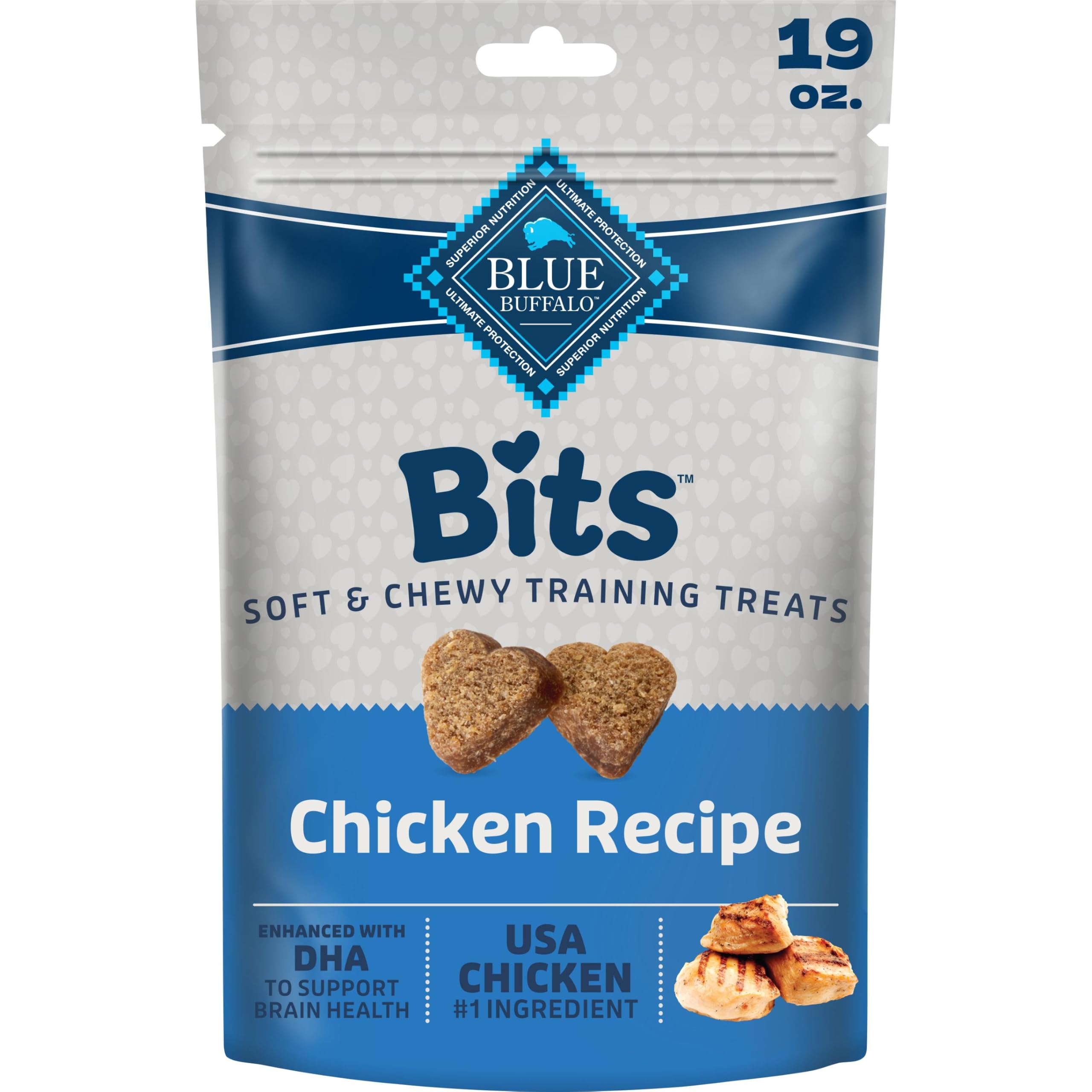
A training session is a numbers game: twenty repetitions, twenty rewards, and a treat that has to be broken by hand costs you a second every time. Blue Bits are already the size of a fat piece of kibble, so we can mark a sit and ask for the next one without looking down at our fingers. That single fact is why this bag lives on the counter during a training push while the bigger, softer treats stay in the cupboard.

Chicken is the first ingredient, and the recipe carries DHA, an omega-3 fatty acid aimed at puppies, along with flaxseed for omega 3 and 6. They're labeled for all life stages and all breed sizes, so the same bag works for an eight-week-old puppy and the old dog who still expects payment for coming inside. Soft and slightly spongy, they compress rather than crumble, which is why a handful survives a pocket.

The smell is the one thing to brace for: a strong, barbecue-ish scent that carries across a room when the bag is open. Outdoors, mid-walk, nobody notices. In a small kitchen, you will.

Bottom line: Training is a numbers game, and this bag wins it: bite-sized pieces, real chicken first, and a soft texture that doesn't slow a puppy down.

4

Farmland Traditions Chicken Jerky

Farmland Traditions Chicken Jerky

Limited-ingredient jerky

Our Score 9.4/10
Check Price

Worth Noting

  • Three-pound bag commits you to one recipe
Chicken
First ingredient, USA-raised
Texture
Dehydrated jerky, breaks apart
Bag Size
3 lb
Ingredients
No grain, soy, or corn
Read the full review

Three pounds is a lot of jerky. For one small dog getting a strip after the evening walk, a single bag covers a season, which is exactly how this one is sold — as a bulk staple rather than a trial size. If you're used to six-ounce bags, the first delivery looks less like a treat order and more like a small parcel of lumber.

The ingredient list is short and the claims are specific: chicken raised in the USA, no grain, soy, or corn, no fillers, and production in an FDA-registered plant in Southern California. The strips are dehydrated rather than cooked soft, so they snap and tear — a strip becomes four rewards without a knife, which is the difference between a treat you portion and one you wrestle with.

We recommend it to households that read labels, with one caveat about firmness. Dehydrated jerky runs hard, and how hard varies from bag to bag; for an older dog or a small mouth, break a strip into short pieces and skip the end nubs, which take the most work. None of that is a reason to avoid it — it's a reason to keep a pair of kitchen scissors nearby.

Bottom line: Short ingredient list, USA-raised chicken, and a three-pound bag that keeps a simple recipe in daily rotation — this is the one for label-readers.

5

Milo's Kitchen Chicken Meatballs

Milo's Kitchen Chicken Meatballs

Senior dogs

Our Score 9.4/10
Check Price

Worth Noting

  • Bigger than a training bite
Chicken
First ingredient
Made In
Utah, USA
Texture
Soft meatball
Bag Size
18 oz
Read the full review

There's a particular dog these are for: the one with four teeth left who still lines up for a reward. A meatball squashes between your fingers, so you can pinch off a piece small enough for a mouth that can't manage a biscuit, and it stays tender after the bag has been open a few days, which is more than most soft treats manage. That's why this is our pick for old dogs.

Chicken is the number-one ingredient, with no meat by-products, no artificial flavors, and no added corn or wheat, and the whole lot is made in Spanish Fork, Utah. The smell is genuinely good — savory, a bit like a roast — which matters more than it sounds when you're handling a dozen a day and the bag lives in the kitchen.

A meatball is bigger than a training bite, so for a dog under about fifteen pounds it's a two- or three-piece treat, and breaking it up leaves a few crumbs in your palm. Soft, rich treats also don't suit every stomach: hand over one at a time for the first few days and stop if the stool loosens.

Bottom line: A soft chicken meatball you can pinch to whatever size an old mouth can manage, with real chicken first and nothing artificial in the bag.

6

Nutrish Savory Roasters Chicken

Nutrish Savory Roasters Chicken

Bulk everyday value

Our Score 9.4/10
Check Price

Worth Noting

  • Chunks vary in size, so rewards do too
Grain
No added grain
Chicken
First ingredient
Texture
Soft chunks
Bag Size
30 oz
Read the full review

Thirty ounces of soft roasted chicken chunks in a pouch is the sort of bag you buy when treats are a daily line item rather than an occasional reward. Real chicken is the first ingredient, there's no added grain, no artificial flavors and no meat by-product meal, and it's cooked in the USA from ingredients sourced here and abroad — a more honest label than a bare made-in-USA claim.

The pieces are irregular chunks rather than uniform kibble. That's fine for a retriever and awkward for a five-pound dog, where half a chunk is already a full reward; the upside is that they break easily, so one chunk becomes two or three pieces without a knife.

We like this as the value pick for multi-dog houses and anyone running several short sessions a day: thirty ounces is enough to be generous with, and the softness means the oldest dog in the pack gets the same treat as the puppy. The one caution is arithmetic — a pouch this size only pays off if you'll finish it, so a single small dog on two treats a day is better served by a smaller bag.

Bottom line: When treats are a daily expense, this pouch earns its keep: real chicken first, soft chunks for any age of dog, and enough volume to stop rationing.

7

SmartBones Mini Bones Chicken

SmartBones Mini Bones Chicken

Rawhide-free chewing

Our Score 9.4/10
Check Price

Worth Noting

  • Gone in minutes for a hard chewer
Count
56 chews
Format
Rawhide-free mini bone
Chicken
Real chicken center
Breed Size
Small breeds
Read the full review

A rawhide chew that isn't rawhide: SmartBones press a vegetable shell around a chicken center and shape it into a small bone, sized for small breeds and sold 56 to a bag. It's the format to reach for when your dog wants something to hold between his paws rather than something to swallow.

How long they last depends entirely on the dog. For a chihuahua mix these are a few minutes of serious chewing; for a determined terrier they're gone before you've sat down. What they do well is occupy without rawhide — the chew softens as it's worked, and the pieces that come off are smaller and more likely to break down than a knot of hide.

Sensitive stomachs are the thing to watch. The chew is richer than a biscuit, and a dog who reacts to rich treats may react to these, so start with one on a quiet day rather than a handful before a car journey. Take away the last stub once it gets small, the same as any chew.

Between this and the dental chew on this list, the split is purpose. We keep both: Greenies is the hygiene habit you schedule, and these are the chew you hand over when you want ten quiet minutes and a slightly cleaner set of teeth at the end. For a small dog that chews hard, these are the more satisfying of the two.

Bottom line: For small dogs that want something to hold: rawhide-free, chicken-centered, and sized for small mouths — expect minutes, not hours.

8

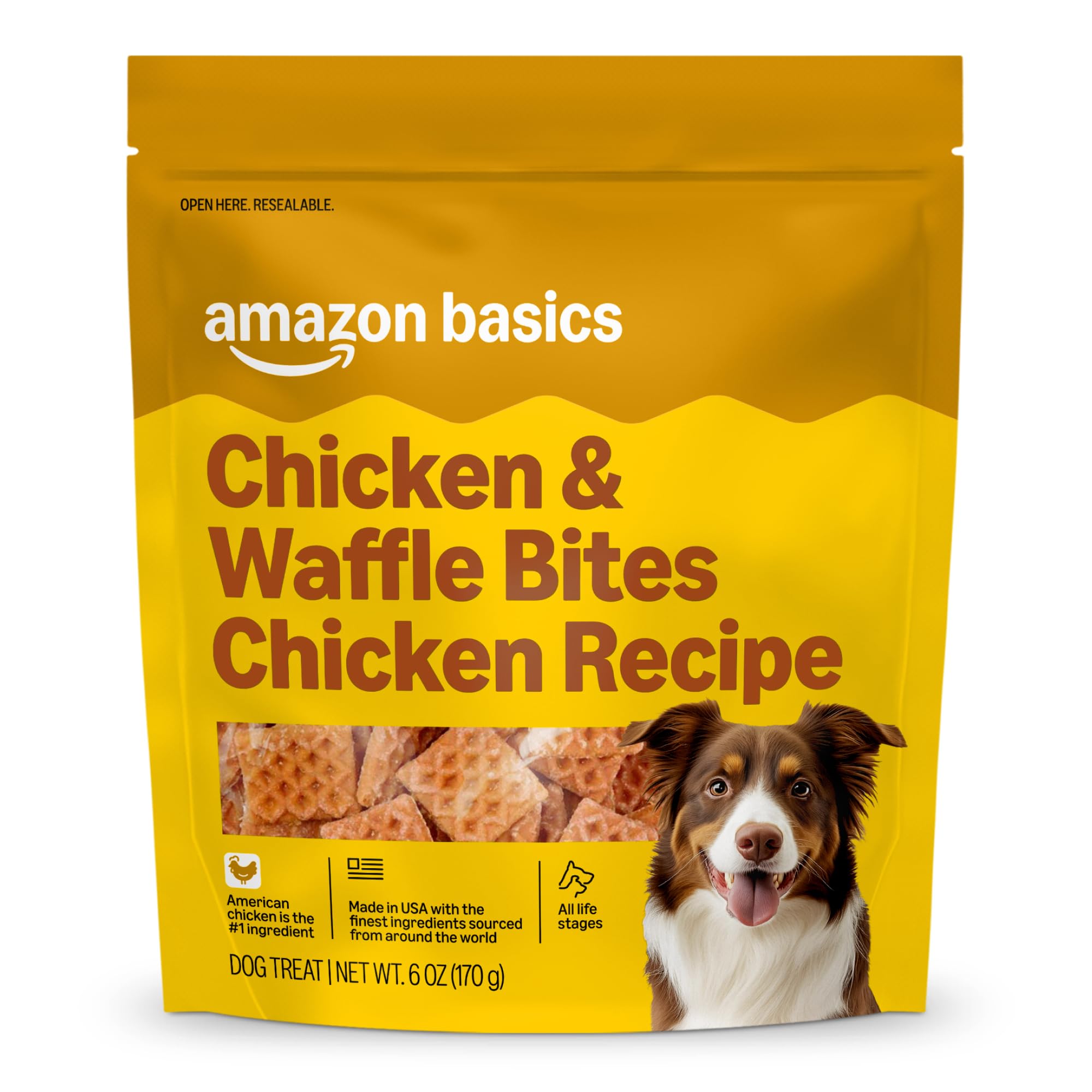
Amazon Basics Chicken & Waffle Bites

Amazon Basics Chicken & Waffle Bites

Small-bag budget

Our Score 9.2/10
Check Price

Worth Noting

  • Crunchy texture won't suit sore mouths
Chicken
First ingredient, US farm-raised
Texture
Crunchy waffle bite
Bag Size
6 oz
Free From
Corn, soy, and wheat
Read the full review

Six ounces is a try-it size, and the crunch is the whole point: these are waffled, biscuity bites rather than the soft chicken treats that make up most of this list. Chicken and waffle is a strange idea for a dog snack until you watch a dog work one over, and the texture is the reason to consider them at all.

We recommend the small bag for exactly that: farm-raised American chicken is the first ingredient, there's no corn, soy, wheat, or artificial flavor, and the outlay is the smallest here, so it's an inexpensive way to find out whether your dog wants texture with his chicken. The pieces snap cleanly into training bits too, which is how we use them — one waffle becomes six or eight rewards.

The caveat runs the other way. A crunchy bite is the wrong tool for a dog with sore gums or missing teeth, and it's firm enough that a delicate eater may refuse it outright. These were sold as Wag until recently, so don't be thrown if the packaging looks unfamiliar.

Bottom line: Crunchy, American-chicken-first, and free of corn, soy, and wheat — worth the small bag if your dog wants texture with his reward.

How We Tested the Chicken Treats

We started by reading ingredient panels on more than 50 bags sold as chicken treats and dropped any where chicken wasn't the first ingredient, where the chicken was a vaguely named meal, or where the bag leaned on flavoring instead of actual meat. From there we kept a spread of formats — freeze-dried cubes, jerky strips, pressed dental chews, soft training bites — and enough price points to say something useful about value, which landed us at 14.

Testing ran three months, with my two dogs plus a rotating panel of coworkers' dogs ranging from a six-pound Yorkie to a Labrador who has never met a treat he didn't like. Each one was offered the same way: from an open palm in the kitchen during a morning training session, then again two days later to see whether the enthusiasm held or the dog had already written it off. Soft bites got judged on how fast they disappeared and whether the dog stayed tuned in afterward; longer-lasting chews were timed on the living room rug. We opened every bag the day it arrived and noted how sharp the smell was and whether it lingered on our hands or the couch cushions.

Hardness got the most scrutiny, since it drives both the dental payoff and the risk. I bent and snapped a treat from each bag and watched how each dog handled it — whether a small dog could bite through or had to gulp, whether a big dog was finished in four seconds flat. Over consecutive days we tracked stools and gassiness and pulled anything that produced a loose afternoon. For the dental chews, we checked back molars weekly for tartar and noted whether the texture delivered a real gnawing session or dissolved on contact. We also counted treats per bag and cost per treat, and weighed how many arrived shattered in the bottom of the bag.

How to Choose Chicken Dog Treats

Chicken first, or chicken flavoring?

Ingredients are listed by weight, so a bag that leads with chicken is telling you something a bag merely flavored with chicken is not. The distinction matters most in dental chews and biscuits, where the substance is grain or starch and chicken is the seasoning that makes it palatable.

Read the first three ingredients and decide which product you're buying. If chicken sits below a grain or a fat, you're paying for flavor — fine, as long as that's what you wanted and you're judging the treat on the job it does instead.

Match the texture to the mouth

Soft, tearable treats are the safest default: they work for puppies, seniors and dogs missing teeth, and you control the size with your fingers. Dehydrated jerky gives a dog something to work at, but firmness varies by bag and the end of a strip is tough for a small mouth. Crunchy biscuits suit dogs who like noise and are wrong for sore gums.

Chew-style treats are a different category in practice — they occupy rather than reward, and they belong in the rotation alongside a soft treat, not instead of one. Decide the texture your dog can physically manage first, then pick the format that fits the moment.

Buy the size your routine will finish

The bag price is the wrong number to compare. What matters is how far the bag stretches: a thirty-ounce pouch of soft chunks is economical in a multi-dog house and a slow haul for one small dog getting two treats a day.

Count the rewards a normal day takes, then work out weeks per bag. If your training comes in bursts, a small bag for sessions plus a large one for daily rewards beats a single enormous bag of anything.

What made in USA and no fillers actually mean

Two labels do a lot of work in this category. A made-in-USA claim can mean the chicken was raised here, or only that the product was cooked or packed here from imported meat, and the more honest bags say which. No fillers usually means no grain, soy or corn — it matters if your dog reacts to them and matters little if not.

Pay the premium for a named origin and a short ingredient list when you're feeding a lot of treats or your dog has reacted before. Otherwise spend the difference on a texture your dog actually enjoys, since that's what determines whether the bag gets finished.

Frequently Asked Questions

Final Verdict

Buy the Blue Buffalo Nudges Homestyle bag if you want one chicken treat that covers most of the week: chicken first, soft enough to tear down for a small dog or hand whole to a big one, and mild enough to use every day.

Change the requirement and the answer changes. Greenies if teeth are the reason you're shopping, Farmland Traditions if a short ingredient list matters more than a pliable texture, and Blue Buffalo Bits if you're running training sessions and need twenty rewards without breaking anything by hand.