Toys & Chews

Best Eco-Friendly Dog Toys of 2026

An eco-friendly dog toy should make you feel good about what’s in your dog’s mouth — but it also has to survive your dog’s mouth. A toy can be compostable or plant-based and still fall apart in ten minutes, or sit untouched because it doesn’t smell, squeak, or bounce the way your dog expects. Over the past four months, I tested 18 eco-friendly toys with my two dogs and a rotating crew of neighborhood pups, from a delicate senior to a power-chewing adolescent. The good ones kept tails moving without leaving a trail of shreds.

The pattern was clear: the toys that earned repeat attention had a texture or scent dogs wanted to investigate, not just a green label. We watched how each held up to chewing, tugging, and fetch, and noted whether edges frayed, squeakers stayed put, or materials seemed to bother dogs with sensitive mouths. “Eco-friendly” doesn’t automatically mean indestructible, and no toy replaces supervision. The picks below are the ones that balanced durability, safety, and genuine dog interest — the kind you’ll rebuy rather than bury in the yard.

1

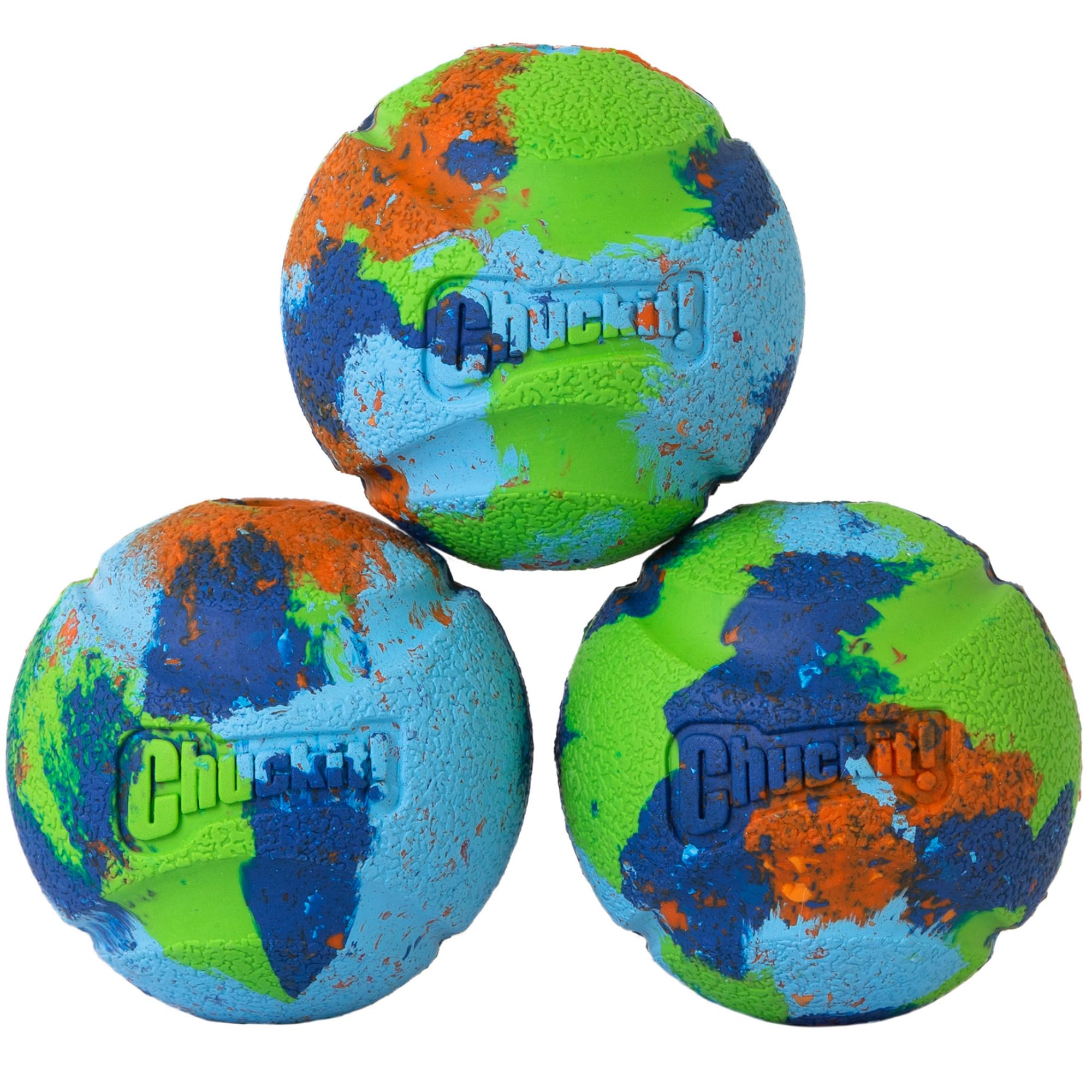
Chuckit! EcoFetch Ball 3-Pack

Top Pick
Chuckit! EcoFetch Ball 3-Pack

Fetch play

Our Score 9.6/10
Check Price

Worth Noting

  • Bright pattern can still vanish in tall grass
Pack
3 balls
Diameter
2.5 in
Dog Size
20–60 lb
Recycled Content
40%, RCS certified
Read the full review

Forty percent is the number worth holding onto. These balls are made with 40% RCS-certified recycled rubber, a claim somebody can audit rather than a green leaf printed onto a standard ball — and it is also a reminder that the other sixty percent is virgin rubber. The 2.5-inch medium suits dogs from 20 to 60 pounds, fits Chuckit! launchers, and arrives three to a pack.

For the park, these are the ones we reach for. The thick rubber core gives a real bounce off pavement and a flat, fast flight out of a launcher, and the ball is soft enough in the mouth that a dog carries it back instead of spitting it out at your feet. Chuckit! is clear that it is a fetch toy and not a chew toy, and that is the right way to treat it: a fetch-obsessed dog gets months of games out of a ball it would ruin in an hour if it lived in the chew basket.

Where it slips is visibility. The bright multi-color pattern is meant to make the ball easier to spot, and in short grass it does, but one that lands in tall grass or a leaf pile can still take a minute to track down. Three to a pack softens that — a lost ball does not end the afternoon.

Bottom line: Buy these if fetch is the game and chewing is not — the recycled content is real, the flight is excellent, and the balls are honest about being balls.
2

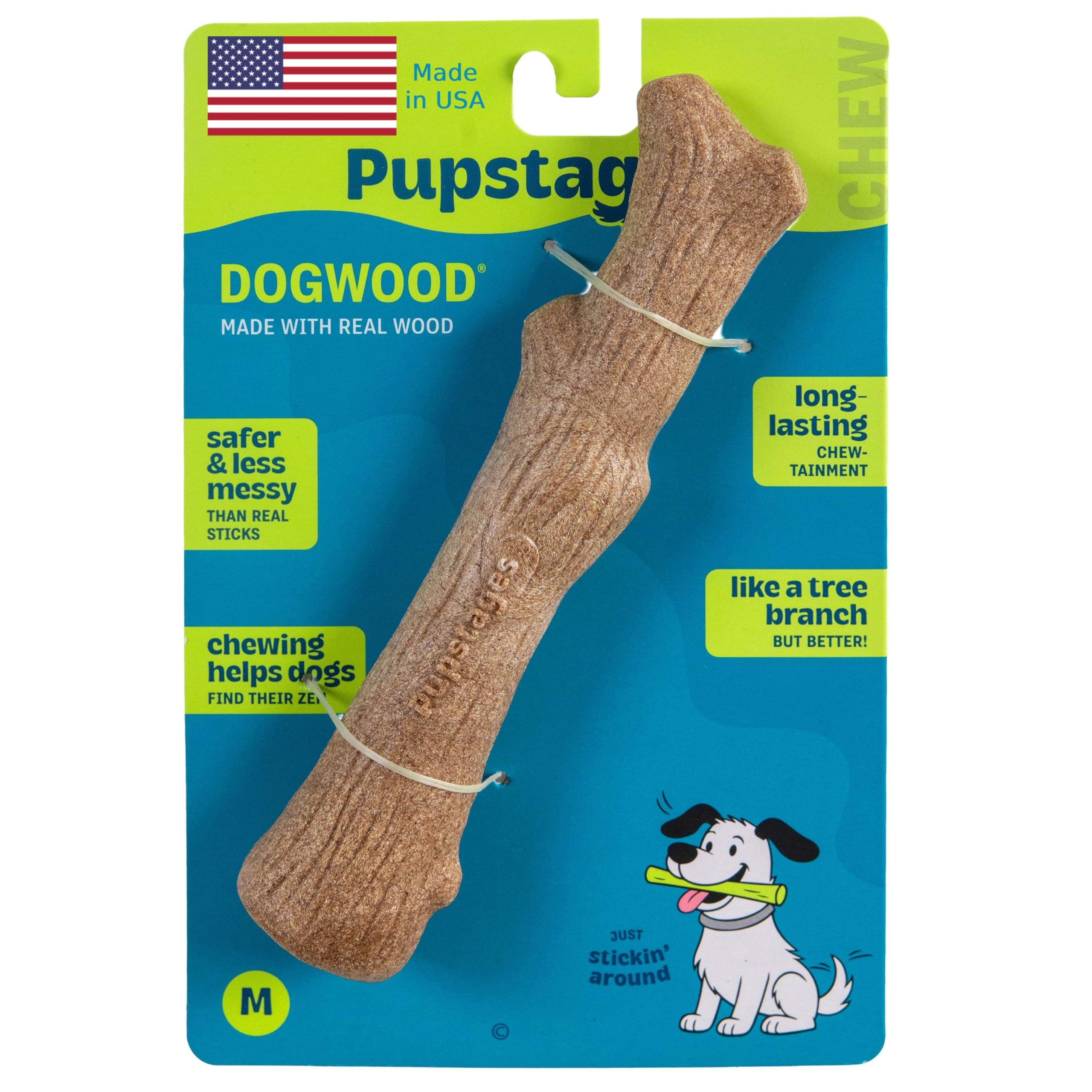
Pupstages Dogwood Stick

Pupstages Dogwood Stick

Medium adult dogs

Our Score 9.0/10
Check Price

Worth Noting

  • Not for puppies, seniors, or dogs over 35 lb
  • Some dogs ignore wood-textured chews
Size
Medium, 26–35 lb dogs
Made In
USA
Cleaning
Top-rack dishwasher-safe
Material
Wood blend, nylon-free
Read the full review

Most dog chews sold as tough are nylon with a flavor sprayed over the top, and getting away from that is the whole point of shopping this category. The Dogwood Stick is a real-wood blend made without nylon, lead, or phthalates, and it is the chew we hand to a medium-sized adult dog first. The mesquite scent is faint rather than candy-sweet, and the firm, faintly fibrous texture is close enough to a stick from the yard that dogs already hooked on wood take to it immediately.

The size band deserves a second read: this medium is built for dogs in the 26 to 35 pound range, and it is explicitly not for puppies or seniors. Inside that window it holds up — the long shape gives a dog room to brace one end against a paw, and a moderate chewer can be weeks into the same chew before the tip rounds over. It is top-rack dishwasher-safe too, which matters more than it sounds once a chew has spent an afternoon in the yard.

Wear is what we watch. A wood blend thins as it goes and the ends can turn sharp, so we look ours over every week or so and take it away once the tip goes ragged or the whole piece would sit behind the molars. With this many dogs using one model, a rough experience now and then is not a shock — the fix is supervision and a timely replacement.

Bottom line: We recommend it as the best eco chew here for a medium adult dog — just stay inside the 26 to 35 pound band and retire it once the ends sharpen.

3

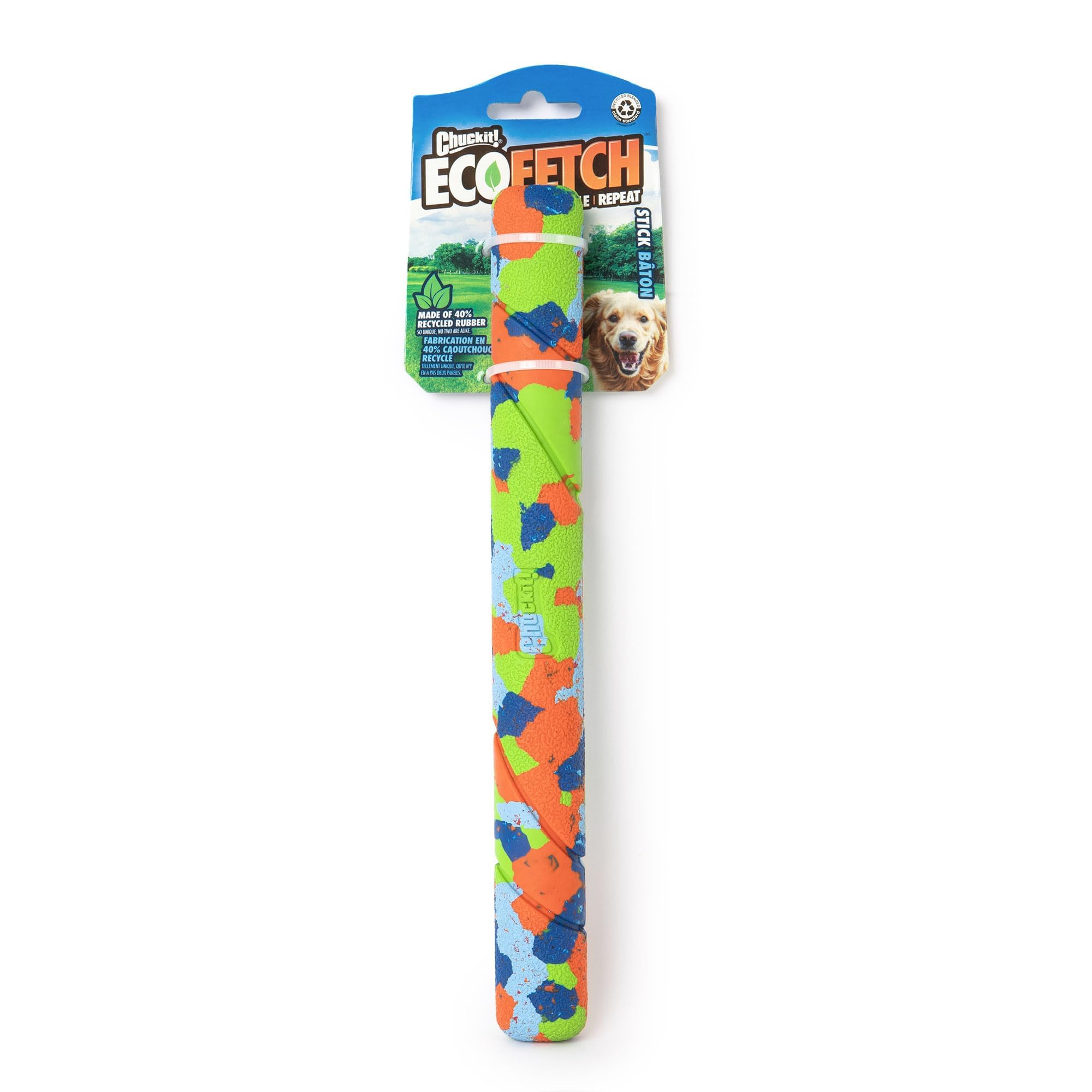
Chuckit! EcoFetch Fetch Stick

Chuckit! EcoFetch Fetch Stick

Tug and chase

Our Score 9.0/10
Check Price

Worth Noting

  • Heavy for small dogs to carry and throw
Length
12 in
Dog Size
All breeds
Recycled Content
40%, RCS certified
Read the full review

Two toys from the same recycled-rubber line made this guide, and they do different jobs. The EcoFetch Stick is the tug-and-chase one: a full 12 inches, so there is room for a dog to clamp one end while you hold the other, and enough weight behind it to fly properly on a long throw across a field.

It is the same 40% certified recycled rubber as the balls, built around a thick core that shrugs off rough play, and the durability read here is about as good as anything in this guide — the kind of toy a hard-chewing dog can work on for months between throws. It is water-repellent, which matters for something that lives by the back door, and it does not need a launcher to be useful.

What sold us is the tug. A ball rolls away and the game stops; a stick gives you a handle, which turns ten minutes in the yard into real work for a dog that needs to pull. Treat it as a fetch toy that tolerates teeth rather than a replacement for a chew — the chewing happens between throws, not instead of them.

Bottom line: The one to add if your dog would rather pull than chase — recycled rubber, a real handle for tug, and enough weight to throw properly in a big yard.

4

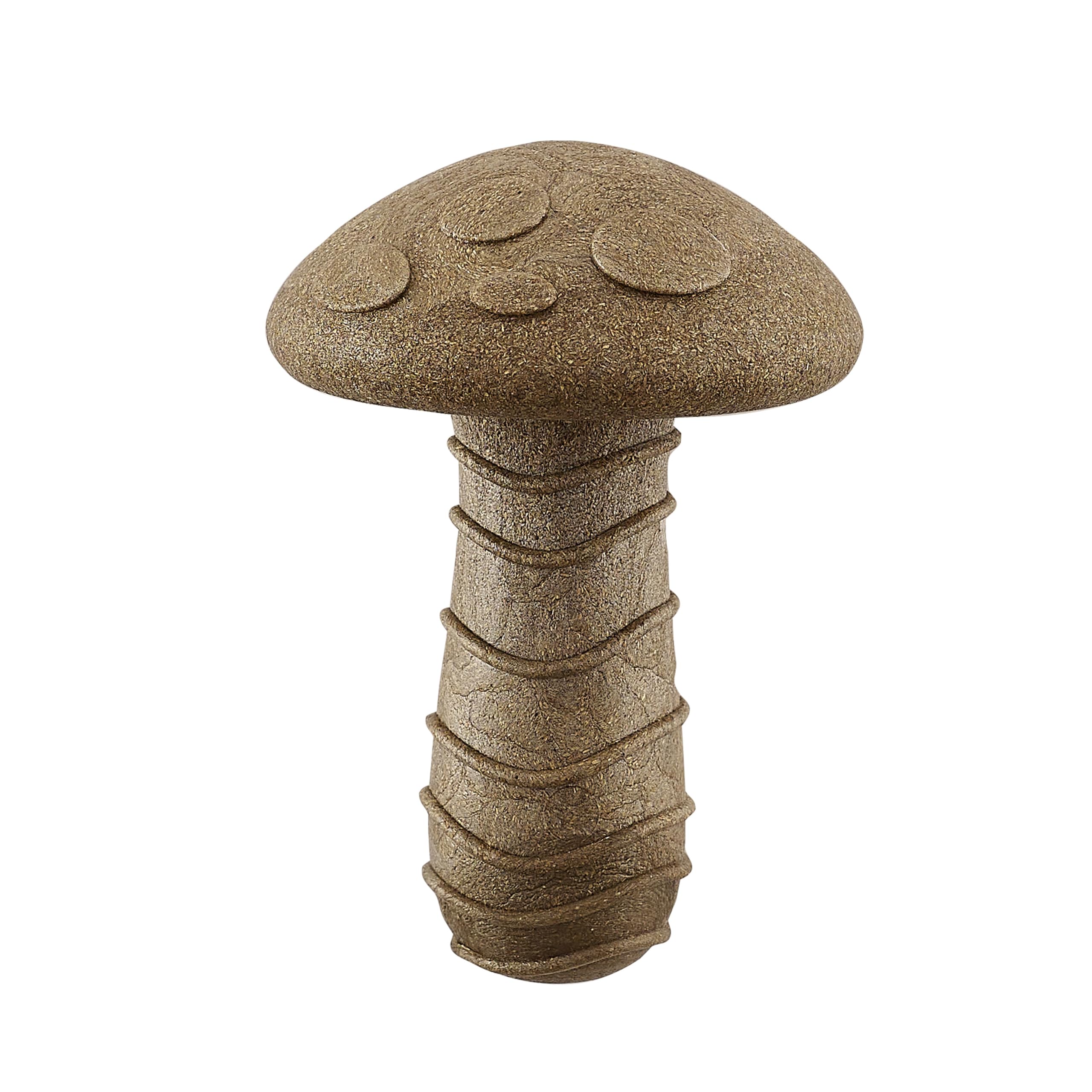
Pupstages Dogwood Mushroom

Pupstages Dogwood Mushroom

Chew and roll

Our Score 8.6/10
Check Price

Worth Noting

  • ⚠️ Comes apart in a strong chewer's jaws
Size
Medium, 4.8 in
Cleaning
Top-rack dishwasher-safe
Material
Wood blend, nylon-free
Chewing Level
Moderate chewers
Read the full review

A mushroom is an odd shape for a chew, and that is exactly why it works. The round cap rolls and wobbles when a dog noses it, so the toy plays back — the only one here that turns a chewing session into a bit of problem-solving. Dogs that pin it with a paw find the wide cap easy to hold, and that small advantage is often what decides whether a chew gets used or ignored.

Under the shape it is the same nylon-free wood blend as the Dogwood Stick, with tooth-scrubbing ridges and bumps molded into the cap, sized medium at 4.8 inches for moderate chewers in the 26 to 35 pound range, and top-rack dishwasher-safe. The peanut-butter scent is stronger than the stick's — clear out of the package, and not subtle while a dog is working on it.

It is a harder chew than the stick version, which we did not expect from the same material, and a dog that likes some give may walk away from it. For the dog that already enjoys a good gnaw, though, the rolling shape is the reason to pick this over yet another straight stick.

Bottom line: Worth it for the moderate chewer who is bored of sticks — the rolling cap gives a chew session some movement, even if it is not the toughest chew here.

5

WOOF HonestChew Antler

WOOF HonestChew Antler

Small dogs

Our Score 8.2/10
Check Price

Worth Noting

  • ⚠️ Can roughen gums on hard gnawing
  • Runs large for the smallest toy breeds
Size
Small, dogs under 25 lb
Material
Plant cellulose and antler
Petroleum-free
No nylon
Read the full review

Start with the weight ceiling, because it decides everything: this antler chew is built for dogs under 25 pounds. If you have a labrador, look elsewhere. If you have a terrier, a poodle, or a small mixed breed that gets through softer toys in an afternoon, it makes a different kind of sense — plant cellulose and antler, no nylon, no petroleum, which is a real departure from the plastic-dressed-as-natural corner of this category.

We kept it on the list for the small-dog shelf specifically. The antler silhouette gives a little dog something familiar to hold onto, the molded texture has enough grip to scrub at the teeth as it is worked, and it is a far cry from the nylon bones it is competing with. It is not the toughest thing here — it is the most convincing plastic-free option actually sized for a dog weighing less than a bag of kibble.

The trade-off sits at the top of that weight band. A steady gnawer gets real time out of one; a determined power chewer will not, and that is the honest limit of a plant-based chew. Buy it for the dog that nibbles and worries at a chew rather than the one that saws through everything in reach.

Bottom line: The plastic-free chew we point small-dog households to, provided the dog is a steady gnawer under 25 pounds and not a power chewer.

How We Tested Eco-Friendly Dog Toys

We started by pulling together about 50 toys marketed as eco-friendly — recycled rubber, natural fibers, plant-based plastics, and refillable or compostable designs — then narrowed the list by reading ingredient lists, safety disclosures, sizing charts, and customer reviews. Price mattered, but so did whether the toy was actually appropriate for the dog in front of us: a tiny fabric star is not a fair test for a 70-pound chewer. We ended up with 18 toys and four months to live with them.

Each toy went home with at least one dog, and some rotated through multiple households so we could compare a picky senior, a medium-energy family dog, and a serious chewer. We introduced every toy the same way — on the living room floor after dinner — and noted whether the dog went for it with nose, paw, or mouth in the first few minutes.

Then we moved to supervised sessions: a 20-minute chew in the kitchen, a backyard fetch or tug game, and a rainy-day indoor play stretch. After each session, we ran a hand over seams and edges, checked for loose squeakers or stuffing, and noted any bits the dog managed to pry loose. Toys that survived the first week went into regular rotation, and we inspected them again after a month of on-and-off use.

We also paid attention to the less obvious stuff: dogs with sensitive stomachs or allergies were watched for excessive drooling, pawing at the mouth, or other signs of irritation. We washed the toys according to their care labels and checked whether they still smelled appealing or came out limp and faded. We compared cost against how often each toy came back out of the basket, since a cheap toy that gets ignored is worse value than a pricier one that earns daily play. If a toy cracked, frayed, or lost a piece during normal chewing, it came out of the rotation and off the list.

How to Choose Eco-Friendly Dog Toys

Read the Material, Then the Percentage

Wood blend, felted wool, plant cellulose, antler byproduct, recycled rubber: these are the materials that actually earn the description, and each behaves differently in a dog's mouth. The trap is a label that leads with a natural-sounding word while nylon does the structural work — a bamboo-fiber chew that is mostly nylon is a nylon chew wearing a hat.

When a listing gives a percentage, treat it as the real story. Forty percent recycled rubber is a meaningful, certifiable claim and also a reminder that the other sixty percent is not recycled. If a toy never says what the base material is, assume the least generous answer and keep looking.

Match the Chew to the Dog's Weight, Not Its Breed

Every hard chew here carries a weight band, and that band does more work than any breed name on the package. A medium-size wood-blend stick built for 26 to 35 pounds is not a small chew for a bigger dog — it is the wrong chew, and a strong chewer will take an end off it in an afternoon.

Puppies and seniors are a separate case. Hard composite chews are generally labeled for adult dogs, and a mouth with puppy teeth or worn molars belongs on something softer. Size up within the maker's range if your dog is borderline; never size past it.

Watch for Sharp Edges, Not Just Splinters

The real risk with a hard chew is not a clean snap, it is the slow thinning that leaves a ragged, sharp edge at the end. Run a thumbnail along the worn end once a week; if it catches, the chew is finished and gets replaced.

The same check applies to size. Once the remaining piece would sit entirely behind the dog's molars, it is a swallowing risk regardless of how much chew is left. Supervision matters most in the last third of a chew's life, when it stops flexing and starts breaking.

Fetch Toys and Chew Toys Are Separate Purchases

Recycled rubber makes an excellent ball and a poor chew toy — the bounce that makes fetch fun comes from a compound a determined dog can eventually work through. Buy a ball for the park and a chew for the rug, and do not ask either to cover the other's job.

For fetch, the ball has to be small enough for your dog to carry and large enough that it cannot be swallowed. A 2.5-inch ball suits dogs from 20 to 60 pounds. A 12-inch stick is a tug and throw toy for a big dog, not something to fling for a terrier.

Value Is Wear Time, Not Sticker Price

A chew destroyed in an afternoon is the expensive one, whatever it cost at checkout. Eco materials vary enormously in hardness, so judge each toy by how long it survives against what it takes to replace it.

Be honest about your dog's chewing style while you do that. A power chewer given a moderate-chewer toy will destroy it, and the toy will take the blame for a mismatch that was ours to prevent.

Frequently Asked Questions

Final Verdict

For most people, the Pupstages Dogwood Stick is the one to buy: a genuinely nylon-free wood blend that keeps a medium adult dog working for weeks, and the budget pick of the group. The catch is the weight band — it is built for 26 to 35 pound adults, not puppies, seniors, or a seventy-pound power chewer.

If your dog lives to fetch rather than to chew, make it the Chuckit! EcoFetch balls instead. If you have a dog under 25 pounds, the WOOF HonestChew Antler is the plastic-free chew actually sized for it. Buy for how your dog plays, then check the ends every week.