Collars & Leashes

Best Leashes for Dogs That Pull of 2026

The first lunge almost never comes with a warning — a squirrel, a delivery van, another dog — and suddenly you're the anchor at the end of a rope that's trying to leave your hand. A leash won't teach your dog not to pull; that's a training job. What it decides is whether that moment feels like a tug of war or a quick correction you can ride out. I walk a 75-pound dog who treats every fire hydrant as his personal property, so I am fussy about handles that keep their shape, hardware that doesn't rattle loose, and a length that gives slack without turning into a tripwire.

Over the past four months, my team and I worked through 14 leashes on morning bathroom runs, crowded sidewalks, and muddy trail loops. The ones that earned a place below share a few boring virtues: stitching that holds, honest length, and a grip that survives a hard yank in the rain. Several better-known styles did not make the cut.

1

Joytale Double Handle Leash

Top Pick
Joytale Double Handle Leash

Everyday pull control

Our Score 9.4/10
Check Price

Worth Noting

  • No elastic give, so hard lunges reach your arm
Width
1 in
Length
6 ft
Handles
Two, including traffic handle
Reflective
Double-sided stitching
Read the full review

A traffic handle earns its keep in about four seconds. The dog spots something, loads its weight forward, and you have a choice: haul on six feet of webbing or drop a hand onto the short loop just above the clip. Joytale puts that loop right where your hand wants it, so the pull ends up at arm's length instead of at the end of a swinging strap. We grabbed it constantly, cutting past a cafe table, waiting at a curb, getting through a vet's doorway.

The build behind that handle is what makes it work. The webbing is an inch wide with a tight weave and reinforced stitching where the loops join, and both handles carry enough padding that a jolt lands on foam rather than the web between your fingers. Reflective stitching runs down both sides, which matters a lot more in October than it does in July.

The swivel snap turns a full 360 degrees, and that is the detail that keeps a leash from becoming a corkscrew when a dog circles or crosses behind you. Six feet gives a dog room to sniff without towing you down the block, and Joytale sells shorter lengths and a dozen colors, so setting up two dogs in matching gear is easy on the wallet.

What you give up is any cushioning. There is no elastic here, so a hard lunge arrives at your wrist undiluted; the short handle lets you shorten the leash, not soften the hit. That is the trade for a leash that never feels vague in the hand. For ordinary walks with a dog that still forgets its manners, we have not found a better balance of control and comfort.

Bottom line: The leash we recommend for most pulling dogs: a traffic handle you can grab fast, padded loops that save your palm, and enough length for a dog to sniff without dragging you.

2

Plutus Pet Double Handle Leash

Plutus Pet Double Handle Leash

Big, strong pullers

Our Score 9.4/10
Check Price

Worth Noting

  • Only sold in a six-foot length
Width
1 in
Length
6 ft
Handles
Two, neoprene padded
Webbing Thickness
2.8 mm
Read the full review

Put the Plutus Pet leash in your hand and the first thing you feel is the webbing: 2.8 mm thick, an inch wide, and woven tight enough that it does not roll in your grip. That thickness is the whole argument for this one. Of the dual-handle leashes here, this is the one we hand to someone whose dog can actually move them.

Both loops are wrapped in neoprene that is noticeably plusher than the bare webbing on cheaper leashes, and the reflective thread is stitched down both sides rather than printed on and worn away. There is a D-ring at the top for a bag holder or keys, and the clasp opens wide enough to swallow a thick collar ring without a fight.

It is not the budget choice. You pay more than you do for our top pick, and the extra buys a heavier, more padded leash rather than more features. For a dog in the sixty-to-ninety-pound range that hits the end with everything it has, that trade makes sense, and the traffic handle sits low enough to grab without looking.

Bottom line: For a genuinely strong dog, we reach for this: thicker webbing, neoprene padding on both loops, and a build that feels made for the weight behind the leash.

3

Taglory Rope Dog Leash

Taglory Rope Dog Leash

Comfortable rope grip

Our Score 9.4/10
Check Price

Worth Noting

  • No traffic handle for a sudden lunge
Handle
Padded foam
Length
6 ft
Reflective
Threads woven through rope
Rope Diameter
1/2 in
Read the full review

Flat webbing sends a pull straight down the line. Round rope does something slightly different: the half-inch climbing rope on this Taglory fills your hand instead of lying flat against it, so there is less of a cutting edge when a dog leans in, and the braid has a little spring when the rope comes taut.

The handle is the part we appreciated most. It is a foam tube rather than a folded loop of webbing, which means no seam to rub against your fingers and no stitched fold to fray. Reflective threads are woven through the full length rather than painted on top, and the metal clasp swivels a full 360 degrees to keep the rope from twisting when a dog weaves around a tree.

Where it earns its place is steady forward pressure. A dog that leans into the leash for a whole walk is easier on your hand with this than with webbing, and the rope is thick enough that a passing squirrel does not instantly turn it into a cheese wire. If your dog explodes sideways at triggers, on the other hand, you will want a short loop to grab, and this leash does not offer one.

It comes in 4-, 5-, and 6-foot lengths, a dozen colors, and two rope diameters, with the half-inch version aimed at dogs from 20 to 120 pounds. There is a one-year warranty listed, which is more cover than most leashes this affordable bother to include.

Bottom line: A simple, strong rope with a foam handle that will not burn your palm; we recommend it if you do not need a second loop.

4

iYoShop Slip Lead

iYoShop Slip Lead

Training a puller

Our Score 9.4/10
Check Price

Worth Noting

  • The loop tightens under any steady pull
Design
Slip lead, leash and collar
Length
6 ft
Weight Range
35 to 120 lbs
Rope Diameter
1/2 in
Read the full review

A slip lead is the fastest thing to get on a dog: one loop over the head, slide the stop, go. It is also the tool with the narrowest margin, because there is no clip to fail but nothing to adjust either. If the loop sits low on the neck instead of high behind the ears, the dog spends the whole walk leaning into pressure.

This iYoShop version is the one we keep coming back to. The half-inch climbing rope is thick enough to feel like a lead rather than a shoelace, the padded handle does not chew into your palm when a dog hits the end, and the adjustable loop is simple enough to set one-handed while the dog is already pulling toward the door.

Reflective threads run the length of it for evening walks, and the sizing covers dogs from roughly 35 to 120 pounds, which takes in most of the dogs that pull hard enough to need a slip lead in the first place. Put it on properly, stopper snug and loop high, and you get an immediate signal with nothing to clip or jingle.

Bottom line: If your dog will accept a loop over its head, this is the slip lead we trust: a padded handle, a half-inch rope, and a clean signal with nothing to clip.

5

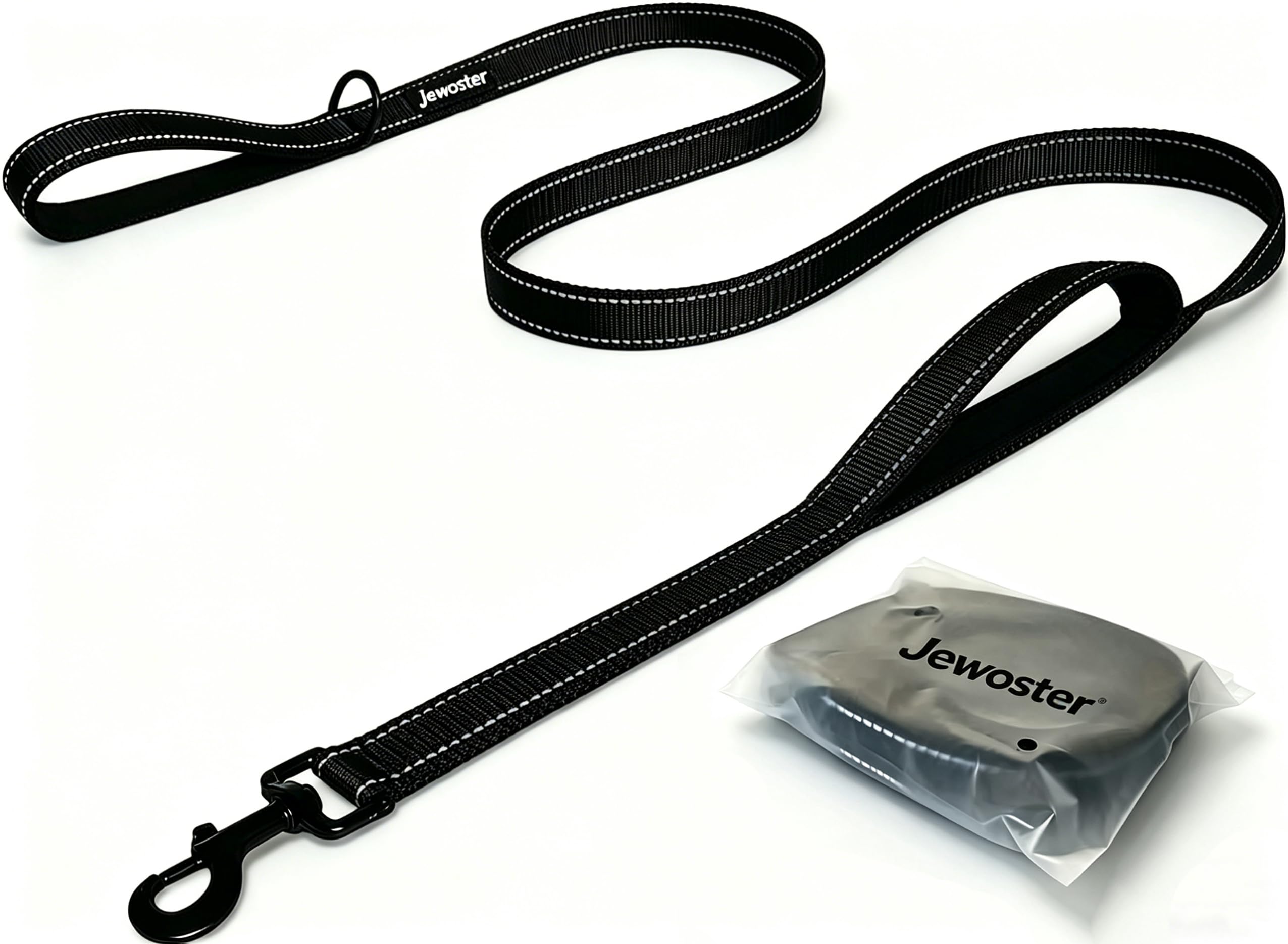
JEWOSTER Heavy Duty Double Handle

JEWOSTER Heavy Duty Double Handle

Budget dual handle

Our Score 9.4/10
Check Price

Worth Noting

  • Six feet is the only length offered
Width
1 in
Length
6 ft
Handles
Two, padded
Webbing Thickness
3 mm
Read the full review

This is the least expensive dual-handle leash in this guide, and it does not look it. The webbing is 3 mm thick and an inch wide, heavy tightly woven stuff, and both loops are neoprene-padded rather than bare. The clasp is a big two-inch swivel that opens wide enough for a thick collar ring.

For a dog that pulls, that combination covers most of what the pricier dual-handle leashes do: a short handle for close control, a padded loop for the long stretches, and enough weight in the webbing that it hangs against your leg instead of whipping around in the wind. We also liked the D-ring at the top, which takes a bag holder without sliding down the leash.

The catch is the long haul. Of the dual-handle options here, this is the one we are least confident about after a year of daily walks, because the webbing and stitching are where wear shows up first. At this end of the price range that is a fair trade rather than a dealbreaker, and it arrives with a zippered pouch that is useful for treats.

Bottom line: If you want two handles on a tight budget, this is the one we point to: thick webbing, padded loops, and no drama about the cost.

6

Joytale Tactical Bungee Leash

Joytale Tactical Bungee Leash

Shock absorption

Our Score 9.2/10
Check Price

Worth Noting

  • Frog clip takes both hands to open
Clasp
Auto-lock frog clip
Length
6 ft
Handles
Two, padded
Seatbelt Buckle
Yes
Read the full review

Joytale makes our top pick, and this is the same idea given a different job. The fixed webbing is replaced by a bungee section that stretches under load, so when a dog hits the end, the first part of the jolt goes into the elastic instead of into your shoulder. For anyone whose arm aches after a walk, that difference is the entire reason to buy this one.

The rest is genuinely tactical. The auto-lock frog clip needs both sides squeezed to open, which means it does not pop loose when a dog spins at a fence, and there are two padded handles so you can still shorten up at a crossing. A seatbelt buckle lets you secure the dog for the drive, and reflective thread runs down both faces of the webbing.

The trade is that a bungee gives before it stops. A hard pull ends with a little more leash out than you planned, which is what you want for your joints and not what you want for a dog you are teaching a limit to. Grab the traffic handle and it stops mattering on most walks. The four-foot version is the better call for a dog that is already strong.

Bottom line: The pick for anyone whose shoulder takes the hit: bungee stretch absorbs the first jolt of a lunge, and the frog clip holds through it.

7

AUROTH Bungee Dog Leash

AUROTH Bungee Dog Leash

Walks and car trips

Our Score 9.2/10
Check Price

Worth Noting

  • Elastic can lose its spring with heavy use
Bungee
Shock-absorbing elastic
Length
6 ft
Handles
Two, padded
Seatbelt Buckle
Yes
Read the full review

Two leashes here can clip into a seatbelt, and this is the one that makes the feature feel deliberate. A seatbelt-compatible buckle near the handle lets you secure the dog for the drive and get straight back to walking at the other end, with no second strap to keep track of in the footwell.

The bungee handles the rest. Stretch in the line takes the first snap out of a lunge, which is the difference between a sore shoulder and a normal one when a dog hits the end, and both handles are padded for the moments you need to hold a dog close at a curb. Reflective stitching runs the length of it for evening walks.

What the bungee does not do is correct anything. The dog still reaches the end of the leash; the difference is what happens to your arm when it does. That makes this a leash for managing a pull rather than teaching a dog out of one, and the elastic is the part that ages, so expect to replace it when the stretch stops springing back.

It comes in four- and six-foot versions and suits small through large dogs, though the heavier your dog, the more sense the bungee makes. If your walks start with a car trip and end with a hard lunge, this one covers both better than anything else here.

Bottom line: Buy it for the car as much as the walk: the seatbelt buckle and the bungee make it our choice for dogs that ride along and pull hard.

8

TagME Slip Lead

TagME Slip Lead

Fast slip-on

Our Score 9.0/10
Check Price

Worth Noting

  • Zero-stretch rope sends the jolt straight to your hand
Handle
Padded EVA foam
Length
6 ft
Size Range
50 to 110 lbs
Rope Diameter
3/8 in
Read the full review

Three seconds is about what it takes to get this lead on a dog: over the head, slide the leather stopper, walk. That speed is why shelters and groomers reach for slip leads, and it is why this one earns a spot by the door for the mornings when fumbling with a collar clasp feels like more trouble than the walk itself.

The rope is zero-stretch climbing line, so a signal travels from your hand to the dog without a delay; a light flick of the wrist is felt at the other end, which is exactly what makes a slip lead useful for teaching a dog to stop leaning. The EVA foam handle surprised us. It is soft enough to grab in a hurry and takes the sting out of a sudden stop at the end of the block.

TagME sizes this by weight rather than breed, with the current three-eighths-inch medium sized for dogs from 50 to 110 pounds and the range running up to 250. Reflective stitching runs the full length. The leather stopper is the part to watch, since leather on rope can creep over a walk; check it before you set off and reset it whenever you feel the loop loosen.

For a dog that pulls and needs a fast, clear correction, this is the tidy answer, and it packs smaller than any of the clipped leashes here. Where it does not fit is a dog that leans into pressure instead of yielding to it; that dog needs the leverage of a traffic handle, not a loop over its nose.

Bottom line: For quick slip-on control without a collar, this is the one we keep by the door: soft foam handle, sizes up to big dogs, and a signal the dog can feel.

How We Tested the Best Leashes for Dogs That Pull

We started by pulling together every leash we could find in the mid-range — nylon flat leashes, climbing-rope styles, bungee and dual-handle designs — then cut the shortlist down by length options, clip type, handle construction, and price. Anything with a stamped-metal clip, glued rather than stitched joins, or a handle that couldn't be replaced or repaired got dropped before testing began.

The remaining 14 leashes went out with five walkers and dogs ranging from a 22-pound terrier to a 90-pound shepherd mix, and each one covered the same route for four months: a 25-minute neighborhood loop twice a day, a Saturday farmer's market crowd, a weekly training class, and at least one wet, cold morning walk with gloves on. We noted whether the handle loop kept its padding after a hard lunge, whether the clip jammed, whether stitching pulled, whether the leash dragged against our legs, and whether reflective thread showed up at dusk.

Slip resistance got its own session. We wet our hands, wrapped them around each handle, and had a colleague yank at the leash while we noted whether our grip shifted, whether the handle bunched, and how much rope or webbing slid through a closed fist before we got a second hand on it. We also measured every leash against its listed length, checked for fraying after mud and salt water, and ran each clip through a full rinse and dry cycle to see if it stayed smooth. The picks below are the ones that came back still sound.

How to Choose Leashes for Dogs That Pull

Start With the Control Feature

Three designs do the work, and they solve different problems. A traffic handle, the second loop near the clip, gives you a brake you can grab without hauling on the full length; it is the most useful thing you can own if your dog lunges at other dogs or traffic. A slip lead gives a fast, direct signal on a dog that will accept a loop over its head, with nothing to clip. A bungee absorbs the shock of the lunge but adds slack.

If you can only have one feature, choose the traffic handle. It handles the sudden stuff, which is what hurts.

Rope or Flat Webbing

Flat webbing lies against your palm and sends a pull straight down the line, and it is the only format that takes a second handle sewn on. Rope fills the hand, does not fold into a cutting edge, and the braid has a little spring to it, which is why rope leashes with padded handles are so common among people walking strong dogs.

Rope is also the more forgiving material around teeth, though nothing here is chew-proof. If your dog mouths the leash on the way home, start with rope.

What a Bungee Can and Cannot Do

Elastic does not stop a dog. It delays the moment the leash goes taut and softens what arrives at your arm, which over a long walk is a real difference and the reason to buy one if your wrist or shoulder is already complaining.

The catch is the slack. For a dog that needs a firm, immediate limit, a fixed length plus a traffic handle teaches more than a stretchy line ever will.

Length Is a Control Decision

Six feet is standard because it lets a dog sniff without the walk becoming a tug-of-war, but every extra foot is slack you have to manage the moment something interesting appears at the end of it.

In a city, a four- or five-foot leash with a traffic handle gives you more usable control than six feet without one. Match the length to where you actually walk, not to the size of the dog.

Check the Hardware Before the Color

The clip is the part that matters and the part that gets the least thought. A swivel snap keeps the line from twisting into a corkscrew when a dog circles; a two-sided frog clip is slower to open but will not pop loose when a dog spins.

Look at the stitching where the clip meets the webbing, because that is where a leash fails first. A pull rating describes the webbing, not proof that the gate stays shut.

Frequently Asked Questions

Final Verdict

After walking pullers on all eight, the Joytale Double Handle Leash is the one we recommend without a caveat. The traffic handle gives you something to grab before a lunge becomes a haul, the padding holds up over a long walk, and nothing about it feels like a compromise made to hit a budget.

If your dog is bigger and stronger than most, the Plutus Pet's thicker webbing and plusher padding are worth the step up. And if the pulling is already costing you a shoulder, try the Joytale Tactical Bungee, with the understanding that it cushions the pull rather than ending it.