Collars & Leashes

Best No Pull Dog Harnesses of 2026

A dog that throws its whole weight toward a squirrel can turn a relaxed walk into a wrestling match, and make every collar-and-leash setup feel like the wrong tool. A good no-pull harness redirects that momentum across the chest instead of the throat, so you stay in control without constant correction. It should also go on without a fight, adjust to fit a deep chest or a narrow one, and stay comfortable enough that your dog forgets it's wearing anything.

Over the past six months, my team and I have tested 13 no-pull harnesses on daily walks, weekend hikes, training sessions, and muddy park runs. We paid attention to what matters once the box is open: whether the straps stay put after a hundred adjustments, whether the padding rubs behind the front legs, and whether the buckles and stitching feel sturdy enough for a dog who pulls hard. The best earned a permanent spot by the door; the weak ones showed their flaws fast. The picks below are the ones that held up.

1

ICEFANG Tactical Dog Harness

Top Pick
ICEFANG Tactical Dog Harness

Strong pullers

Our Score 9.4/10
Check Price

Worth Noting

  • Chest panel doesn't wrap far on narrow, deep-chested dogs
  • Hand wash only
Size
Large
Buckles
2 aluminium (2800N), 2 plastic (1500N)
Harness Weight
1.43 lb
Leash Attachments
Front anti-pull D-ring and back V-ring
Read the full review

Two aluminium neck buckles rated to 2,800 newtons, two plastic chest buckles, and doubled stitching at every stress point — this is the harness built like the working vest it looks like, and it's the one here we hand over when a dog leans its whole weight into the leash.

The two leash points do different jobs. The V-ring at the back is for ordinary walking and for anything that needs a long line; the single D-ring sewn onto the chest is the anti-pull point, and it turns a dog that's committed to a scent rather than letting it drag you down the block. Padding runs under the chest and belly, the handle over the shoulders is there for a doorway or a gate, and the MOLLE strips and velcro panels let you dress it up if that's your thing.

The trade is weight. At 650 grams it's the heaviest harness in this group, and a small or elderly dog will walk more slowly in it. The chest panel also doesn't wrap far enough on a narrow, deep-chested dog — a doberman build rather than a shepherd one — and that's how a determined dog backs out of it on a trail. If yours is broad and strong, neither matters much.

Bottom line: For a big, powerful dog that leans into the leash, the rated buckles and doubled stitching here are the most reassuring hardware in this group.
2

PoyPet No Pull Dog Harness

PoyPet No Pull Dog Harness

Everyday walks

Our Score 9.2/10
Check Price

Worth Noting

  • Stiff adjusters make the first fitting slow
  • Hand wash only
Size
Medium
Harness Weight
6.56 oz
Adjustment Points
4
Leash Attachments
Front and back metal D-rings
Read the full review

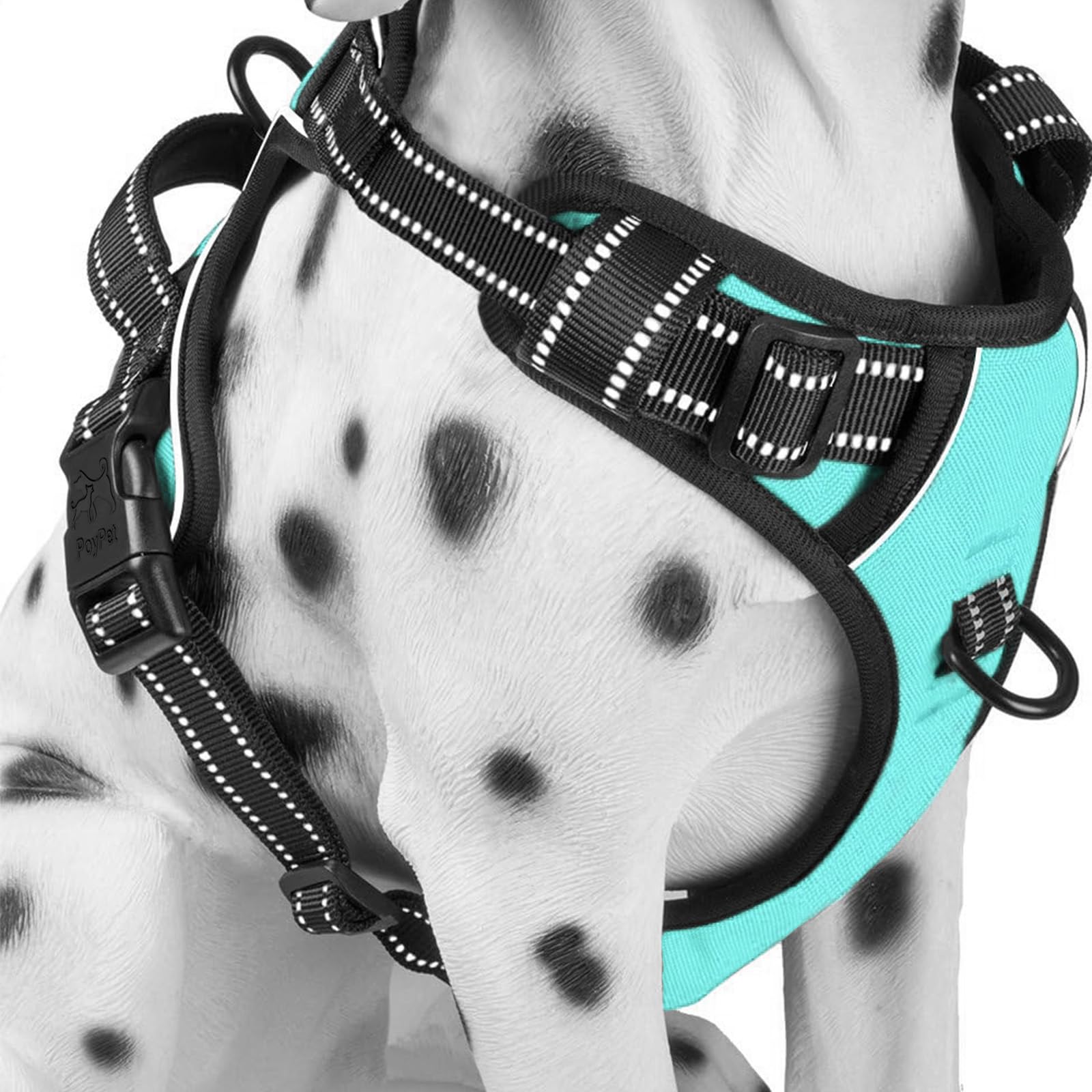
Hook the leash to the chest D-ring and a hard pull turns the dog's shoulder toward you instead of letting it brace and lean. That redirection is the whole mechanism of a no-pull harness, and the PoyPet delivers it with the fewest compromises in this group: metal D-rings front and back, four adjustable straps, a padded handle across the shoulders, and reflective stitching down both sides. We recommend it as the default because nothing else here pairs that control with this level of construction at the low end of the price range.

Sizing is the part to slow down on. The harness is sized by chest girth, and a dog that lands near a break between two sizes can go either way, so measure the widest part of the ribcage behind the front legs with a soft tape and choose from that number rather than from the breed list. You want two fingers of room under the chest strap and no more; a harness that shifts is a harness a dog can back out of.

The small details hold up on repeat walks. The handle sits where your hand naturally falls when you need the dog close at a curb, and the padding keeps it from biting into your palm the way bare webbing does. The air mesh under the chest panel stops it turning into a heat pad in July, and the reflective piping runs far enough around the sides to catch a headlight on a dark street.

Bottom line: If you want one harness that steers a puller without choking it, this is the one we hand people: front and back metal rings, four-point adjustment, and a padded handle that stays useful.

3

Ruffwear Front Range Harness

Ruffwear Front Range Harness

Long hikes

Our Score 9.2/10
Check Price

Worth Noting

  • Adjustment range runs short on deep-chested dogs
  • The most expensive harness in this group
Size
Small
Padding
Closed-cell foam chest and belly panels
Adjustment Points
4
Leash Attachments
Aluminum V-ring and chest webbing point
Read the full review

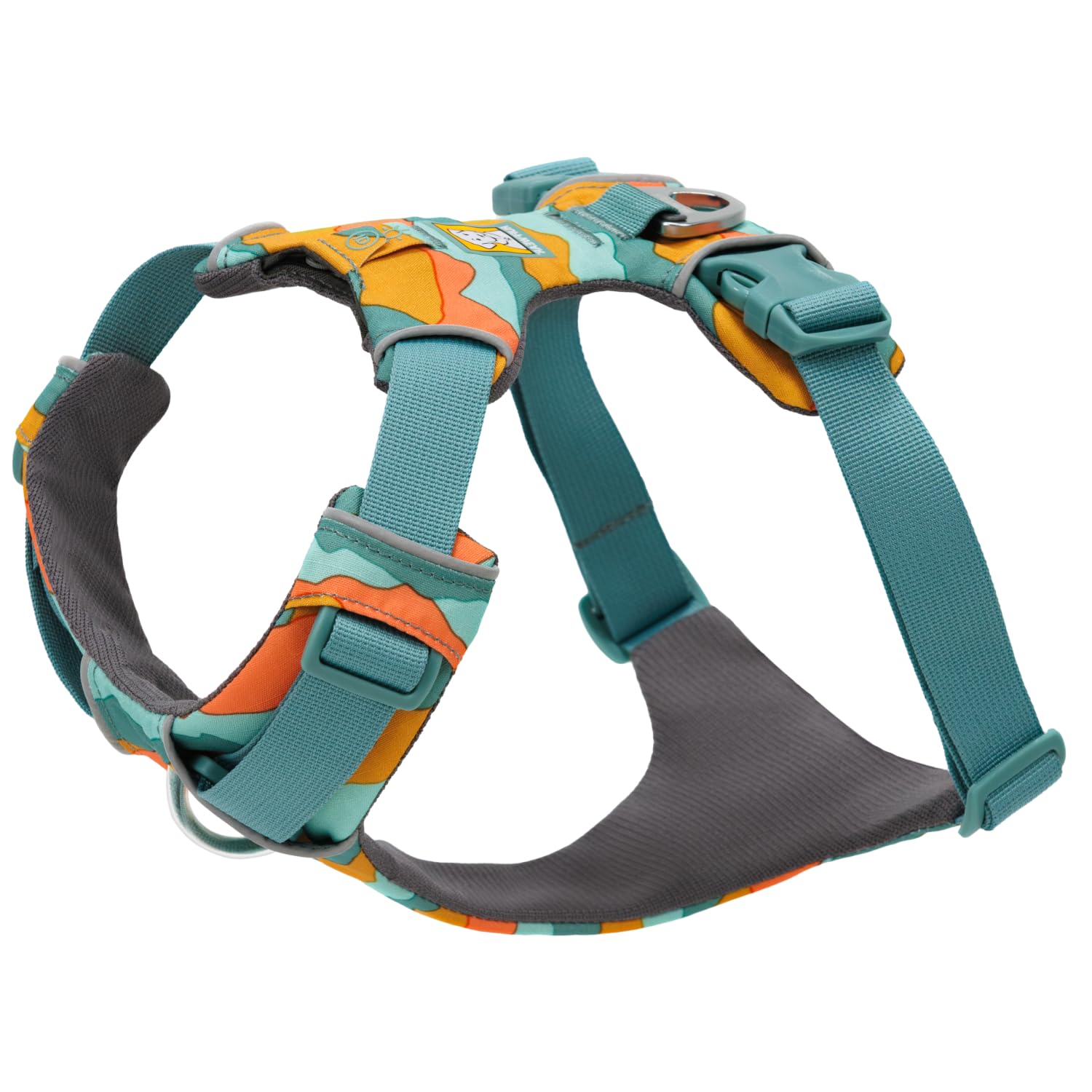
The highest price here buys foam. Closed-cell padding runs through the chest and belly panels, the aluminum V-ring at the back is the sort of hardware you stop noticing, and the shell stays flat against the body instead of bunching up behind the shoulders. There's an ID pocket, a loop for a beacon light, and reflective trim in the places a driver actually sees.

We reach for the Front Range when the walk is long rather than difficult. That padding is what makes it the most comfortable harness here over an afternoon — no rubbing behind the front legs, no matting on a double coat — and it's the one we put on a dog with a full day ahead of it. What it isn't is the strongest pull-stopper in this group. The chest attachment is reinforced webbing rather than a free-sliding anti-pull ring, so it steers a dog that's leaning rather than one that has already launched.

Fit needs care. Four straps is generous, but the adjustment range runs short on a deep-chested dog, and a loose chest strap is how a dog backs out of any vest on this page. Set the chest first, then the neck, then check by pulling gently backward on the back ring while the dog stands still. If the harness slides toward the shoulders, tighten the chest another inch before you leave.

Bottom line: Buy this one for the dog that hikes with you: the foam padding and four-point fit are the most comfortable long-wear setup here, and the chest point still steers a mild puller.

4

Harness Lead Escape Resistant

Harness Lead Escape Resistant

Escape artists

Our Score 9.2/10
Check Price

Worth Noting

  • No handle or clip choice like a vest
  • Rope cover frays at rub points
Size
Medium/Large
Design
Leash and harness in one
Harness Weight
11.2 oz
Tensile Strength
3,700 lbs
Read the full review

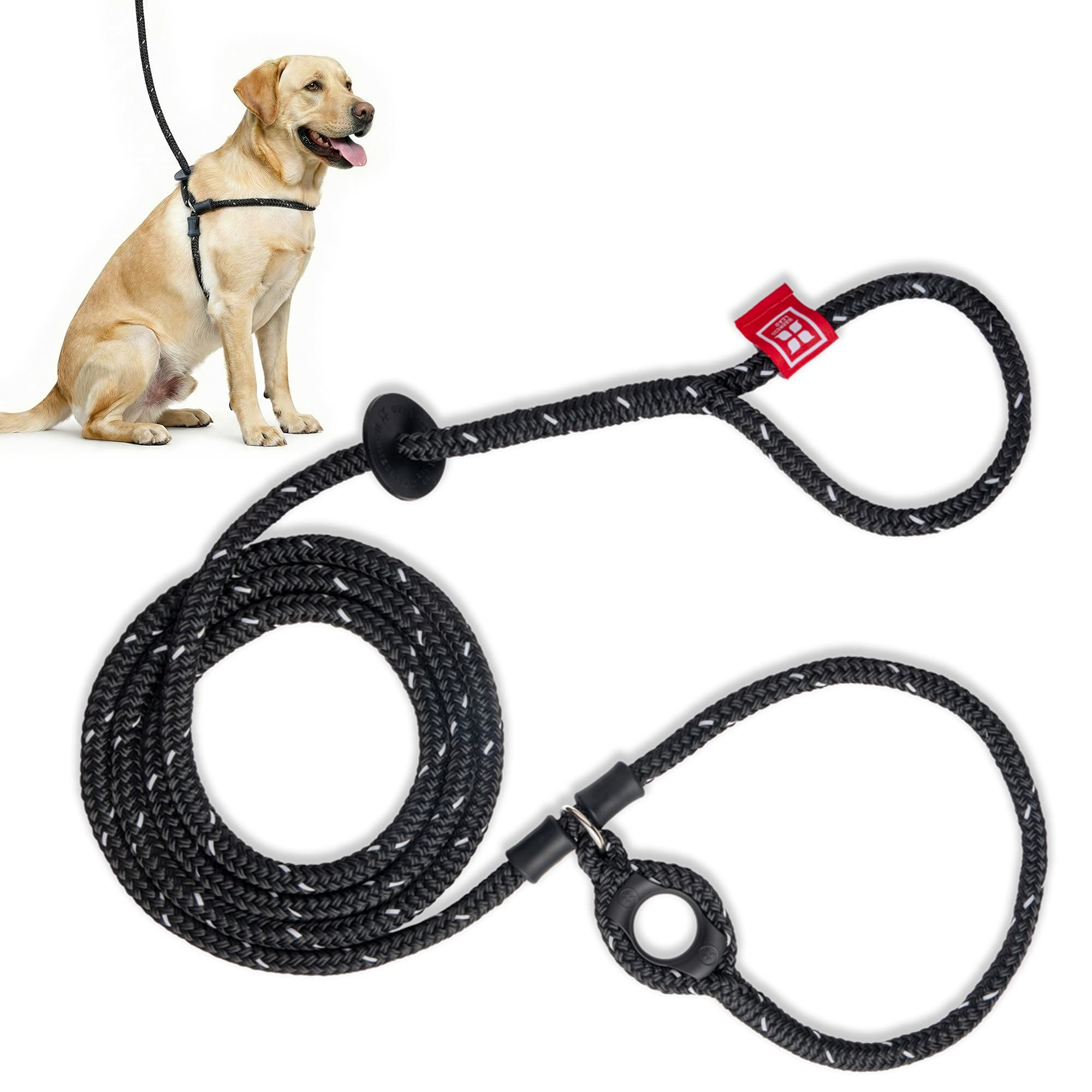
No vest, no buckle, no padding: the Harness Lead is a single length of spliced rope that loops over the chest, passes under the belly, and carries on into your hand as the leash. It looks like nothing else on this page, and for a dog that has learned to reverse out of a vest, it's the design that finally holds.

The mechanism is the tightening. Two movable stops sit against the front legs, and when a dog pulls backward the loop closes around the chest instead of sliding over the shoulders; when the dog stops, the pressure eases. That same quality is why the instructions are blunt: walking tool only, never tie a dog out in it, and no jerking or yanking to correct.

We keep it in the roundup for one narrow, real problem. If your dog can slip a step-in vest in under three seconds, no amount of strap tightening fixes that; a harness that closes as the dog backs up does. What you give up is everything a vest offers — no handle to grab at a curb, no choice of front or back clip, and a fitting that takes a couple of tries before the stops sit right against the front legs.

The rope is rated to 3,700 pounds of tensile strength, far more than any dog will ask of it, and the soft finish means there are no hard edges to rub — the whole thing is one continuous, hand-washable piece.

Bottom line: For the dog that backs out of every vest, this rope harness is the escape-resistant answer — just accept that it's a walking tool, not a vest you leave on.

5

Beebiepet Tactical Dog Harness

Beebiepet Tactical Dog Harness

Trail and training

Our Score 9.2/10
Check Price

Worth Noting

  • More fabric and weight than a plain vest
  • Plastic chest fasteners on a heavy-duty build
Included
5 ft leash
Weight Range
30-100 lbs
Harness Weight
1.63 lb
Leash Attachments
Front and back clips
Read the full review

Two things come out of the box: the vest and a five-foot leash with a foam handle. Add the writable ID panel, the velcro patches and the MOLLE strips, and this is the most complete kit here for a dog that's expected to carry something.

The build is heavier than the cheap vests and it feels it — nylon webbing, reinforced stitching, four adjusters across the neck and chest, and two leash clips with the anti-pull ring on the chest. A large is listed for dogs from 30 to 100 pounds, a wider spread than most of the vests here, so measure before you pick a size rather than assuming the letter will do.

Where the tactical styling costs you is fabric and fasteners. There's more material to get wet and more adjustment to check before a walk, and the chest fasteners are plastic on an otherwise heavy-duty vest.

Our read: it's the right buy if you want one order to cover the walk and you like the idea of a dog carrying its own gear. It's not the sharpest pull-stopper here — the chest ring redirects, but the ICEFANG's hardware is stronger for a dog of the same size and the PoyPet steers a committed puller more cleanly.

Bottom line: The most complete package here — vest, leash and ID panel in one order — for a big dog that's expected to carry its own water on the trail.

6

rabbitgoo No Pull Dog Harness

rabbitgoo No Pull Dog Harness

First harness

Our Score 9.0/10
Check Price

Worth Noting

  • Coat can thin where the chest panel rubs
  • Hand wash only
Size
Medium
Chest Range
15-27.8 in
Adjustment Points
4
Leash Attachments
Front and back metal hook loops
Read the full review

Ask around a dog park and you'll see this harness on more dogs than anything else here. It's what people buy first, because it costs little and still gives you a front clip, a back clip, reflective piping, and a handle over the shoulders.

The design works in your favor: the vest slips over the head, two buckles close on the chest, and four straps set the fit. The double layer of webbing around the chest holds its shape, the mesh lining keeps a short-coated dog from overheating, and the whole thing comes out of a hand wash looking much the same.

We still point first-time buyers here, with one condition. The straps are the weak spot — the adjusters are stiff, the webbing is thick, and getting four of them dialed in the first time is genuinely annoying. Once they're set, the harness stays where you put it, so treat the first fitting as a one-off job in the kitchen rather than something you'll redo every morning.

Where it gives ground to the PoyPet is refinement. The chest panel is thicker, the hardware is plainer, and the whole harness sits a little heavier on a small dog. For a puppy that will outgrow it in a season, a calm dog, or a spare that lives in the car, none of that is worth paying more to avoid.

Bottom line: The low-cost way into a two-clip harness that most dogs can wear comfortably, as long as you're willing to spend the first fitting working four stiff straps.

7

PHOEPET No Pull Dog Harness

PHOEPET No Pull Dog Harness

Head-shy dogs

Our Score 9.0/10
Check Price

Worth Noting

  • Shell and stitching are lighter than the other vests
  • Clips can be stiff to release
Size
Medium
Closure
3 buckles, neck buckle lockable
Harness Weight
7.68 oz
Leash Attachments
Front and back metal hook loops
Read the full review

Three buckles, one of them lockable at the neck, mean this vest opens completely flat and wraps on instead of being dragged over the ears. On a head-shy rescue or an older dog with a stiff neck, that isn't a small convenience — it's the difference between a harness that goes on twice a day and one that stays in the cupboard.

We rate it the pick for dogs that fight the over-the-head routine, and it earns that on more than the fastening. The chest hook redirects a puller, the back hook handles the loose half of the walk, and the padding under the chest is soft enough that there's a lot less head-ducking once the thing is on. Putting it on takes two hands at first and one hand once you know the order.

Two things to know. The straps are the stiffest of the vests here — they hold where you set them, which is the point, but threading them the first time takes a while. And the sizing runs generous, so a dog at the low end of a medium will swim in it; measure rather than going up a size to leave room.

Bottom line: If your dog fights having anything pulled over its head, this three-buckle vest goes on flat and wraps around, and the front ring still does the steering.

8

BARKBAY No Pull Dog Harness

BARKBAY No Pull Dog Harness

Calm big dogs

Our Score 9.0/10
Check Price

Worth Noting

  • Zinc alloy adjusters are the wear point under load
Size
Large
Chest Range
24.5-32.5 in
Harness Weight
10.4 oz
Leash Attachments
Front and back metal points
Read the full review

The chest range is the first thing that matters here: this large covers 24.5 to 32.5 inches, which puts it on boxers, pits and shepherds rather than in the middle of the size chart. After that it's a plain, well-padded vest with a reflective strip down each side and a lift handle over the shoulders.

Putting it on is quick — the buckles sit on top, so you're not fishing under the belly in the rain — and the padding means a dog that walks politely will forget it's wearing it. The front clip does the steering, the back clip handles the loose-leash half, and the reflective strips are bright enough to matter on an early walk.

Hardware is where this one asks you to pay attention. The zinc alloy adjusters are the part that can let go under a hard pull, and a strap that fails mid-walk means a loose dog, so run your thumb over each adjuster and check the stitching at the chest seam every few weeks.

So it's a fair buy for a big, calm dog whose owner wants to be seen at dusk, and a shakier one for a dog that lunges. If pull control is the whole reason you're shopping, the PoyPet's chest ring and the ICEFANG's hardware both do more of that work.

Bottom line: A straightforward large-dog vest with two clips, reflective strips and a lift handle — good value if your dog walks politely, less so if it's a hard puller.

How We Tested the Best No-Pull Dog Harnesses

We started by reading sizing charts, return policies, and owner reviews, then narrowed a much longer list to 13 harnesses that spanned small, medium, and large dogs, different adjustment styles, and a range of prices. That shortlist included front-clip, back-clip, and dual-clip designs, because the point was not to crown one style but to see which harness actually reduced pulling without sacrificing comfort or control. Over six months, those 13 lived by the front door and went on daily neighborhood walks, weekend trail hikes, training sessions with a squirrel-obsessed terrier, and muddy park runs.

Fit and security got the most attention. I measured each dog's chest and neck, set every strap, and watched for gaps at the shoulders or rubbing behind the front legs. On walks, I checked whether the harness stayed centered when a dog lunged, whether straps crept looser after a few blocks, and whether a determined dog could back out of it. Ease of use was timed, too: how long it took to put on and take off a wriggly dog, whether buckles could be fastened one-handed, and whether the adjustments held after repeated on-and-off.

Comfort and construction were judged over the long haul rather than in the first five minutes. We watched for chafing, restricted shoulder movement, and padding that flattened or shifted; we also inspected webbing, stitching, D-rings, and buckles before and after the six months, noting frayed edges, bent hardware, or seams that started to separate. Durability showed up in small ways — a strap that stretched, a buckle that got gritty, a chest panel that stayed put after a wash. The harnesses that held their shape and fit are the ones we recommend below.

How to Choose No Pull Dog Harnesses

Start With the Front Clip

Pull control comes from geometry, not from the label. A leash clipped at the chest sits ahead of the dog's shoulders, so when the dog pushes forward the ring drags sideways and the dog turns back toward you. A back clip does the opposite: it lets a dog lean into the leash and pull harder. Both have a job — front for the street, back for the sniffing half of the walk.

What a front clip will not do is teach a loose-leash walk. It reduces the leverage a dog can put into the leash, and the training does the rest. If your dog launches at other dogs, start on the chest ring and expect to steer rather than stop.

Measure the Chest, Not the Breed

Size comes from one number: chest girth, taken at the widest part of the ribcage just behind the front legs. Breed lists are a starting point at best — a bulldog and a border collie can share a chest measurement and nothing else. Measure with a soft tape, write the number down, and compare it to the range on the chart.

Where a dog sits between two sizes, take the larger and use the straps. Puppies are the exception worth planning for: most will need a second harness before their first birthday, which is an argument for the cheaper picks while they grow.

Match the Fastening to Your Dog

How a harness goes on decides whether you'll use it. Over-the-head vests are quick once the dog accepts them; three-buckle designs open flat like a coat and are the better answer for a head-shy rescue, an older dog with a stiff neck, or one that has learned to duck. A rope design that wraps and tightens is a different tool again, and it is the one for a dog that reverses out of vests.

Whatever you choose, practice the fastening in the hallway before you try it at a curb in the rain. A harness you dread putting on gets left at home.

Read the Hardware and the Weight

Two things end walks: a buckle that lets go and a strap that won't stay where you set it. Look for metal at the load points, doubled stitching at the seams, and adjusters that need real force to move — a strap that slides easily is a strap that loosens on a pulling dog.

Weight matters more than it looks. The heavy tactical vests here run several times the weight of the mesh ones, which is fine on a shepherd and a burden on something smaller. Front handles are for the ten seconds you need a dog close, not for lifting anything bigger than a terrier.

Frequently Asked Questions

Final Verdict

The PoyPet is what we point most people to: a chest ring that turns a puller, a back ring for the rest of the walk, four straps to shape the fit, and a padded handle for the moments you need the dog close. If your walks are long and rough rather than difficult, the Ruffwear's foam and four-point fit justify the premium. And if your dog treats every harness as an escape challenge, the Harness Lead is the one that holds.