Food & Treats

Best Puppy Food for German Shorthaired Pointers of 2026

A German shorthaired pointer puppy can look like a sleek little athlete and still have a surprisingly delicate digestive system. Between growth spurts, training sessions, and long off-leash runs, the wrong formula can show up as loose stools, a dull coat, or a puppy who turns up his nose at dinner. The right puppy food fixes that: steady fuel for growth, a taste a picky GSP will actually finish, and digestion calm enough that you’re not tracking accidents across the kitchen. It also has to be good value day after day and come in a bag that keeps kibble fresh to the last scoop.

Over the past six months, we fed 12 puppy foods to a small crew of German shorthaired pointers at different stages of puppyhood. The richest formula didn’t automatically win: several puppies ate more eagerly, had firmer stools, and kept a healthier coat on moderate formulas that were easier to digest. What follows is the short list that held up on taste, healthy growth, value, and the bag itself.

1

Purina Pro Plan Large Breed Puppy

Top Pick
Purina Pro Plan Large Breed Puppy

Large-breed GSP puppies

Our Score 9.4/10
Check Price

Worth Noting

  • Premium price compared with all-breed picks
Formula
Large-breed puppy
Bag Size
34 lb
Joint Support
Glucosamine
First Ingredient
Chicken
Read the full review

A German Shorthaired Pointer puppy grows fast enough that the joint question arrives before you have finished buying the first bag. This is the formula we put first for that stage: it is built for large-breed puppies, with glucosamine for developing joints and a growth rate that is meant to stay steady rather than explosive. The DHA and high protein are the familiar puppy-food basics, but the large-breed framing is the part that matters most for a GSP headed toward the upper end of the breed's size range.

We like the 34-pound bag for a household that has a routine and a sealed storage bin. It brings the cost per pound down compared with the trial bags here, and it means fewer reorders during the stretch when a puppy is eating well and growing quickly. For a single small puppy, that much food is a commitment; check the best-by date and store it dry. The formula is not the one to choose if your GSP is clearly going to stay on the smaller side, because an all-breed puppy food can do that job without the large-breed premium.

Inspect the bag when it arrives, especially with a bag this size; a torn or stale bag is a hassle to deal with after the fact. Puppy stomachs are individual, so make the switch over a week or more rather than rushing it. When the transition is gradual, this is the most complete large-breed starting point in this group.

Bottom line: For a GSP puppy expected to mature on the larger side, this is the formula we recommend first: controlled growth, joint support, and a big bag that suits a serious feeding routine.
2

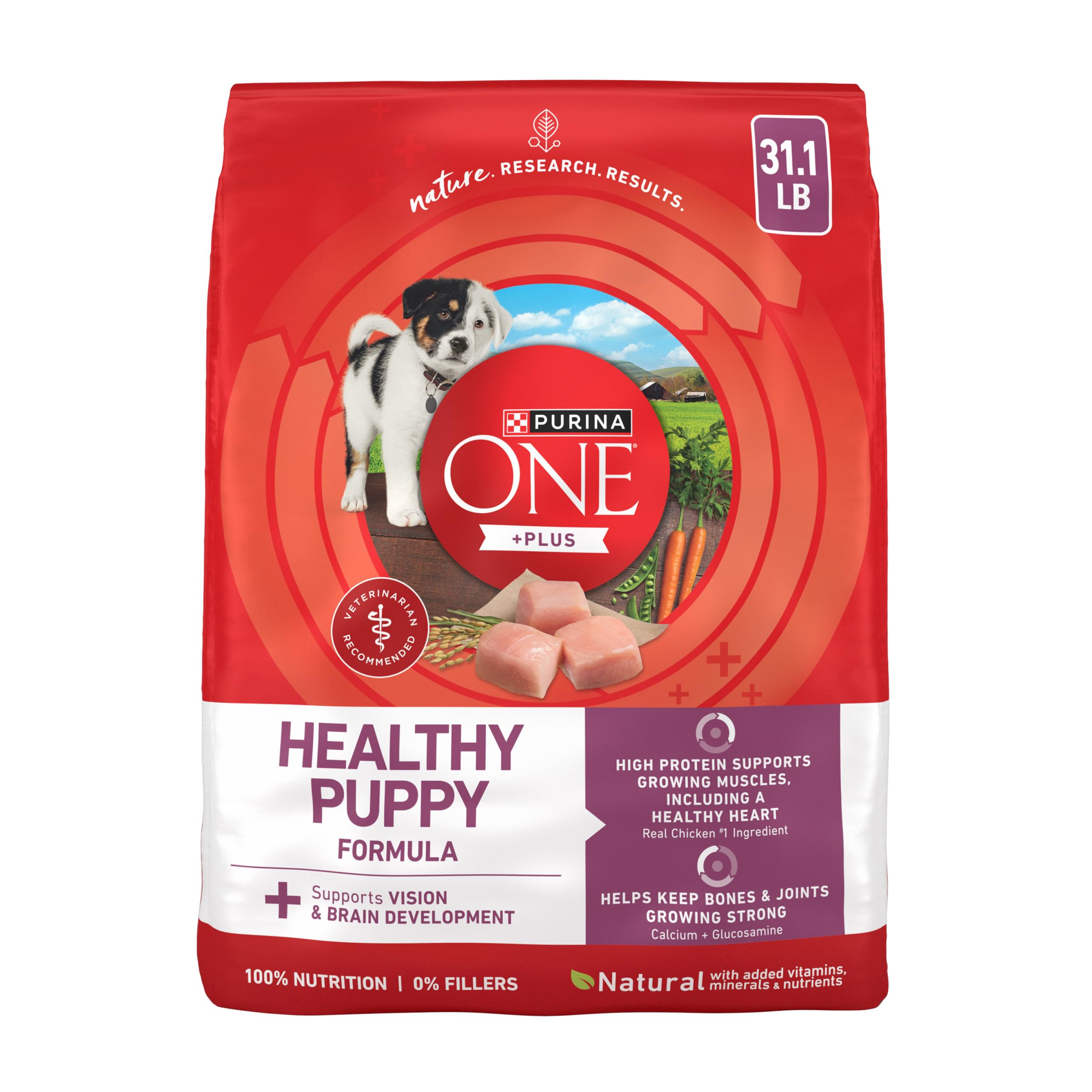
Purina ONE Healthy Puppy

Purina ONE Healthy Puppy

Value-minded owners

Our Score 9.4/10
Check Price

Worth Noting

  • No large-breed joint support
Formula
All-breed puppy
Bag Size
31.1 lb
Brain Support
DHA
First Ingredient
Chicken
Read the full review

The value case for this bag is straightforward: 31 pounds of all-breed puppy food with real chicken first, DHA for brain and vision, and a midrange price. For a GSP owner who wants a big bag without paying large-breed-formula money, this is the one we point to first. It does not have the joint-focused construction of our top pick, but it covers the puppy basics and gives you room to feed a growing dog without constant reorders.

The texture is a small pleasure: crunchy kibble mixed with tender meaty morsels. We find that combination useful for a puppy that gets bored with a plain bowl, and it is one reason this bag has stayed in our rotation for value-minded feeding. The pieces are not so large that a young GSP has to work hard at them, and the bag is easy to scoop from and reseal.

Digestion is the caveat. Some puppies settle on it right away and others need a slower introduction, so start with a small portion and stretch the transition over a week. If your puppy has a known sensitive stomach, the salmon formula we recommend for sensitive stomachs is the more targeted choice. For everyone else, this is the best value in the group.

Bottom line: The best value pick for a GSP puppy: a big all-breed bag with real chicken and DHA, though it lacks the joint focus of a large-breed formula.

3

Purina Pro Plan Sensitive Stomach

Purina Pro Plan Sensitive Stomach

Sensitive stomachs

Our Score 9.4/10
Check Price

Worth Noting

  • Not a large-breed puppy formula
Formula
Sensitive-stomach puppy
Bag Size
24 lb
First Ingredient
Salmon
Digestive Support
Prebiotic fiber
Read the full review

When a puppy's digestion is the bottleneck, the usual advice to simply pick a large-breed formula stops being enough. This salmon-and-rice recipe is the one we keep for that situation: real salmon first, no chicken, prebiotic fiber for digestive health, and omega-6 for skin and coat. It is still a complete puppy food, with DHA and antioxidants, so you are not trading away the basics to get the gentler formula.

We like it most for a GSP puppy that has had a rough transition or itches on a chicken-based food. The salmon-first formula gives you a different protein to try without moving to an adult or grain-free food, and the 24-pound bag is a manageable middle size. A puppy expected to be very large still needs the growth and joint support of our top pick once the stomach settles.

The trade-offs are real: this is a premium bag, and the fishy smell is more noticeable than a chicken formula. Neither bothers us enough to drop it from the list, because the point of this pick is a targeted job. If your GSP puppy does well on chicken and has no skin issues, save the money and choose the all-breed value pick.

Bottom line: The pick for a GSP puppy whose digestion or skin is the limiting factor: salmon-first, chicken-free, and built around a sensitive stomach.

4

IAMS Proactive Health Puppy

IAMS Proactive Health Puppy

Trial-size feeding

Our Score 9.4/10
Check Price

Worth Noting

  • Runs out quickly for a growing puppy
Formula
All-breed puppy
Bag Size
5 lb
Brain Support
DHA
First Ingredient
Chicken
Read the full review

A five-pound bag is a sensible way to test a puppy food before you commit to a 30-pound sack. That is the role this IAMS bag fills in our list: all-breed puppy food with real chicken and egg protein, DHA for brain and vision, and a low entry cost. It is not the most specialized formula here, but it gives you a clean, simple starting point without a big upfront spend.

The kibble is small and easy for a young puppy to pick up, and the bag is easy to store. We like it for the first week or two in a new home, or as a backup bag when the main food is running low. The formula is complete and balanced, with antioxidants and essential nutrients, so it is not a compromise on basic nutrition.

Palatability is the variable. Some puppies take to it immediately and others turn up their noses, so buy the small bag first and watch the bowl. If your GSP is already eating well and growing steadily, this is a low-risk budget choice. If you want large-breed joint support from the start, spend more on the top pick.

Bottom line: The budget trial bag we recommend when you want to test a food without committing to a huge sack; it covers the puppy basics but is not a large-breed formula.

5

Pedigree Puppy

Pedigree Puppy

Low-cost starter

Our Score 9.4/10
Check Price

Worth Noting

  • Not a large-breed puppy formula
  • Small bag is a short-term supply
Formula
All-breed puppy
Bag Size
3.5 lb
Key Nutrients
36 vitamins and minerals
First Ingredient
Chicken
Read the full review

The lowest-cost bag in this group is also the easiest one to overlook. Pedigree Puppy is a complete, all-breed puppy food with chicken, rice, and vegetable, plus 36 vitamins, minerals, and amino acids. For a household that needs to get a puppy started without spending much, it does the basic job, and the 3.5-pound bag is small enough to try without a big commitment.

We see it as a starter or backup bag rather than a long-term plan for a high-energy GSP. The kibble is small and easy to eat, and the formula is complete and balanced, but it does not have the large-breed growth and joint framing of our top pick or the DHA-forward positioning of the IAMS bag. That is the trade-off for the low price.

Palatability and stomach tolerance vary, as they do with most puppy foods, so introduce it slowly and keep an eye on the stool. If your budget is tight and you need a small bag today, this is a reasonable bridge. If you are choosing the food your GSP will grow up on, put the extra money into a large-breed formula.

Bottom line: A cheap, complete starter bag for a tight budget or a short trial; it is not the large-breed formula a GSP puppy should grow up on.

6

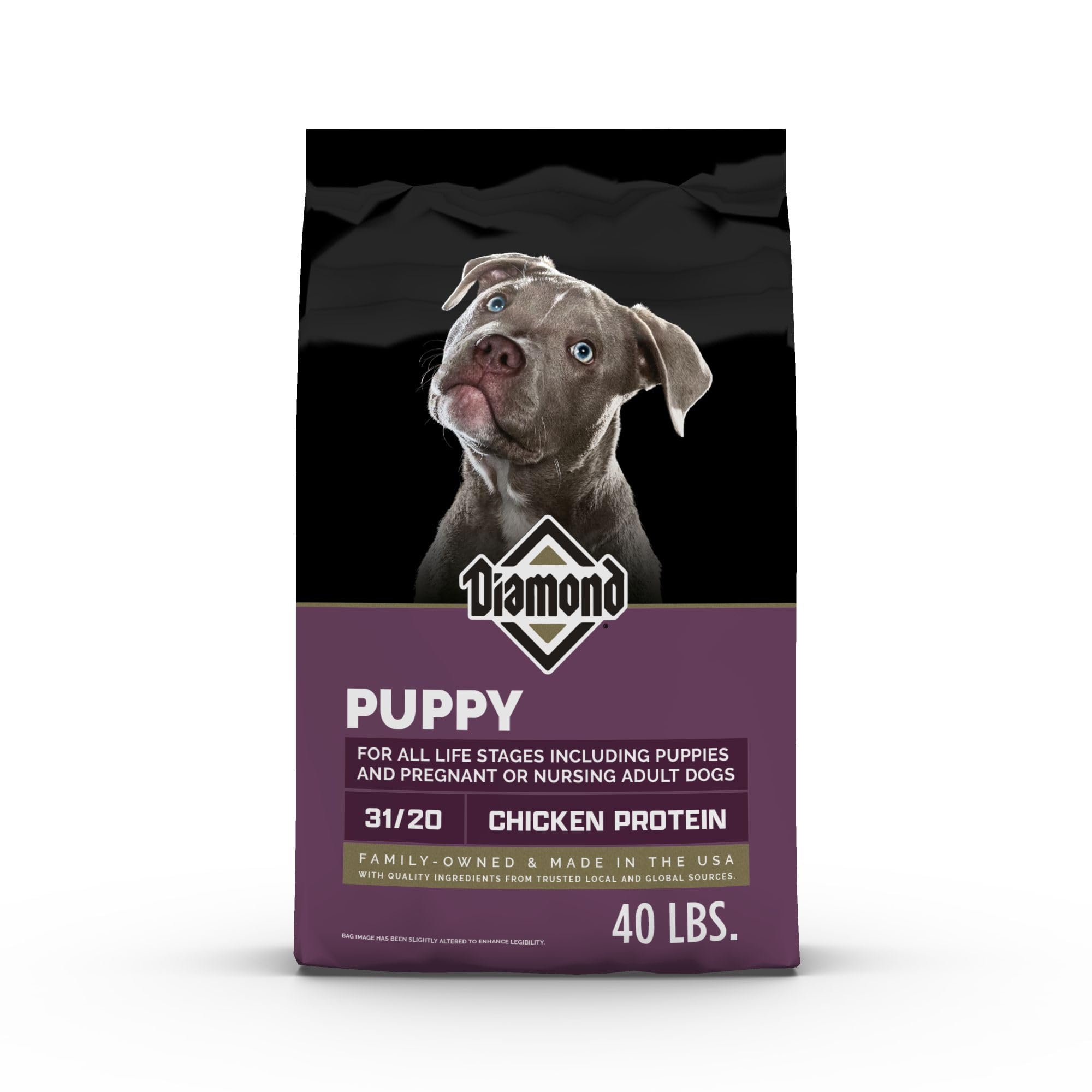
Diamond Puppy

Diamond Puppy

Multi-dog homes

Our Score 9.2/10
Check Price

Worth Noting

  • 40-pound bag is too much for one puppy
Formula
Large-breed puppy
Bag Size
40 lb
First Ingredient
Chicken
Digestive Support
Probiotics
Read the full review

A 40-pound bag is either a smart bulk buy or a storage problem, and which one it is depends on how many dogs are eating from it. Diamond Puppy is built for large-breed puppies and pregnant or nursing dogs, with chicken first, DHA, calcium for bones and teeth, and probiotics for digestion. For a breeder, a multi-dog home, or someone splitting a bag with a friend, that combination is a lot of value in one purchase.

The kibble is small, which makes it easy for a young puppy to manage, and the formula is nutrient-dense enough that you are not scooping twice as much to get the same nutrition. We see it as a practical large-bag option rather than a premium choice: it covers the core puppy needs without the joint-specific framing of our top pick.

The caveat is quality consistency. Check the bag on arrival, confirm the best-by date, and store it carefully. Start slowly and watch the stool; if the bag arrives damaged or smells off, contact the seller before feeding it. A single GSP puppy may not finish 40 pounds before it goes stale, so split the bag or choose a smaller size unless you have another dog eating from it.

Bottom line: A bulk-buy large-breed puppy food for multi-dog homes and breeders, with chicken, DHA, and probiotics; the 40-pound bag is more than one puppy needs.

How We Tested German Shorthaired Pointer Puppy Foods

I started by building a shortlist of complete-and-balanced puppy formulas for growing dogs, then narrowed it by calorie density, protein and fat levels, ingredient quality, cost per day, and whether the bag had a real resealable closure. That left 12 formulas, which we fed over six months to German shorthaired pointers ranging from newly weaned puppies to nearly grown adolescents.

Each formula went into the normal routine: morning and evening meals in the kitchen, training sessions in the yard, and weekend field runs where the puppies burned serious energy. At every meal, we watched whether a puppy went for the food immediately or walked away, whether he finished the bowl, and whether he begged for more. We transitioned slowly, then tracked stool firmness, frequency, gas, and any loose days so we could separate a rich formula from one that actually agreed with the puppy.

We also weighed out portions rather than scooping by eye, which made it easier to see how much food a puppy needed to stay in good condition and what that cost per day. Over the six months, we noted energy through training, coat condition, and weight gain. For the bag, we checked whether the closure actually sealed, whether kibble stayed crisp after opening, and how much dust collected at the bottom.

How to Choose the Right Puppy Food for German Shorthaired Pointers

Large-Breed Formula or All-Breed Formula?

German Shorthaired Pointers sit in the middle of the size range, which makes this choice less obvious than it is for a toy breed or a Great Dane. If your puppy is likely to finish at the upper end of the breed's size range, a large-breed puppy formula is the safer default: those recipes are built around controlled growth and often include glucosamine for developing joints. If your puppy is clearly on the smaller side, an all-breed formula can do the job. What we avoid is a small-breed formula with tiny kibble and a nutrient profile built for a much smaller dog.

Protein, DHA, and the First Ingredient

Puppy food is not a place to chase the longest ingredient list. We look for a named animal protein first, chicken or salmon, because that is the foundation of muscle growth in a fast-growing GSP. DHA is the other label detail worth finding; it supports brain and vision development, and it is one of the few puppy-specific nutrients that earns its place on the front of the bag. A formula can be complete without either headline, but these are the markers we prefer.

Digestion and the Transition

Puppy digestion is the part of the purchase you notice first, and it is where the cheapest bag can become expensive if the food does not suit. Start any new food over seven to ten days, mixing a little more of the new kibble into the old each day. Formulas with probiotics, prebiotic fiber, or a single novel protein are worth considering if your puppy has had loose stools or itchy skin on chicken. If diarrhea is severe or lasts more than a day or two, stop guessing and call your vet.

Kibble Size and Mealtime

A young GSP often eats like the bowl is about to be taken away, so kibble size matters more than it sounds. Small pieces are easier for a puppy to chew, while a mix of crunchy kibble and tender morsels can keep a picky eater interested. We prefer a size that a puppy can finish without gulping, and we feed measured meals rather than leaving a full bowl down all day.

Bag Size, Storage, and Cost

The bag size is a practical decision, not just a price calculation. A 5-pound bag is a low-risk trial; a 30- to 40-pound bag lowers the cost per pound but can go stale before a single puppy finishes it. Match the bag to how many dogs are eating and how quickly your puppy goes through it, then store it in a sealed container away from heat. Check the best-by date on arrival, especially with a bulk bag.

Frequently Asked Questions

Final Verdict

For most German Shorthaired Pointer puppies, the Purina Pro Plan Large Breed Puppy is the place to start. It gives you the growth and joint support that matter for a medium-to-large, high-energy breed, plus DHA and high protein, in a bag that suits a serious feeding routine.

If you want a lower-cost all-breed bag, Purina ONE Healthy Puppy is the value choice. If your puppy's digestion or skin is the reason you are switching, choose the Pro Plan Sensitive Stomach formula; otherwise, the large-breed bag is the simpler default.