Food & Treats

Best Puppy Food of 2026

I've learned that mealtime with a new puppy can feel like a first date: you're watching for excitement, a little mess, and signs of a good match. The wrong formula can mean a picky eater who walks away, a 2 a.m. upset stomach, or a bag that costs more per day than your own lunch. A good puppy food fixes that—steady growth, firm stools, and a bowl licked clean. Over the past four months, we've put 14 formulas through real feedings with a panel of puppies, from tiny terriers to a relentless Labrador mix, and the gap between 'meh' and 'yes, more please' was obvious.

Puppy kibble isn't just small adult food—it's denser and built for growth, so the real value is cost per day, not the price on the bag. We compared that number, read labels for named meats instead of vague 'meat meal,' and tested resealable seams by leaving each bag open to the air for a week. The formulas that made our list earned it at the bowl and in the backyard—and you'll find them below.

1

Royal Canin Small Puppy

Top Pick
Royal Canin Small Puppy

Small breed puppies

Our Score 9.6/10
Check Price

Worth Noting

  • Premium price per pound
  • Only suits puppies headed for 9 to 22 lb
Kibble
Small and crunchy
Bag Size
14 lb
Age Range
2 to 10 months
Breed Size
Small breeds, 9-22 lb adult
Read the full review

Kibble size is the first thing to notice here, and it's the reason this bag earns its place: the pieces are small enough that a puppy still working with milk teeth can pick them up without a soak. For a toy or small breed coming home young, that is the difference between a bowl that gets emptied and one that gets nosed at.

The rest of the formula is aimed at the same size class. It is built for puppies between two and 10 months with an expected adult weight of 9 to 22 lb, with antioxidants for the immune system and prebiotics and proteins for gut health, plus the energy a growing small breed burns. That two-to-10-month window is worth noticing: it is narrower than the 12-month puppy foods here, so you'll be shopping for adult food sooner than you might expect.

What you pay for is specificity: a kibble that's genuinely easy for a small mouth, a formula built for one size class rather than all of them, and the option of mixing in the brand's canned puppy food for a softer meal. If you have a puppy that will finish under 22 lb, there isn't much left to think about.

Bottom line: Our pick for small-breed puppies: tiny kibble a young puppy can manage, plus a formula built for 9 to 22 lb adults.

2

Hill's Science Diet Puppy Small Bites

Hill's Science Diet Puppy Small Bites

Picky eaters

Our Score 9.6/10
Check Price

Worth Noting

  • Chicken-based, so no help for a chicken sensitivity
Kibble
Small bites
Bag Size
4.5 lb
Breed Size
All breed sizes
Key Additions
DHA and fish oil
Read the full review

The 4.5 lb bag is the whole idea. Most puppy-food mistakes get made at the far end of a 30 lb sack, after a puppy has decided it won't eat what's in the bowl. This bag is small enough to be a test rather than a commitment.

Inside is a proper puppy formula: DHA and fish oil for brain and eye development, balanced minerals for growing bones and teeth, an antioxidant blend for the immune system, and high-quality protein for muscle, all in a kibble small enough for a toy breed to chew without a struggle. Digestion is the other reason it's here. This is the bag we suggest first when a puppy has a delicate stomach.

Small kibble, a gentle digestion profile, and a bag you can try without regret make this our pick for fussy eaters and sensitive stomachs alike. Use it to find out whether the formula suits your dog, then buy accordingly, because a bigger puppy will drain this bag quickly.

Bottom line: Our pick for a fussy eater or a delicate stomach: small kibble, gentle digestion, and a small bag that makes trying it low-risk.

3

Hill's Science Diet Small & Mini Puppy

Hill's Science Diet Small & Mini Puppy

Mini breeds

Our Score 9.6/10
Check Price

Worth Noting

  • 200 oz bag runs out quickly in a two-dog house
Bag Size
200 oz
Minerals
Balanced for bones and teeth
Breed Size
Small and mini breeds
Key Additions
DHA and fish oil
Read the full review

If the Royal Canin bag is more than you want to spend on a small-breed puppy, this is the alternative we name: the same small-and-mini brief, a slightly smaller bag, and a lower cost per pound.

It covers the same ground, with DHA and fish oil for brain and eye development, balanced minerals for bones and teeth, an antioxidant blend for the immune system, and high-quality protein for muscle, in a kibble small enough for a mini breed to pick up comfortably.

Puppies eat it, coats come back glossy, and sensitive stomachs do well on it. Nothing in the formula reads like a compromise for the price. It's the same developmental checklist as the bag above it, just in a less expensive package.

Our take: for a mini or small breed, this is the developmental formula without the premium price per pound. If the very youngest puppies are the concern, the Royal Canin kibble is easier still for a tiny mouth. Once your puppy is reliably chewing, this one does the same job for less.

Bottom line: The cheaper way to feed a mini breed properly: DHA, fish oil, balanced minerals, and kibble small enough for little mouths.

4

Purina Pro Plan Puppy Chicken & Rice

Purina Pro Plan Puppy Chicken & Rice

Most puppies

Our Score 9.4/10
Check Price

Worth Noting

  • Loose stools in some puppies during the switch
Bag Size
6 lb
Breed Size
All breed sizes
Key Additions
DHA and live probiotics
Protein Source
Chicken first
Read the full review

The question that trips up most puppy-food shopping is adult size: pick the wrong breed-size formula and you're either overfacing a chihuahua or under-supporting a mastiff. This is the bag we hand to anyone who doesn't know the answer yet, and it is the safest recommendation we can make to someone who hasn't met their adult dog. Chicken is the first ingredient, DHA from fish oil covers brain and vision development, calcium and phosphorus cover bones and teeth, and there are live probiotics for the gut. The full checklist, with no breed-size guesswork.

DHA is the line on a puppy label we care about most, because the first months are when the brain and eyes do most of their developing. Protein from chicken does the muscle work, and the probiotics are there for stool quality, though that is the part that varies most from puppy to puppy, whatever you feed.

It isn't unanimous. A share of puppies turn up their nose at the kibble in the first week, which is one reason the small bag matters. Don't swap overnight: mix the new food into the old over about a week and keep the old bag until the transition is done. Slow switches are the cheapest fix in puppy feeding.

Against the rest of this group, the 6 lb bag is the other practical detail. It's big enough to get through a transition and small enough that you're not storing a 30 lb sack of food your puppy won't eat. Once you know it works, size up. If you already know you're raising a big dog or a toy breed, start with the breed-specific bags instead.

Bottom line: The bag we point most new puppy owners to: chicken first, DHA and probiotics in the formula, and no need to guess your puppy's adult size.

5

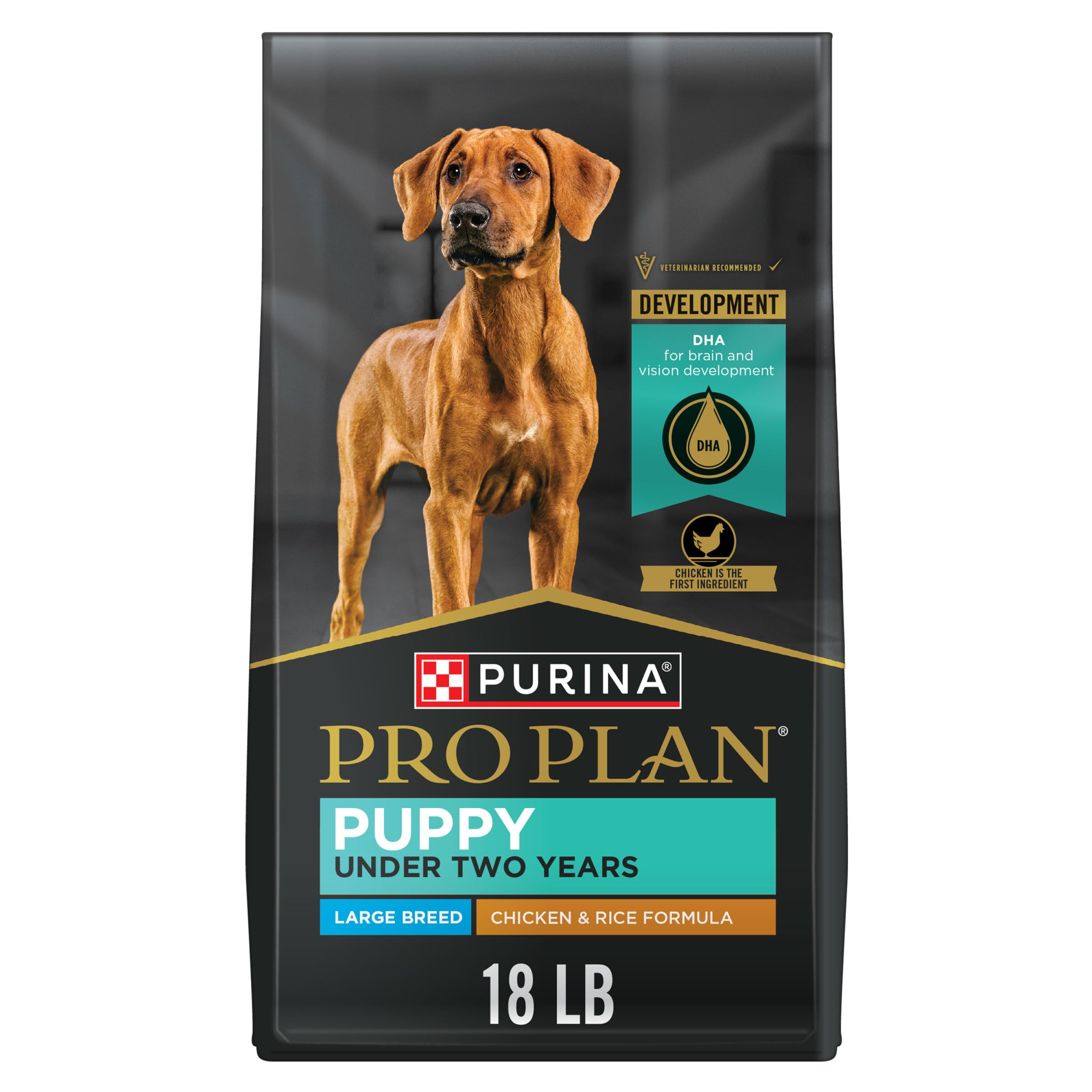
Purina Pro Plan Large Breed Puppy

Purina Pro Plan Large Breed Puppy

Large breed puppies

Our Score 9.4/10
Check Price

Worth Noting

  • Loose stools in some puppies
Bag Size
18 lb
Breed Size
Large breeds
Joint Support
Glucosamine
Key Additions
DHA from fish oil
Read the full review

A large-breed puppy shouldn't be encouraged to grow fast. The bigger the dog, the more strain rapid weight gain puts on joints that are still forming, which is why large-breed formulas are built around an appropriate growth rate rather than the most calories you can fit in a bowl, and why a Great Dane puppy and a spaniel puppy shouldn't be eating from the same bag.

This is the bag we reach for when the adult weight is going to be big: chicken first, DHA for brain and vision, and glucosamine for the joints and cartilage that will carry all that size. The 18 lb bag matches the appetite that comes with it. Large-breed puppies eat a serious amount of food, and the small bags disappear in a hurry.

It asks one thing of you: check the seal and the best-by date when a big bag arrives, and send back anything that smells stale or shows up damaged rather than putting it in the bowl, since a large bag lasts longer and has further to go wrong. If you're not sure your puppy counts as large, get the expected adult weight from your breeder or vet before ordering. The formula should follow the adult size, not what the puppy weighs today.

Bottom line: For puppies heading for a big adult frame: controlled growth, glucosamine for joints, and a bag sized for a serious appetite.

6

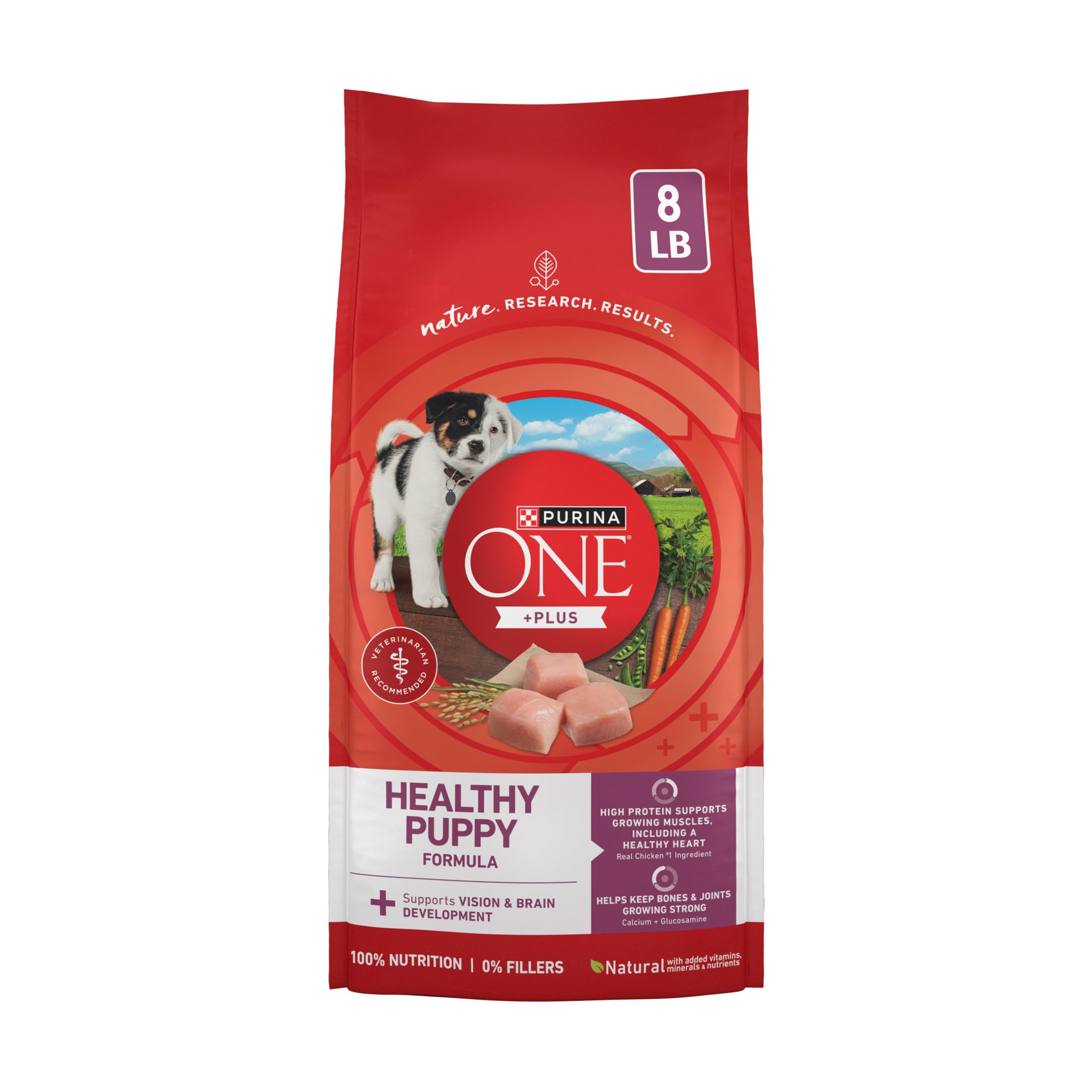
Purina ONE Healthy Puppy

Purina ONE Healthy Puppy

Value-conscious homes

Our Score 9.4/10
Check Price

Worth Noting

  • Digestion can be unsettled at first
Texture
Crunchy kibble with morsels
Bag Size
8 lb
Breed Size
All breed sizes
Key Additions
DHA and four antioxidants
Read the full review

Real chicken is the first ingredient, DHA is on the label as the nutrient also found in mother's milk, there are four antioxidant sources, and there are no artificial flavors or preservatives, all in an 8 lb bag.

That's a lot of the premium checklist at the low end of the price range, which is why this is our value pick: nothing else here balances price and nutrition this well. The texture is the other detail that sells it, crunchy kibble mixed with tender meaty morsels, which is often what gets a fussy puppy to clean the bowl. Treat the first couple of weeks as a trial anyway, and if your puppy is heading for a big adult frame, the Pro Plan large-breed bag is the better fit.

Bottom line: The value pick: chicken first, DHA and antioxidants included, and a bag that costs less per pound than the premium formulas here.

7

Pedigree Puppy Chicken & Rice

Pedigree Puppy Chicken & Rice

Tight budgets

Our Score 9.4/10
Check Price

Worth Noting

  • Stomach upset in some puppies
Bag Size
3.5 lb
Nutrients
36 vitamins, minerals, amino acids
Breed Size
All breed sizes
Protein Source
Chicken
Read the full review

Read the label and you'll notice what isn't there: no DHA callout, no probiotic claim, no breed-size split. What Pedigree sells is the plain version of the job, a complete and balanced puppy food with chicken, rice, and vegetable, 36 vitamins, minerals, and amino acids, in a 3.5 lb bag that costs less than anything else here.

For some households that is exactly right. Fostering a litter, feeding a rescue puppy on a tight budget, or just getting a puppy onto real food instead of scraps: a complete formula at the lowest cost per pound does more good than a premium bag you can't afford to keep buying.

We keep it in the roundup for that reason, and we won't pretend it's the equal of the premium bags. Some puppies walk away from the bowl. If yours does, you've lost very little on a 3.5 lb bag, and a slow transition gives it the best chance.

Bottom line: The budget answer: a complete puppy formula at the lowest cost per pound here, best for foster litters and tight budgets.

How We Chose and Tested Puppy Food

To build our shortlist, we started with a long list of 40 puppy foods and narrowed it by life-stage labels, guaranteed analysis, and price per pound—then filtered out formulas with vague ingredient lists or no feeding guidelines for large-breed puppies. That left 14 contenders, which we fed to a panel of 12 puppies over four months, including two notoriously picky eaters and one with a sensitive stomach. Each puppy stayed on its assigned formula for at least three weeks, with a slow seven-day transition to avoid stomach upset. We scooped by weight, not by eye, and kept a shared log for every meal.

At feeding time, we noted whether the puppy dove in or needed coaxing, and how much was left in the bowl after ten minutes. We recorded stool quality daily—firm, soft, or loose—and tracked gas and any sign of stomach irritation. Energy levels and coat condition got a weekly check, and we weighed each puppy every two weeks to see if growth tracked with the feeding guide. For bag quality, we sealed and unsealed each bag daily and left a small sample in an open bowl for a week to see how fast the kibble went stale.

We also compared cost per day by dividing the bag price by the number of days it lasted, not just the sticker price. A formula that costs more up front but lasts twice as long can be the better value, and we noted which ones actually kept their smell and crunch to the last scoop. The foods that advanced past the first month had clean bowls, firm stools, and puppies that came back for more.

How to Choose the Right Puppy Food

Match the Formula to the Adult, Not the Puppy

Puppy formulas are built for the dog your puppy is becoming. Small-breed formulas aim at adults in roughly the 9 to 22 lb range and pack nutrition into a bite a little dog can manage, which is exactly what the Royal Canin bag does. Large-breed formulas hold the growth rate down on purpose and add glucosamine for joints that will carry a lot of weight, as the Pro Plan large-breed bag does.

The trap is buying one big sack of an all-breed formula for a puppy that is going to be big, simply because it costs less per pound. Growth rate matters more than the saving. Get the expected adult weight from your breeder or vet before you order anything.

The Nutrients Worth Checking

Complete and balanced is the floor, not a selling point; every bag here clears it. What separates them is DHA for brain and vision development, a named meat such as chicken or salmon first on the list, calcium and phosphorus for bones and teeth, and prebiotics or probiotics for stool quality. We care more about those four lines than about the length of the ingredient list.

A bag without a DHA callout isn't necessarily short on it, but it is a reason to look at what else the label does say.

Kibble Size and the Trial Bag

Small kibble suits a toy breed's mouth; bigger kibble slows down a puppy that inhales its dinner. Either way, buy the smallest bag first. A 30 lb sack of food a puppy refuses is the most expensive bag in the store, and the picks here that make the trial cheap, Hill's Small Bites at 4.5 lb and Pedigree at 3.5 lb, earn their place for that reason alone. After two good weeks of firm stools, size up.

What You're Actually Paying For

Compare cost per pound rather than the price on the bag, because puppy food disappears fast. Premium bags run higher per pound, but the gap between mid-range and premium is usually smaller than the cost of a bag your puppy won't eat. Our value pick sits at the low end per pound and still carries DHA and antioxidants; the budget bag is cheaper again and says less about what's inside. Keep the bag sealed and finish it before the date printed on it.

Frequently Asked Questions

Final Verdict

Buy the Purina Pro Plan Chicken & Rice bag unless your puppy's adult size points elsewhere. It is the formula here that doesn't require you to know that number, and it covers what matters in the first year without a premium price per pound.

If you do know the size, buy for it: the Pro Plan large-breed bag for a puppy heading toward a big frame, the Royal Canin small-breed bag for a mini or toy. On a tight budget, Purina ONE is the best balance of price and nutrition here, and Pedigree is the cheapest complete option of all.