Food & Treats

Best Puppy Food for Large Breeds of 2026

Large-breed puppies do everything fast, including grow — a 10-week-old who fits in your lap in June can be a 70-pound teenager by winter. That speed is exactly why their food isn't the same as a small breed's: it has to fuel all that bone and muscle without pushing growth so hard that joints pay for it later. The right formula pulls that off while keeping stools firm, the coat glossy, and the puppy genuinely excited to eat — and it does it at a price you can keep paying for a year.

My own puppy treated every new bag as a gamble: some he inhaled, others he nosed at and walked away from. Over the past five months, we've fed 11 large-breed puppy formulas to a rotating crew of growing dogs, and the differences showed up fast. One thing worth knowing before you buy: switching foods too quickly causes more loose stools than any ingredient list will, so plan on ten days of mixing. The picks below are grouped by the puppy they suit — the chowhound, the delicate stomach, the tight budget.

1

Purina Pro Plan Large Breed Puppy

Top Pick
Purina Pro Plan Large Breed Puppy

Most large-breed puppies

Our Score 9.4/10
Check Price

Worth Noting

  • Chicken-first recipe won't suit poultry-sensitive puppies
Bag Size
34 lb
Life Stage
Large-breed puppy
Joint Support
Glucosamine
First Ingredient
Chicken
Read the full review

Pro Plan's large-breed puppy formula is the one we kept coming back to because it covers the basics without making the decision complicated: chicken is the first ingredient, glucosamine is included for developing joints, and DHA from fish oil supports brain and vision. The bag also states the formula is designed to support an appropriate growth rate for large-breed puppies, which is the whole reason to buy a large-breed food instead of a general puppy formula. We think that combination makes it the easiest recommendation for most homes.

The 34-pound bag is the practical part. It is heavy enough that you want a scoop and a sealed storage bin ready before the first feeding, and it takes up a real shelf or pantry corner. In exchange, you are not reordering every week, which matters once a puppy is eating steadily. We transferred ours into a bin and kept the bag's feeding chart taped inside the lid, a small habit that made portioning easier.

The formula already includes glucosamine and DHA, so you are not assembling a separate supplement routine on day one. That is the kind of convenience we want in a puppy food: one bag that covers the large-breed basics and a size that does not need constant reordering. We like having a default that does not force a choice between joint support and a bag that lasts more than a few days.

Bottom line: For most large-breed puppies, we recommend Pro Plan's chicken-and-rice formula because it pairs joint and brain support with a bag size that keeps feeding practical.

2

Hill's Science Diet Large Breed Puppy

Hill's Science Diet Large Breed Puppy

Controlled growth

Our Score 9.4/10
Check Price

Worth Noting

  • Higher cost per pound than the big bags here
Bag Size
15 lb
DHA Source
Marine algae oil
Bone Support
Optimal calcium
Digestive Support
Prebiotic fibers
Read the full review

The 15-pound bag is the first thing you notice about Hill's Science Diet Large Breed Puppy. It is easier to carry and store than the 30- and 40-pound sacks here, which makes it a better fit for a small pantry or a household that would rather not decant a huge bag at once.

What we like is the growth-focused formula behind that smaller bag: optimal calcium levels for controlled bone and joint development, marine algae oil for DHA, and prebiotic fibers for digestive and immune support. The formula is built around the idea that a large-breed puppy should grow steadily rather than simply fast, and that is the right priority. We prefer this one for a household that wants a tightly specified formula and a smaller bag to store.

The kibble is one of the better matches here for a large puppy: the pieces are big enough that a growing dog has to chew rather than swallow a mouthful whole. That is a small detail, but it is the kind of thing you notice at feeding time, especially with a puppy that eats fast.

Bottom line: We point owners who want a tightly controlled growth formula toward Hill's Science Diet Large Breed Puppy, especially in households that value a smaller, easier-to-store bag.

3

IAMS Proactive Health Large Breed Puppy

IAMS Proactive Health Large Breed Puppy

Budget feeding

Our Score 9.4/10
Check Price

Worth Noting

  • Digestive upset is the weak spot
DHA
Omega-3 DHA
Bag Size
30.6 lb
Bone Support
Optimal calcium
First Ingredient
Chicken
Read the full review

IAMS Proactive Health Large Breed Puppy is the cheapest large-breed puppy food in this group, and it still leads with chicken, adds omega-3 DHA, and lists optimal calcium levels for bones and joints. For a household feeding a rapidly growing puppy on a budget, that combination is hard to ignore.

We kept IAMS in the budget slot because it does the core job without asking you to pay for a premium formula. The kibble is sized for large puppies, and the 30.6-pound bag is easier to handle than the 34- and 40-pound sacks here while still lasting a reasonable stretch. We were surprised by how much of the large-breed checklist it covers at this price.

The bag is not the most premium-feeling package in this group, but that is not why you buy it. The reason to choose IAMS is simple: it gets a large-breed puppy the basics, in a size that is manageable, for less than the other picks here. The kibble size is the detail that makes it feel less like a compromise.

Bottom line: We keep IAMS in the budget slot because it covers the large-breed basics for the least money here.

4

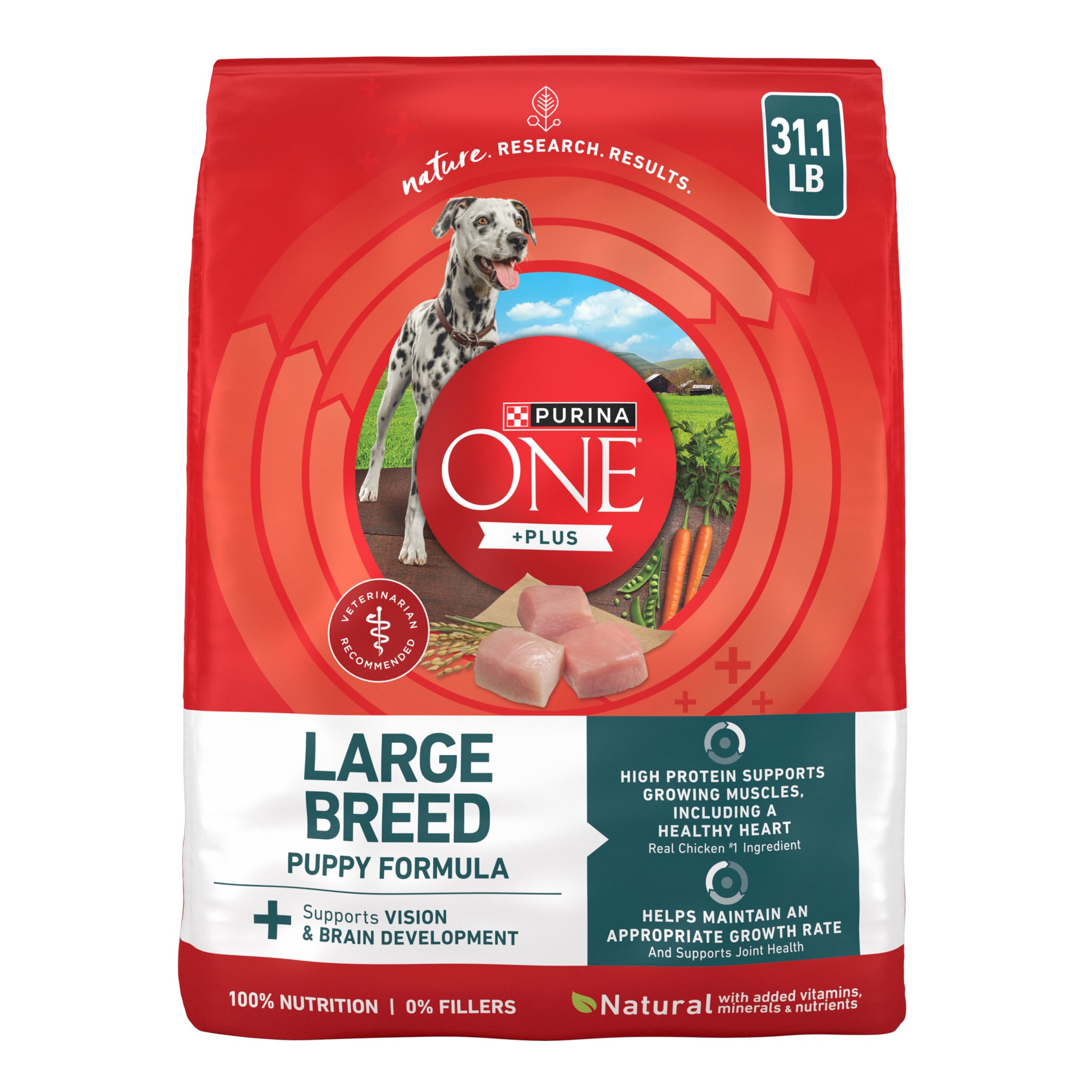
Purina ONE Plus Large Breed Puppy

Purina ONE Plus Large Breed Puppy

High-protein value

Our Score 9.4/10
Check Price

Worth Noting

  • Mixed palatability; some puppies refuse it
  • Some puppies develop loose stools
Protein
High protein
Bag Size
31.1 lb
Joint Support
Glucosamine
First Ingredient
Chicken
Read the full review

The crunchy kibble and tender meaty pieces are the first thing that stands out about Purina ONE Large Breed Puppy. That texture mix is designed to keep a puppy interested in dinner, and it gives you something to try if plain kibble has become boring. The formula leads with chicken, adds DHA and glucosamine, and comes in a 31.1-pound bag that sits between the budget and premium options here.

High protein is the headline, and the formula is built around muscle growth, brain development, joint health, and immune support. We found the bag easy enough to handle, and the mid-size format means fewer reorders than the 15-pound Hill's bag without the storage commitment of the 40-pound Diamond bag. That middle ground is the reason it earns a look.

We think Purina ONE is a solid high-protein option when you want a mid-size bag and a texture mix that keeps mealtime interesting. The formula covers the large-breed basics, and the mid-size bag is the practical detail that makes it easy to fit into a feeding routine.

Bottom line: We think Purina ONE is a solid high-protein alternative when you want a mid-size bag and a texture mix that keeps mealtime interesting.

5

Diamond Naturals Large Breed Puppy

Diamond Naturals Large Breed Puppy

Lamb-based feeding

Our Score 9.2/10
Check Price

Worth Noting

  • Some puppies develop loose stools
Bag Size
40 lb
Life Stage
Large-breed puppy
First Ingredient
Pasture-raised lamb
Digestive Support
Probiotics
Read the full review

Diamond Naturals puts pasture-raised lamb first, which gives large-breed puppy feeding a different protein option instead of another chicken-and-rice bag. We liked having that choice, especially for a household that has already tried a chicken formula and wants to compare how a lamb recipe goes. The 40-pound bag is the largest here, so it also cuts down on how often you have to reorder.

The formula is built for large-breed puppy growth and includes probiotics for digestive and immune support. The bag is heavy enough that you want a scoop and a sealed bin ready before you open it, and the pellet shape is easy to portion. We found the value story straightforward: more food per bag, a different protein, and a formula aimed at the same growth job as the others.

The lamb-first recipe is the real differentiator, not the bag size; the bag is just what makes it convenient. If your puppy does well on lamb, this is a practical way to keep the pantry stocked without switching brands every few weeks.

Bottom line: If chicken hasn't agreed with your puppy, we like Diamond Naturals' lamb-first formula and its big 40-pound bag.

How We Picked and Tested Large-Breed Puppy Foods

We started with the guaranteed analysis on the back of every bag, narrowing to formulas that carried an AAFCO feeding statement for large-breed growth and a calcium-to-phosphorus ratio in the range veterinarians recommend for big-boned dogs. From there we cut anything we couldn't buy in a bag over 20 pounds, since a puppy headed for 80 pounds will empty a small bag in ten days, and we weighed cost per pound against how much of the food actually got eaten.

Eleven formulas made the cut, and each one got at least four weeks in a bowl over a five-month stretch, fed to puppies between 10 weeks and 10 months old in our own homes and two foster setups. We scooped by weight rather than by eye so portions were comparable, and at the 6 a.m. feeding we noted whether the puppy dove in or picked at the bowl; at the evening feeding, whether it finished.

The rest was pickup duty and hands-on handling. We rated stool firmness on the morning yard walk, brushed each puppy weekly to see whether the coat stayed glossy or dulled, and weighed them monthly against a growth chart to check that gains were steady rather than spiky. We also lived with the packaging — whether the closure resealed, whether kibble at the bottom of a 30-pound bag still smelled fresh in week three, and how much ended up as crumbs in the car. Formulas that looked good on paper but produced loose stools or a puppy who walked away didn't stay on the list.

How to Choose the Right Puppy Food for Large Breeds

Start With the Growth Formula, Not the Bag Size

Large-breed puppies have a narrow window for growth: too many calories or an unbalanced calcium-phosphorus ratio can put extra stress on developing joints. That is why a food labeled for large-breed puppies is worth the search. A general puppy formula may be fine for a small breed, but it is not the same job. Look for a life-stage statement that names large-breed puppies or controlled growth, and do not assume a bigger bag or a higher protein number makes a food better for a big dog.

Read the First Few Ingredients and the Support Nutrients

We look for a named protein first, chicken in most of these and lamb in the Diamond Naturals bag, then check whether the formula adds DHA for brain and eye development and glucosamine for joints. Those are the practical markers of a large-breed puppy formula, not marketing words like natural or premium. Protein level matters, but it is not the whole story. Use the guaranteed analysis and the life-stage claim together, and treat a high protein number as useful only when the rest of the formula fits a growing large dog.

Match Kibble and Bag Size to Your Routine

Large-breed puppies tend to eat quickly, so kibble size can do a small amount of work for you: a piece that requires chewing is better than one small enough to swallow in a breath. Hill's and IAMS both lean into kibble sized for large puppies, while Purina ONE uses a mix of crunchy and tender pieces. Bag size is the other practical call. A 40-pound bag is cheaper per pound but needs airtight storage and space; a 15-pound bag is easier to handle but runs out faster. Buy the format you can store properly.

Switch Slowly and Watch the Stool

Any puppy food can cause loose stools when it is introduced too fast, and the transition is where most of the trouble shows up. Mix the new food with the old over about a week, starting with a small share of the new kibble and increasing it gradually. Keep the old food on hand in case you need to slow down. If diarrhea lasts more than a day or comes with vomiting or lethargy, call your vet rather than pushing through. A food that suits one puppy can still upset another.

Frequently Asked Questions

Final Verdict

Pro Plan Large Breed Dry Puppy Food is the one we recommend first for most large-breed puppies. It has the right growth focus, joint and brain support, and a bag size that makes daily feeding practical. Hill's Science Diet is the pick when controlled calcium and a smaller bag matter more than cost per pound; IAMS is the budget fallback when the basics are enough. Start with the formula that fits your puppy's expected adult size, then let stool and growth checks guide the switch.