Food & Treats

Best Puppy Food for Small Breeds

A small-breed puppy's mouth is about the size of a thumbnail, and their stomach isn't much bigger — which is why a bag of food built for a retriever often ends up nibbled around and half-eaten. Kibble that's too big gets refused; kibble that's too rich leads to loose stools and a 2 a.m. cleanup. The right formula solves both: pieces a tiny jaw can crunch, calories dense enough that a few bites count, and a recipe gentle enough for a stomach that's still figuring itself out.

We fed 12 small-breed puppy formulas to a panel of test puppies over three months, and the ones eaten down to the last piece had small, consistent kibble and a smell that survived an open bag for a week. Worth knowing: "small breed" on the label usually means higher calorie density, not just smaller pieces, so portion math matters more than it looks. The picks below were built for tiny mouths, touchy digestion, and a stage that decides whether you end up with a picky adult.

1

Royal Canin Small Puppy Dry

Top Pick
Royal Canin Small Puppy Dry

Most small puppies

Our Score 9.6/10
Check Price

Worth Noting

  • Contains fish, gluten and wheat
  • Premium price for a 4 lb bag
Flavor
Chicken
Bag Size
4 lb
Life Stage
Puppy, 2 to 10 months
Expected Adult Weight
9 to 22 lb
Read the full review

Nine to 22 pounds is the number that decides whether this bag is right for your puppy, and it is the first thing we look for on any small-breed formula. That window covers most of the dogs people mean when they say small — miniature poodles, cockapoos, Havanese, Shih Tzus, small terriers — and it draws an honest line at both ends. A Chihuahua headed for six pounds and a corgi headed for thirty are both small puppies at eight weeks, and neither is what this food was built for.

For the puppies inside that band, this is the bag we reach for. The kibble is genuinely small: a ten-week-old puppy picks a piece up on the first try rather than nosing it around the bowl, which sounds like a minor point until you have watched a hungry puppy lose interest in a meal it cannot get into its mouth. It stays crunchy in the bag, and a spoonful of the matching Thin Slices in Gravy is a good way to move a reluctant puppy onto dry food without a fight.

The nutrition is aimed squarely at that growth window — antioxidants for the developing immune system, prebiotics and quality protein for gut health, and the energy a puppy burning through its first year actually needs. Nothing here feels like filler, which is part of why the bag turns up in so many puppy-going-home kits.

Digestion is the one place the formula is not a sure thing. Some puppies take to it with firm stools from the first bowl; others need a slower path, and loose stools can show up in the first week. Plan the change rather than improvising it — keep a week of the old food and taper it in.

Bottom line: Our default small-breed puppy food: a formula built around a 9 to 22 pound adult weight, with kibble small enough that a ten-week-old puppy eats a full meal without a struggle.

2

Hill's Science Diet Small & Mini Puppy

Hill's Science Diet Small & Mini Puppy

Everyday value feeding

Our Score 9.6/10
Check Price

Worth Noting

  • Chicken-based, so unsuitable for chicken allergies
Bag Size
4.5 lb
Breed Size
Small and mini
Life Stage
Puppy
Key Nutrients
DHA and fish oil
Read the full review

Same small-and-mini brief, a bigger bag, less money per pound — that is the short version of why this Hill's bag sits beside our top pick rather than behind it. The pieces are a nibble size that small mouths handle easily, and the 4.5 lb bag goes further than the Royal Canin's 4 lb. For a household feeding one small puppy through its first year, this is the better-value way to do the same job.

What you are paying for is a growth formula with DHA and fish oil, the pair we look for first on a puppy label because they are tied to brain and eye development in the early months. There is an antioxidant blend for the immune system and balanced minerals for bones and teeth, which matters more in a small breed than the packaging suggests: these dogs finish growing fast, and the skeleton they build early is the one they keep.

Palatability is good rather than ecstatic. Puppies eat it steadily, and few of them do the bowl-dragging routine our top pick gets. If you have a genuinely fussy puppy, that is worth knowing before you commit to a bag this size — this is a food for dogs that eat to live, not the other way round.

Bottom line: The value pick we point most small-breed households to — the same size-focused nutrition, with DHA for brain and eye development, for less per pound than our top pick.

3

Royal Canin Yorkshire Terrier Puppy

Royal Canin Yorkshire Terrier Puppy

Yorkshire Terrier puppies

Our Score 9.6/10
Check Price

Worth Noting

  • Most expensive food here, in the smallest bag
Breed
Purebred Yorkshire Terrier
Bag Size
2.5 lb
Life Stage
Puppy, 8 weeks to 10 months
Kibble Shape
For short muzzle and bite
Read the full review

The kibble in this bag is not just a smaller version of a standard piece — it is shaped for a short muzzle and the bite of a Yorkshire Terrier, the sort of detail that sounds like marketing until you watch a flat-faced puppy chase a round piece of food around a bowl. It works. The pieces sit in the mouth instead of skittering off the tongue, and a puppy that has been picking at meals gets through one.

Everything else on the label points at the same dog. Omega-3, omega-6 and biotin support the coat a Yorkie grows through adolescence, the stretch where the puppy fluff turns into adult hair and the difference shows up fast. There are antioxidants and vitamin E for the immune system, and prebiotics aimed at stool quality. The window is tight — 8 weeks to 10 months — which lines up with how quickly a Yorkie does the bulk of its growing.

Whether it earns its place comes down to the dog in front of you. For a purebred Yorkie with a short muzzle and a coat you are trying to bring through, the extra money buys something real: food the dog can actually eat and nutrients aimed at the hair. For a Maltese, a Havanese or a small mixed breed, it buys nothing the Small Puppy bag does not already do better on value.

Bottom line: Worth the premium only if you have a Yorkie: kibble shaped for a short muzzle and coat nutrients aimed at a breed whose hair changes fast.

4

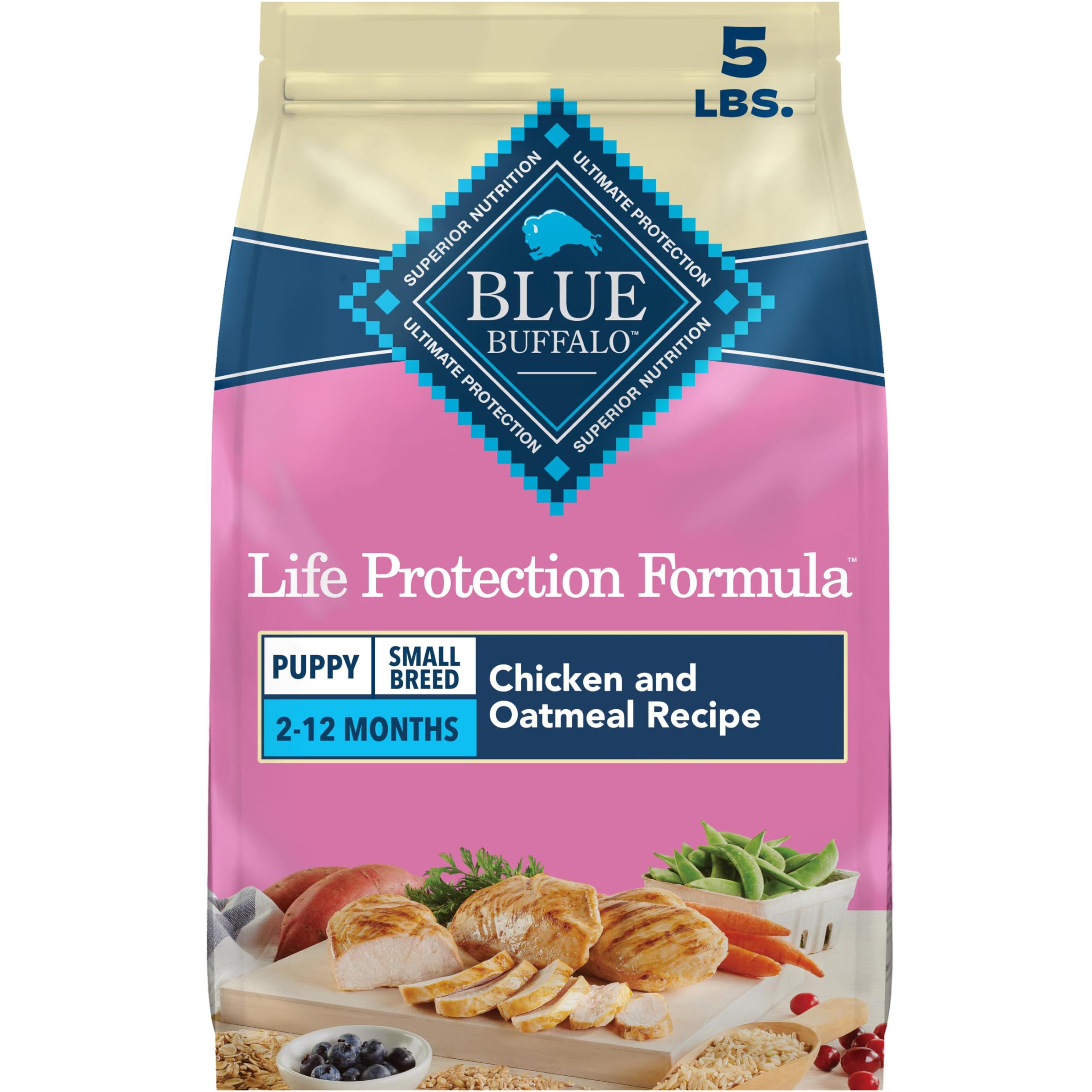
Blue Buffalo Small Breed Puppy

Blue Buffalo Small Breed Puppy

Tight grocery budgets

Our Score 9.4/10
Check Price

Worth Noting

  • Kibble runs large for very small puppies
Grains
Brown rice, barley, oatmeal
Bag Size
5 lb
Life Stage
Puppy, 2 to 12 months
First Ingredient
Real chicken
Read the full review

Real chicken is the first ingredient, the grains are brown rice, barley and oatmeal, and the recipe skips corn, wheat and soy — on paper this is the most food per dollar in the group, and it is why the bag earns a place for households watching the grocery bill. The 5 lb size also means fewer reorders than the premium bags, which matters when you are buying puppy food every few weeks.

Our hesitation is digestion. Puppies on this food split: some do well on it from the first bowl, others get loose stools or turn their nose up at it, which is an odd combination for a food built on chicken and oatmeal. If your puppy is one of the easy ones, this is genuinely good value and we would happily feed it. If not, the savings disappear into a bag you end up giving away, so make the change over a week or more instead of swapping overnight and give it a fortnight before you judge it.

Bottom line: A real budget option with chicken first and no corn, wheat or soy, as long as your puppy's stomach agrees with it.

How We Tested 12 Small-Breed Puppy Foods

We started by pulling every formula sold specifically for small- or toy-breed puppies, plus the all-life-stages foods whose kibble measured small enough to qualify. From there we filtered on guaranteed analyses and AAFCO statements, calorie density, and cost per day rather than cost per bag. That left 12 formulas, which we fed to a rotating panel of small-breed puppies — and a couple of obliging adults who volunteered as taste testers — across three months.

Each bag went through the same routine. We measured kibble with calipers for width, thickness, and how much the pieces varied, then watched puppies pick it up from both a shallow bowl and a snuffle mat to see whether they chewed or gulped. Meals were timed: how much was gone at five minutes, at fifteen, and what was still sitting there at the end of the day. Palatability got a second read on training walks, where we used kibble as rewards and noted which ones a puppy would still work for after it had already eaten.

Digestion was tracked in a daily log — stool firmness, frequency, gas, and any overnight accidents — for the first ten days of every switch, since that's the window where a food either settles or doesn't. We weighed puppies weekly to confirm that the ones cleaning their bowls were gaining steadily rather than just eating a lot. Value came last: we calculated cost per day for a puppy expected to top out around 10 to 15 pounds, because a cheap bag that takes twice the volume to satisfy a dog is not actually cheap.

How to Choose the Right Puppy Food for Small Breeds

Start with the adult weight, not the puppy's size

Small is a wide band. The same eight-week-old puppy might grow into a five-pound Yorkshire Terrier or a twenty-five-pound cockapoo, and those two dogs do not need the same food. Royal Canin handles this the clearest way here, printing an expected adult weight of 9 to 22 pounds on the Small Puppy bag, which tells you both who it is for and who it is not.

Ask your breeder, or check the breed standard, for the puppy's expected adult weight before you buy. If the number lands under about nine pounds, a breed-specific or toy formula is the closer fit; if it lands over twenty-two, you are shopping in the wrong section entirely.

Kibble size and muzzle shape

A puppy's mouth is small for a few weeks; after that, kibble size is about comfort rather than capability. The trap is trusting the front of the bag — small breed on the label does not guarantee small pieces, and the Blue Buffalo kibble here runs chunky for a toy mouth while the Royal Canin and Hill's pieces suit a ten-week-old.

Short-muzzled breeds such as the Yorkie and the Shih Tzu need shape as well as size, which is the whole argument for a breed-specific bag. Put a handful down in front of the puppy before you commit to a large one.

Growth nutrients that earn their place

Both Hill's and Royal Canin build their puppy formulas around DHA and fish oil, the nutrients we look for first because they are tied to brain and eye development in the early months. Antioxidants for the immune system and balanced minerals for bones and teeth turn up on all four bags here, and the differences between them are smaller than the price gaps suggest.

The bigger variable is the age window. Small breeds finish growing faster than large ones, and the puppy formulations here close at 10 to 12 months. Do not stockpile a year of puppy food for a dog that will be on adult food by spring.

Plan the switch before you open the bag

Loose stools in the first week of a new food are common and not always the food's fault — a puppy's gut is easily unsettled, and a sudden swap is the usual culprit. Mix the old food with the new over seven to ten days, starting at roughly a quarter new, and slow down if the stools loosen.

If things have not settled two weeks after the transition is complete, that bag may not be the right one. And never change food in the same week you change homes; a new puppy has enough going on.

Work out the cost per pound, not the cost per bag

Small bags cost more per pound than large ones, and the breed-specific 2.5-pound bags sit at the top of that curve — you are paying for a shorter run and a narrower formula. That is not automatically a bad deal, because a small puppy empties a small bag while it is still fresh, and freshness counts with kibble.

Do the division before you compare two bags, and buy the smallest size first when you are trying something new. The genuinely expensive bag is the one the puppy refuses to finish.

Frequently Asked Questions

Final Verdict

If your puppy is headed for somewhere between 9 and 22 pounds, the Royal Canin Small Puppy is the bag to start with: kibble small enough for a ten-week-old mouth, a formula built for that exact growth band, and the immune and gut support a puppy needs through its first months.

If budget is the deciding vote, Hill's Science Diet Small & Mini does the same job with a little more food for the money. And if the puppy is a Yorkie, the breed-specific bag is the one place here where paying more buys something the size formula cannot.