Toys & Chews

Best Puppy Toys for Teething of 2026

Teething turns a sweet puppy into a small, determined machine with one goal: put everything in their mouth. The wrong toy can be too hard for sore gums, too flimsy to survive a single afternoon, or just boring enough that your puppy goes right back to the chair leg. The right one gives real relief, redirects that chewing energy, and buys you a few minutes of peace.

Over the past three months, my team and I tested 16 teething toys with a rotating crew of puppies, including my own. We paid attention to what they actually reached for—texture, scent, shape—and how long that interest lasted. The ones that made the cut were well-made, appropriately sized for a puppy's mouth, and durable enough to justify the cost. They also had to be soft enough to soothe sore gums without being so hard that a puppy gave up. Every puppy is different, so I've called out which picks suit aggressive chewers versus gentle nibblers.

1

KONG Puppy Teething Chew

Top Pick
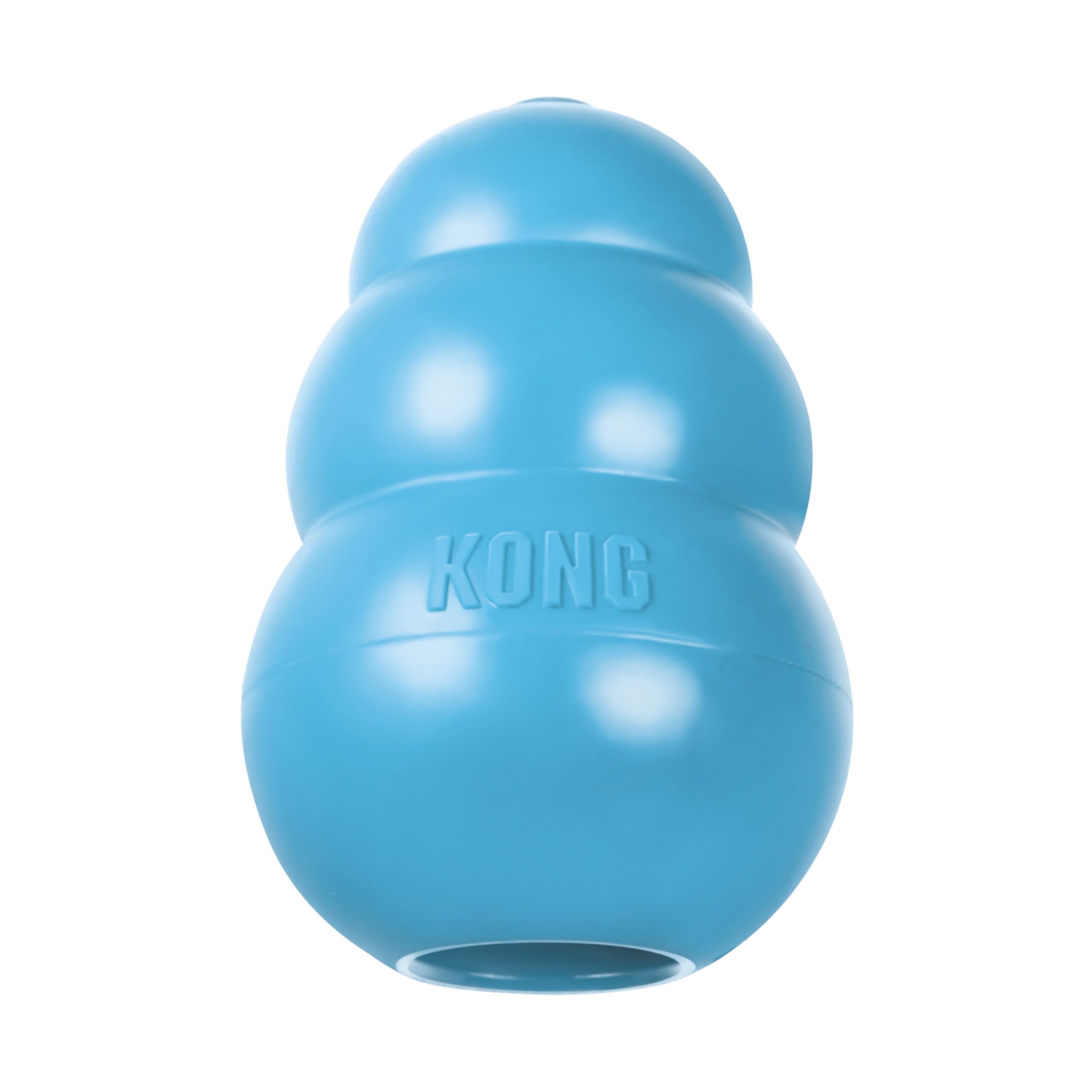
KONG Puppy Teething Chew

Small-breed puppies

Our Score 9.2/10
Check Price

Worth Noting

  • Soft rubber can give way under a determined chewer
Size
Small (Pack of 1)
Material
Natural rubber
Stuffable
Hollow center
Dimensions
6.3"L x 3.9"W x 2.91"H
Read the full review

Puppies cut 28 baby teeth, and KONG formulates the rubber in this one for those teeth rather than for an adult jaw, so it is made to give under a bite instead of resisting it. That single property matters more than any feature on this page, and it is why the small blue Classic is the toy we name first. It is 6.3 inches long and 50 grams, light enough for a young puppy to pick up and carry, and the hollow core takes kibble, paste, or a frozen plug of peanut butter.

What keeps it in the rotation is that it never becomes furniture. A plain rubber shape gets mouthed once and abandoned; fill this one and it turns into a project, and the frozen version is what we reach for when a puppy is clearly sore. The catch is cleaning. Once it has been stuffed, the far end holds a film of old kibble that a tongue cannot reach, so a bottle brush earns its place next to the toy basket.

Size is worth a second look before you order. Small here suits a puppy that will finish up on the smaller side; a retriever cross will be chewing past it within a couple of months, and the Large is the better buy for that dog. It measures just under three inches through the middle, which is exactly why it suits a small mouth and why it stops fitting so quickly.

Bottom line: For most puppies cutting their first teeth, we point here: the rubber is genuinely soft, the hollow center takes food, and Small suits a puppy that stays on the smaller side.

2

KONG Puppy Binkie

KONG Puppy Binkie

Puppies that carry

Our Score 9.2/10
Check Price

Worth Noting

  • Tears easily under a determined chewer
  • Small runs large for toy-breed puppies
Shape
Pacifier
Weight
3.53 oz
Material
Natural rubber
Age Range
Up to nine months
Read the full review

Some puppies lie down and work on a chew; others want to carry something around and show you. The Binkie is for the second kind. It is soft natural rubber built into a pacifier shape, 7.44 inches long and 100 grams, twice the weight of the small Classic, and the extra mass gives a medium-breed puppy something solid to clamp its front teeth around. Watching a puppy trot past with a pacifier in its mouth is the least scientific observation in this roundup and the one we enjoyed most.

The hollow inside takes kibble or paste the way the Classic does, and a frozen Binkie gives a restless puppy a good long chew. The shape has one more thing going for it: it sits in the mouth rather than under the paws, so a puppy can gnaw while it wanders, which is exactly what a teething puppy with no attention span wants to do.

Size is the part to check twice. Small here is a bigger mouthful than the small Classic, and a Yorkshire terrier puppy will probably ignore it, though one that does pick it up looks ridiculous carrying it. A cocker spaniel or a lab cross in the four-to-six-month window is the mouth this was built around.

Bottom line: This is the one we hand a puppy that likes to carry things: the pacifier shape stays in the mouth, and the extra weight gives a medium-breed puppy more to hold.

3

N-Bone Puppy Teething Rings

N-Bone Puppy Teething Rings

Edible relief

Our Score 9.0/10
Check Price

Worth Noting

  • Gone in one sitting for a keen chewer
  • Labeled for puppies three months and older
Form
Edible chew
Count
6 rings
Flavor
Chicken
Age Range
3 months and older
Read the full review

This is the only thing in the roundup a puppy eats. N-Bone's rings are a rice-based chew with chicken flavor, calcium and DHA, built to be gnawed down rather than mouthed, which makes them useful for the puppy that has lost interest in rubber and needs a reason to keep chewing. They are fully digestible, corn-, wheat- and soy-free, and there is no toy to wash afterwards.

We noticed the rings go tacky as they warm, so one that crosses a carpet picks up every bit of fluff on the way back to the mouth. The final inch softens into a gluey stub, and that is the piece you take out of the puppy's mouth rather than the piece it finishes. A soft stub can plaster itself to the roof of the mouth, which makes these a chew to sit with rather than leave down.

Used that way, they earn their place in the cupboard. A puppy that turns its nose up at a rubber chew will usually take a ring, and the chewing is real work for a sore mouth. N-Bone labels them for puppies three months and older, and they count as treats, so they slot into a day instead of replacing the toys. An edible chew is a consumable, and it disappears at the rate a keen puppy chews.

Bottom line: We keep these in the cupboard as a change of pace from rubber: a chicken-flavored chew a puppy will actually finish, best for short supervised sessions after three months.

4

Nylabone Puppy Pacifier

Nylabone Puppy Pacifier

Gentle chewers

Our Score 9.0/10
Check Price

Worth Noting

  • Long 8.4-inch body is a stretch for tiny mouths
Flavor
Bacon
Material
Polyurethane
Dimensions
8.4"L x 3.9"W x 1.7"H
Puppy Size
Up to 25 lbs
Read the full review

This is the firm one, and that is the recommendation and the catch in the same sentence. Where KONG's puppy rubber yields under a thumbnail, the Nylabone pacifier is rigid, bacon-scented polymer with nubs across the surface, scoped by its maker to puppies with gentle chewing styles and up to 25 pounds. For that puppy it is the longest-lived chew here by a distance; for a shredder it is the wrong purchase entirely.

The nubs are the gum-soothing part, since a puppy can press its back teeth into them without the toy collapsing, and the bacon flavor is infused through the material rather than coated on the outside, so it does not wash off in a week. What we could not get past is how polarizing the firmness is: puppies either take to it or refuse it outright, with no in-between. A chew a puppy will not pick up soothes nothing, so offer a softer toy first and keep this for a puppy that has shown it likes resistance.

Length is the other practical note. At 8.4 inches tip to tip it is generous for a labrador puppy's jaw and a stretch for a Chihuahua's, and the ring underneath makes it easy to pin with a paw while the mouth works the other end.

Bottom line: For a steady, gentle gnawer rather than a shredder, we like this firm bacon-scented chew: it outlasts rubber, and the nubs give sore gums something to work against.

5

Zeaxuie 9-Pack Puppy Toys

Zeaxuie 9-Pack Puppy Toys

Starter variety

Our Score 9.0/10
Check Price

Worth Noting

  • Plush pieces come apart quickly
  • Toys run smaller than the photos suggest
Size
Small
Count
9 pieces
Materials
Plush and rubber
Toy Types
Plush, rope, treat ball
Read the full review

Nine toys for about what a single chew costs here is an odd sort of value, and it is the reason this pack makes the list. Four squeaky plush toys, three rope toys, a treat ball and a roll of bags arrive together, which in the first couple of weeks of puppyhood is genuinely useful: you find out fast which shapes get picked up and which sit in the basket.

We treat it as a discovery pack rather than a teething solution, and that distinction matters. Plush and rope are for tugging, squeaking and redirecting a puppy away from shoelaces; neither gives sore gums the firm, cold pressure a rubber chew does, and the plush pieces come apart quickly under real chewing. What earns its place is the unstuffed fox with crinkle paper inside. It is the piece that gets carried around, and it does not shed filling when it eventually tears.

The rope toys last longest, and the treat ball holds attention longer than expected for something so simple. Use the pack to learn your puppy's taste, then spend properly on the two or three things it actually uses.

Bottom line: A starter set, not gum relief: we found that nine toys tell you within a week which shapes a puppy loves, which is worth knowing before you spend on the real chew.

How We Tested the Best Puppy Toys for Teething

We started by pulling together a shortlist of teething toys from customer reviews and vet-tech recommendations, then filtered out anything with recurring complaints about loose pieces, sharp edges, or a too-hard feel. That left 16 toys across rubber, fabric, rope, and silicone, including a few freeze-friendly options. For three months, a rotating crew of puppies—from an eight-week-old foster to my own five-month-old—used them in real homes, not a lab.

We introduced each toy during the same daily windows: after breakfast, during the late-afternoon fussies, and on a quiet evening wind-down. We watched which ones puppies reached for first (scent, texture, and shape all seemed to matter), how long they stayed engaged during a 15-minute session, and whether they came back to the same toy the next day. We also checked size and hardness by watching whether a puppy could comfortably grip the toy with both paws and gnaw toward the back molars without gagging or losing interest. A good teething toy had to give slightly under a thumbnail—enough relief for sore gums, not so soft that it shredded.

After every session, we inspected seams, stitching, and material for punctures, fraying, and missing chunks. Over three months, we tracked which toys survived daily chewing, which ones a puppy ignored after a week, and which ones held up well enough to justify their cost. Because puppies have strong preferences, we noted the toys that appealed to aggressive chewers and the ones better suited to gentle nibblers.

How to Choose Puppy Toys for Teething

Soft rubber, firm nylon, or something edible

Puppy rubber is mixed to flex, so a bite gives before a tooth does. Nylon and firm polymer do not flex at all, which is why they last far longer and why their makers scope them to gentle chewers. Edible chews are a third category: they do the work by disappearing, and they are gone in a sitting.

Start with soft rubber unless you already know your puppy's style. A puppy that leaves deep tooth marks in rubber within minutes is not a candidate for a firm chew, whatever the packaging claims, and a puppy that nibbles politely will get months out of a firm one that a shredder would ruin in an afternoon.

'Small' means something different on every product page

Among the picks here, small runs from 6.3 inches and 50 grams to 8.4 inches, and that range decides whether a puppy can lift the thing. Two rules cover most of it: the toy should be long enough to stick out either side of the mouth so it cannot be swallowed whole, and light enough for a young puppy to carry around.

Buy for the mouth you will have in two months, not the one in front of you. Puppies grow out of small fast, and the most common mistake is ordering the size that fits an eight-week-old for a dog that will double before the baby teeth are gone.

Stuffing and freezing do more than the shape does

A plain rubber chew gets mouthed once and abandoned. Wedge kibble or paste into a hollow one and freeze it and you get a longer session plus cold pressure on sore gums, which is the closest thing to real relief in this category.

Not every toy takes it. The Nylabone is solid, the two KONGs are hollow, and that difference matters more than their shapes do once a puppy is genuinely uncomfortable. Decide whether you want a stuffer or a simple chew before you order.

Budget for replacement, not permanence

Nothing here is a lifetime purchase. Edible chews are gone in a sitting, soft rubber lasts until a puppy's jaws get serious, and firm nylon outlasts both but only in a gentle mouth.

Two or three toys in rotation, replaced as they wear, work better than one expensive chew, and rotating them also keeps each one interesting. When a puppy has seen the same three shapes for a fortnight, swap one out and put the old one back a week later.

Supervise, inspect, retire

Check the toy before it goes back in the basket: cracked rubber, flaking nylon, a soft edible stub, or a hole a tooth has opened. Any of those means it is finished, not that it needs watching.

Supervision matters most with edible chews and with any toy a puppy is actively destroying. No chew in this roundup is indestructible, so the ten-second check each time is the whole safety system.

Frequently Asked Questions

Final Verdict

The KONG Puppy in Small is the one we buy first for most puppies: rubber formulated for baby teeth rather than adult jaws, a hollow center that turns a chew into a stretch of real work, and a shape small enough to carry.

If your puppy is clearly heading for a large adult frame, order the same toy in Large rather than switching brands, because it is the size that stops working, not the design. And if you want something to hand over at mealtimes, the N-Bone rings cover a gap rubber cannot.